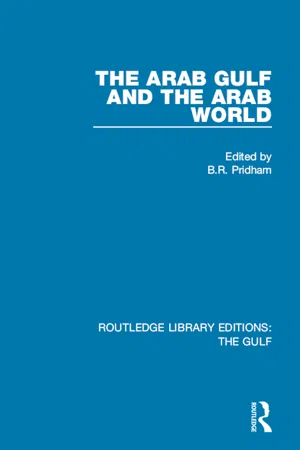
This book, first published in 1988, compiles selected contributions to a symposium on 'The Gulf and the Arab World' held by the Centre for Arab Gulf Studies at Exeter University, UK, in July 1986. The historical perspective was considered to be a prerequisite for focusing on modern developments, and two chapters are devoted to the coming of both the Arabs and Islam to the Gulf, and a further chapter examines the role of the Ottoman Empire in the region. The remaining chapters concentrate on recent interaction under the broad headings of political and socio-political affairs, demographic aspects, financial interchange and questions of security. A large part of the book is devoted to detailed analysis of the main factor in Arab Gulf/Arab world relations: the huge flow, in one direction, of Arab migratory manpower and, in the reverse direction, of Gulf financing and workers' remittances.
- 320 pages
- English
- ePUB (mobile friendly)
- Available on iOS & Android
eBook - ePub
The Arab Gulf and the Arab World
Part One
Early and Ottoman History
1
The Arabisation of the Gulf
Michael G. Morony
In order to be -ised something must not have been that way previously. To speak of the Arabisation of the Gulf, therefore, begs two very important questions. One is what constitutes Arabisation — which depends, in part, on how an Arab identity is defined. In general, such definitions tend to be circular in that an Arab identity is determined by whatever distinguishes those people who are called Arabs by themselves or by others. Modern, nationalist definitions of an Arab identity tend to be cultural or ethnic in nature and to include such matters as language, religion and behavioural norms and values. It is not uncommon for a modern definition of an Arab identity to be retrojected into the past and to identify as Arabs people who may or may not have identified themselves as such.1 The possibility remains that definitions of an Arab identity may have been subject to historical change or development, and may have varied geographically, or within the same society. The implicit assumption in this case is that changes in the way a term is used reflect real changes in identity. In what follows an attempt will be made to take such considerations into account because they mean that the nature of Arabisation may have varied according to time or place. Since the earliest references to aribi identify them as pastoralists, Arabisation could be synonymous with Bedouinisation. Arabisation could also be discussed in terms of the spread of the Arabic language or of tribal society.
However an Arab identity is defined, Arabisation is a process of change in the identity of the population of a region. A region may be said to have undergone Arabisation when Arabs have become predominant either through immigration or assimilation. Rather than measuring predominance in numerical terms, i.e. when Arabs have simply become a majority of the population, it would be more productive to determine predominance in terms of the ability of a population to assimilate outsiders, i.e. to Arabise them, because that preserves its Arab identity. Conversely, when immigrants with an Arab identity assimilate to a population with a different identity, the region where this occurs cannot be said to have undergone Arabisation. The boundary between bilād al-carab and bilād al-cajam, then, is historically subject to geographical change as the regions where Arabs predominate, expand or contract.2
The second question raised by the Arabisation of the Gulf concerns the implicit assumption that there was a time when the Gulf was not Arab. On what basis can this be said? Ḥamid al-Jāsir, for instance, seems to work with the notion that there was a time before Arabs settled (yaḥullu) the region of Qaṭīf,3 while Muḥammad al-Muslim claims that the original inhabitants on both sides of the Gulf were Dravidians who preceded the Semitic peoples who moved there from the Arabian peninsula.4 Nevertheless, for Shaikh cAbdullāh al-Khalīfa, al-Baḥrayn had become part of the Arabian peninsula (jazīrat al-carab) before the end of the pre-Islamic period through participation in the customs, religions, traditions, and civilisation of the Arabs.5
The evidence for such a change is largely linguistic, demographic and political in nature. It consists of Arabic place names, inscriptions and literary references to the languages spoken in particular places. It also includes the migration of Arab groups and political domination by Arab rulers. But for some times and places there is scarcely enough evidence to describe a process of Arabisation adequately.
Unfortunately, the use of ethnic toponyms in antiquity makes this process more difficult to describe. Were peoples named after the regions they occupied, or were regions named after the people who lived there?6 Territorial and ethnic identities may overlap but are not necessarily the same. References to a land of Arabs (mat Aribi) occurs in the Assyrian records along with the first references to Arabs themselves.7 The fact that the entire peninsula came to be called Arabian has contributed to the confusion of territorial and ethnic identities.8 According to Rentz, Arabia has ‘retained’ its basic Arab character for over two thousand years in spite of Abyssinian and Persian immigration.9 We sometimes forget that the ancient South Arabians never called themselves that.10
When we apply these considerations to the Arabisation of the Gulf, we confront yet another issue. Do bodies of water unite or separate? Before the advent of modern transportation port cities and coastal societies tended to be more cosmopolitan and to have more in common with each other than with their own hinterlands.11 Maurizio Tosi has emphasised the importance of trade12 and cultural interaction in relating parallel phenomena on the Iranian plateau to the development of prehistoric cultures on the eastern Arabian coast until 2000 BC,13 and Abdullah Masry has seen the proto-historic settlements in eastern Arabia as part of a larger inter-regional trade system.14 The assimilation of some of the Banū cIjl to Persian settlers in al-Baḥrayn15 has been widely cited as evidence of Persian cultural influence in eastern Arabia in the Sasanid period. In contrast, Faruq Omar has defined the Arab regions of the Gulf in Islamic times as the sawād of al-cIrāq, al-Aḥwāz, al-Baḥrayn, and al-cUmān which were the eastern part of the Arab homeland (waṭan), because the ethnic border between Muslim Arabs and other peoples who became Muslim lay along the east coast of the Gulf, al-Aḥwāz and al-cIrāq.16
What, then, gave Arabs a unique identity? Spencer Trimingham abandons the use of geographical, economic or linguistic criteria for the earliest Arabs (aribi) in favour of a self-ascriptive identity based on their pastoral way of life. This is not purely economic because there were also non-Arab pastoralists, and he claims that surviving Aramaean pastoralists assimilated to the early Arabs and adopted their language.17
When or where can we begin to call sedentary populations Arab then? Shahid opts for the simplest solution by regarding sedentary Arabs as deriving from former pastoralists who settled in oases.18 But it remains unclear in what sense they remained Arabs, especially if they were partially or entirely assimilated to other Semitic populations. Nevertheless, Shahid locates this development around the fringes of the peninsula from the Gulf to the Fertile Crescent and western Arabia, ringing its arid centre. He seems to place it vaguely during the Hellenistic period and late antiquity because he identifies Gerrha, Qaṭīf, Ḥīra, Ḥadr, Tadmur, Petra, Dedān, Makka, Ṭā′if and Najrān as the towns where this occurred.19 In the south araban was still used for pastoralists in the Sabaic inscription of Sharaḥ′il Yaqbul in 523 ad at Bi′r Ḥimā, while the same description also refers to the people (shcb) of Hamdān, both townsmen and pastoralists (harn wcrbn).20
Nor were early Arabs tribal according to Werner Caskel, who argued that the Tanūkh, Nizār and Asad were ‘peoples’ rather than tribes in Ptolemy (fl. second century ad) and the Nemāra inscription (328 ad). For him the tribal organisation of society according to genealogical structures appears to have originated among the Arab pastoralists east of Damascus some time before the third century ad.21 However that may be, there appears to be evidence of tribal organisation at Hatra in references to groups such as the bny TYMW and bny BLcQB′ in inscriptions from the first century ad,22 and perhaps in Pliny’s contemporary reference to the Arabum gens of Attali on the lower Tigris.23 These may not even be the earliest such attestations, and, in any case, the earliest attestation of tribalism need not coincide with its earliest actual occurrence. Aribi may have been tribal much earlier or all along. All we know is that they do not seem to be described that way at first and begin to be described thus in about the first century ad. This also depends, of course, on how one chooses to interpret terms such as gens, bny, shcb, and ′l. It seems even more difficult to determine when or where the Arabic language became a self-conscious part of an Arab identity.
By the end of late antiquity much more can be added to an Arab identity. Von Grunebaum identified the typical cultural traits (dīn al-carab) of the ‘Northern’ Arabs as toughness, hospitality towards the aḥmar, an aversion to kingship, individualism, group solidarity and honour, hospitality, competitiveness, a belief in destiny and demons, shared ritual practices such as sacrifice, a shared system of values regarding oaths and forbidden, holy things (ḥaram), and the observance of ancestral sunna.24 The simplest paradigm, then, would be a bicoordinate system of the historical elaboration of an ‘Arab’ identity and the geographical spread or contraction of the bilād al-carab.25
But where was Arabia? Originally, in the ninth and eighth centuries BC, the Aribi-land lay between the Euphrates and Syria.26 Xenophon identifies the desert region extending for five stages (35 parasangs) along the left bank of the Euphrates as Arabia.27 By Hellenistic times ‘Arabia’ was generally the steppeland to the east and south of the Fertile Crescent according to the geographers and confirmed politically by the creation of a satrapy of Arabāyā by the Persians in 539 BC and by the location of the Roman province of Arabia approximately in modem Jordan and southern Syria.28 Even Ammianus Marcellinus, as late as the fourth century ad regarded the initial Arab region to have reached from Assyria to the Cataracts of the Nile without any reference to the peninsula.29 The later Hellenistic geographers applied ‘Arabia’ to everything beyond, from the Greek point of view, to the south and east, until the name came to be used for the entire peninsula30 similar to their use of ‘Asia’ for everything east of the Ionian coast of western Anatolia. But Herodotus had not even been aware that there was a peninsula beyond ‘Arabia’, and the depiction of the Gulf by Hellenistic writers was ‘ill-conceived’, to say the least.31
In order to avoid confusing ‘Arabs’ with ‘Arabians’, it would be most productive to proceed from this point by applying two criteria: (1) Where are people called Arabs to be found? and (2) Where is the language called Arabic attested?
With regard to the first question, the earliest Aribi known to the Assyrians were pastoralists in the Syrian steppeland west of the Euphrates, and the first known Arab was a certain Gindibu (Jundub) who contributed 1000 camel-mounted soldiers to an anti-Assyrian coalition at Damascus in 854 BC.32 In the eighth and seventh centuries BC the main Ar...
Table of contents
- Cover
- Half Title
- Title Page
- Copyright Page
- Original Title Page
- Original Copyright
- Table of Contents
- List of Tables
- List of Figures
- Glossary of Words Not Explained on First Appearance
- List of Abbreviations
- Preface
- Note on Transliteration
- Part One: Early and Ottoman History
- Part Two: Political and Socio-political Aspects
- Part Three: Demographic and Financial Interchange
- Part Four: Gulf Security and Stability in a Divided Arab World
- Select Bibliography
- Index
Trusted by 375,005 students
Access to over 1.5 million titles for a fair monthly price.
Study more efficiently using our study tools.
Frequently asked questions
Yes, you can cancel anytime from the Subscription tab in your account settings on the Perlego website. Your subscription will stay active until the end of your current billing period. Learn how to cancel your subscription
No, books cannot be downloaded as external files, such as PDFs, for use outside of Perlego. However, you can download books within the Perlego app for offline reading on mobile or tablet. Learn how to download books offline
Perlego offers two plans: Essential and Complete
- Essential is ideal for learners and professionals who enjoy exploring a wide range of subjects. Access the Essential Library with 800,000+ trusted titles and best-sellers across business, personal growth, and the humanities. Includes unlimited reading time and Standard Read Aloud voice.
- Complete: Perfect for advanced learners and researchers needing full, unrestricted access. Unlock 1.5M+ books across hundreds of subjects, including academic and specialized titles. The Complete Plan also includes advanced features like Premium Read Aloud and Research Assistant.
We are an online textbook subscription service, where you can get access to an entire online library for less than the price of a single book per month. With over 1.5 million books across 990+ topics, we’ve got you covered! Learn about our mission
Look out for the read-aloud symbol on your next book to see if you can listen to it. The read-aloud tool reads text aloud for you, highlighting the text as it is being read. You can pause it, speed it up and slow it down. Learn more about Read Aloud
Yes! You can use the Perlego app on both iOS and Android devices to read anytime, anywhere — even offline. Perfect for commutes or when you’re on the go.
Please note we cannot support devices running on iOS 13 and Android 7 or earlier. Learn more about using the app
Please note we cannot support devices running on iOS 13 and Android 7 or earlier. Learn more about using the app
Yes, you can access The Arab Gulf and the Arab World by B.R. Pridham in PDF and/or ePUB format, as well as other popular books in History & World History. We have over 1.5 million books available in our catalogue for you to explore.