eBook - ePub
Democratic Planning and Social Choice Dilemmas
Prelude to Institutional Planning Theory
- 340 pages
- English
- ePUB (mobile friendly)
- Available on iOS & Android
eBook - ePub
About this book
Using the economic approach of social choice theory, this unique book examines difficulties found in democratic processes involved in the creation and implementation of planning policies. Social choice theory focuses on the hard trade-offs to be made between rationality in decision-making on the one hand, and political values such as democracy, liberalism and freedom from manipulation on the other. As an institution can be seen as a set of rules, the focus on rules and procedures of collective choice makes social choice theory well suited for analysing important political aspects of planning institutions. Special attention is given to communicative planning and the logical reasons why all the desirable properties of dialogue cannot be simultaneously attained. The analysis provides original and significant new insights into the process and the institutions involved. It highlights weak spots of present planning techniques and procedures and suggests further steps towards institutionally enriched planning theory.
Information
PART I
DEMOCRACY, RATIONALITY, AND PLANNING: APPLYING ARROW’S THEOREM
As long as unanimity reigns, collective choice is easy and straightforward. When individuals disagree, however, an amalgamation of their preferences has to take place before a collective and democratic choice can be made. Arrow’s (1963) theorem states that no suitable social institution (decision rule) exists for making these choices. Suitability would require that collective choice be both consistent and fair. But the requirements cannot be fulfilled under the nearly omnipresent condition of conflicting interests. Consequently, the making of recommendations or decisions in practice displays various trade-offs between the desired properties. Arrow’s theorem suggests that public planning is condemned to prepare for social choice that is either indeterminate or the result of unfair procedure (Sager 1998a). Supposedly, most planners would still want to act rationally, but what should be meant by rational planning in these circumstances? One strategy might be to identify processes relaxing the Arrow conditions in a manner causing the least unfairness or the least politically harmful decision cycles.
Chapter 1 reconsiders some arguments for preferring deliberative to majoritarian decision-making. This is of interest because much communicative planning is designed to build consensus and rests on ideas of deliberative democracy. Planning recommendations made by dialogue are based on the intellectual force of arguments. These arguments are statements giving reasoned rankings of the planning alternatives. Dialogue encompasses the amalgamation of arguments in accordance with democratic criteria promoting the communicative rationality of the process and the legitimacy of the recommendation. The balancing and weighing of arguments should preferably avoid decision cycles that would make the recommendation of a plan arbitrary. By an analogy with Arrow’s theorem, it is demonstrated that dialogue cannot ensure consistent recommendations and simultaneously prepare for political decision-making in a democratic manner. The result is valid for debates over planning alternatives when differences in quality are not comparable across all arguments (concerning noise, safety, visual standard, social impact, etc.), which is the most common situation.
Chapter 2 follows up the theme of amalgamating arguments which was introduced in the previous chapter. There, the arguments were fused by dialogue, while the amalgamation is here assumed to be assisted by a formal ex ante evaluation technique. Each item entering the evaluation is regarded as an argument, as the alternatives are ranked against each of the items, e.g., the various impacts of the plan or project. The main conclusion is that, provided the ordering scales are non-comparable across items, the evaluation techniques cannot combine cycle-free recommendations and the democratic principles of constructing an argumentative synthesis.
Chapter 3 analyzes a few structured group processes with formal communicative procedures. Most attention is given to the Delphi technique and the nominal group technique, but expert decision panels combined with cost-benefit analysis are also discussed. The aim is to clarify the degree of correspondence between the procedures of the structured group processes and the seemingly innocuous assumptions of the Arrow theorem. It is argued that some deviations from Arrow’s assumptions can often be justified in planning contexts calling for the use of structured group processes. The group techniques can then help achieve both consistency and fairness. Finally, some institutional and communicative features of the cost-benefit analysis are outlined.
Chapter 4 provides two examples of instability in political decision-making in the transport sector. The airport case illustrates the working of a voting paradox. The case explains the notions of ‘decision cycle’ and ‘inconsistency’ that are used throughout the book. In the tram case the instability occurs over time, and so the preferences of the parties may have changed between the decisions. The tram case nevertheless illustrates the instability effects of changing coalitions and other characteristics of democratic politics. The political attractiveness of the middle alternative in this case illustrates the median voter theorem.
Chapter 1 studies a dialogical procedure, Chapter 2 analyzes algorithmic techniques, and Chapter 3 deals with group processes containing elements of both communication and calculation. The chapters show that it should neither be taken for granted that calculative planning can be equipped with democratic procedures leading to stable recommendations, nor that communicative planning can be so equipped. Chapter 4 shows that democracy and consistency can also be difficult to combine in political practice.
Chapter 1
Paradox of Dialogical Decision-making
Making Decisions by Amalgamating Arguments
Introduction
Deliberation is quiet, reflective conversation open to a wide range of evidence and respectful of different views. It is a communicative process of weighing the available data, considering alternative possibilities, arguing about relevance and worthiness, and then choosing the best alternative by balancing the arguments put forward (Walzer 1999:58). The purpose of this chapter is to examine whether deliberative and dialogical decision-making is vulnerable to logical problems analogous to those arising when deriving social choice from individual preferences, e.g., by voting.
Deliberative democracy is a topical theme in political science (Bohman and Rehg 1997, Elster 1998b, Macedo 1999), and the ‘deliberation’ term is presently gaining a foothold also in planning theory (Forester 1999). This development is obvious, as deliberation is at the core of communicative planning. This kind of public planning is often seen as an integral element in the decision-making process of deliberative democracy. Hence, it should be of interest to the planning profession whether or not this process can be simultaneously consistent and fair.
Social choice theory has shown that majority voting and other amalgamation of individual preferences can easily lead to decision cycles. The problem is mentioned in some basic textbooks (Patton and Sawicki 1993:336) and decision-orientated literature for planners (O’Doherty 1996:Ch.1). The outcome of the decision is arbitrary with cycles, and hence it is also arbitrary whether the best alternative according to an impact assessment is actually chosen. To guarantee consistency, the decision procedure must have some rather undemocratic features, e.g., dictatorship. The main thrust of Arrow’s theorem and the associated literature is that there is an unresolvable tension between logicality and fairness. With democratic institutions, some social decisions will be inconsistent (Riker 1982:136). Then, no meaningful choice can be made, and this can be interpreted as eroding the legitimacy of majoritarian democracy. When decision cycles include top-ranked alternatives, the ‘will of the people’ is not defined. This makes it difficult to give meaning to the pursuit of ‘the public interest’ which is often seen as the general goal of public planning.
Arrow’s impossibility theorem has served as the foundation of profound scepticism about models of democracy based on majority voting or other decision rules amalgamating individual preferences (Riker 1982, Coleman and Ferejohn 1986). The critique has increased the interest in deliberative models of democracy and spurred efforts to defend these and other models of democracy from the seemingly devastating implications of the impossibility theorems proved by social choice theorists (Christiano 1993, Mackie 1998). Against this backcloth, and with the upswing of communicative planning, it is of interest to investigate whether dialogue and deliberation – with the weighing and balancing of arguments as a crucial phase – are also vulnerable to Arrow type impossibilities. It is argued here that the logical problems present in the aggregation of preferences show up again in the fusing of arguments. While representative democracy is based on amalgamation of individual preferences, deliberative democracy requires some sort of (informal) amalgamation of arguments.
Collective decisions can some times be made by discussing and persuading until a particular option gains general acceptance. Decisions can also be made by voting or some other technique for amalgamating individual preferences, as seen in Figure 1.1. These decision-making procedures are associated with deliberative and majoritarian democracy, respectively. Procedures based on discussion and voting are not mutually exclusive. On the contrary, preferences and arguments influence each other, and the associated decision models are often reciprocally complementary (Manin 1987). Voting without preceding exchange of arguments can easily lead to dictatorship of the majority. And one-sided emphasis on arguments may prolong the process indefinitely and moreover give experts undue power. Nevertheless, several scholars commend deliberative decision-making (Fishkin 1991, Miller 1993) partly in order to escape the paradox of voting and the discouraging results of social choice theory, e.g., Arrow’s general impossibility theorem (Arrow 1963). This chapter considers whether the recommendation is substantiated.
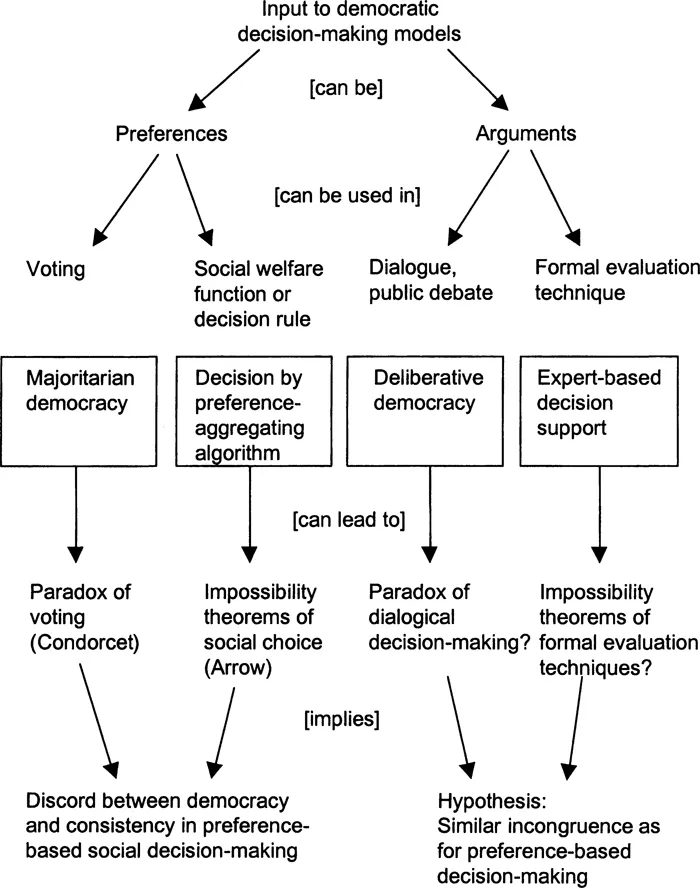
Figure 1.1 Forms of social decision-making and the respective incompatibilities
Figure 1.1 should be read from the top, and the meaning of the arrows at each level is given in square brackets. Decision-making according to the theory of social choice, which is used throughout the entire book, constitutes column two in the figure. Some problems of voting (column one) are illustrated in Chapter 4. Dialogical decision-making is examined in the present chapter, while rank-based evaluation techniques are analyzed in Chapter 2. Some structured group processes dealt with in Chapter 3 mix procedures from the left and the right side of Figure 1.1.
Argument-based Decision-making
The core concept of the exposition is ‘argument’, which is here a statement offering a reasoned ordering of the planning alternatives (on an ordinal scale, interval scale, or ratio scale). As Habermas (1990:198) puts it: ‘Argumentation insures that all concerned in principle take part, freely and equally, in a cooperative search for truth, where nothing coerces anyone except the force of the better argument’. It is common in communicative planning theory to recommend that arguments be exchanged in accordance with the norms of Habermasian dialogue (Flyvbjerg 1998a:213):
Validity and truth are ensured where the participants in a given discourse respect five key processual requirements of discourse ethics: (1) no party affected by what is being discussed should be excluded from the discourse (the requirement of generality); (2) all participants should have equal possibility to present and criticize validity claims in the process of discourse (autonomy); (3) participants must be willing and able to empathize with each other’s validity claims (ideal role taking); (4) existing power differences between participants must be neutralized such that these differences have no effect on the creation of consensus (power neutrality); and (5) participants must openly explain their goals and intentions and in this connection desist from strategic action (transparence).
It is clear from the citation that dialogue has strong democratic properties, although it does not count votes or bow to preferences. Dialogue can be seen as a way of making decisions by fusing arguments informally and without algorithms. Scholars have pointed out the gap between ideals and possibilities of implementation in Habermas’s critical theory of communicative action. Nevertheless, Habermasian dialogue remains an important theoretical reference point in communicative planning (Forester 1993a, Healey 1999). It is used here to characterize the process of deliberation, although the conclusions of the chapter apply equally well to similar processes described by, e.g., Fishkin (1991), Benhabib (1994), Gutmann and Thompson (1996) and implied by Rawls’s (1996) notion of ‘public reason’.
Assume now that there is a public planning debate over an identified set of options. The dialogue turns on the strong and weak sides of the planning alternatives X, Y, and Z and how their aspects should be balanced against each other to reach a comprehensive view of each planning proposal. Each argument (A) refers to a positive or negative aspect, e.g., noise from a planned highway, and lists the alternatives according to quality when only this single aspect is considered. When all the arguments are presented, the set of ‘argument relations’ is established, for instance:
- Anoise(X, Y, Z)
- Aaccessibility(Y, Z, X)
- Acost(Z, X, Y)
Depending on the measurability of the aspects of quality, argument relations provide information about the alternatives yielding not only rankings but even quality differences and ratios. The dialogue establishes the set of argument relations and amalgamates these relations into an overall ‘dialogical outcome relation’ (DO), for example:
- DO(X, Y, Z).
The amalgamation of arguments leading to a dialogical outcome relation is here called a ‘dialogical decision procedure’. Hence, such a procedure produces a list of planning alternatives ordered according to their overall credentials. A transitive ordering is such that when planning alternative X is ranked higher than alternative Y, and Y is ranked higher than alternative Z, then X is ra...
Table of contents
- Cover
- Half Title
- Title Page
- Copyright Page
- Table of Contents
- List of Figures and Tables
- Preface and Acknowledgements
- Introduction: The Social Choice Approach to Institutional Planning Theory
- PART I: DEMOCRACY, RATIONALITY, AND PLANNING: APPLYING ARROW’S THEOREM
- PART II: PUBLIC INTEREST AND PROTECTED SPHERES: APPLYING SEN’S THEOREM
- PART III: MANIPULATION IN PLANNING: APPLYING GIBBARD AND SATTERTHWAITE’S THEOREM
- Epilogue: Challenge and Response
- Bibliography
- Glossary of Social Choice Terms
- Index
Trusted by 375,005 students
Access to over 1.5 million titles for a fair monthly price.
Study more efficiently using our study tools.
Frequently asked questions
Yes, you can cancel anytime from the Subscription tab in your account settings on the Perlego website. Your subscription will stay active until the end of your current billing period. Learn how to cancel your subscription
No, books cannot be downloaded as external files, such as PDFs, for use outside of Perlego. However, you can download books within the Perlego app for offline reading on mobile or tablet. Learn how to download books offline
Perlego offers two plans: Essential and Complete
- Essential is ideal for learners and professionals who enjoy exploring a wide range of subjects. Access the Essential Library with 800,000+ trusted titles and best-sellers across business, personal growth, and the humanities. Includes unlimited reading time and Standard Read Aloud voice.
- Complete: Perfect for advanced learners and researchers needing full, unrestricted access. Unlock 1.5M+ books across hundreds of subjects, including academic and specialized titles. The Complete Plan also includes advanced features like Premium Read Aloud and Research Assistant.
We are an online textbook subscription service, where you can get access to an entire online library for less than the price of a single book per month. With over 1.5 million books across 990+ topics, we’ve got you covered! Learn about our mission
Look out for the read-aloud symbol on your next book to see if you can listen to it. The read-aloud tool reads text aloud for you, highlighting the text as it is being read. You can pause it, speed it up and slow it down. Learn more about Read Aloud
Yes! You can use the Perlego app on both iOS and Android devices to read anytime, anywhere — even offline. Perfect for commutes or when you’re on the go.
Please note we cannot support devices running on iOS 13 and Android 7 or earlier. Learn more about using the app
Please note we cannot support devices running on iOS 13 and Android 7 or earlier. Learn more about using the app
Yes, you can access Democratic Planning and Social Choice Dilemmas by Tore Sager in PDF and/or ePUB format, as well as other popular books in Physical Sciences & Analytic Chemistry. We have over 1.5 million books available in our catalogue for you to explore.