This volume explores the complex and contradictory ways in which the cultural, scientific and political myth of whiteness has influenced identities, self-perceptions and the process of integration of Nordic immigrants into multicultural and racially segregated American society in the nineteenth and twentieth centuries. In deploying central insights from whiteness studies, postcolonial feminist and intersectionality theories, it shows that Nordic immigrants - Danes, Swedes, Finns, Norwegians and Sámi - contributed to and challenged American racism and white identity. A diverse group of immigrants, they could proclaim themselves 'hyper-white' and 'better citizens than anybody else', including Anglo-Saxons, thus taking for granted the racial bias of American citizenship and ownership rights, yet there were also various, unexpected intersections of whiteness with ethnicity, regional belonging, gender, sexuality, and political views. 'Nordic whiteness', then, was not a monolithic notion in the USA and could be challenged by other identities, which could even turn white Nordic immigrants into marginalised figures. A fascinating study of whiteness and identity among white migrants in the USA, Nordic Whiteness will appeal to scholars of sociology, history and anthropology with interests in Scandinavian studies, migration and diaspora studies and American studies.
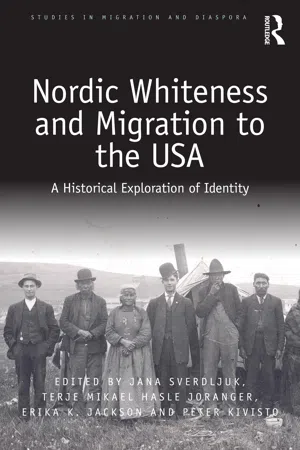
eBook - ePub
Nordic Whiteness and Migration to the USA
A Historical Exploration of Identity
- 192 pages
- English
- ePUB (mobile friendly)
- Available on iOS & Android
eBook - ePub
Nordic Whiteness and Migration to the USA
A Historical Exploration of Identity
About this book
Information
Part 1
Whiteness as epistemological ignorance
1 Norwegian migration and displaced indigenous peoples
Toward an understanding of Nordic whiteness in the land-taking
Betty A. Bergland
Introduction
The migration of European immigrants to North America in the nineteenth and twentieth centuries and the displacement of indigenous people intersect historically and geographically; nevertheless, these two historical phenomena rarely emerge together in the history of immigration. In short, the historiography of migration has essentially neglected or masked these intersections. The European colonization of the Americas begins over five hundred years ago, leading to massive devastation for indigenous peoples. From the fifteenth century in North America, the British, Dutch, French, and Spanish colonizers left behind war and destruction, well before formation of the United States in the late eighteenth century. When representatives of the new “republic” of the US began to spread across the continent, they employed the same policies as the colonizers before them with the same devastating effects (Berkhofer, Jr., 1979; Cronon, 1983; Todorov, 1984). Then, by the end of the nineteenth century when professional historical associations formed, this history emerged in triumphal narratives of Anglo-Saxon superiority. A gradual narrative shift surfaced in the twentieth century as historians focused on social history, also called the people’s history, that included immigration history—but also labor, women’s, indigenous, and ethnic histories—in short, separate subfields. Thus, the historical profession fragmented, not only within the area of social history, but also generally in the specializations of historical study. Consequently, potential intersections, such as immigration and indigenous studies, tended to remain separate fields. More recently, however, theoretical approaches—including postcolonial studies, feminism, settler colonialism, critical race theory, and whiteness studies—offer frameworks for rethinking this history and the long-term effects. This essay foregrounds the historical intersections of indigenous and immigrant peoples,—emphasizing Norwegians and indigenous peoples in the Upper Midwest,—and draws on whiteness studies to explore the processes of Norwegians identifying as white. Securing land remains core to understanding that identification.
The concept of Nordic whiteness emerges in a number of recent books, journal publications, and conferences that begin to study racial thinking in broad contexts (Loftsdottir & Jensen, 2012; Lundstrom & Teitelbaum, 2017). These important studies demonstrate the regional and global dimensions of this scholarship, as well as its interdisciplinary and transnational nature. However, most work on Nordic whiteness foregrounds the Nordic countries and contemporary conditions, rather than the vast Nordic migration to North America. For example, in Scandinavian Studies (Summer, 2017) only two of six articles consider im/migrants in the US but both address contemporary matters: Catrin Lundstrom’s rich study on contemporary Swedish migrant women and Lisa Locascio’s intriguing study on a twenty-first-century television show (Hell on Wheels) exploring Mormon Scandinavian whiteness (Lundstrom & Teitelbaum 2017). Rich and meaningful, both articles illuminate the recent and valuable scholarship on whiteness; however, historical perspectives on (Nordic) whiteness and migration emerge less frequently, possibly because of the greater complexity and challenge posed by historical inquiries on racial formations. Nevertheless, historians have a long history of writing about race, many emphasizing race and migration, and so advancing our understanding of racialization processes in American history. Many historians have been at the forefront of this work (Roediger, 1991, 2005; Jacobson, 1998; Lipsitz, 1998). The philosopher Charles W. Mills complements the historical perspectives, I propose, by offering a meaningful theoretical framework for understanding the broad trans-historical dimensions of race and racializing patterns in US history. His work seems especially valuable in exploring the intersections of indigenous and immigrant histories.
In the influential book, The Racial Contract, Mills introduces the concept of the racial contract, writing: “The Racial Contract establishes a racial polity, a racial state, and a juridical system, where the status of whites and nonwhites is clearly demarcated, whether by law or by custom” (Mills, 1997, 13-14). 1 The purpose of that racial state, he argues, is “specifically to maintain and reproduce this racial order, securing the privileges and advantages of the full white citizens and maintaining the subordination of nonwhites.” In addition, he asserts, the racial order expects whites to give consent, explicit or tacit, in exchange for benefits—economic, social, and cultural. This, he argues, “could be called Whiteness.” Furthermore, if white citizens fail to live up to the civic and political responsibilities of Whiteness, Mills explains, they would be “in dereliction of their duties as citizens.” In effect, he argues, “race” is neither an “afterthought” nor “deviation” from so-called “raceless Western ideals, but rather a central shaping constituent of those ideals” (Mills, 14). The world created in the last five hundred years (following European exploration, conquest, slavery, imperialism, and settler colonialism) is shaped by this racial order, an order that persists to the present in its exploitative forms.
In other words, giving consent must be an ongoing process. According to Mills, the contract makes continuous demands for the privilege of whiteness; that is, beneficiaries must consistently embrace a misinterpretation of the world, what he calls, “an epistemology of ignorance” (Mills, 18). 2 Within the racial contract, white beneficiaries, “[must] learn to see the world wrongly, but with the assurance that the set of mistaken perceptions will be validated by white epistemic authority, whether religious or secular.” He continues,
Thus, in effect, on matters related to race, the racial contract prescribes for its signatories an inverted epistemology, an epistemology of ignorance, a particular pattern of localized and global cognitive dysfunctions (which are psychologically and socially functional), producing the ironic outcome that whites will in general be unable to understand the world they themselves have made.
(Mills, 1997, 18; italics in original)
In other words, whites secure benefits of their whiteness when they accept the terms of the racial contract, including the implied superiority of their whiteness, and avoid questioning the system. This theoretical framework helps us understand not only the neglect of race in the historiography of both US history and migration studies but also how and why Nordics as immigrants in the new world had to learn the meaning of their own whiteness. In the contractual foundation Mills describes, the imperial/colonial and state powers shape the contract, but cultural and social institutions inform and enforce the contract—educational, religious, legal, and political bodies—that educate and reinforce the inverted epistemology, an epistemology of ignorance, that secures white privilege for its adherents.
Reasonably, one might argue that most (though not all) European immigrants to North America benefitted from the racial contract, yet those that settled on indigenous land vacated by federal policies became beneficiaries in great measure—and for generations—because of the land. Scholars have shown that Norwegian migration to North America was predominantly a land-seeking and agricultural migration: as historian Odd S. Lovoll writes, Norwegians were the “most rural of any immigrant group in the nineteenth century” (Lovoll, 1998, 14). While Norwegian migration to the United States began in 1825, peaked in 1882, and included industrial and urban migrants, only one-fourth of Norwegian immigrants in 1900 lived in cities of more than 25,000. In other words, most settled in small, rural communities. As late as the 1910 census, most Norwegian im/migrants were still located in small, rural communities of less than 25,000, “the lowest percent of any European immigrant group,” writes Lovoll, and were deeply linked to an agricultural economy (Lovoll, 1984, 231). 3 In other words, land—its acquisition and everything associated with possession—is critical to understanding Norwegian migration. This is true, not only for individuals that homesteaded, owned, and farmed land, but also for those who were sustained in the ancillary economies and communities of the agricultural settlements. Central to those communities and families are the federal Indian and land policies that led to dispossession and displacement for the indigenous peoples of these regions—policies that included war, removal, exile, and reservations. Such policies enabled immigrants to claim land and pass it on to subsequent generations.
This essay argues that Norwegian immigrants—generally, but with possible exceptions—consented to the racial contract in a process that occurred gradually over time and space. This also meant that most immigrants and their descendants also consented to a misinterpretation of the world. 4 To explore these developments, historically and geographically, I foreground three periods in the Upper Midwest that illuminate both the convergence of migration and indigenous histories and demonstrate the gradual embrace of whiteness by Nordic immigrants: 1) Wisconsin in the period of Indian Removal (1830s to 1850s); 2) Minnesota and South Dakota in the era of Civil and Indian Wars (1860s and 1870s); and 3) early twentieth century “national” centennial celebrations of Norwegian Americans in the Twin Cities (1914, 1925). These historical moments demonstrate how Norwegian immigrants came to understand their presence in North America, accept American values, and reveal a gradual acceptance of the racial contract. While historical evidence shows a prevailing but gradual embrace of the racial contract, historians must allow for resistance, however small or inadequate. Such resistance may be individual or collective but requires additional systematic study.
Wisconsin in the period of removal and migration (1830s–1850s)
In 1838, Ole Rynning published in Norway his influential guidebook for emigrating Norwegians, entitled A True Account of America, two years after Wisconsin became a Territory and one year after the first Norwegians entered that Territory. The first Norwegians in the Midwest (the “Sloopers” from Kendall, New York) came in 1834 to Fox River, Illinois, where Rynning also wintered on the frontier at Beaver Creek (Qualey, 1938, 17–39). Thus, with his university degree, Rynning brought both experiential and intellectual knowledge to his tract for prospective immigrants in which he posed and answered thirteen questions. His tenth question addressed perceived dangers: “Is there considerable danger from disease in America? Is there reason to fear wild animals and the Indians?” This formulation addressed fears of potential immigrants, but it also naturalized demeaning images of Indians for immigrants by categorizing them with animals and disease. He answered simply: “Indians have now been transported away.” He added, “these people [the Indians] are very good-natured, and never begin hostilities when they are not affronted” (Rynning, 1926, 91). Thus, he allayed fears of potential immigrants and encouraged migration. Though he speaks well of the Indians here, he failed to provide contexts or explanations for understanding the vacated lands or the meaning of “transported away.” Perhaps inadvertently, Rynning fostered a foundation for epistemological ignorance. What is ignored is how Wisconsin became a Territory: that is, through suppressing resistance and war, especially the Black Hawk War of 1832, paving the way for territorial status in 1836 and massive white settlement. One scholar called it “the last war of conquest for Wisconsin” (Robbins, 1992, 91). In 1848, Wisconsin gained statehood, and by 1850 there were 9,467 Norwegians in the state (3% of the total white population); by 1860, 29,557 (3.8%) and by 1870, 59,619 (5.6%). Norwegians outnumbered Swedes and Danes in 1850 by two to one, but in 1870 these combined groups outnumbered Norwegians by a few thousand (Qualey, 1938, 40).
The geographical area of the state of Wisconsin was part of the Old Northwest Territory, contributing to the region’s long history. Furthermore, the diverse histories of indigenous peoples shaped by the shifting federal policies pose another layer of complexity and critical element for understanding Nordic immigrants settling in Wisconsin. Historian Nancy Lurie categorizes Wisconsin tribal histories into four groups: 1) those removed to Wisconsin by the federal government from the East (the Oneida in New York); 2) those that migrated into Wisconsin from the East because of white incursions on their land (Potawatomi, the Brotherton, and the Stockbridge-Munsee—the latter, a new social formation made from remnants of eastern tribes); 3) those tribes indigenous to the region that resisted removal (Menominee, Hochunk, and Ojibwe); and 4) tribes original to the area but removed west of the Mississippi (Sauk, Fox, Kickap...
Table of contents
- Cover
- Half-Title
- Series
- Title
- Copyright
- Dedication
- Contents
- Acknowledgements
- Contributors
- Series editor’s preface
- Introduction: Whiteness in Nordic immigrants’ identity formation
- PART 1 Whiteness as epistemological ignorance
- PART 2 Not quite whitePainful experiences of Sámi immigrants
- PART 3 White immigrants and the failure of class solidarity
- PART 4 Nordic superiority and the derogatory representations of others
- PART 5 Challenging intersections of whiteness and ethnicity
- PART 6 Nonconformity and resistance to white norms
- Conclusion: Nordic slotting into the American ethno-racial hierarchy
- Index
Trusted by 375,005 students
Access to over 1.5 million titles for a fair monthly price.
Study more efficiently using our study tools.
Frequently asked questions
Yes, you can cancel anytime from the Subscription tab in your account settings on the Perlego website. Your subscription will stay active until the end of your current billing period. Learn how to cancel your subscription
No, books cannot be downloaded as external files, such as PDFs, for use outside of Perlego. However, you can download books within the Perlego app for offline reading on mobile or tablet. Learn how to download books offline
Perlego offers two plans: Essential and Complete
- Essential is ideal for learners and professionals who enjoy exploring a wide range of subjects. Access the Essential Library with 800,000+ trusted titles and best-sellers across business, personal growth, and the humanities. Includes unlimited reading time and Standard Read Aloud voice.
- Complete: Perfect for advanced learners and researchers needing full, unrestricted access. Unlock 1.5M+ books across hundreds of subjects, including academic and specialized titles. The Complete Plan also includes advanced features like Premium Read Aloud and Research Assistant.
We are an online textbook subscription service, where you can get access to an entire online library for less than the price of a single book per month. With over 1.5 million books across 990+ topics, we’ve got you covered! Learn about our mission
Look out for the read-aloud symbol on your next book to see if you can listen to it. The read-aloud tool reads text aloud for you, highlighting the text as it is being read. You can pause it, speed it up and slow it down. Learn more about Read Aloud
Yes! You can use the Perlego app on both iOS and Android devices to read anytime, anywhere — even offline. Perfect for commutes or when you’re on the go.
Please note we cannot support devices running on iOS 13 and Android 7 or earlier. Learn more about using the app
Please note we cannot support devices running on iOS 13 and Android 7 or earlier. Learn more about using the app
Yes, you can access Nordic Whiteness and Migration to the USA by Jana Sverdljuk, Terje Mikael Hasle Joranger, Erika Jackson, Peter Kivisto, Jana Sverdljuk,Terje Mikael Hasle Joranger,Erika K. Jackson,Peter Kivisto,Erika Jackson, Jana Sverdljuk, Terje Mikael Hasle Joranger, Erika K. Jackson, Peter Kivisto in PDF and/or ePUB format, as well as other popular books in Education & Teaching Arts & Humanities. We have over 1.5 million books available in our catalogue for you to explore.