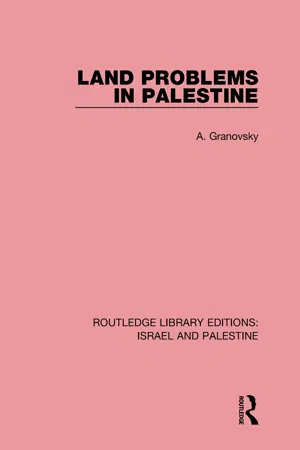
The land question in Palestine evoked an unprecedented interest on the part of the Jewish public in the 1920s. This book, first published in 1926, studies the various phases of the land policy of the National Fund, the standard bearer of national Jewish land policy in Palestine. The problems of Jewish land policy were precipitated into the foreground because all Zionist groups came to realise the key role which the soil itself was thought to play in Jewish Palestine, and the imperative to own the land itself. A single thought runs through this book: that the Jewish Homeland can be erected only upon nationalized land.
- 118 pages
- English
- ePUB (mobile friendly)
- Available on iOS & Android
eBook - ePub
Land Problems in Palestine (RLE Israel and Palestine)
PART I.
THE JEWISH NATIONAL FUND:
THE SOCIAL INSTRUMENT FOR THE UPBUILDING OF PALESTINE
1
In practice, as in theory, the Zionist Organization is motivated in its Palestinian activities by Jewish nationalism and a social point of view. Those inspired solely by the nationalist motive hold that Zionism has the single object of achieving a Jewish majority in Palestine, which shall found a spiritually and economically self-sustaining commonwealth. The defenders of the social point of view, however, adding general human considerations to the nationalist motive, are impelled to aim at something higher. For example, the Haluzim, those self-sacrificing and enthusiastic pioneers, are not content with their own personal transformation into peasants or industrial labourers. They dream of a Jewish commonwealth which shall be not merely an ingathering of the exiles; it represents to them an opportunity of freeing the national life from the social and economic ills of the capitalist order.
The latest period of Zionist work in the Land (which, if measured by its results, is the most important in the history of Jewish colonization) represents the triumph of the latter tendency. The nationalist motive is being synthesized with the social point of view in this formula: a Jewish commonwealth with new social forms.
It is not by mere chance that land reform ideas have played so significant a rôle in the great works consummated in Palestine during the last few years. The many new settlements have been founded, and the thousands of recently arrived labouring men and women settled, not upon private but upon nationalized land. It was, moreover, not accidental that the major part of the upbuilding work—both in the cities and on the land—has been carried out through closely knit co-operative labour groups. (The various problems of land nationalization come to light as work progresses, and find a natural solution in practice.)
The Zionist Organization began its practical work in Palestine eighteen years ago by founding small agricultural co-operative settlements, which held rigidly to the principle of Self-Labor.1 Exploitation of workers in such settlements was thus made impossible. Various forms of labor co-operatives have since been called into being, reaching their high water mark in farming groups with several hundred working members. New and advanced forms have been created not only for production, but for the distribution of products as well.
2
In the upbuilding of Palestine the most important problem to be faced is the need of the settlers for land. The Jewish National Fund (Keren Kayemeth le-Israel) was therefore created (1901) by the Zionist Organization in order to provide land for Jewish colonization. Both the national and the social ends above referred to were embodied in the policy of the Fund, namely: to redeem the soil of the Homeland by purchase (“Geulat ha-Aretz”) ; and to make the soil, as the basis of the Homeland, not private but national Jewish property. The nationalization of Jewish land in Palestine was proclaimed from the very first.2 As the instrument of national Jewish land policy in Palestine, the Fund aims to bring all ground used for Jewish colonization into public ownership. Its means are derived from donations gathered in multifarious ways, day in and out, by the ceaseless efforts of thousands of Jews the world over. What is acquired with the people’s money, ought to remain in the possession of the people.
Land acquired by the Jewish National Fund, therefore, becomes a permanent holding. It may not be sold, nor even mortgaged. The usual real estate business transactions are therefore precluded with these public lands. (It is noteworthy that the proviso against alienation is the only unalterable clause in the statutes of the National Fund.)
The National Fund turns over its land to the Jewish settlers in the form of hereditary leaseholds, since they have the right of use only. As tenants, they pay a moderate ground rent to the Fund in its of owner.
Steps are taken to prevent the rural Arab population from being made homeless through the land acquisitions of the Fund. It buys chiefly from Effendis (Arab landed gentry) who own large tracts, but do not cultivate them. If, however, Arabs happen to be working on land bought from an Effendi, they are compensated. In the case of a purchase in the Valley of Jezreel, for instance, some part of the tract was left to Arab tenant farmers, with a buying option on favourable terms within a given period.
3
The principles of land nationalization, with their very significant agricultural, economic and social implications, are integrated into the system of the National Fund. Its hereditary leasehold represents the first attempt to provide a definite legal setting for the new social forms of the developing Jewish com monwealth.
With the withdrawal of the soil from private ownership, the harmful social and economic effects of such land tenure fall away. One of the severest ills of private ownership in land is that increase in value, though it is due to the labours of the whole community and not of the individual, unjustly accrues to the latter as landlord. This unearned increment has helped to create large landed estates and a class of wealthy land owners. Under the National Fund system, however, the increased values accrue to the community as a whole. At the end of a fixed period (ten years for urban land, and twenty-five for rural), a re-appraisal is made of the ground value of each leasehold, which is entered in the books of the Fund at its new value. The rise in value of the land is absorbed, and the national wealth augmented, in that the tenant pays a correspondingly increased ground rent. However, the terms of the lease are so framed that not only the interests of the community, but also those of the settlers are adequately safeguarded.
4
The National Fund system provides opportunity to influence and control the economic methods of the tenant farmers in the public interest. In many countries agriculture suffers from the unrestrained economic freedom of the private landowner, with its frequent disastrous effects upon himself, his successors, and even the general community. In order both to avoid this evil and to foster normal development of Jewish agriculture and a Jewish peasantry, the Fund has imposed a series of checks upon its tenants (designed to prevent abuse of the soil, immoderate indebtedness, over-parcellation of farms, and much else.3) Furthermore, a method of bequest is being devised which will obligate the settler so to divide his leasehold among his heirs that each plot will serve as a normal farm. Concentration of several farm parcels in one hand is not permitted, since such estates would be too large to be worked by the settlers and their families. They would be forced to employ cheap labor, and such labor would almost always be non-Jewish—a situation that must by all means be avoided. Self-Labor, without hired assistance of any kind, is a basic principle in the Reconstruction of Palestine as the Jewish Homeland. The underlying idea of Self-Labor is to prevent a compulsory lowering of the higher standard of life of the Jewish worker. This principle of Self-Labor-in which the idea of Jewish labor only is of course implicit-is carried out in practice through a norm of measurement whereby the unit of land allotted to each settler is determined by the working capacity of a family without employing additional labor.
Still another important public interest is here involved. Jewish agriculture in Palestine is as yet in its infancy. Being unaccustomed to farming, the settlers must adapt themselves to the new way of life by degrees. The only practicable form of agriculture for the present is, therefore, extensive cultivation, which requires much surface. With the general progress of agriculture in the country and the maturing of the settlers into actual “dirt“ farmers, farming will gradually tend toward intensification. It will then be possible to reduce the size of the individual farm, thus releasing new ground for later corners. The Jewish commonwealth must reserve to itself the right of reducing the original allotments per settler so as to provide access to the soil to the ever-increasing number of immigrants. With the growth of the commonwealth, such a right of intervention may some day become exceedingly important for the assurance of an opportunity to every working Jew to settle on the soil as a producer.
5
Speculation in land is one of the most baneful effects of private ownership. Land values increase, thanks to general progress, without special effort on the part of the landowner. The outcome is a rapid rise in rents, which enables the landlord to pocket a handsome profit. This applies particularly to the cities. Rapid growth of a city sends up prices of ground within urban, especially surburban areas, in double quick time. And then the land speculators manœuvre prices up still higher, beyond all reason. Rents and house-building methods are subjected to the pressure of speculation; inevitably, tenement houses with tiny rooms go up that will yield a profit even upon a high-priced site. The ensuing extortionate rents and unhealthy housing conditions fall precisely upon the poorest sections of the population.4
As the instrument of Jewish land policy in Palestine the National Fund aims to combat speculation in land. The thousands of immigrants who are settling in the cities have the greatest difficulty to find normal housing facilities, owing to the mounting prices and the land speculation which have followed the rapid growth of the Palestinian cities, as for example, Tel Aviv. It is the duty of the National Fund to provide the new-comers with sites for their homes on favorable terms. New urban quarters could be established if large tracts were bought in the vicinity of the cities, where land is still to be had at fair prices. Both rents and building methods could be improved in this way. The best means of combating speculation, exploiting landlords and bad housing is through an active urban land policy. This pre-eminently social task falls precisely upon a public institution like the National Fund, which will doubtless be obliged to shoulder it.5
The Fund thus has a large task in the cities as well as upon the land, since it is the instrument of that social policy upon which depends the success of the whole work of Reconstruction. Upon it devolves the duty of providing a free soil for the Jewish people, out of which a new and better national life, liberated from the evils of the capitalist system, will blossom forth.
___________________________
1 That is, all work must be done by the members of the group themselves, without hired labor.
2 This principle underlies the proposals (published in 1897) of Prof. Hermann Schapira, the father of the National Fund: “The land acquired through the ‘General Jewish Fund’ may never be alienated, nor even sold to individual Jews. It is to be leased only, and for no longer a term than 49 years.”
3 Detailed information on the provisions of the lease will be found in the chapter on “The Hereditary Leasehold of the National Fund.” (See below.)
4 Speculation is further discussed in the chapter on “Land Speculation in Palestine: Its Dangers.”
5 Compare chapter on “Combating Land Speculation.”
“GEULAT HA-ARETZ”1 AND A LAND POLICY.
1
On the threshold of the new period of Zionist colonization in Palestine—following the war—the functions of the Jewish National Fund underwent a thorough revision. For the first nineteen years of its existence it had been a general Zionist colonizing agency ; now it became the land fund of the Zionist Organisation. The Zionist World Conference in London (1920) clearly defined its scope as the instrument of Zionist land policy, both in the rural and urban districts. Five years have since elapsed. It is now in order to judge whether, and to what extent, these principles have been realized in the activities of the National Fund.
In so far as it has concentrated upon land purchase and the concomitant primary improvements, the Fund has given full effect to the London program. The ratio of funds invested in land and improvements has continually risen until ninety per cent. of all its expenditures in Palestine was claimed for these two purposes. It is, therefore, to-day in actual fact the land fund of the Zionist Organisation. However, the important function of carrying on a social land policy, imposed upon the Fund in 1920, could be fulfilled only in a very inadequate measure.
As already explained, two ideas underlie the activity of the National Fund : first, the national idea (“Geulat ha-Aretz”), that is, the redemption of the soil and the increase of national land possessions ; second, the social idea, that is, land reforms and healthy social conditions. The London Program of 1920 was intended to achieve a harmonious synthesis of the national and the social ideas.
During the last few years the policy of the National Fund has been dominated by the Geulat ha-Aretz idea, by the desire to bring the largest possible areas into Jewish ownership. Land was purchased chiefly, almost exclusively, in rural districts. While large rural tracts were acquired, no attention whatever was paid to urban and suburban land. The small urban plots acquired by the Fund during the last five years represent quite incidental and—for the most part—unconsummated purchases. Being concerned to acquire the largest possible extent of ground that its very limited means could cover, cost was the determining factor in its purchases. Under such a policy, only rural land, which is still comparatively cheap, could be acquired. For one dunam of suburban land (one-fourth of an acre) argued the advocates of Geulat ha-Aretz, which costs £E15 to £E20 ($75 to $100), we can buy five dunams in the country. And they held the latter to be more essential.
Geulat ha-Aretz, then, was the criterion for all National Fund land purchases. Considerations of social land policy were relegated to second place. No bit of land might be bought from Jews under any circumstances at all, however important the reasons in favor of such purchase. For instance, when a small Jewish settlement could not be set on its feet except through acquisition of additional tracts which happened already to belong to Jews, the purchase was not made, despite the objective necessity. This was, however, in consonance with the Geulat ha-Aretz point of view that it is not the function of the National Fund to take over land already in Jewish possession, be its extent never so small.
In the widespread verbal and written propaganda conducted by the National Fund during recent years, also, Geulat-ha-Aretz has been made the leading motive. This single thought has been proclaimed over and over again.
The Geulat ha-Aretz attitude is perhaps justified by the status of the colonization work imm...
Table of contents
- Cover
- Half Title
- Title Page
- Copyright Page
- Original Title Page
- Original Copyright Page
- Table of Contents
- Preface
- Foreword
- Part I
- Part II
Trusted by 375,005 students
Access to over 1.5 million titles for a fair monthly price.
Study more efficiently using our study tools.
Frequently asked questions
Yes, you can cancel anytime from the Subscription tab in your account settings on the Perlego website. Your subscription will stay active until the end of your current billing period. Learn how to cancel your subscription
No, books cannot be downloaded as external files, such as PDFs, for use outside of Perlego. However, you can download books within the Perlego app for offline reading on mobile or tablet. Learn how to download books offline
Perlego offers two plans: Essential and Complete
- Essential is ideal for learners and professionals who enjoy exploring a wide range of subjects. Access the Essential Library with 800,000+ trusted titles and best-sellers across business, personal growth, and the humanities. Includes unlimited reading time and Standard Read Aloud voice.
- Complete: Perfect for advanced learners and researchers needing full, unrestricted access. Unlock 1.5M+ books across hundreds of subjects, including academic and specialized titles. The Complete Plan also includes advanced features like Premium Read Aloud and Research Assistant.
We are an online textbook subscription service, where you can get access to an entire online library for less than the price of a single book per month. With over 1.5 million books across 990+ topics, we’ve got you covered! Learn about our mission
Look out for the read-aloud symbol on your next book to see if you can listen to it. The read-aloud tool reads text aloud for you, highlighting the text as it is being read. You can pause it, speed it up and slow it down. Learn more about Read Aloud
Yes! You can use the Perlego app on both iOS and Android devices to read anytime, anywhere — even offline. Perfect for commutes or when you’re on the go.
Please note we cannot support devices running on iOS 13 and Android 7 or earlier. Learn more about using the app
Please note we cannot support devices running on iOS 13 and Android 7 or earlier. Learn more about using the app
Yes, you can access Land Problems in Palestine (RLE Israel and Palestine) by Abraham Granovsky in PDF and/or ePUB format, as well as other popular books in History & History Reference. We have over 1.5 million books available in our catalogue for you to explore.