- 432 pages
- English
- ePUB (mobile friendly)
- Available on iOS & Android
eBook - ePub
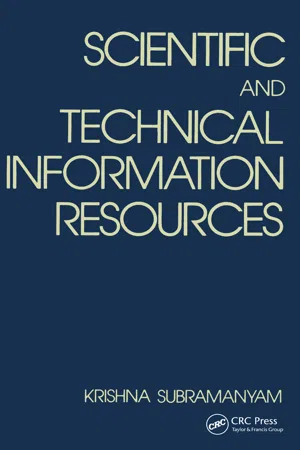
Scientific and Technical Information Resources
About this book
This book focuses on current practices in scientific and technical communication, historical aspects, and characteristics and bibliographic control of various forms of scientific and technical literature. It integrates the inventory approach for scientific and technical communication.
Information
1
Scientific and Technical Communication
1.1 Introduction
The date of the first scientific writing is not known precisely. Contributions to science were made by the early civilizations of Assyria, Babylonia, China, Egypt, and India. In these early civilizations, knowledge was transmitted largely through oral communication, and the fragments of papyri and cuneiform clay tablets that are extant from these periods do not give us a precise picture of the pattern of scientific communication during these early periods. The invention of the moveable type by Gutenberg in 1455 was a landmark event in the history of written communication. The printing press made it possible to prepare and disseminate multiple copies of manuscripts.
During the sixteenth and seventeenth centuries, great advances were made in intellectual, economic, technological, and social spheres by natural philosophers such as Francis Bacon and René Descartes, who placed great emphasis on the scientific method of inquiry. During this period, written communication was largely through books and gazettes. The book was not particularly suited to the rapid dissemination of new ideas, since the author had to work for several years and accumulate enough results to warrant publication of a book. Accounts of single observations and discoveries began to be disseminated through booklets or pamphlets. For example, William Harvey’s work on the circulation of blood was published as a 72-page booklet in 1628 [1].
Though many changes have taken place in recent times in the modes of dissemination of scientific information, the basic function of scientific literature, namely, to serve as a foundation for advances in science, has remained unchanged. In his opening address to the Royal Society Scientific Information Conference, 1948, Sir Robert Robinson, President of the Royal Society, said [2]:
The sciences have deep human interest and are not devoid of spiritual value. The object of our Founders was declared to be the improvement of natural knowledge. By that they meant, and we still do mean, improvement and spread of knowledge of nature. Neither they could, nor we can, condone the scientific miser who investigates for his own satisfaction, or profit, and keeps the results to himself for selfish reasons, whether they be aesthetic or economic.Faraday expressed it very well (he always did) when he described the three necessary stages of useful research—the first to begin it, the second to end it, and the third to publish it.
Sir Robinson was reiterating the principle that the march of science rests on its published record, and that ready access to scientific and technical information is a fundamental need of scientists everywhere. More recently, Elmer Hutchisson, director of the American Institute of Physics, asserted his “conviction that the written record of the accomplishments of scientific research constitutes one of civilized man’s most important intellectual resources” [3]. Scientists constantly draw upon this growing volume of records, and also strive to contribute their individual share, however small, to the total body of recorded knowledge.
1.2 Characteristics of Scientific Literature
Scientific knowledge is the objective knowledge of the universe and its phenomena, generated by the scientific method of inquiry and validated to conform with empirical observations of natural phenomena. Every new addition to the store of objective knowledge is an extension of the existing body of knowledge as recorded in the primary literature of science. The new knowledge so developed is recorded on tangible media and thus adds to the stockpile of scientific literature. Therefore, scientific literature, which embodies the existing store of objective knowledge, is at once the foundation on which the incremental progress of science rests and also a product of such advances in scientific knowledge. In the humanities, new developments do not necessarily replace past achievements: Bernard Shaw’s plays do not make Shakespeare’s plays obsolete, and Picasso’s paintings do not replace those of Rembrandt. But the nature of the objective knowledge of science is quite different; each incremental advancement in scientific knowledge in some way adds to, modifies, refines, or sometimes totally refutes the prior knowledge on which the advancement was based to begin with. Einstein’s general theory of relativity is an extension and a generalization of Newton’s classical mechanics; the heliocentric theory of Copernicus rejected and replaced Ptolemy’s geocentric theory, then prevailing. This noncumulative quality of science is shared by the literature of science; hence the clamor of scientists and other users of scientific information for the most recent literature.
The second important attribute of science, which is shared to a large extent by the literature of science, is its universality. Scientific truth is “supranational,” and transcends political, sociological, cultural, and linguistic limitations, although these factors influence the organizational dynamics of scientific research in any given society. For example, the organization of scientific research activity in the United States is different from that in the Soviet Union because of the vast differences in the political ideologies and socioeconomic infrastructures of these two countries. However, Soviet physics could not be different from American physics inasmuch as the laws of physics, regardless of the nationality of the physicists who discover them, or of the language in which they are expressed, are as immutable as the natural phenomena they depict. Any aberration that may be deliberately or inadvertently superimposed upon scientific truth by political demagoguery or other ideological considerations, as exemplified by the Lysenko affair in the USSR, is bound to be discovered and rejected sooner or later [4].
Likewise, scientific literature, which is a record of the objective knowledge generated by science, is quintessentially universal, although there may be vast differences in its language, bibliographic format, and physical medium. These differences can be resolved by appropriate transformation (e.g., translation and reformatting), and then the scientific literature produced in one country can be used by the scientists of another country. The abstracts in Referativnyi Zhurnal, a Russian abstract journal, are translated and incorporated into Applied Mechanics Reviews of the American Society of Mechanical Engineers. Many physics journals produced in the USSR are translated from cover to cover by the American Institute of Physics, Plenum Publishing Corporation, and other agencies, and are made available to English-speaking physicists throughout the world. This could not have been done if scientific literature, like science itself, were not essentially universal. The same cannot be said of the literature of other branches of knowledge, however. Some branches of the social sciences and the humanities are more or less culture specific, and are not transplantable across cultural-geographical interfaces. Islamic law, for example, cannot be practised in the United States, even if books on Islamic law can be translated into English, because of the culture dependency of law. Such translations are useful, though, for academic pursuits.
Scientific literature is the validated record of the achievements of science. Traditionally, scientists have been zealous in guarding the high standards of scholarship and quality of the work reported in scientific literature. Research articles submitted by scientists for publication in scholarly journals are refereed by a panel of experts to ensure accuracy and quality. In order to obtain impartial assessment of the manuscripts, the refereeing process is usually done anonymously. The author is not aware of the identity of the referees, and in some cases, the referees also do not know the identity of the author. Scientific societies play a dominant and useful role in maintaining this tradition of validation of scientific literature.
Scientific literature is also a “public” record of scientific knowledge. The channels of communication (e.g., the primary journal and the conference platform) are accessible to anyone who satisfies the requirements of quality as set forth by scientists themselves. Also, the literature of science is “public” in another sense: With the exception of documents containing proprietary matter or information pertaining to national safety, the literature of science is accessible by anyone for use. Very elaborate bibliographic control mechanisms have been set up to promote easy and rapid access to scientific literature. Since science is sustained by its own literature, the accessibility of scientific literature is crucial for the unimpeded growth of science.
1.3 The Structure of Scientific Literature
The structure of scientific literature can best be understood by tracing the progression of scientific information from its generation as a result of research and development (R & D) endeavors through its dissemination in primary literature, its surrogation in secondary services, and...
Table of contents
- Cover
- Half Title
- Series Page
- An Important Message to Readers...
- Title Page
- Copyright Page
- Preface
- Table of Contents
- 1. Scientific and Technical Communication
- 2. Scientific Societies
- 3. The Primary Journal
- 4. Conference Literature
- 5. Dissertations, Theses, and Research in Progress
- 6. Patents
- 7. Technical Reports
- 8. Standards and Specifications
- 9. House Journals
- 10. Trade Catalogs
- 11. Biographical Literature
- 12. Dictionaries and Thesauri
- 13. Directories and Yearbooks
- 14. Handbooks and Tables
- 15. Encyclopedias
- 16. Review Literature
- 17. Translations
- 18. Bibliographic Control of Scientific and Technical Literature
- 19. Current Trends and Prospects
- Bibliography
- Appendix: Abbreviations
- Author Index
- Subject Index
Trusted by 375,005 students
Access to over 1.5 million titles for a fair monthly price.
Study more efficiently using our study tools.
Frequently asked questions
Yes, you can cancel anytime from the Subscription tab in your account settings on the Perlego website. Your subscription will stay active until the end of your current billing period. Learn how to cancel your subscription
No, books cannot be downloaded as external files, such as PDFs, for use outside of Perlego. However, you can download books within the Perlego app for offline reading on mobile or tablet. Learn how to download books offline
Perlego offers two plans: Essential and Complete
- Essential is ideal for learners and professionals who enjoy exploring a wide range of subjects. Access the Essential Library with 800,000+ trusted titles and best-sellers across business, personal growth, and the humanities. Includes unlimited reading time and Standard Read Aloud voice.
- Complete: Perfect for advanced learners and researchers needing full, unrestricted access. Unlock 1.5M+ books across hundreds of subjects, including academic and specialized titles. The Complete Plan also includes advanced features like Premium Read Aloud and Research Assistant.
We are an online textbook subscription service, where you can get access to an entire online library for less than the price of a single book per month. With over 1.5 million books across 990+ topics, we’ve got you covered! Learn about our mission
Look out for the read-aloud symbol on your next book to see if you can listen to it. The read-aloud tool reads text aloud for you, highlighting the text as it is being read. You can pause it, speed it up and slow it down. Learn more about Read Aloud
Yes! You can use the Perlego app on both iOS and Android devices to read anytime, anywhere — even offline. Perfect for commutes or when you’re on the go.
Please note we cannot support devices running on iOS 13 and Android 7 or earlier. Learn more about using the app
Please note we cannot support devices running on iOS 13 and Android 7 or earlier. Learn more about using the app
Yes, you can access Scientific and Technical Information Resources by Krishina Subramanyam,Subramanyam in PDF and/or ePUB format, as well as other popular books in Languages & Linguistics & Library & Information Science. We have over 1.5 million books available in our catalogue for you to explore.