- 304 pages
- English
- ePUB (mobile friendly)
- Available on iOS & Android
eBook - ePub
Pumps for Chemical Processing
About this book
A reference for the chemical engineer on the application, selection, construction, procurement, installation, operation, and maintenance of the three basic types of pumps used in chemical processing: centrifugal, rotary, and reciprocating. Emphasizes aspects that cause practical operating problems,
1. Introduction
Pumping in the chemical process industry involves the bulk movement of process liquids, the precise injection of reactants, and the provision and dissipation of energy. For convenience, these three functions are referred to as process, metering, and utility. While utility does not involve the handling of process chemicals, there will be no processing without it, so its inclusion is justified.
Pumping is the so-called “heart” of chemical processing, and it’s a good analogy. Successful pumping is thus of fundamental importance; achieving it involves getting all the following “right”:
- Conditions of service
- Pumping specification
- Procurement
- Installation
- Operation
- Maintenance
Not getting any one of these “right” can cripple a process. Generally, though, mistakes in the last four can be corrected, albeit at great expense. But if the first two are not “right,” if the basics are not sound, all subsequent corrections will be “Band-Aids.”
Because developing a sound pump specification is so important, it is the focus of this section. Figure 1.1 shows the basic sequence for doing this, which this volume follows. Note, also, that iteration is an inherent part of this sequence.
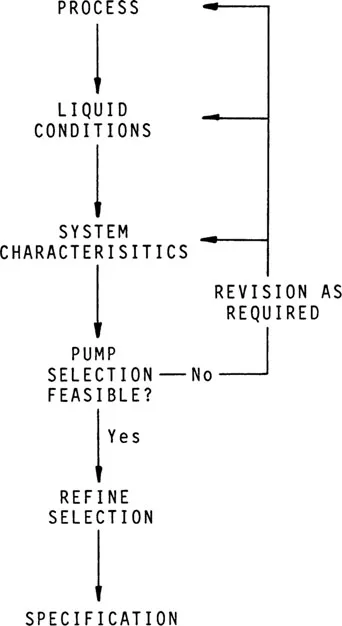
G 1.1. Process for developing a sound pump specification.
The pump types reviewed are centrifugal, rotary, and reciprocating. For each type the review covers basic characteristics, specific configurations and their uses, then available materials of construction, all with a view to chemical process service. For clarity, specific information on metering and utility pumps is given in Chapters 9 and 10, respectively.
The size of this volume is limited, thus an exhaustive treatment is not possible. Instead, the material seeks to highlight the fundamental, the novel, and the usually troublesome, thereby supplementing other related material. For greater detail on pumps in general, the reader is referred to the Pump Handbook [1.1], The Chemical Engineering Guide to Pumps [1.2], Centrifugal Pumps [1.3], and Reciprocating Pumps [1.4]. A recent publication, Process Pump Selection—A Systems Approach [1.5], adds notably to the “art” of pump selection (in metric units). Throughout the volume, references on specific topics are cited to enable further reading.
References
- 1.1. I. J. Karassik et al. (eds.), Pump Handbook, 2nd ed., McGraw-Hill, New York, 1986.
- 1.2. K. McLaughton (ed.), The Chemical Engineering Guide to Pumps, McGraw-Hill, New York, 1984.
- 1.3. I. J. Karassik and R. Carter, Centrifugal Pumps, McGraw-Hill, New York, 1960.
- 1.4. T. L. Henshaw, Reciprocating Pumps, Van Nostrand Reinhold, New York, 1987.
- 1.5. J. Davidson (ed.), Process Pump Selection—A Systems Approach, The Institution of Mechanical Engineers, Suffolk, U.K., 1986.
2. Liquid Conditions
Chemical process pumping involves the handling of liquids that are corrosive or toxic or both. This requirement distinguishes the service from general pumping and has a major bearing on materials of construction, internal mechanical construction, and the type of seal necessary.
Because the nature of the liquid to be pumped has such a bearing on pump construction, its precise determination is an essential first step in any pumping application. Not doing this with sufficient precision is a prime cause of premature failure in chemical pumps.
2.1. Properties
Liquid properties influence the type of pump and its mechanical construction. Those needed for pump selection are:
Specific gravity (SG) or relative density (RD)Vapor pressureViscosityRheological characteristic (if other than Newtonian)
Specific heat, though not often quoted, is useful, particularly when the application has minimal net positive section head (NPSH) available.
Liquid properties are usually specified at the pumping temperature or over the expected temperature range, if that is the case.
2.2. Temperature
Liquid properties and corrosiveness vary markedly with temperature, thus the precise temperature is important. General terms such as “cold,” “hot,” or “ambient” do not provide sufficient information. An ideal specification gives the expected temperature range and the normal operating temperature.
2.3. Constituents
Most liquids pumped are solutions of multiple constituents. To help insure the most appropriate materials are used for the pump, it is necessary to know the liquid’s constituents and their concentration. In this connection it is vital that all constituents, major and trace, be identified and that their concentration be given in specific units.
Trace constituents, particularly halogens, halides, or compounds of hydrogen, can render a nominally suitable material entirely unsuitable. Examples are the effect of fluorides on high silicon iron (cited by Birk and Peacock in Ref. 1.1) and of hydrogen sulfide on a variety of materials (see NACE [2.1]).
Concentration needs to be stated specifically to avoid varying interpretations of terms such as “dilute” and “concentrated.” Similar treatment is necessary for trace constituents because their effect can vary markedly with very small changes in concentration.
2.4. Acidity and Alkalinity
Whether a solution is acidic or alkaline or likely to vary is of consequence to material selection. For this reason, the solution’s pH, or possible range of pH, needs to be specified.
2.5. Aeration
The degree of aeration of a solution can have a significant effect on its corrosiveness. Alloys that rely upon oxidation for passivity, Type 316 stainless steel for example, suffer severe corrosion in deaerated solutions. For alloys dependent upon a reducing environment for corrosion resistance, aeration of the solution can promote severe corrosion.
2.6. Solids
In low concentrations, often seemingly innocuous, solids suspended in the pumped liquid can cause corrosion-erosion. Frequently, the damage can be severe enough to result in premature, catastrophic failure of a pump’s casing. If solids are likely to be present, their material, size, and concentration need to be specified.
2.7. Allowable Leakage
Pollution, both atmospheric and ground, known carcinogenic effects, and high toxicity dictate that many of the liquids used in the chemical industry be allowed to leak at only very low rates or not at all. Low or zero leakage requires special consideration in the selection, design, and quality of the pump’s “pressure boundary.”
2.8. Product Quality
With some liquid...
Table of contents
- Cover
- Title Page
- Copyright Page
- Preface
- Table of Contents
- 1. Introduction
- 2. Liquid Conditions
- 3. Corrosion
- 4. System Characteristics
- 5. Pump Class Selection
- 6. Centrifugal Pumps
- 7. Rotary Pumps
- 8. Reciprocating Pumps
- 9. Metering Pumps
- 10. Utility Pumps
- 11. Seals
- 12. Couplings
- 13. Baseplates
- 14. Procurement
- 15. Installation
- 16. Operation
- 17. Maintenance
- Symbols
- Index
Trusted by 375,005 students
Access to over 1.5 million titles for a fair monthly price.
Study more efficiently using our study tools.
Frequently asked questions
Yes, you can cancel anytime from the Subscription tab in your account settings on the Perlego website. Your subscription will stay active until the end of your current billing period. Learn how to cancel your subscription
No, books cannot be downloaded as external files, such as PDFs, for use outside of Perlego. However, you can download books within the Perlego app for offline reading on mobile or tablet. Learn how to download books offline
Perlego offers two plans: Essential and Complete
- Essential is ideal for learners and professionals who enjoy exploring a wide range of subjects. Access the Essential Library with 800,000+ trusted titles and best-sellers across business, personal growth, and the humanities. Includes unlimited reading time and Standard Read Aloud voice.
- Complete: Perfect for advanced learners and researchers needing full, unrestricted access. Unlock 1.5M+ books across hundreds of subjects, including academic and specialized titles. The Complete Plan also includes advanced features like Premium Read Aloud and Research Assistant.
We are an online textbook subscription service, where you can get access to an entire online library for less than the price of a single book per month. With over 1.5 million books across 990+ topics, we’ve got you covered! Learn about our mission
Look out for the read-aloud symbol on your next book to see if you can listen to it. The read-aloud tool reads text aloud for you, highlighting the text as it is being read. You can pause it, speed it up and slow it down. Learn more about Read Aloud
Yes! You can use the Perlego app on both iOS and Android devices to read anytime, anywhere — even offline. Perfect for commutes or when you’re on the go.
Please note we cannot support devices running on iOS 13 and Android 7 or earlier. Learn more about using the app
Please note we cannot support devices running on iOS 13 and Android 7 or earlier. Learn more about using the app
Yes, you can access Pumps for Chemical Processing by J.T. McGuire in PDF and/or ePUB format, as well as other popular books in Technology & Engineering & Chemistry. We have over 1.5 million books available in our catalogue for you to explore.