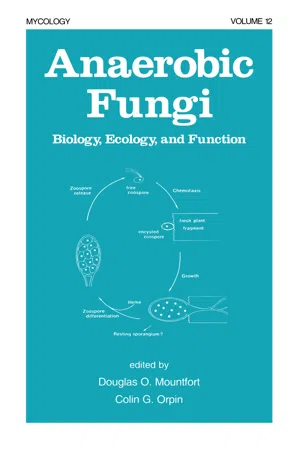
Uniting-for the first time-current information on anaerobic fungi from a number of different disciplines, this unique reference examines the taxonomy, physiology, biochemistry, molecular biology, and ecology of anaerobic fungi-focusing on fungi from the rumen and other gut environments such as the cecum and hindgut of nonruminant herbivores.
Anaerobic Fungi
- 304 pages
- English
- ePUB (mobile friendly)
- Available on iOS & Android
eBook - ePub
About this book
Information
1
Anaerobic Fungi: Taxonomy, Biology, and Distribution in Nature
Division of Tropical Crops and Pastures
CSIRO
Brisbane, Queensland, Australia
CSIRO
Brisbane, Queensland, Australia
I. THE DISCOVERY OF ANAEROBIC FUNGI
Herbivorous mammals depend for their survival on a symbiotic association with microorganisms in their alimentary tract. The diet of grazing and browsing herbivores consists largely of plant structural carbohydrates, such as cellulose and hemicelluloses, that the animals themselves are unable to digest. Instead, the symbiotic microorganisms in the alimentary tract, particularly in the rumen of ruminants and the cecum and hindgut of nonruminants, hydrolyze these compounds under anaerobic conditions, with the production of microbial cells and volatile fatty acids that the animal can utilize as sources of nutrition (1,2,3). In order to understand and control digestion of plant structural carbohydrates and improve the production efficiency of ruminants, the microbial population of the rumen of domestic sheep and cattle has been studied extensively (1,2,3).
The microbial population of the rumen is diverse, and until the discovery of anaerobic fungi, it was believed to consist principally of anaerobic and facultatively anaerobic bacteria, ciliated protozoa, and flagellate protozoa. Early workers (4,5) documented the existence of uniflagellate, biflagellate, and multiflagellate organisms in rumen contents, believing them to be flagellate protozoa. These organisms were placed in the genera Callimastix, Oikomonas, Monas, and Sphaeromonas. Multiflagellate organisms similar to the Callimastix frontalis described by Braune (5) in the rumen were subsequently found in different habitats; Callimastix equi Hsuing was found in the horse cecum (6), Callimastix jolepsi in the pulmonate snail (7), and Callimastix cyclopis in the copepod Cyclops stenuus (8). The status of the multiflagellate organisms from the horse cecum and the pulmonate snail remains to be determined, but Callimastix cyclopis has been examined in some detail (8). It was found that the flagellate was in fact a zoospore of a fungus with a plasmodial vegetative stage that developed in the body cavity of the host copepod and, on maturity, gave rise to the flagellates. It was believed that the flagellates would then infect a new host to continue the life cycle. Since this species was identified as a fungus and not a protozoan, it was proposed that the rumen flagellates with multiple flagella, which were still assumed to be flagellate protozoa, should be reclassified as a species of zooflagellate in the new genus Neocallimastix (8), with frontalis (5) as the type species.
Many of the flagellated rumen organisms described by Liebetanz (4) and Braune (5) have since been shown to be not protozoa, but the flagellated zoospores of anaerobic fungi (Fig. 1). The first report of isolation of an anaerobic fungus, a species of Neocallimastix, was published in 1975 (9). The organism was isolated during attempts to isolate and culture anaerobic flagellate protozoa from the rumen contents of sheep using a published procedure (10). Flagellates did indeed grow in the cultures, but it was impossible to separate the flagellates from what appeared to be vegetative fungal growth in the culture. It was soon evident that the flagellates were released from reproductive structures borne on the fungal rhizoids, and that the life cycle of the organism consisted of an alternation between a motile, flagellated zoospore stage and a vegetative rhizoid-bearing reproductive stage. The organism was similar both in morphology and life cycle to a chytridiomycete fungus, but it was a strict anaerobe. Until then, fungi were regarded as being either anaerobes or facultative anaerobes, and the detection of microorganisms similar to chytridiomycete fungi that could grow only under chemically reducing conditions in the absence of molecular oxygen was novel. Because of the revolutionary nature of this finding, acceptance by the scientific community was slow. The presence of chitin in the cell walls of these and similar organisms (11) confirmed that they were true fungi despite being strict anaerobes.
Methods for the isolation and culture of anaerobic fungi have since been considerably refined, so that the organisms can now be routinely isolated from suitable habitats with little difficulty. Anaerobic fungi are now regarded as a normal component of the microbial population of the rumen.
The reason why the rumen fungi remained undiscovered while research on rumen bacteria and protozoa went ahead strongly during the period up to 1975 is not difficult to understand, even though electron microscopy was commonly employed to determine microbial activity during the digestion of plant tissues in the rumen and the flagellates of the rumen fungi had been described (as flagellate protozoa) as early as 1910 (4). Work on the flagellate protozoa of the rumen was limited because of their small population densities and the consequent assumption that they were of little importance in rumen metabolism; hence the fungal flagellates were also largely ignored. In addition, it was common for rumen microbiologists to strain rumen contents through cheesecloth to remove the large plant fragments before microbiological analysis, as pointed out by Bauchop (12). In doing this, the microbiologists were separating the bulk of the vegetative growth of the fungi from their working material, and it was only after the introductory work of Orpin (13,14) on the invasion of plant tissues by the flagellates of the rumen fungi, and the scanning electron microscopy of Bauchop (15), that the significance of separating the plant particles from rumen contents was recognized in this context. The fungal growth is normally tightly attached to digesta fragments (Fig. 2). However, rough handling during the straining of digesta through muslin sometimes damages the vegetative fungal growth and breaks sporangia from the rhizoids (Fig. 2b). These sporangia can be differentiated from protozoa (Fig. 1c) in the filtered rumen fluid by their lack of motility, high refractivity, and lack of cilia; they contain no skeletal plates and usually have a short length of rhizoid attached.

Figure 1 Flagellate zoospores of anaerobic fungi as observed in fresh rumen contents, (a) A multiflagellate zoospore, possibly of Neocallimastix sp., is shown, together with the large bacterium Magnoovum eadii (arrowed), (b) A uniflagellate zoospore is shown, together with Quin’s Oval (Q) and another large bacterium – Selenomonas ruminantium (S). The zoospores can be clearly differentiated from the large bacteria, (c) Uni flagellated zoospores (arrowed) can be seen in relation to a ciliated protozoan, Entodinium sp. (P). Phase-contrast microscopy. (a) × 2000; (b) ×2000; (c) ×700.
Additional reasons why the rumen fungi remained undiscovered until recent years were the difficulty of isolating them from rumen contents without the use of antibiotics to suppress the growth of bacteria (9,14,16,17) and the need to isolate them from low dilutions of rumen contents. This is usually within the range of 10−3–10−5, well below that normally employed for the isolation of anaerobic rumen bacteria. Thus colonies of anaerobic rumen fungi would probably not have been observed during the isolation of rumen bacteria.
The importance of these fungi in herbivore nutrition is still not well understood, but their undoubted ability to utilize major plant cell wall polysaccharides for growth (18–20) and to produce a wide range of enzymes with activities capable of hydrolyzing many of the components of plant cell-walls (21,22,23) shows that they have the potential to contribute substantially to plant-fiber degradation in the alimentary tract of the host animal.
The life cycles of all anaerobic fungi so far described consist of an alternation between a motile, flagellate zoospore stage, free-living in the liquid phase of the digesta, and a nonmotile, vegetative, reproductive stage, saprophytic on digesta fragments in the alimentary tract of the animal. The zoospores of all species are able to change to an ameboid form and may be observed crawling over digesta fragments and, in culture in vitro, the sides of culture vessels. Evidence is accumulating that in some species (isolated from ruminants) an additional oxygen-tolerant stage may be developed in the feces. An oxygen-resistant stage, possibly a sporangium, is suspected (24), but in an isolate from the horse cecum, a possible resting stage unlike a sporangium has been identified (25). In the coelomic parasite Coelomyces ( = Callimastix) cyclopis of Cyclops stenuus, a resting cyst gives rise to biflagellate zoospores that are the infective stage for the mosquito, a second host of the parasite (26); as yet no such cysts have been observed in the anaerobic fungi, unless the putative resting stage of an isolate from the horse cecum (25) is equivalent. A schematic, generalized life cycle of anaerobic fungi from the rumen as we understand it at present is shown in Fig. 3.

Figure 2 Vegetative stages of anaerobic fungi found in rumen contents. In the scanning electron microscope (a), the sporangia of the fungi can be seen with the associated rhizoid (arrowed) penetrating the plant...
Table of contents
- Cover
- Halftitle Page
- Title Page
- Copyright Page
- Series Introduction
- Preface
- Contents
- Contributors
- 1. Anaerobic Fungi: Taxonomy, Biology, and Distribution in Nature
- 2. The Ultrastructure of Anaerobic Fungi
- 3. Nutrition and Survival of Anaerobic Fungi
- 4. Fermentation Product Generation in Rumen Chytridiomycetes
- 5. Regulatory Constraints in the Degradation and Fermentation of Carbohydrate by Anaerobic Fungi
- 6. Ultrastructure of Plant Cell-Walls Degraded by Anaerobic Fungi
- 7. Interactions Between the Rumen Chytrid Fungi and Other Microorganisms
- 8. Effects of Diet on the Fungal Population of the Digestive Tract of Ruminants
- 9. The Nucleic Acids of Anaerobic Fungi
- 10. Differential and Integral Equations and Their Application in Quantifying the Fungal Population in the Rumen
- 11. Anaerobic Fungi: Future Perspectives
- Index
Trusted by 375,005 students
Access to over 1.5 million titles for a fair monthly price.
Study more efficiently using our study tools.
Frequently asked questions
Yes, you can cancel anytime from the Subscription tab in your account settings on the Perlego website. Your subscription will stay active until the end of your current billing period. Learn how to cancel your subscription
No, books cannot be downloaded as external files, such as PDFs, for use outside of Perlego. However, you can download books within the Perlego app for offline reading on mobile or tablet. Learn how to download books offline
Perlego offers two plans: Essential and Complete
- Essential is ideal for learners and professionals who enjoy exploring a wide range of subjects. Access the Essential Library with 800,000+ trusted titles and best-sellers across business, personal growth, and the humanities. Includes unlimited reading time and Standard Read Aloud voice.
- Complete: Perfect for advanced learners and researchers needing full, unrestricted access. Unlock 1.5M+ books across hundreds of subjects, including academic and specialized titles. The Complete Plan also includes advanced features like Premium Read Aloud and Research Assistant.
We are an online textbook subscription service, where you can get access to an entire online library for less than the price of a single book per month. With over 1.5 million books across 990+ topics, we’ve got you covered! Learn about our mission
Look out for the read-aloud symbol on your next book to see if you can listen to it. The read-aloud tool reads text aloud for you, highlighting the text as it is being read. You can pause it, speed it up and slow it down. Learn more about Read Aloud
Yes! You can use the Perlego app on both iOS and Android devices to read anytime, anywhere — even offline. Perfect for commutes or when you’re on the go.
Please note we cannot support devices running on iOS 13 and Android 7 or earlier. Learn more about using the app
Please note we cannot support devices running on iOS 13 and Android 7 or earlier. Learn more about using the app
Yes, you can access Anaerobic Fungi by Douglas Mountfort,Mountfort in PDF and/or ePUB format, as well as other popular books in Biological Sciences & Biology. We have over 1.5 million books available in our catalogue for you to explore.