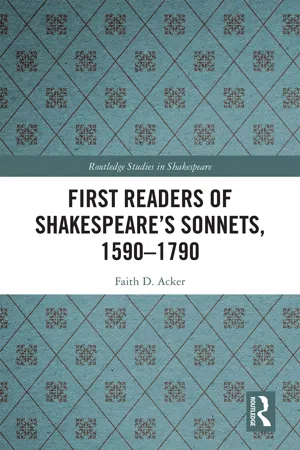
For more than four centuries, cultural preferences, literary values, critical contexts, and personal tastes have governed readers' responses to Shakespeare's sonnets. Early private readers often considered these poems in light of the religious, political, and humanist values by which they lived. Other seventeenth- and eighteenth- century readers, such as stationers and editors, balanced their personal literary preferences against the imagined or actual interests of the literate public to whom they marketed carefully curated editions of the sonnets, often successfully. Whether public or private, however, many disparate sonnet interpretations from the sonnets' first two centuries in print have been overlooked by modern sonnet scholarship, with its emphasis on narrative and amorous readings of the 1609 sequence. First Readers of Shakespeare's Sonnets reintroduces many early readings of Shakespeare's sonnets, arguing that studying the priorities and interpretations of these previous readers expands the modern critical applications of these poems, thereby affording them numerous future applications. This volume draws upon book history, manuscript studies, and editorial theory to recover four lost critical approaches to the sonnets, highlighting early readers' interests in Shakespeare's classical adaptations, political applicability, religious themes, and rhetorical skill during the seventeenth and eighteenth centuries.
- 224 pages
- English
- ePUB (mobile friendly)
- Available on iOS & Android
eBook - ePub
First Readers of Shakespeare’s Sonnets, 1590-1790
About this book
Information
1 The Passionate Pilgrim and Shakespeare’s ‘sugred’ Reputation
In 1598, Francis Meres likely tantalized Shakespeare’s literary fans with a reference to ‘honytongued Shakespeares [. . .] sugred Sonnets,’ which Meres described as shared ‘among his private friends.’1 Meres’ mention omits many desirable details. He never reveals the identities of the ‘private friends,’ he never quantifies the number of available sonnets, and his reference to ‘sonnets’ may not even refer to the poems now classified as Shakespeare’s sonnets. In 1598, the term ‘sonnet’ denoted a short lyric poem, including the structured fourteen lines of rhymed iambic pentameter that most modern scholars associate with the word, but also encompassing many other short verse forms. To a Renaissance reader, ‘sonnets’ could be ‘songs’ or other short ‘poems.’ Nevertheless, many early modern writers could—and did—write formal fourteen-line sonnets, in the style of Francesco Petrarch, whose fourteenth-century sonnets to the beloved, unattainable Laura sparked a burst of imitative poetical collections. Many of these appeared in England in the late 1590s, loosely inspired by the poems Richard Tottel had printed in his lyric verse anthology Songes and Sonettes (1557). Sonnets by Shakespeare featured prominently in his play Loues Labors Lost,2 first published in 1598, right around the time that Meres noted the sonnets’ privileged private transmission.
Meres’ reference, however, cannot be explained away by an encounter with sonnets on the stage of Loues Labors Lost. Instead, Meres establishes himself as one of Shakespeare’s ‘private friends,’ or one of the very first, exclusively chosen, readers of private Shakespearean poetry. Aspiring sonnet readers outside this intimate circle might have found two Shakespearean sonnets and another short lyric poem printed in Labors, had they known to look. For most readers, however, Shakespeare’s sonnets would have been more easily accessible a year later, when stationer William Jaggard published a small poetical collection titled The Passionate Pilgrime.3 Aligned with Meres’ earlier hints, the volume included versions of the poems we now know as Shakespeare’s Sonnets 138 and 144 as well as three poems from Labors and sixteen other lyric verses, several not by Shakespeare. No one really knows whether Jaggard knew which poems in the collection were Shakespeare’s (or not), or how much editorial intervention Jaggard may have imposed upon the Pilgrim poems as he prepared them for print. Since Jaggard’s versions of the Shakespearean sonnets differ from those poems as printed in Thomas Thorpe’s 1609 edition of Shakespeare’s sonnets, Jaggard’s versions might be Shakespeare’s earlier drafts or include changes made by Shakespeare’s ‘private friends’ as they shared these pieces with one another. Either way, Jaggard was one of Shakespeare’s earliest readers, and he specialized in early modern literary tastes. Many of his marketing strategies emphasized currently popular qualities of the sonnets, including features Meres had already noted. Jaggard not only made these purportedly exclusive Shakespearean sonnets available to the public, but he capitalized on the versatile applications of the included poems and celebrated the sonnets’ affinity with Shakespeare’s established canon. If Jaggard read Meres’ analysis, he may have forged these connections intentionally; if not, then Jaggard and Meres, two early sonnet readers, independently valued many of the same features of Shakespeare’s shorter poems. More importantly, Jaggard expected his audience—Shakespeare’s would-be readers—to value and desire particular qualities of the text, and he shaped his edition to meet these desires.
The Passionate Pilgrim is both rare and unique. No identifiably complete copy of the first edition exists today, but from the extant fragments we know that Jaggard left vast amounts of unused space on his printing forms. When his apprentices laid out Pilgrim’s pages on the large sheets of paper that printers used, they placed a single poem or a few stanzas of a longer poem on every other page. After this large sheet was folded three times and stitched (forming a quire), then trimmed to separate the folded leaves, most leaves had printing only on their front (recto) sides. Although the second edition is sixty-four pages long, for instance, only three leaves in the fourth gathering have printing on the back side (verso). The entire volume could easily have been printed upon three large sheets instead of four. It could even have been compressed onto two sheets if Jaggard and his printers had not skipped pages and spaced out so many stanzas. The absence of titles renders the beginnings and endings of several poems unclear. For a reader new to the collection’s contents, only shifts in form would differentiate each poem from the next.
Just as Meres valued several different aspects of Shakespeare’s sonnets, so Jaggard marketed Pilgrim to multiple audiences. For readers who appreciated the courtly ideals of Renaissance sonnet sequences, he used Pilgrim’s paratexts to align the volume with recent and popular collections such as Astrophel and Stella (1591), Rosalynd (1592), Phillis (1593), and Fidessa (1596), all of which had recently appeared in the bookshops of St. Dunstan’s Churchyard, where Jaggard then kept his shop. For existing fans of Shakespeare’s poetry, Jaggard affiliated the volume with Shakespeare’s name and linked it to recent publications of the poet’s works, particularly the popular narrative poem Venus and Adonis.4 Finally, he built upon Shakespeare’s long-standing association with classical texts by highlighting the volume’s classical themes and, later, by adding more classical poetry to its contents. Pilgrim’s brevity, single-sided printing, careful genre associations, and affiliation with Shakespeare’s classical texts were meant to entice a wide range of possible buyers.
As a seventeenth-century stationer, Jaggard functioned much as a modern commissioning editor might. When he encountered new texts, he would have considered not only his own preferences as a reader, but also the interests and values of men and women who had previously purchased his publications. These individuals may even have chatted with Jaggard or some of his apprentices, and these conversations may have given Jaggard a better sense of current readers’ literary interests. Other members of Jaggard’s target audience might have been the clients of his competitors. As a stationer in St. Dunstan’s bustling churchyard, which could hold about seven shops at a time,5 Jaggard would have been able to see which books his neighbors offered and which of those had the greatest commercial success. Unsurprisingly, he borrowed many techniques from his competitor colleagues. He advertised Shakespeare’s name prominently, chose a title with multiple literary connotations, arranged the poems to prioritize popular qualities, and matched his textual decorations to those of similar poetical bestsellers. His strategies paid off. Pilgrim merited two reprints within thirteen years, and continued to be read well after the publication of Thomas Thorpe’s 1609 quarto. In fact, by preempting the 1609 sonnets and by expanding its 1612 reprint, The Passionate Pilgrim may have overshadowed Thorpe’s larger collection. Jaggard’s publication sold well and was widely read.
The comparative multiplicity of editions and the occasional transcriptions thereof demonstrate the effectiveness of Jaggard’s edition. By 1599, Shakespearean sonnets were read both publicly and privately, and their readers valued them. Jaggard’s clients, newly elevated to the elite status of Shakespearean sonnet readers, valued the collection’s content and themes, and did not seem to notice stylistic discrepancies between the four formal sonnets by Shakespeare and several other poems—some by other poets—that completed the volume. In fact, the one extant manuscript transcribed by an early Pilgrim reader reveals the compiler’s engagement with Jaggard’s content and advertised themes. This reader read and then copied down three Pilgrim sonnets with classical emphases and characters, and supplemented these with two poems describing the duplicity of a female beloved. He seems to have appreciated many of Pilgrim’s marketed features even as his interpretations and classifications of Jaggard’s included poems overlook other advertised features of the 1599 and 1612 collections. Meres, Jaggard, and this early reader shared many cultural and literary values, but all three interpreted the poems personally and disparately.
Texts and Editions
The Passionate Pilgrim currently exists in three versions. Only two imperfect quires of what Joseph Quincy Adams has convincingly identified as the first edition are extant, and they have been bound with two complete quires of what is probably the second edition.6 An early reader collected these gatherings, and four other books, in a single volume containing five texts bound together (sammelband). The full volume, in its original calfskin binding, is carefully preserved in the cold vault of the Folger Shakespeare Library.7 Four complete quires of the second edition, bound together, form two separate copies now preserved at Trinity College, Cambridge, and the Huntington Library in California. The revised and augmented third edition of 1612 survives in two copies, one at the Folger and the other in Oxford University’s Bodleian Library.
The extant first edition fragments are the first and third quires in the Folger sammelband. The second quire of the second edition appears between them, and the fourth quire of that edition concludes the Pilgrim section of the book.8 Four other texts follow: Shakespeare’s Lucrece, T. M.’s The Ghost of Lucrece, the anonymous sonnet sequence Emaricdulfe, and Shakespeare’s Venus and Adonis.9 All five have been trimmed to be the same size, and four of the five use the same printers’ ornaments; so, despite the presence of six editions of five texts published by five stationers and written by three authors, the volume has both thematic and typographical continuity.
The pages from the first Pilgrim edition contain fewer paratexts than those of the second. Many early modern printers used sequential letters and numbers called signatures to indicate the preferred sequence of pages within a book. They al...
Table of contents
- Cover
- Half Title
- Series Page
- Title Page
- Copyright Page
- Dedication
- Table of Contents
- List of Figures
- Acknowledgments
- List of Abbreviations
- The Author to the Reader
- Introduction: ‘The Meaning’ of the Sonnets
- 1 The Passionate Pilgrim and Shakespeare’s ‘sugred’ Reputation
- 2 Reading and Revising Shake-Speare’s Sonnets (1609)
- 3 The Manuscripts of Sonnet 2: Sex, Sonnets, and Spirituality
- 4 John Benson’s Sonnet Sequences (Poems: Written by Wil. Shake-Speare. Gent.)
- 5 Celebrations of Church and King: An Early Cambridge Reader
- 6 Restoration Revisions: Musical, Dramatic, and Miscellany Readings
- 7 Supplementing Shakespeare and Creating the Canon
- 8 Edmond Malone: Plotting the Sonnets
- 9 Reading the Sonnets after Malone: Independent Responses
- Sonnet Futures
- Works Cited
- First Line Index of Referenced Poems
- Index of Names and Places
- Index of Terms and Concepts
Trusted by 375,005 students
Access to over 1.5 million titles for a fair monthly price.
Study more efficiently using our study tools.
Frequently asked questions
Yes, you can cancel anytime from the Subscription tab in your account settings on the Perlego website. Your subscription will stay active until the end of your current billing period. Learn how to cancel your subscription
No, books cannot be downloaded as external files, such as PDFs, for use outside of Perlego. However, you can download books within the Perlego app for offline reading on mobile or tablet. Learn how to download books offline
Perlego offers two plans: Essential and Complete
- Essential is ideal for learners and professionals who enjoy exploring a wide range of subjects. Access the Essential Library with 800,000+ trusted titles and best-sellers across business, personal growth, and the humanities. Includes unlimited reading time and Standard Read Aloud voice.
- Complete: Perfect for advanced learners and researchers needing full, unrestricted access. Unlock 1.5M+ books across hundreds of subjects, including academic and specialized titles. The Complete Plan also includes advanced features like Premium Read Aloud and Research Assistant.
We are an online textbook subscription service, where you can get access to an entire online library for less than the price of a single book per month. With over 1.5 million books across 990+ topics, we’ve got you covered! Learn about our mission
Look out for the read-aloud symbol on your next book to see if you can listen to it. The read-aloud tool reads text aloud for you, highlighting the text as it is being read. You can pause it, speed it up and slow it down. Learn more about Read Aloud
Yes! You can use the Perlego app on both iOS and Android devices to read anytime, anywhere — even offline. Perfect for commutes or when you’re on the go.
Please note we cannot support devices running on iOS 13 and Android 7 or earlier. Learn more about using the app
Please note we cannot support devices running on iOS 13 and Android 7 or earlier. Learn more about using the app
Yes, you can access First Readers of Shakespeare’s Sonnets, 1590-1790 by Faith D. Acker in PDF and/or ePUB format, as well as other popular books in Literature & Literary Criticism. We have over 1.5 million books available in our catalogue for you to explore.