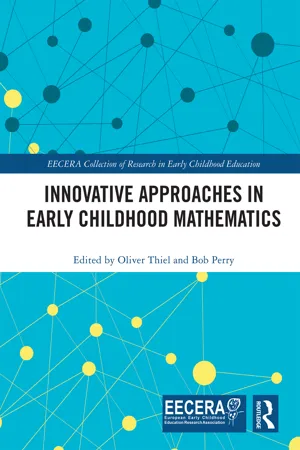
Innovative Approaches in Early Childhood Mathematics
eBook - ePub

Innovative Approaches in Early Childhood Mathematics

  1. 160 pages
  2. English
  3. ePUB (mobile friendly)
  4. Available on iOS & Android
eBook - ePub

Innovative Approaches in Early Childhood Mathematics

About this book

The chapters in this book investigate and reflect on many of the issues and challenges raised by the current trends and tensions in early childhood mathematics education. They emanate from seven countries – Australia, Northern Ireland, Norway, Portugal, Spain, Sweden, and Switzerland.

Ever since Fröbel invented the kindergarten, mathematics has been a part of early childhood pedagogy. Mathematics is an important part of children's daily life, which helps them to understand the world around them. Nowadays, early childhood mathematics is in the international spotlight. Partly this is the result of myriad studies that seem to show that early childhood mathematics achievement is a strong predictor of success or otherwise in future school mathematics, other school subjects, and life itself. Another influence on early childhood mathematics education is the advent of the political and advocacy juggernaut known as STEM (Science, Technology, Engineering, and Mathematics). Early childhood mathematics education is important for children's present and future learning.

This book provides a strong collection of current research for the consideration of all in the early childhood education field. It was originally published as a special issue of the European Early Childhood Education Research Journal.

Trusted by 375,005 students

Access to over 1.5 million titles for a fair monthly price.

Study more efficiently using our study tools.

Information

Publisher
Routledge
Year
2020
eBook ISBN
9781000740882

1 Teachers’ involvement in children’s mathematizing – beyond dichotomization between play and teaching

Camilla Björklund, Maria Magnusson and Hanna Palmér
OPEN ACCESS
ABSTRACT The focus of this article is on mathematics teaching in a play-based and goal-oriented practice, such as preschool, and on how different lines of actions may impact children's learning opportunities. Video recordings of authentic play activities involving children and nine teachers from different preschools were analyzed qualitatively to answer the following research questions: (1) What lines of action do teachers use when they teach mathematics in play? and (2) What implications may different ways of teaching have for children's learning opportunities? The analysis revealed four different categories: confirming direction of interest; providing strategies; situating known concepts; and challenging concept meaning. As these differ regarding both the mathematics content focused on and the kind of knowledge emphasized, they have implications for children's learning opportunities.

Introduction

There is a growing consensus in policy and research that early mathematics is important and bears relevance for children's development in the short and long term. Young children can possess deep and rich mathematical competencies (English and Mulligan 2013; Newton and Alexander 2013), and several studies show that early mathematical competencies have positive effects on later school performance (Duncan et al. 2007; Perry and Dockett 2008; Ginsburg 2009).
Despite the solid view that early mathematics is important, there is no agreement as to how preschool mathematics education should be conducted. Differences in opinion are visible both within and between countries, resulting in a plural view on preschool mathematics (Palmér and Björklund 2016). One of the most prominent differences regards the relation between play and teaching: is teaching to be integrated with or separated from children's play? On the one hand, there are paradigms emphasizing children's right to play, undisturbed by adults, for the sake of play itself (Sundsdal and Øksnes 2015); and on the other hand there is contemporary Nordic research developed within theoretical frameworks that emphasizes a consolidation of the two (Pramling and Pramling Samuelsson 2011; Pramling, Doverborg, and Pramling Samuelsson 2017). The former paradigms often have philosophical underpinnings, as opposed to the latter paradigms' embracing preschool as part of the education system. We find such dichotomies (between play and teaching) unfruitful and contradictory to the fact that many countries around the world include preschool children in the education system and that both teaching and play are central features of this practice.
This is an Open Access article distributed under the terms of the Creative Commons Attribution License (http://creativecommons.org/licenses/by/4.0/), which permits unrestricted use, distribution, and reproduction in any medium, provided the original work is properly cited.
Sweden is one example whereby early childhood education is available to all children aged one to six years, with a national curriculum that clearly states that the preschool practice is commissioned to ensure that children develop their competencies to their full potential. However, experiences from the Swedish context show that early childhood education is a delicate issue that needs further study (Swedish Schools Inspectorate 2016). As part of the education system, teaching is to be conducted in the Swedish preschool (Education Act 2010:800). At the same time, 'a conscious use of play' (6) is emphasized as important in relation to children's learning (National Agency of Education 2011). What is left for the teachers and researchers within this field to determine is how to teach in a play-based and goal-oriented practice. We address this question in this article by studying how teaching (mathematics) in a play-based and goal-oriented practice can be conducted, and how different lines of action may impact children's learning opportunities. The empirical material used is part of a larger research project aiming to investigate the teaching-play relation in Swedish preschool practice. Mathematics as a content for learning is of special interest in this context, since while teachers in general claim that they teach mathematics in preschool (Björklund and Barendregt 2016), an evaluation by the Swedish Schools Inspectorate (2017) shows that mathematics teaching needs to be further developed in a majority of Swedish preschools.
The specific research questions focused on in the article are: (1) What lines of action do teachers use when they teach mathematics in play? and (2) What implications may different ways of teaching have for children's learning opportunities?

Research on mathematics teaching and play

The relation between teaching, mathematics and play can be seen as either 'mathematics made playful', such as games in which counting, sorting and different mathematical operations are prominent, or 'mathematizing elements of play' whereby the primary act is play and a teacher might try to introduce mathematical concepts or operations to the child's play activities (van Oers 1996, 74). The notion of mathematizing is often used when the emphasis is on children (including preschool children) trying to understand different phenomena in their surrounding world and mathematics becomes a part of this exploration (Freudenthal 1968). According to this perspective, the mathematics teaching of young children should necessarily be based in the children's own lived experiences (for example play) and involve extending these experiences through mathematical inquiry (Gravemeijer and Terwel 2000). Anghileri (2006, 49) suggests that the teaching process involves the teacher 'initiating reflective shifts such that what is said and done in action subsequently becomes an explicit topic of discussion'. In other words, the actions that children and teacher are involved in become the topic that will be discussed from a mathematical point of view and situated in the activity. This can be related to the act of playing, whereby participants often enter and exit the play context to negotiate the meaning and progress of the ongoing play.
Play activities, and particularly role play, may serve as teaching opportunities if the teacher participates and is able to make use of occurring mathematical phenomena (van Oers 1996). The role of the teacher is then to extend children's encounters with mathematics, in addition to organizing a rich environment that offers opportunities to explore new as well as familiar notions (Wager and Parks 2016). In this approach, it is not enough that mathematical representations and notions are present in the play; the reflection on and enhancement of mathematical thinking in the children depends on the teacher's ability to seize the moment. This comes down to the idea of how children learn; Wager and Parks (2016), as well as van Oers (1996), embrace the idea of children's initiatives and explorations as essential, but emphasize that teachers need to bring in new content and perspectives that will extend the children's experiences, including the children's own play (e.g. Magnusson and Pramling 2017).
This means that teaching mathematics is not merely about promoting counting, adding, naming, or using measures; it is rather about expanding the play and helping the children to understand the surrounding world, thus to mathematize. A key, according to van Oers (1996), can be found in questions from the teacher that encourage the children to discern a problem that emerges in the play activity, helping them mathematize their play content, and furthermore to solve the problem through mathematical operations or representations. There are significant findings on the relation between children's learning outcomes and the frequency and duration of play-based mathematics activities they are engaged in (Cohrssen, Tayler, and Cloney 2015), but less is known about the efficacy of different ways of teaching in relation to play.

Theoretical framing

In our study, we base our understanding of teaching on the framework of developmental pedagogy (Pramling and Pramling Samuelsson 2011; Pramling, Doverborg, and Pramling Samuelsson 2017). Similar to the previously described mathematizing (Gravemeijer and Terwel 2000), developmental pedagogy takes its point of departure from children's own lived experiences, whereby teaching implies enabling a child to experience familiar phenomena in new ways or widen his/her experiences, resulting in an extended repertoire of ways to encounter the surrounding world. The teaching triad - consisting of the teacher (who facilitates this extension of experiences), the learner, and the content for learning – is relational. This means that there is a delicate balance between the learner's concept knowledge and the (teacher's) intended way of understanding a concept that relies on their coordinating their perspectives.
Intersubjectivity, in the sense of coordinating perspectives between teacher and learner, is considered necessary in both play and teaching. In play situations, the participants agree on the play rules and boundaries, whereby certain codes are known by the participants and promote the progression of the play. In teaching situations, teacher and learner have to establish a common temporary view, some kind of joint understanding of what they are talking about and that there might be different ways of seeing the object of learning. Thus, a situation in which intersubjectivity is temporarily sufficiently established is a pre-condition for both play and teaching.
In accordance with developmental pedagogy, teaching in early childhood education is understood as supporting children's awareness and their making sense of the surrounding world, which include both getting acquainted with new concepts and experiencing and exploring familiar phenomena in new ways. Support for children's awareness and understanding can be achieved by establishing sustained shared thinking. This pedagogical interaction is characterized by 'two or more individuals who "work together" in an intellectual way to solve a problem, clarify a concept, evaluate activities, or extend a narrative' (Siraj-Blatchford 2010, 157). In an interaction in which sustained ...

Table of contents

  1. Cover
  2. Half Title
  3. Series Page
  4. Title
  5. Copyright
  6. Contents
  7. Citation Information
  8. Notes on Contributors
  9. Introduction – Innovative approaches in early childhood mathematics
  10. 1 Teachers' involvement in children's mathematizing – beyond dichotomization between play and teaching
  11. 2 Young children's mathematical learning opportunities in family shopping experiences
  12. 3 Mathematizing in preschool: children's participation in geometrical discourse
  13. 4 Affective-motivational aspects of early childhood teacher students' knowledge about mathematics
  14. 5 Mathematical pedagogical content knowledge in Early Childhood Education: tales from the 'great unknown' in teacher education in Portugal
  15. 6 The impact of the Promoting Early Number Talk project on the development of abstract representation in mathematics
  16. 7 The role of and connection between systematization and representation when young children work on a combinatorial task
  17. 8 What makes a task a problem in early childhood education?
  18. 9 Learning through play – pedagogy and learning outcomes in early childhood mathematics
  19. 10 Using a bioecological framework to investigate an early childhood mathematics education intervention
  20. Index

Frequently asked questions

Yes, you can cancel anytime from the Subscription tab in your account settings on the Perlego website. Your subscription will stay active until the end of your current billing period. Learn how to cancel your subscription
No, books cannot be downloaded as external files, such as PDFs, for use outside of Perlego. However, you can download books within the Perlego app for offline reading on mobile or tablet. Learn how to download books offline
Perlego offers two plans: Essential and Complete
  • Essential is ideal for learners and professionals who enjoy exploring a wide range of subjects. Access the Essential Library with 800,000+ trusted titles and best-sellers across business, personal growth, and the humanities. Includes unlimited reading time and Standard Read Aloud voice.
  • Complete: Perfect for advanced learners and researchers needing full, unrestricted access. Unlock 1.5M+ books across hundreds of subjects, including academic and specialized titles. The Complete Plan also includes advanced features like Premium Read Aloud and Research Assistant.
Both plans are available with monthly, semester, or annual billing cycles.
We are an online textbook subscription service, where you can get access to an entire online library for less than the price of a single book per month. With over 1.5 million books across 990+ topics, we’ve got you covered! Learn about our mission
Look out for the read-aloud symbol on your next book to see if you can listen to it. The read-aloud tool reads text aloud for you, highlighting the text as it is being read. You can pause it, speed it up and slow it down. Learn more about Read Aloud
Yes! You can use the Perlego app on both iOS and Android devices to read anytime, anywhere — even offline. Perfect for commutes or when you’re on the go.
Please note we cannot support devices running on iOS 13 and Android 7 or earlier. Learn more about using the app
Yes, you can access Innovative Approaches in Early Childhood Mathematics by Oliver Thiel,Bob Perry in PDF and/or ePUB format, as well as other popular books in Bildung & Frühkindliche Bildung. We have over 1.5 million books available in our catalogue for you to explore.