'One may state Dilthey's significance in most general fashion by characterizing his work as the first thorough-going and sophisticated confrontation of history with positivism and natural science. Dilthey's sweep was universal: he strove to reduce to order the multifarious realms of knowledge, the conflicting traditions of cultural study, that he had embraced. Thus Dilthey laid out a program that no mortal – and certainly no one whose mind had been formed in the third quarter of the nineteenth century – could hope to bring to completion. Yet despite its inconclusiveness, Dilthey's work exerted enormous influence. The distinction he had drawn between natural and cultural science became standard for historians and, to a lesser extent, for social scientists also. After Dilthey historians no longer needed to apologize for the "unscientific" character of their discipline: they understood why its methods could never be quite the same as those of natural science. And the contemporary tradition of intellectual history grew naturally out of Dilthey's teaching.' – H. Stuart Hughes
eBook - ePub
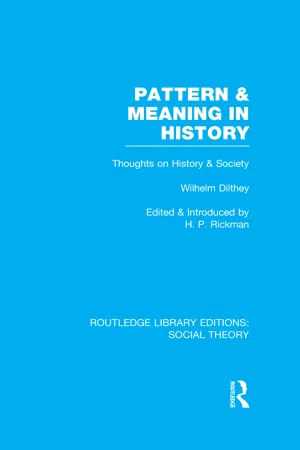
Pattern and Meaning in History (RLE Social Theory)
Wilhelm Dilthey's Thoughts on History and Society
- 168 pages
- English
- ePUB (mobile friendly)
- Available on iOS & Android
eBook - ePub
Pattern and Meaning in History (RLE Social Theory)
Wilhelm Dilthey's Thoughts on History and Society
About this book
Information
GENERAL INTRODUCTION
Dilthey’s thought is very much alive today. In the spheres of history, biography and sociology one frequently comes upon ideas which have their—sometimes unacknowledged—source in his work. In other cases brief references to his importance are coupled with a recognition of the difficulties of presenting his ideas. For instance Mr F. Stern (in his selection of texts about history ‘The Varieties of History’ 1957) pays tribute to Dilthey’s continuing influence. ‘It is only in the last decade or so that the implications of Dilthey’s historical thought have been elaborated and, to some extent, popularized.’ Yet he has to say that some of the greatest historians ‘Burkhardt, Croce, Dilthey and Pieter Geyl for example—had to be omitted because none of their shorter writings embodied the essence of their thought sufficiently to be truly representative. Similarly Professor Hughes (in Consciousness and Society 1959) speaks of Dilthey’s ‘enormous influence’ and claims that ‘the present study itself, in conception and orientation, has its origins in the canons for the philosophical investigation of society which Dilthey originally established’. He must acknowledge too ‘In a study like this it is obviously impossible to present any complete analysis of the work of so versatile and complex a thinker as Dilthey.’
One could certainly continue this list of testimonies to Dilthey’s importance. His sense of the value of individuals and his insight into the wealth and variety of the historical scene can be a source of inspiration to all who are concerned with human affairs. For practising historians his extensive writings retain a special interest as they deal with many of the problems which touch their work, with philology and source criticism, with the use of biographical material, with the interpretation of cultural phenomena and political actions, with the analysis of institutions and organizationsand with the relevance of systematic studies such as economics, psychology or comparative jurisprudence to the reconstruction of historical events. He also discussed—more generally—the nature of historical knowledge, the place of valuations in historical accounts and the way in which the historian can tell a meaningful story.
Dilthey not only deserves justice as one of the great originators of our modern ways of thinking but should also be heard as one who has still a fruitful contribution to make to the current discussions on the nature and methods of history. For this reason I have selected and arranged passages from his maturest writings on this subject to make as continuous a text as possible. To these I have added an introduction which provides a brief account of Dilthey’s life and writings and a sketch of the broad outlines of his theory of history. Technical discussions on Dilthey’s philosophic position—his theory of knowledge for instance—which might be of interest to professional philosophers have been avoided as they would have made the book less accessible to the more general reader.
1. THE IMPORTANCE OF HISTORY
The importance of history and the equal importance of reflecting on its nature, method and influence is obvious and needs little justification. History is one of the forms of disciplined research by means of which the human mind satisfies its curiosity and orientates itself in the world. Its subject matter is the human past and the way the present has come about. The historian, to promote the advance of his discipline, must—like other research workers—take stock of his subject periodically and reflect on the nature and methods of history. He must consider fresh developments of various kinds; the use of new types of evidence—of church registers, court proceedings or state archives—the extension of subject matter, for instance, from diplomatic to social history, and the switch of interest from rulers and warriors to peasants and workers. He has to reflect on the use of techniques made available by the advance of different sciences: chemical tests to establish the genuineness of documents, or statistical methods to present economic trends. Finally, he must weigh the relevance to his research of generalizations which the progress of different disciplines such as psychology, economics, social anthropology and sociology provide. Faced with problems such as these the thoughtful historian is forced to step outside his daily routine to reconsider the nature of his subject and to redefine the scale on which he works and the aims he pursues.
But history is not a specialized subject of interest only to historians. It concerns us all. We look to it for an understanding of the world we live in, for an illumination of human nature unfolding its potentialities in the course of time and even for some hints about the future which may guide our actions. Indeed, throughout the ages human beings have felt that they received from history a revelation of the workings of destiny and its purposes with man. To the interpretation of this revelation they have brought their own points of view. Confident and optimistic spirits to whom, on the whole, life seemed good, saw, in the course of history, the forward march towards a splendid present and an even more splendid future. Saddened and oppressed minds saw only a futile meandering, or even a plunge towards disaster of which they tried to warn their contemporaries. Religious thinkers saw in history, dimly or clearly, the working of God’s purpose, liberals the spread of free institutions. Thus, in their views of history, individuals or whole ages have expressed their own conceptions of life. Because such conceptions govern not only what we select as relevant from the mass of facts, but also what forces we believe determine the course of events, they colour historical presentation. This presentation, in turn, is adduced to justify the original point of view. In short, our ideas of history reflect our philosophic, religious, moral and political attitudes, and, at the same time, reinforce them. Reflection on our idea of history, in consequence, confronts us with our own presuppositions and can lead to understanding of ourselves and the temper of our age. In this lies its importance for all of us and for the historian it is, in addition, an aid to detachment. Every age, therefore, which seeks to understand historical reality and to become alive to its own deeper impulses must examine its attitude to history afresh.
2. DILTHEY: THE MAN AND HIS WORK
How historical understanding—untrammelled by metaphysical dogma and undimmed by prejudice—could be achieved and made to serve clear-eyed comprehension of his own troubled age and how, finally, this insight could free man for creative activity, was W. Dilthey’s lifelong preoccupation. His hard-won conclusions have not, I believe, lost their relevance today.
The outer events of Wilhelm Dilthey’s life were unspectacular and can be stated briefly. Born in the Rhineland in 1833, the son of a protestant clergyman, he was first destined for a theological career. His interest in history and philosophy turned him from this path. He became a philosopher though he retained his love for history throughout his life. In 1867 he was appointed Professor of Philosophy at Basel. From there he moved to Kiel and thereafter to Breslau. In 1882 he was called to Berlin where he remained till his death in 1911.
Greatly loved by his pupils and admired by his contemporaries he made a deep impression on the intellectual climate of his age. Many testimonies to the charm and greatness of his personality can be quoted. The poet, Hugo von Hofmannsthal, for instance, wrote of him in lyrical terms: ‘Wonderful the atmosphere around this old man … spiritual shining autumnal air … the air of Athens, the most delicate, wise and unsentimental air there is … ‘… winged conversation … wise cheerful, sparkling of ageless eyes … impassioned conversation, impassioned listening : joy, impatience, passion in both’ ‘… this is what philosophizing means, this is what it means to live a philosopher’s life’ (Der Tag 1911) Professor Anna Tumarkin writing with the warm affection of a disciple tried to evaluate his significance for his age in an article published shortly after his death in ‘Archly für Philosophie’ (1912) I quote a few lines: ‘Our age having become conscious through historical studies of the relativity of every individual historical formation, needs an orientation which leaves unconfined the manifold of individual forms and the wealth of life which, in its totality, remains for ever incommensurable. This is the deep tendency which today, dominates all metaphysical research, all religious longing, all fluctuations of artistic feeling and all forms of the human studies.
‘Nobody has more deeply experienced this fundamental tendency of our intellectual life in its generality or interpreted it more truly than Dilthey.’
Another pupil, Professor H. Nohl, wrote in his introduction to Volume IV of Dilthey’s collected works: ‘I have watched the growth of this book … and I shall never forget the struggle to the point of exhaustion of the mysterious old man who thought only of his task; nor shall I forget the passionate absorption in the historical world of the mind and all its potentialities which I was privileged to share with him. What Dilthey praised in Hegel—the objective immersion, in complete self forgetfulness, in the subject—was his own essential nature.’
Dilthey applied his passionate, and yet clear-sighted, interest, his capacity for hard work and the power to absorb himself in his material—all the qualities to which his friends testify—to a wide range of subjects. Firstly and above all, he was, of course, a philosopher and all his different preoccupations found their place in the development of a comprehensive philosophic point of view. This point of view he himself described as a philosophy of life because it expressed the conviction that philosophizing must be based on and concerned with the fullness of human life in its social and historical manifestations. He reacted thus against the aridity of philosophies which start from a thinking subject in whose veins no real blood flows and against the narrowness of a positivism which, in deference to the methods of the physical sciences, confines its range to what can be seen and touched. His philosophy, because of its flexible and undogmatic character, can hardly be called a system; yet he brought a distinctive approach to the different traditional spheres of philosophy; the theory of knowledge, moral philosophy, aesthetics and the philosophy of history. In every case he developed his theories—in accordance with his programme of a philosophy of life—in close relation to concrete manifestations of human life and the disciplines concerned with them. Thus he wrote perceptively on music which he loved, produced searching studies of great poets, discussed educational practice and theory at some length and shrewdly criticized the psychology of his day.
His preoccupation with history deserves special consideration. It followed from his conception of the place and importance of historical knowledge that, in addition to pursuing historical research for its own sake, he approached the understanding of almost any problem, any idea, any cultural manifestation, in terms of its historical development and its place in a historical context. Thus, about two thirds of the First Volume of his collected works—his ‘Introduction to the Human Studies’— is occupied with a historical account of the growth of metaphysical thinking from the ancient Greeks onwards and the way in which the human studies are related to this development. Volume II contains an analysis of conceptions of man in the Fifteenth, Sixteenth and Seventeenth centuries in which the ideas of thinkers ranging from Melanchton, Zwingli and Calvin to Giordano Bruno, Spinoza and Hobbes are presented. Volume III is dedicated to studies on the History of the German spirit and deals with Leibniz and his age, with Frederick the Great and the German Enlightenment and with the growth of the historical spirit in the Eighteenth century. Volume IV contains an account of the young Hegel and sketches of the life and work of various German Idealists. In Volume VI aesthetic theories of the Seventeenth, Eighteenth and Nineteenth century are discussed. Volume VIII deals historically with the development of philosophies and world views. Volume IX contains a history of educational ideas from the time of ancient Greece to the Seventeenth century. In Volume XII contributions to the history of Prussia are collected (accounts of Stein, Humbold, Gneisenau, etc., as well as discussions on law reform, the development of the welfare state and the place of the monarchy).
All this historical work, ranging over most of the European past—whether history pure and simple or history subserving the systematic grasp of some problem—is confined to the history of ideas. In this sphere he was an original researcher, using archives and unpublished material and showing great skill in interpreting it.
Thus, his reflections on history sprang from deep personal interest in and first hand knowledge of historical research. I emphasize this point for the historian is justifiably suspicious of a philosopher who has only a nodding acquaintance with history and wants to teach him his job.
The range and originality of Dilthey’s work provided inspiration in many other spheres beside that of history. He made important contributions to literary criticism and suggested new lines for the development of psychology. To discuss these lies outside the scope of this book but a word on the relevance of his thought to the development of sociology may be in place.
To Dilthey sociology meant the kind of work associated with the name of A. Comte and he had no very high opinion of it. He considered specific work in the spheres of economics, comparative religion or comparative jurisprudence much more important. But, if we understand by sociology the systematic study of regularities within society, we can say that Dilthey was almost constantly occupied with it. In that sense sociology is the sister discipline of history. Both deal with the life of humanity, the former attempting generalizations about uniformities, the latter setting out the sequence of unique events. Hence Dilthey developed his methodology of the social sciences side by side with his theories on history. His analysis of understanding, classification of expressions, account of the objectifications of life and description of cultural systems, which are represented in the texts and discussed in the introductions, are all contributions to this methodology.
I will refer briefly to some salient points and students of sociology will be able to recognise their relevance to the subsequent development of the subject.
Firstly, the use of understanding provides the human studies with a method distinct from those of the physical sciences and thus frees them from subservience to the latter. As understanding is not a matter of penetrating intuitively into the minds of others but of realizing what their expressions mean, we are led on to an analysis of the range of expressions and of the way in which we understand them. Words, gestures and actions—which are also expressions because they reveal the agents’ intentions—must each be understood in a different way; they provide the sociologist with different kinds of evidence.
Secondly, the understanding of expressions is based on familiarity with the social and cultural context in which they occur. This context of institutions, traditions, rules and conventions which modern social anthropologists call the ‘culture pattern’ and which Dilthey called ‘the objective mind’ or the ‘objectifications of life’ can and must become the subject of sociological research.
Thirdly, the study of these culture patterns can be made more effective if we distinguish various functional systems such as education or economic production. These systems can be understood in terms of the way they are organized to satisfy the human needs from which they arise.
There has certainly been some acknowledgement of Dilthey’s importance in this sphere. For instance, Professor Talcot Parsons (in The Structure of Social Action) recognizes that the concept of understanding ‘owes more perhaps to Dilthey than to anyone else’. Yet the extent of the debt which such great originators of modern sociology as Max Weber owe to Dilthey has been insufficiently recognized. Historians of the development of sociology frequently complain about the difficulty, obscurity and ambiguity of the concept of ‘understanding’ when a close study of Dilthey would have done much to mimimize these difficulties.
Perhaps it is also worth while to mention the decisive influence which Dilthey’s work exercised on the development of the philosophic movement usually called ‘existentialism’. Heidegger, considered one of the founders of this movement and probably Germany’s most influential modern philosopher, has himself testified to this influence. In Sein und Zeit (p. 366) he wrote, ‘Fundamentally the following analysis of temporality and historicity is solely concerned with preparing the way for the assimilation of the researches of W. Dilthey which the present generation has yet to achieve’.
Nevertheless, a number of factors combined to delay full recognition of Dilthey’s importance. To start with, the sheer bulk of his works is rather forbidding. His collected works comprise twelve large volumes and several other books are not included in that collection. Secondly, his very virtues involved him in serious flaws of composition. Because of the range of his interests most of his works are fragments. His recoil from any form of dogmatism made him avoid any neat rounding off of theories. His sense of the complexity of problems and his great flexibility of mind drove him into ever new attempts to tackle problems from a new angle. Up to the end of his life this candid and subtle thinker continued to rearrange and rewrite his material. In his old age he faced, somewhat unhappily, a growing mountain of manuscripts, some of them dictated to students and never revised, and the final crowning of his life’s work by a systematic presentation of a critique of historical reason eluded him.
Only when scattered reflections and the work of his last years were edited and published posthumously by his disciples and when some of them, above all Professor Misch (in his important introduction to Volume V and in his massive work Lebensphilosophie and Phänomenologie 1931) pointed out and developed some of their implications, did the full importance of Dilthey as an original philosopher emerge. By then his thought was beginning to be overshadowed by the meteoric rise of the more incisive and more melodramatic formulations of Existentialism. Now that the signs are multiplying that this philosophy is past the peak of its popularity German thinkers are returning to Dilthey’s more balanced and less desperate view. At this very moment his collected works, long out of print—are being completed and gradually reprinted.
Dilthey never really made his mark on the English speaking world in spite of the fact that his cast of mind, his liberalism, his empiricism, his suspicion of metaphysics and his own sympathizing with the British empirical tradition as represented, for instance, by J. S. Mill, should make him congenial to Anglo-Saxon readers. The great obstacle was, no doubt, his style and the difficulty of translating it into English. Though he could write pithily and eloquently at times he is more often weighty and involved. The traditional German style of writing philosophy combined with his temperament to produce this result. From the former stems, no doubt, the constant preference for abstract rather than concrete expression, from the latter the tendency to express his sense of the complexity and interrelatedness of things in the very structure of his sentences. In consequence, his main works have never been translated into English and all that is available to English readers is less than fifty pages of selected passages translated by Professor Hodges and included in his Wilhelm Dilthey, an Introduction.
Yet the very nature of his writing makes it impossible to represent his view adequately in brief quotations or by selecting some essays or articles summarizing his theoretical position. He has to be read in bulk and from that reading grows an appreciation of his subtle and elastic approach. Again and again he appe...
Table of contents
- Cover
- Half Title
- Title Page
- Copyright Page
- Original Title Page
- Original Copyright Page
- Acknowledgements
- Table of Contents
- General Introduction
- I The Historical World and the Methods of History
- II The Historical Relevance of Autobiography and Biography
- III Individual Life and its Meaning
- IV The Understanding of Others and the Objective Mind
- V The Historical Approach and the Order of the Human World
- VI Meaning and Historical Relativity
- Index
Trusted by 375,005 students
Access to over 1.5 million titles for a fair monthly price.
Study more efficiently using our study tools.
Frequently asked questions
Yes, you can cancel anytime from the Subscription tab in your account settings on the Perlego website. Your subscription will stay active until the end of your current billing period. Learn how to cancel your subscription
No, books cannot be downloaded as external files, such as PDFs, for use outside of Perlego. However, you can download books within the Perlego app for offline reading on mobile or tablet. Learn how to download books offline
Perlego offers two plans: Essential and Complete
- Essential is ideal for learners and professionals who enjoy exploring a wide range of subjects. Access the Essential Library with 800,000+ trusted titles and best-sellers across business, personal growth, and the humanities. Includes unlimited reading time and Standard Read Aloud voice.
- Complete: Perfect for advanced learners and researchers needing full, unrestricted access. Unlock 1.5M+ books across hundreds of subjects, including academic and specialized titles. The Complete Plan also includes advanced features like Premium Read Aloud and Research Assistant.
We are an online textbook subscription service, where you can get access to an entire online library for less than the price of a single book per month. With over 1.5 million books across 990+ topics, we’ve got you covered! Learn about our mission
Look out for the read-aloud symbol on your next book to see if you can listen to it. The read-aloud tool reads text aloud for you, highlighting the text as it is being read. You can pause it, speed it up and slow it down. Learn more about Read Aloud
Yes! You can use the Perlego app on both iOS and Android devices to read anytime, anywhere — even offline. Perfect for commutes or when you’re on the go.
Please note we cannot support devices running on iOS 13 and Android 7 or earlier. Learn more about using the app
Please note we cannot support devices running on iOS 13 and Android 7 or earlier. Learn more about using the app
Yes, you can access Pattern and Meaning in History (RLE Social Theory) by H.P. Rickman in PDF and/or ePUB format, as well as other popular books in Philosophy & Philosophy History & Theory. We have over 1.5 million books available in our catalogue for you to explore.