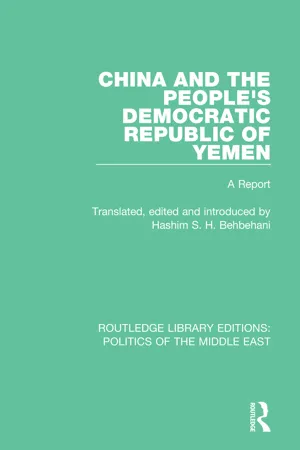
This report, first published in 1985, was compiled by members of the People's Democratic Republic of Yemen (South Yemen) and is an interesting historical document. Because of the PDRY's own political orientation the leadership, when it came to power, sought help, advice and assistance from other Communist governments. Among these was China. By historical coincidence that country at the time of the PDRY's delegation visit was engulfed in what we know as the Cultural Revolution. Very few official foreign delegations were received by the Chinese at the time and so this report becomes doubly interesting as it sheds a fascinating light on the political situation in both countries at that time. More importantly, it represents one of the rare pieces of published material on China and the Arab World
- 72 pages
- English
- ePUB (mobile friendly)
- Available on iOS & Android
eBook - ePub
About this book
Information
From the Minutes of the Meetings of the Delegation of The People’s Republic Of South Yemen in Peking,
September 1968
An official delegation from the People’s Republic of South Yemen visited the People’s Republic of China. Led by Saif al-Dal’ī, the delegation included as members Faysal ’Abd al-latif, ’Alī ’Antar and three others. The visit, which began on 16 September 1968 and lasted until 24 September 1968, was in response to an official invitation sent by the People’s Republic of China to the Arab republic, before a full year had passed since its independence.
The following account comprises the texts recorded by a member of the delegation, Faysal ’Abd al-latif, in his journal, immediately after each meeting of the delegation in Peking and in other parts of China which the delegation visited.
The First Session – 18 September 1968
The first session began on 18 September 1968 and was attended on the Chinese side by the Deputy Foreign Minister, the Deputy Chief of the General Staff, the Deputy Minister of Foreign Trade, the Vice-President of the Committee on Economic Relations with Foreign Nations, the Deputy Head of the Department of External Relations, and the Deputy Head of the Department of Protocol in the Foreign Ministry.
The Yemeni delegation consisted of six members, under the chairmanship of Saif Al-’Dal’ī.
Saif presented the major points which the delegation hoped to discuss, which were:
1. Political, social and economic conditions and problems in Yemen.
2. The National Front and its experience of struggle in the liberation and independence of Yemen.
3. Conditions in the Arab region, and in particular the questions of Yemeni unity and Arab unity.
4. The Palestine issue.
5. The international situation.
6. Familiarization with the Chinese revolutionary experience.
The Deputy Foreign Minister of China then presented the principal topics from the Chinese side, which were:
1. Support for South Yemen.
2. Backing for the Arab states in their war against imperialism and Zionism.
3. The experience of China and the Cultural Revolution.
4. Present-day revisionism.
The Deputy stressed the fact that the views of the People’s Republic of China are its own, which are not binding on anyone else in any way.
The session was terminated because the pre-arranged programme for the visit included a tour of the city – its streets, an inspection of the markets, and some aspects of daily activity in them. During this tour, the Yemeni members came to understand that studies in China had been suspended for a period of two years on account of the Cultural Revolution and its victory.
In the evening, a dinner party was held for the Yemeni delegation. Words of welcome were given by the Deputy Premier and Foreign Minister, Marshal Ch’en Yi. In his speech he attacked contemporary revisionism and pointed to the Palestinian resistance. He spoke of the Russian campaign against China and recalled that, in the days of Stalin, Russia wanted to help China and co-operate with it, but since the Twentieth Congress of the Soviet Communist Party, Khruschev had begun to follow a different policy, aiming to subjugate China to Soviet influence and to prevent it from becoming a major power. So he resorted to withdrawing the Soviet experts who had been working in China and discontinued the Soviet loans which were to be repaid in commodities. A stage of aggravation and harassment began with China’s settlement of these debts. Ch’en Yi related examples of this sort of harassment, such as the problems encountered with oranges, pigs, and so on.
The Second Session – 19 September 1968
Discussion centred on the two agenda proposals, and it was agreed that the following topics be examined and discussed:
1. Diplomatic relations.
2. Financial aid and loans.
3. Projects.
4. Commodity aid.
5. Military aid.
6. Cultural and educational assistance.
7. Technical aid.
Concerning the topic of diplomatic relations and the reason behind the delay in opening an embassy for the People’s Republic of China in Aden, the Chinese Deputy Foreign Minister spoke on the Cultural Revolution and the necessity of re-educating all cadres, including the members of the diplomatic corps, and said that all ambassadors of China were in the country at present in order to participate in the Cultural Revolution. He noted that they numbered forty-one ambassadors, not including the Chinese ambassador to Egypt, Huang Hua. He indicated that the opening of the embassy might be delayed until the start of the new year, but it might be possible to despatch a chargé d’affaires in November or December.
On financial aid and loans, Saif requested the sum of £15,000,000 in order that Yemen might be able to face its numerous problems. Saif enumerated the projects which are under consideration for construction in Yemen, mentioning roads, land reclamation, wells, development of the salt industry, electricity in rural areas, and the building and equipping of schools and hospitals in rural areas.
The Chinese delegation replied that in principle they would accede to the economic requests but that the details would be discussed subsequently.
The second session was thus concluded.
Visit to a Factory – 19 September 1968
In the afternoon the programme included a visit to an underwear factory in Peking.
One of the members of the Chinese delegation expounded the Great Cultural Revolution, saying that it was a great political revolution for the proletariat in its struggle against the bourgeoisie and all of the exploitative classes.
There had been some trouble in January 1967, and disagreements among the revolutionary workers. But Comrade Mao dispatched one of the comrades from the army cadres, confirming that the task of the army is to support the force of the left.
On 26 July 1967 the army had helped the workers to study the Thought of Mao and the necessity of identifying friends and enemies. The army helped the workers of the factory to set in motion a campaign of criticism against Khruschevism. In this manner, the consciousness of the workers was raised.
A revolutionary council for the factory was established on 12 November 1967, after which the workers put into effect the principles of ‘self-reliance’ and ‘putting out optimum effort’ a method adopted by the Party and the people during the Cultural Revolution.
The Cultural Revolution was set in motion in twenty-nine provinces, that is, all provinces with the exception of Taiwan.
Then the Yemeni delegation visited a large room in the factory where the Thought of Mao is studied before and after work. They also paid a visit to the nursery, where the children go to sleep with portraits of Mao above their heads.
The members of the revolutionary council in the factory are proud of the fact that there is not one illiterate worker in their factory, and that the lowest level of workers there have finished elementary education, while others have completed intermediate and secondary education. As regards the political standard (Marxist-Leninist thought), they are more advanced than university students. The council members mentioned also that party members total 15–20 per cent of all the workers in the factory; party membership, however, yields no advantage; rather, all are treated equally. In fact the party member is required to be a living example and a model of perfection among the workers – he is the last to enjoy any privilege and the first to take on duties and face hardships.
They also pointed to the fact that there is very little difference between workers, officials, and cadres, and sometimes the salaries of the workers are the highest. The important element always is the political obligation: raising the red flags, knowing the Thought of Mao and following and implementing his teachings. They also confirmed that all of the workers have received military training.
Then one of the members of the revolutionary council in the factory spoke on Khruschevism and the danger it poses to the revolution. He stressed that those who follow Khruschev are the class enemies of the revolution.
Special Session – 19 September 1968
In the evening a special session was held which was attended on the Chinese side by the Deputy Premier and Foreign Minister Ch’en Yi, and the Deputy Foreign Minister, and on the Yemeni side by Saif al-Dal’ī, Faysal ’Abd al-latif, and ’Ali ‘Antar.
Faysal explained South Yemen’s experience of struggle. He spoke about his country’s poverty and the abominable exploitation practised by British imperialism for 129 years, and the reactionary classes such as the sultans and feudal lords.
Faysal spoke of the lack of accurate statistics in Yemen. The extent of cultivated land is estimated at 220,000 feddans, and there are about 700,000 to 1,000,000 feddans of reclaimable land. Feudalism, as exemplified by the ruling families, owns nearly 70–80 per cent of the cultivated land.
Faysal spoke about the working class, saying that its circumstances most nearly approximate to those of a lumpenproletariat due to the dependency economy. In Aden there is a petrol refinery which employs 2,000 workers from a total of about 80,975 workers, according to the 1965 figures. Unemployment figures now reach 25,000 workers; this is attributable to the closure of the Suez Canal, since the harbour of Aden had been very active and an important staging-post. Likewise the British military bases employed a larger number of workers whose work was terminated with the evacuation of the colonialists from South Yemen. In addition to this, the country’s economy is characterized by being a service economy, which accounts for approximately 80 per cent of the economic activity. The budget reaches £33,000,000 while the income totals £8,000,000; because of this underdeveloped economy, the class situation is not completely crystallized, although, to be sure, this does not mean an absence of class contradictions.
Feudalism exists, as exemplified by the ruling families, by the foreign bourgeoisie, and by the bourgeoisie linked to the foreigners, which represents a small segment; there is also the petty bourgeoisie of peasant origin. Confronting these are the working class (especially in the services sector), which is an unstable group influenced by the bedouin spirit; the class of peasants, which is the largest class of the community, covering most of the rural areas in Yemen and influenced by the tribal spirit; and finally, the herdsmen, whose community is pastoral and governed by a backward tribal system. The bedouin way of life has a clear influence on the petty bourgeoisie, worker, and peasant classes.
Then Faysal shifted to discussion of the National Front, which represents an alliance between the peasants, workers, and petty bourgeoisie. In fact, the National Front is not a front composed of sundry organizations, but is rather an arrangement which is held together by a unity of political, combative, and organizational positions. Its interests are brought together in the Charter.
There are nascent popular institutions for the workers, students, and women, and a federation of popular organizations; moreover, there is a move which is crystallizing into a federation for the peasants.
Faysal then spoke on the tasks of this stage, which is one of national democratic liberation, aiming at safeguarding and consolidating national independence by fighting imperialism and colonialism, and by rooting out feudalism. He said that the National Front intends to follow the path of scientific socialism, and for this reason the cadres of the Front devote earnest study to Marxist-Leninist thought and the writings of Mao Tse-Tung. They also aspire to learn from the revolutionary experiences of other peoples and from their accumulated knowledge – especially from the Chinese revolution, which was able to liberate hundreds of millions of human beings, as well as destroying colonialism and the large reactionary forces which it had encountered over the harsh and bitter decades, ending with a crushing victory for this great revolution over its enemies.
Then Faysal spoke about conditions in the Arab region and described the defeat of June 1967 and Israel’s occupation of the territory of three Arab states with the full co-operation of American imperialism. He stated the dangers which Israel represents to the Arab future and the struggle of the Arab people for liberation and progress. He stressed the importance of Yemeni unity and likewise the need for Arab unity, confirming that unity is one of the goals of the contemporary Arab struggle.
Faysal then addressed the Palestine problem and commended the position of the People’s Republic of China and its principled stand in backing the struggle of the Palestinian people. He noted the necessity of supporting this struggle in a broader and more comprehensive way and spoke about the Popular Front for the Liberation of Palestine, its progressive line of thought, and the obligation to aid and support it in view of the fact that it is a progressive revolutionary fighting force, for it has a well developed Marxist-Leninist orientation.
After Faysal had reviewed the international situation and, in particular, the conspiracies hatched by the forces of imperialism against the Arab revolution, he asked that the Chinese speak on their revolutionary experience, since it is a rich human treasure for the advancement of mankind and the liberation of the nations of the world.
Ch’en Yi spoke very briefly on the importance of the issue of national liberation and the liberation of the economy. He also explained the dimensions of the Cultural Revolution, and promised to discuss in detail the issues of national democratic liberation in the next session. With great modesty, he said, ‘We are eager to learn from the experiences of other peoples and we have benefited from the exposition presented by the Yemeni delegation concerning the revolutionary experience of Yemen. We say this to you in sincerity and not as flattery: for we really have benefited from your experience.’ The Yemeni delegation then reiterated its request to visit Comrade Mao, and Ch’en Yi promised that the request would be granted, although, in the event, no such visit took place. In addition, the military and economic committees were meeting to study the details of the requests of the Yemeni delegation.
Visit to one of the Army Units – 20 September 1968
The Yemeni delegation (Saif, Faysal, and ‘Antar) made a visit, in company with the Vice-Premier and Deputy Foreign Minister, to one of the army units.
On the way to visit Military Unit No. 191, Faysal asked Marshal Ch’en Yi, Deputy Premier and Foreign Minister, why China persists in declaring that it receives official delegations which are not official and popular ones?
The Marshal replied: This is in your interest, in the service of your struggle – this is the reality and the truth.’ He went on to say: What the Arab peoples are facing is the war against imperialism and colonialism and the extermination of feudalism, not the building of socialism. You do not fight capitalism directly. We are pleased that you want to carry out a national democratic revolution, and that you want to follow the line of scientific socialism. We are also delighted that you have a great respect for Chairman Mao and that you intend to study his writings and thoughts. For if you studied these writings, you would find that you are passing through the stage of national democracy; if you were to bypass it, wanting to leap over it, you would fall and lose your footing. Marxist-Leninist theory posits stages of historical development – feudalism, then capitalism, then the end of capitalism and the transition to socialist society. There is no alternative to passing through these stages. Concerning feudalism in your country, there are the sultans and princes by whom the peasants are exploited. And from your words it is clear that you have a serious task before you in combating feudalism, for to this day you have not yet liberated the peasantry.
And it is not your country alone over which feudalism has dominion, for you are aware that you have strong neighbours who practice feudalism of the worst kind. Surrounding you is the Kingdom of Saudi Arabia, where the people are subject to a reactionary feudalist system about which you know much. Indeed, you know better than we about the intentions it harbours towards you. This system is not only feudalist; in addi...
Table of contents
- Cover
- Half Title
- Title Page
- Copyright Page
- Original Title Page
- Original Copyright Page
- Table of Contents
- Dedication
- Introduction
- From the Minutes of the Meetings of the Delegation of the People’s Republic of South Yemen in Peking, September 1968
Trusted by 375,005 students
Access to over 1.5 million titles for a fair monthly price.
Study more efficiently using our study tools.
Frequently asked questions
Yes, you can cancel anytime from the Subscription tab in your account settings on the Perlego website. Your subscription will stay active until the end of your current billing period. Learn how to cancel your subscription
No, books cannot be downloaded as external files, such as PDFs, for use outside of Perlego. However, you can download books within the Perlego app for offline reading on mobile or tablet. Learn how to download books offline
Perlego offers two plans: Essential and Complete
- Essential is ideal for learners and professionals who enjoy exploring a wide range of subjects. Access the Essential Library with 800,000+ trusted titles and best-sellers across business, personal growth, and the humanities. Includes unlimited reading time and Standard Read Aloud voice.
- Complete: Perfect for advanced learners and researchers needing full, unrestricted access. Unlock 1.5M+ books across hundreds of subjects, including academic and specialized titles. The Complete Plan also includes advanced features like Premium Read Aloud and Research Assistant.
We are an online textbook subscription service, where you can get access to an entire online library for less than the price of a single book per month. With over 1.5 million books across 990+ topics, we’ve got you covered! Learn about our mission
Look out for the read-aloud symbol on your next book to see if you can listen to it. The read-aloud tool reads text aloud for you, highlighting the text as it is being read. You can pause it, speed it up and slow it down. Learn more about Read Aloud
Yes! You can use the Perlego app on both iOS and Android devices to read anytime, anywhere — even offline. Perfect for commutes or when you’re on the go.
Please note we cannot support devices running on iOS 13 and Android 7 or earlier. Learn more about using the app
Please note we cannot support devices running on iOS 13 and Android 7 or earlier. Learn more about using the app
Yes, you can access China and the People's Democratic Republic of Yemen by Hashim S.H. Behbehani in PDF and/or ePUB format, as well as other popular books in Storia & Storia cinese. We have over 1.5 million books available in our catalogue for you to explore.