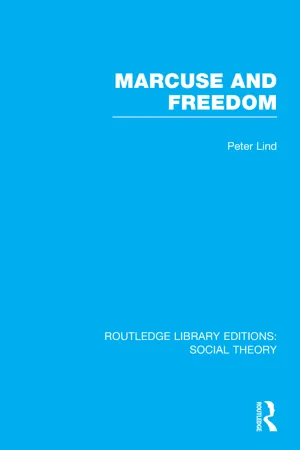
This comprehensive study of Marcuse's thought concentrates on his theory of freedom, arguing that it is this which supplies the key to all his writings. This argument is substantiated by a detailed chronological examination of Marcuse's works. The author shows the rigorous logic underlying Marcuse's thinking, which is often obscured in Marcuse's own presentation, and pays particular attention to the influence of Heidegger, and of Marx's notion of human labour. This sympathetic reconstruction of the subject attempts to rescue Marcuse from misunderstanding and superficial criticism, and argues that Marcuse's most famous work, One Dimensional Man, is in fact an aberration from the mainstream of his work. This book forms one of the most accessible and reliable treatments of Marcuse available.
- 318 pages
- English
- ePUB (mobile friendly)
- Available on iOS & Android
eBook - ePub
Marcuse and Freedom (RLE Social Theory)
Chapter One
INTRODUCTION
1.1 The Question of Freedom
Freedom - personal, political, religious or economic - is a pervasive ideal in our societies. It is best comprehended as a series of questions almost without answers. What should we understand by freedom? How important is this ideal for our daily lives? What role should it play in the establishment or improvement of the social institutions structuring our existence? How can freedoms of all kinds be promoted? That freedom is unquestionably good and valuable is the most fundamental tenet of the wider liberal ethic which has progressively emerged during the last four or five centuries. This took place in the context of the complex economic, social and political transformations that marked the end of feudalism in Europe, and to these processes liberalism itself, as a political doctrine, was to contribute (1). The range of questions and ideals evoked by the notion of freedom is what constitutes - in an often confused, vague and yet very real sense - the most distinctive trademark of Western political and social institutions, and more clearly still, that of Western philosophy and culture.
The following considerations should help to clarify the context for the present work. These considerations are banal enough. It seems intuitively fair to say that the present age has seen a hitherto unprecedented increase in freedom for many people, be it in terms of their spare time, their ability to travel, or in relation to the sort of job and existence they and their children can aspire to. Yet at the same time there are too many disquieting signs that not all these achievements have genuinely promoted freedom. The imperative of the work place, the demands in time and energy of the once cosy middle class career have increased considerably, and the impenetrability of complex economic and social systems seems greater than ever. This is perhaps more true of politics than in any other sphere of life, where we see many traditional liberties eroded, not so much by the perversity of man or the cunning of the political rulers as by what, by all accounts, appears as the force of events. There no longer seems to be clear-cut and certain answers for either the larger options or for detailed, technical and yet important policy issues such as pollution or local government. This appears to be true at all levels, and in such a context, it can be difficult to see how the traditional ideals of democracy, parliamentarism and individual rights can be retained as valid, possible, or useful. The end of ideology has not yet arrived, but many signs suggest that the ideal of freedom based on the rational and conscious choice of man the elector-citizen is perhaps obsolete, if it ever was a solution (2).
The question of freedom occupies a singular place within the literature of political theory (3). It is often treated as a technical problem, requiring either conceptual clarification (4) or some futher reflection on the place of democracy or elections in liberal capitalist countries or elsewhere (5). Yet freedom is not a technical term alone, and cannot be treated as such. Any such attempt (6) will be up against the manifold and powerful connotations which we associate with the term, however much we may want to ignore them for the purpose of peaceful research (7).
The question of freedom, however intractable, is central to political theory, and appears there mostly under three headings. One is the question of individual rights, including the whole series of difficulties such ideals may generate theoretically, conceptually and practically (8). Secondly there is the question of democracy, which shapes our entire attitude toward our own institutions as well as those of other political systems (9). The third, less easily identifiable and no less difficult, is the matter of the degree of individual liberty provided by the various political and social institutions. The answers to such questions, of which Berlin’s celebrated 1958 essay on “Two Concepts of Liberty” is undoubtedly the most impressive, even today, if less for its substance than for its almost uncanny persuasiveness, are ones which necessarily cut accross many disciplines; yet without such answers, however provisional, there can be no discussion of the good society (10). Not to take account of such ideas, the debates they may engender, and the divisions they may reveal, can surely only mean that politics can only be a matter for technical answers and/or for the wheelings and dealings of The importance of the question of freedom for other areas of social research should need no emphasis. The concept of freedom is a most useful focal point for quite diverse enquiries in philosophy, sociology, history and political science (11). It thus allows for fruitful interdisciplinary encounters and limited comparative exercises. It cuts across many traditional boundaries with puzzling, yet stimulating consequences. If anything, it forces upon the searcher a sense of the comprehensive nature of many social problems and circumstances. The price for this highly integrative capacity is, not unexpectedly a high degree of complexity and indeterminacy. This indeterminacy and ambiguity has three main causes, all consequences of the comprehensiveness of the concept itself. The most obvious of these is the variety of linguistic and political connotations that the term has acquired in daily and theoretical discourse. As soon as we leave the terrain of evocative generalities, the usage of term can be shown to be highly problematical - simple reflection shows that even expressions such as “free economy” or “free elections” are riddled with problems (12). A second important cause for this equivocal character of most statements about freedom in general comes from the range of problems, in relation to day to day situations or in terms of distinctive philosophical/scientific puzzles and approaches thereto, that the term can be taken to encompass. It is possible to speak of freedom in relation to education (13), when buying a beer (14), or with respect to the range of options open to individuals within a society (15). The third important cause for this almost constitutional ambiguity leads us to the host of problems raised by the largely undoubted, if restricted human capacity for free will and self-direction, and its potential consequences for both individual and human history (16).
The importance of Marcuse’s work in this context is that it deals, at least implicitly, with all these aspects of freedom, and moreover, does so from an explicit marxist standpoint. The latter point is essential. There are surprisingly few marxist works dealing directly with the question of freedom, Garaudy’s La Liberté and Raya Dunayevskaya’s Marxism and Freedom being the only two obvious exceptions (17). Most other marxist works with a bearing on the question will focus on the problem of alienation, with a few to either elucidate what Marx may well have meant by that phrase (18), or aim at broadening Marx’s intent to include every human aspiration under the sun (19). Alternatively, we are stuck with such much used phrases as Hegel’s “freedom is necessity”, which, for all the philosophical impetus it may have given to generations of marxist scholars, still seems unhelpful in the context of a wider liberal tradition (20). There is of course the work of Sartre or Merleau-Ponty, which, for all their ingenuity, seem to my mind so remote from the marxist tradition as to lose any element of representativeness in the present context: This is especially true of Sartre’s major work, Being and Nothingness which contains much good material on the question of freedom and has virtually no relation whatsoever with the marxism he displays in his other writings (21).
Marcuse is one of the very few marxist thinkers who explicitly addresses himself to the question of freedom. Furthermore he does so in the context of a vigorous critique of contemporary civilization, a critique informed by Kant, Hegel, Marx and Freud. Against the overwhelming liberal bent of much of the literature on freedom, liberal here in the dual sense of a specific political and philosophical tradition, Marcuse opposes his own views on freedom, views which are highly critical, if not unreservedly so, of the complacency displayed by much of that literature (22). Against the predominant view of liberty as purely an individual matter, Marcuse opposes an ideal of community and the reality of profoundly collective human institutions. Against the belief in piecemeal social engineering, gradual changes and the priority of technical solutions, Marcuse advances a view of the good society as an integral whole, advocates the necessity of revolution and constantly stresses human will and human reason as the lasting guarantees for a free society. He attacks the romantic yearning for a better past as well as the unquestioning acceptance of the ethos of linear progress, challenges accepted views on the nature of man, the role of art and of the constitution of society. He suggests that there may be a freedom that is at once material and spiritual, individual and communitarian, spontaneous and rational. That such a freedom exists echoes throughout most of his work. That we may judge present freedoms with respect to this more inclusive conception is perhaps nowhere more clearly stated than in One Dimensional Man, his most famous work.
The following passage from that work is particularly suggestive. The contrast between “Freedom” and freedoms is forcefully drawn, and the provocative underlying thesis is that of a “benevolent totalitarianism” where existing freedoms in contemporary “advanced industrial societies” contribute to a general and much more fundamental lack of freedom:
“Under the rule of a repressive whole, liberty can be made into a powerful instrument of domination. The range of choice to the individual is not the decisive influence in determining the degree of human freedom, but what can be chosen and what is chosen by the individual. The criterion for choice can never be an absolute one, but neither is it entirely relative. Free election of masters does not abolish the masters or the slaves. Free choice among a wide variety of goods and services does not signify freedom if these goods and services sustain social controls over a life of toil and fear - that is, if they sustain alienation. And the spontaneous reproduction of superimposed needs by the individual does not establish autonomy; it only testifies to the efficacy of the controls” (23).
This passage, along with the various arguments interwoven into its central thesis, would appear to justify classifying Marcuse’s work as an important contribution to literature on freedom from the marxist (24) tradition, or from the more recent body of “Western Marxism” (25). Yet it would be futile to look further into One Dimensional Man for a better structured theory or more detailed considerations. There are a number of similar passages which suggest that such a structured conception of freedom may exist, or that some such theory may be found in Marx, or in some combination of Marx with Freud, or Hegel, or even Fourier, but that is all. Their is very little on Marx in that work and there is nothing more elaborate on freedom than obscure references or vague, if evocative, statements.
Yet there is a theory of freedom in Marcuse, and it is both detailed and fairly well structured, and it rests very firmly on a distinctively marxist reading of contemporary realities. It is not to be found in One Dimensional Man, which is most certainly-Marcuse’s worst book and in many ways quite unrepresentative of his other writings. It marks the high point of a period where Marcuse was furthest away from his basic marxist orientation (I shall return to this point) and it is the only major work of Marcuse not guided and informed by his wider understanding of what constitutes human freedom. Such an idea is present elsewhere in Marcuse, and i...
Table of contents
- Cover
- Half Title
- Title Page
- Copyright Page
- Original Title Page
- Original Copyright Page
- Table of Contents
- List of Tables
- Preface
- Acknowledgements
- 1. Introduction
- 2. Marx, Marxism And Heidegger. Marcuse’S First Theory of Human Liberation
- 3. The Second Encounter with Marx: Marcuse’S New Theory of Human Liberation
- 4. The Co-Operative Society
- 5. The Idea of the Co-Operative Society in the Thirties and Forties
- 6. The Idea of the Co-Operative Society in the Late American Period
- 7. Freedom and the Dialectic of Liberation
- 8. Freedom and Contemporary Civilisation
- 9. Conclusions
- Bibliography of Works by Marcuse
- Index
Trusted by 375,005 students
Access to over 1.5 million titles for a fair monthly price.
Study more efficiently using our study tools.
Frequently asked questions
Yes, you can cancel anytime from the Subscription tab in your account settings on the Perlego website. Your subscription will stay active until the end of your current billing period. Learn how to cancel your subscription
No, books cannot be downloaded as external files, such as PDFs, for use outside of Perlego. However, you can download books within the Perlego app for offline reading on mobile or tablet. Learn how to download books offline
Perlego offers two plans: Essential and Complete
- Essential is ideal for learners and professionals who enjoy exploring a wide range of subjects. Access the Essential Library with 800,000+ trusted titles and best-sellers across business, personal growth, and the humanities. Includes unlimited reading time and Standard Read Aloud voice.
- Complete: Perfect for advanced learners and researchers needing full, unrestricted access. Unlock 1.5M+ books across hundreds of subjects, including academic and specialized titles. The Complete Plan also includes advanced features like Premium Read Aloud and Research Assistant.
We are an online textbook subscription service, where you can get access to an entire online library for less than the price of a single book per month. With over 1.5 million books across 990+ topics, we’ve got you covered! Learn about our mission
Look out for the read-aloud symbol on your next book to see if you can listen to it. The read-aloud tool reads text aloud for you, highlighting the text as it is being read. You can pause it, speed it up and slow it down. Learn more about Read Aloud
Yes! You can use the Perlego app on both iOS and Android devices to read anytime, anywhere — even offline. Perfect for commutes or when you’re on the go.
Please note we cannot support devices running on iOS 13 and Android 7 or earlier. Learn more about using the app
Please note we cannot support devices running on iOS 13 and Android 7 or earlier. Learn more about using the app
Yes, you can access Marcuse and Freedom (RLE Social Theory) by Peter Lind in PDF and/or ePUB format, as well as other popular books in History & 20th Century History. We have over 1.5 million books available in our catalogue for you to explore.