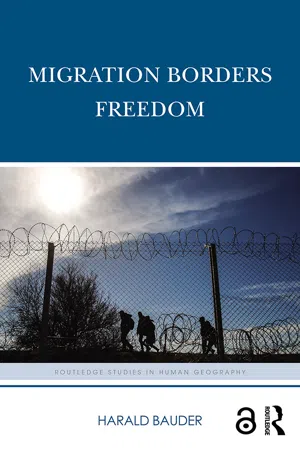
International borders have become deadly barriers of a proportion rivaled only by war or natural disaster. Yet despite the damage created by borders, most people can't – or don't want to – imagine a world without them. What alternatives do we have to prevent the deadly results of contemporary borders?
In today's world, national citizenship determines a person's ability to migrate across borders. Migration Borders Freedom questions that premise. Recognizing the magnitude of deaths occurring at contemporary borders worldwide, the book problematizes the concept of the border and develops arguments for open borders and a world without borders. It explores alternative possibilities, ranging from the practical to the utopian, that link migration with ideas of community, citizenship, and belonging. The author calls into question the conventional political imagination that assumes migration and citizenship to be responsibilities of nation states, rather than cities. While the book draws on the theoretical work of thinkers such as Ernst Bloch, David Harvey, and Henry Lefebvre, it also presents international empirical examples of policies and practices on migration and claims of belonging. In this way, the book equips the reader with the practical and conceptual tools for political action, activist practice, and scholarly engagement to achieve greater justice for people who are on the move.
The Open Access version of this book, available at https://www.taylorfrancis.com/books/9781315638300 has been made available under a Creative Commons Attribution-Non Commercial-No Derivatives 4.0 license.
What we seek is freedom. Freedom to move, return, and stay
Syed Khalid Hussan (2013, 280)
A drowned two-year-old boy became the first known migrant casualty of the year on Saturday after the crowded dinghy he was travelling in slammed into rocks off Greece’s Agathonisi island.
This is how the consortium the “Migrants’ Files” recorded the tragic and unnecessary death of a toddler on January 2, 2016. The consortium, created by journalists from over 15 countries in Europe, aims to provide reliable and comprehensive data about the men, women, and children who have perished during their attempt to reach Europe. It does more than count the dead: it gives the migrants a human face by recording their names, age, gender, and the exact location where they died or went missing (Migrants’ Files 2016).
A small sample of the entries recorded on the consortium’s website paints a grim picture. On December 24, 2015, while the Christian world prepared to celebrate the birth of its savior, “at least 18 migrants drowned when their overcrowded boat sank in the Aegean Sea, the Turkish coastguard recovered the bodies including several children from the sea, and were hunting for another two who were missing.” On August 27, 2015: “Up to 200 bodies have been discovered floating off the coast of Libya.” Earlier in the year “about 400 migrants are feared died in an attempt to reach Italy from Libya when their boat capsized, survivors said” (April 13, 2015). “An overcrowded boat broke apart shortly after leaving Tripoli en route to Italy,” resulting in 600 missing people who likely drowned (May 8, 2011). The list goes on and on. It includes not only drownings, but also fatalities among stowaways in trucks, deaths by starvation and exhaustion, migrants shot to death by border guards, desperate suicides, and other causes of death. A map of the 196 recorded incidents in 2015, resulting in 1,472 deaths and 2,130 persons missing, shows that attempts to enter Europe by sea claimed the most human lives (Figure 1.1). Most fatalities occurred in the Aegean Sea as migrants tried to reach Greece from Turkey, and off the coast of Libya as they attempted to reach Italian shores. Border-related deaths also occurred after migrants had crossed the physical border, such as in Austria, where 71 migrants were found dead in the back of a truck in August of 2015. Altogether, the database contained 3,049 entries in early January 2016, with an estimated 31,811 men, women, and children dead or missing since 2000. The numbers are staggering. The disheartening truth, however, is that the actual numbers are even higher. Despite the journalists’ valiant efforts to record carefully every fatality, many deaths occur that nobody sees or documents.
Figure1.1 Missing and dead migrants en route to Europe, 2015
Source: Migrants’ Files; map by Birgitt Gaida
In Australia, researchers at Monash University have created a similar database. The Australian Border Deaths Database records the known deaths resulting from Australia’s border practices. It contains entries such as the drowning of 58 persons on April 11, 2013, including “Rehmatullah Muhammad Kan, male; Mahidi Fidayee, 16 years, male; Abdul Aziz, 63 years, male; Ibar Hussain Rajabi, 17 years, male; the rest unknown, all Afghan.” Their boat was “lost at sea in Sundra Strait off Indonesian coast carrying 72 asylum seekers bound for Australia. 14 survivors found, 5 confirmed deaths, 53 missing presumed drowned.” Another incident was the loss of 353 persons on October 19, 2001 – 146 children, 142 women, 65 men from Iraq and Afghanistan – who “drowned after [their] refugee vessel codenamed ‘SIEV X’ sank off Indonesia, but in Australian aerial border protection surveillance zone.” Altogether, the database recorded 1,947 deaths between early 2000 and January 2016 (Border Crossing Observatory 2016). As in the case of the European statistics, the actual number is likely much higher (Pickering and Cochrane 2012).
Meanwhile, in the USA, forensic anthropologist Lori Baker is running a lab at Baylor University in Texas, where she and a team of scientists and students extract and analyze the DNA from the remains of migrants who died trying to cross the border from Mexico into the USA. Baker told the Los Angeles Times about her first case: in 2003 she examined the bones of a woman found in 2003 in Pima County, Arizona. A voter registration card found nearby provided clues about the identity of the deceased migrant, and Baker’s analysis revealed that the DNA and the name on the card matched.
Rosa Cano Dominguez, 32, was a mother of two from the Yucatan region who had been traveling to work in the Pacific Northwest when she sprained her ankle. She was abandoned by smugglers.
(Hennessy-Fiske 2013)
The scientist and the migrant had a lot in common. Both were pregnant, working mothers in their 30s, and both were from families with low socioeconomic status. “I cried and cried over that case,” Baker told the Los Angeles Times reporter, revealing the emotions she experienced when she discovered who the deceased person actually was.
Deaths at the border occur not only at the perimeter of rich countries in the Global North. In 2015, the global media reported about thousands of Rohingya people who were rescued at sea by Southeast Asian fishermen after fleeing Myanmar, where they have been denied citizenship and faced various forms of abuse. Since legal ways to migrate were unavailable and neighboring countries said they would not take them, the Rohingya were forced to rely on unscrupulous smuggler syndicates. These smugglers then abandoned the refugees at sea, often leaving them without water or food (NPR 2015). If they succeeded in bringing the refugees to their agreed-upon destination, they often held them to ransom in jungle camps to extract additional funds from them or their families. The media reported about mass graves littering the border between Thailand and Malaysia, containing the bodies of Rohingya who did not survive the brutal conditions in the camps or who were killed outright (Davis and Cronau 2015; Beech and Kelian 2015).
International borders have become deadly barriers that are on a par with war, genocide, and major epidemics and natural disasters in the number of fatalities they produce (Brian and Laczko 2014). Although border deaths are not a recent phenomenon, the horrific death counts of migrants in the Mediterranean Sea, in the waters between South East Asia and Australia, along the US–Mexico border, and in the waters of Southeast Asia illustrate the catastrophic dimensions this phenomenon has now assumed.
Migration scholars are increasingly speaking of “border regimes” to capture the complex and ever changing practices that govern migration (Tsianos and Karakayali 2010). These regimes do not neatly distinguish between the migrant-as-victim and the state seeking to constrain mobility. Rather, they focus on the interplay between governments and administrations, civic institutions, other actors using various technologies of surveillance and mechanisms of control, and migrants’ efforts and motivations to circumvent these technologies and mechanisms. These regimes have assumed a new quality that explains a large portion of the increase of migrant deaths in recent years.
These deaths are not primarily a problem of smuggling, as the mainstream politicians and media would like us to believe. Certainly, there are smugglers without scruples who care little about migrants’ lives and use the migrants’ vulnerable situation to extort as much money from them as possible. These smugglers are monsters. Without closed borders, however, these smugglers would not have any desperate “customers” to prey upon.
People have always migrated to escape war and hunger, to be with loved ones, or to seek out greener pastures. Today, however, advancements in transportation have made travel faster and cheaper, and communication technologies have made it possible to connect with family and friends independent of physical distance. As a result, the mobility of the global population has increased in volume and migration flows have diversified. At the same time, political developments have fostered global migration. With the downfall of the Iron Curtain, for example, migration has become possible for significant numbers of people in Asia and Europe; and the political turbulences following the Arab Spring displaced millions of people and forced them to cross borders to seek refuge. Meanwhile, a parallel development is the increasing integration of national economies and a corresponding growing political interdependency of countries.
The growing global political and economic integration prompted globalization scholars and corporate strategists to predict that borders would become irrelevant (e.g. Ohmae 1991, 1995). From today’s vantage point, these predictions were wrong. Rather than vanishing, borders continue to be highly relevant. Faster and cheaper transportation does little good when entry to safer destinations in Europe, Australia, the USA, and other countries is off limits. In fact, many people are completely immobilized when they are detained in their attempts to cross these borders. In the context of migration, borders and their regimes are not disappearing but are becoming stronger and increasingly deadly.
Interestingly, the enduring relevance of borders has gone hand in hand with the ongoing transformation of economic and political relationships between nation states. Europe exemplifies how these relationships are in constant flux: the European nation states that belong to the Schengen Area may have opened their borders to each other’s citizens, but, at the same time, they militarized the border at the perimeter of the Schengen Area. In 2015, some nation states, such as Austria, Germany, and Sweden, temporarily re-established controls at their borders in an effort to regulate the migration of refugees. The continual changes in policies and practices related to migration give me hope that the hardening of borders for a large part of the world’s population is not an unstoppable trend that will end only when borders are completely sealed. Rather, governments and other actors involved in regulating migration may come to their senses and realize that it is impossible to completely seal borders; they may seek alternative solutions by reducing the barriers to migration for everyone and, at one point, eliminate them altogether.
In the long run, political and economic structures are likely to continue breaking away from the national scale. Although the national imagination is still a powerful force – for example, to mobilize national electorates, as can be seen by the recent rise of nationalist anti-immigrant political parties and party programs throughout the Global North – it may eventually be replaced by new geopolitical imaginaries. Sociologist Saskia Sassen (2008, 147) sees “globalization and electronic networks” as such new imaginaries that will sooner or later transform politics and rearrange political systems as we know them today. If indeed this trend continues, the long-term scenario in which borders are irrelevant may be possible after all. People may then be free to migrate.
Currently, however, migration is still controlled and negotiated at international borders and by national citizenship, which most people receive at birth. In fact, free cross-border mobility would do little to improve the situation of migrants if they continue to be put in danger due to lack of citizenship. To address the root problem of closed borders and exclusion, we need to ask ourselves some tough questions. Should migration be unconstrained by international borders? How can such firmly established political practices and principles regarding national boundaries change? What kind of political imaginations would be required for a world in which all people possess the freedom of migration? Migration Borders Freedom seeks to answer these questions.
Freedom, Borders, Migration
Modern society cannot be imagined without the concept of freedom. It was central to the philosophies of enlightenment thinkers, such as Immanuel Kant and Georg W. F. Hegel, as well as John Locke and Adam Smith. Their ideas shaped not only the field of philosophy but also the political and economic systems that organize almost every aspect of our lives today. Nevertheless, there is no universally accepted definition of freedom. Instead, this concept has been interpreted in various ways.
One interpretation of the concept of freedom relates to the autonomy of individuals to reason and decide. This autonomy includes the freedom to decide on religious matters, freedom of speech, the freedom to negotiate and sign a contract, to buy, sell, and own property, and the freedom from being told by others what to do and how to live. This liberal interpretation of freedom relates to the concept of equality: every person should equally be able to enjoy freedom, and no person or group should possess an asymmetrical ability or right to interfere with another person’s freedom. Individual freedoms have also provided the philosophical basis for a set of laissez-faire economic and political practices commonly known as neoli...
Table of contents
Cover Page
Half Title Page
Series Page
Title Page
Copyright Page
Dedication
Table of Contents
List of figures
Preface
Acknowledgments
1 Introduction
PART I: Diagnosis
PART II: Solutions
Index
Trusted by 375,005 students
Access to over 1.5 million titles for a fair monthly price.
Study more efficiently using our study tools.
Frequently asked questions
Yes, you can cancel anytime from the Subscription tab in your account settings on the Perlego website. Your subscription will stay active until the end of your current billing period. Learn how to cancel your subscription
No, books cannot be downloaded as external files, such as PDFs, for use outside of Perlego. However, you can download books within the Perlego app for offline reading on mobile or tablet. Learn how to download books offline
Perlego offers two plans: Essential and Complete
Essential is ideal for learners and professionals who enjoy exploring a wide range of subjects. Access the Essential Library with 800,000+ trusted titles and best-sellers across business, personal growth, and the humanities. Includes unlimited reading time and Standard Read Aloud voice.
Complete: Perfect for advanced learners and researchers needing full, unrestricted access. Unlock 1.5M+ books across hundreds of subjects, including academic and specialized titles. The Complete Plan also includes advanced features like Premium Read Aloud and Research Assistant.
Both plans are available with monthly, semester, or annual billing cycles.
We are an online textbook subscription service, where you can get access to an entire online library for less than the price of a single book per month. With over 1.5 million books across 990+ topics, we’ve got you covered! Learn about our mission
Look out for the read-aloud symbol on your next book to see if you can listen to it. The read-aloud tool reads text aloud for you, highlighting the text as it is being read. You can pause it, speed it up and slow it down. Learn more about Read Aloud
Yes! You can use the Perlego app on both iOS and Android devices to read anytime, anywhere — even offline. Perfect for commutes or when you’re on the go. Please note we cannot support devices running on iOS 13 and Android 7 or earlier. Learn more about using the app
Yes, you can access Migration Borders Freedom by Harald Bauder in PDF and/or ePUB format, as well as other popular books in Physical Sciences & Geography. We have over 1.5 million books available in our catalogue for you to explore.