- 270 pages
- English
- ePUB (mobile friendly)
- Available on iOS & Android
eBook - ePub
About this book
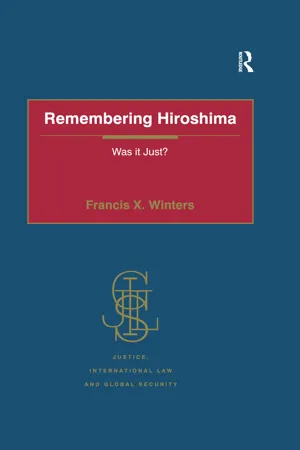
Taking the example of the nuclear bombing of Hiroshima as a case in point, Francis Winters analyzes the ethics of warfare, demonstrating how the examples of World War II hold relevance to the contemporary world. The volume examines the ethics of Japan's refusal to surrender and seeks to balance the verdict of responsibility for Hiroshima by extending the analysis to the ethics of the end of the war. It also illustrates how two displays of American naval and munitions power had an impact on Japan comparable to the September 11, 2001 assaults on America. Linking his study with two contemporary films on Iwo Jima, the author illustrates how the 1940s were an era of costly triumph that can still inspire national pride in American citizens. Unique in concept and approach, this volume will have relevance to scholars interested in both historical and contemporary politics, US-Japan relations as well as foreign policy and the ethics of warfare.
Information
Chapter 1
A Comet, a Tsunami, a Cloud: The Drama of United States—Japan Relations, 1853–1941
On the night of July 8, 1853, just after Americans first anchored in Japanese waters (at Uraga, south of Edo, the capital), a comet swept across the sky about midnight “in the form of a red wedge-shaped tail.” The comet trailed bright sparks, bathing the four American steamships in a strange blue light during its appearance from midnight to dawn. The officer of the watch on Perry’s flagship, the Mississippi, observed that the appearance of the comet was an omen “promising favorable issue to our effort to bring a singular and half-barbarous people into the family of civilized nations, without bloodshed.”1
At the moment of Perry’s arrival, the city, now named Tokyo, was the world’s largest, with a population of one million. It was the political and military capital of Japan, and the center of a dynamic culture, including drama, art and poetry. At the time of Perry’s voyage, Japan had the highest literacy rate of any society in the world. In 1853, Perry’s own national capital, Washington, had a population of 40,000, and boasted two paved streets. Unsurprisingly, the Japanese also regarded the Americans, along with all other outsiders, as barbarous.2
It is not recorded whether the comet was sighted over Edo by the residents of the shogun’s palace, nor whether this “half barbarous” people considered it an auspicious event. Unsurprisingly, the bakufu government declared a state of emergency and mobilized its troops to defend Edo Castle. At any rate, whether it was the light of this comet, or just the smoke that the residents saw belching from the smokestacks of the strange ships anchored at Uraga that the first Japanese observers described as “ships on fire,” it was surely ominous for Japan that shortly after receiving the news of Perry’s arrival, the reclusive and sickly 60 year-old ruler Ieyoshi (the twelfth Tokugawa shogun) collapsed and never recovered. He died two weeks later on July 22, well before Perry’s second visit in February 1854. Some American accounts, perhaps proudly, claim that the shogun’s death was a direct result of the shock of Perry’s arrival. Japanese scholars dispute this cause-and-effect linkage, of which there exists no historical record. Nevertheless, leaders at Edo kept the shogun’s death a secret for the time being, hoping to prevent further instability. Ieyoshi’s successor, Iesada, was mentally feeble and is described as a “half-wit,” whose principal interests were playing with his cats and cooking beans for his retainers. Due to these handicaps, he was never able to rule, thus weakening the Tokugawa regime and making it vulnerable to the restive revolutionary forces in the southern and south-western areas of Satsuma/Choshu. Thus, the Tokugawa regime had “gone soft” just at the moment of crisis, when they had to respond to this profound and unprecedented challenge from the west.3
Iemochi, the fourteenth Tokugawa shogun, took power in 1858 at 12 years of age and died while still in his youth in 1866. His successor, Yoshinobu, resigned two years later in 1868, making way for the Meiji reformers. These reformers, the Satsuma and Choshu leaders, decisively supported by daimyo of other regions, seized on the shock of Perry’s sudden intrusion by “reinventing government” in a modernizing drive that would enable them to compete with western powers on their own terms, including modern weaponry and, eventually, empire-building.4
Perry remarked in 1855, the year after the conclusion of his revolutionary voyage, that “no one can at present foretell the consequences” of his initiatives in Asia. These words turned out to be among his most prophetic, along with his intuition that the Japanese whom he had encountered were eager students of the latest technological inventions that he had brought with him and very likely to rival the west in these arts now that they had gotten a glimpse of them (cf. below, 50) Thus the epochal military and political consequences over the next century of Perry’s muscular diplomacy in Japan stunningly illustrate humanity’s limited capacity to foresee the long-range consequences of seemingly uncomplicated choices. For the revolutionary new Meiji regime that seized power in 1868, inspired at least partially by the need to respond to this American intrusion, was soon to embark on a forced westernization program that led to the wholly rational emergence among the new Japanese leaders of the determination to match the western powers by building military forces of comparable strength, and eventually acquiring their own empire. It goes without saying that Commodore Perry never dreamed of the eventual sight of six Japanese aircraft carriers, sailing in the very distant wake of Perry’s own “sacred mission” to open Japan to the west, as they turned east into the wind off Oahu on December 7, 1941, their Zero fighters warming their engines for the surprise attack on Pearl Harbor.5
Perry had unabashedly aspired to shock the Japanese government into modernizing. But he certainly harbored no intention of toppling that government, with whatever consequences this might entail, such as the abrupt and induced birth of a formidable competitor for control of the Pacific waters and shores. But the direct link in Japanese thinking between Perry’s military challenge to Japan and the ensuing decades of Japanese militarism was voiced unapologetically in 1946 during the proceedings of the International Tribunal for the Far East by Lt Colonel Kanji Ishiwara (1889–1949), who lashed back at his Allied accusers that the blame for the recent Japanese military rampages should be laid on the shoulders of Commodore Perry, whom he judged primarily responsible for “opening” Japan to the dangers of a pitiless international system.
As early as the 1930s, Kanji Ishiwara had publicly urged his fellow-countrymen to prepare for a final cataclysmic imperial and interracial duel with the United States. After his return from graduate studies in Germany, he quickly became an apostle of imitating the imperial campaigns of Napoleon. Under this inspiration, he served as one of the principal architects of Japan’s expansion on the Asian mainland, beginning in 1931. The military defeat, and near destruction, of Japan in 1945 did nothing to correct his vision. However unwelcome and startling this riposte by Kanji in 1946—blaming Perry for Japan’s war record—may have been to the members of the international tribunal, there is ample evidence that this linking of Japanese militarism to Perry’s armed intervention was historically astute, even if judicially irrelevant. For the revolution introduced in Japan in 1868 was indeed the almost immediate result of Perry’s challenge, the fruit of a radical social/political upheaval directly triggered by the recent unanswerable American military threat. The radical and epochal military challenge posed by Perry’s abrupt arrival would unsurprisingly dictate that the remodeled Japanese state would turn on a military axis. Buruma remarks that, indicatively of this social and political revolution in Japan, during the pivotal years between 1932 and 1945, only four of those who served as prime ministers were civilians.6
Buruma concludes (p. 51):
Many, if not most, men of Meiji were heirs to such Edo intellectuals as Honda Toshiaki, who believed that no serious nation could be without an empire ....When the Japanese took over Taiwan as a spoil of their [1894] victory, they vowed to make it into a model of enlightened colonialism .... What had not been achieved through cultural mimicry [of Western nations] in ballrooms and fancy clubs had been brought about by blood and iron. Japan was now a power of substance. Just before the Japanese army defeated the forces of imperial China, the unequal treaties with the West ended. And now that they had proven their military mettle, Japan was able to inflict similarly unequal treaties on China. The lesson learned from Commodore Perry had finally borne its dark fruit.
This Japanese perception, that their own militant twentieth-century expansionist course, that led eventually to Pearl Harbor and, after Pacific-wide terrors including the instantaneous obliteration of Hiroshima and Nagasaki, had consciously sailed in the wake of Perry’s earlier adventure, was evident in the “Introduction” to the apologia of Foreign Minister [1941–1942, 1945] Togo Shigenori, titled in translation The Cause of Japan. In that introduction (compiled from sections of the first part of Togo’s own manuscript memoir) the translators and editors of the manuscript, Togo Fumihiko and Ben Bruce Blakeney, delineate Togo’s assessment of the impact of Perry’s journey on the entire foreign policy of Japan in the following years:
Mr. Togo was born, in 1882, scion of a family of samurai of the province of Satsuma, into a time of ferment. The American Commodore Perry, coming with his “Black Ships” a short three decades earlier, had peremptorily awakened Japan from medieval slumber, had taught her the lesson [that] even an island empire was part of the world [and] must embrace the world’s thought and the world’s machines if it would survive. Japan’s egocentric feudalism crumbled under the onslaught of the nineteenth century, and she entered the world. Japan adopted a modern system of government and administration, modern finance and modern arms; railroads were built; the telegraph came; diplomatic relations were opened with foreign countries. Japan became a member .... of the community of nations.
Japan learned from the world not only the world’s forms of speech, not only the power of its fleets and its battalions, its power of steam; she learned, too, its power politics. Japan saw that success, not to say survival, in the nineteenth-century world meant empire, and forthwith she set about attaining one ... [i]n 1876 Japan—employing a faithful replica of Perry’s tactics—had “opened” Korea ...7
Foreign Minister Togo, in his prison-cell apologia for his long service in the cause of Japan, understandably reflected on the cause of Japan’s defeat and of his own imprisonment by the Americans at the close of the war. The origin of this military collision (1941–1945) was explained by Togo as the inevitable response by Japan to the shock instilled into Japan’s rulers by the experience of their utter vulnerability in 1853–1854 to the modern military technology brandished by the Americans. In Togo’s accounting, it was the ships of Perry that coerced Japan to build its own navy and army, with the dire eventual martial dynamics of this abrupt upheaval in the course of Japan’s history. Although neither Perry nor his superiors in Washington could have imagined in 1853 an eventual war with this isolated and pre-modern people, the shock of his invasion had undeniably sown the seeds of war. Togo did not exaggerate the historical responsibility of the Americans for that ominous outcome, although the Americans had been—and for the most part remain—wholly unconscious of this earlier contribution to the outbreak and virulence of the Pacific war. For it was a war of rival imperial ambitions over a seamless ocean. While Perry had “opened” Japan in good conscience, the Japanese reached for empire in equally good conscience following, as they believed, his lead.
It is important, however, to grasp the radical discontinuity in the Japanese memory of Perry between the accusatory one of the elites, including Togo, who would assume responsibility for the arming, defense and overseas expansion of Japan, and the altogether contrasting popular image of Perry in all the remaining segments of society, more numerous but less powerful than the elites. A Japanese scholar specializing in American studies, Nagai Jun’ichi, has recently completed a study of the remarkable century-long popular enthusiasm for Perry in Japanese culture, broken briefly during the war years, and restored to its pristine enthusiasm after the (1945–1952) occupation. As Nagai explains, this favorable image of Perry in Japan is due primarily to the portrait of the Commodore presented in Japanese primary school textbooks.8
As early as 1898, when Perry’s grandnephew was lecturing at Keio University in Tokyo, the Prime Minister of Japan, Okuma Shigenobu, delivered a lecture in the Commodore’s honor, praising Perry for his exceptional contribution to Japan in opening it up to the wider world. Such gracious remarks were thus understood to be the official position of the Japanese government, which then incorporated them in the textbooks of the day. (Beginning in 1943, however, textbooks reversed their outlook, now painting Perry as the leader of the “foreign barbarians.”) The same general peacetime pro-Americanism, generated as a result of Perry’s forceful introduction of Japan to the modern world, is also evident in the erection of an important monument to Perry which stands today. In 1900, Rear-Admiral Beardslee, who had served as a midshipman on one of Perry’s vessels in 1853–1854, returned to Japan and proposed that the Japanese erect a memorial marker at Kurihama to commemorate that this was the gate through which Perry first introduced Japan to the modern world. In response, the Emperor Meiji himself contributed a sum of 1,000 yen toward the monument, which was completed on July 6, 1901. Prime Minister Katsura Taro, along with Rear-Admiral Rodgers, a grandson of Commodore Perry, attended the dedication. The monument stood firm until February 1945, when it was removed, but not destroyed, in the final furor of the war, then nearing its end. The monument was restored to its place of honor in November 1945.9
Perry's Mission
The mission assigned to this fleet of four American ships (soon to expand to a fleet of 10) had arisen from the synergistic forces of: (1) American continental expansion towards the Pacific coast in the first half of the nineteen...
Table of contents
- Cover
- Half Title
- Title
- Copyright
- Contents
- Acknowledgments
- Prologue: Structure of the Ethical Argument
- Dedication
- 1 A Comet, a Tsunami, a Cloud: The Drama of United States-Japan Relations, 1853-1941
- 2 The Ballet of Blood: The Final Struggles between Japan and the United States: Iwo Jima and Okinawa
- 3 Deus ex Machina: Hirohito Intervenes to Demand Surrender
- 4 Truman Decides
- 5 The Crucible of Conscience: Five Judgments on Hiroshima
- Bibliography
- Index
Trusted by 375,005 students
Access to over 1.5 million titles for a fair monthly price.
Study more efficiently using our study tools.
Frequently asked questions
Yes, you can cancel anytime from the Subscription tab in your account settings on the Perlego website. Your subscription will stay active until the end of your current billing period. Learn how to cancel your subscription
No, books cannot be downloaded as external files, such as PDFs, for use outside of Perlego. However, you can download books within the Perlego app for offline reading on mobile or tablet. Learn how to download books offline
Perlego offers two plans: Essential and Complete
- Essential is ideal for learners and professionals who enjoy exploring a wide range of subjects. Access the Essential Library with 800,000+ trusted titles and best-sellers across business, personal growth, and the humanities. Includes unlimited reading time and Standard Read Aloud voice.
- Complete: Perfect for advanced learners and researchers needing full, unrestricted access. Unlock 1.5M+ books across hundreds of subjects, including academic and specialized titles. The Complete Plan also includes advanced features like Premium Read Aloud and Research Assistant.
We are an online textbook subscription service, where you can get access to an entire online library for less than the price of a single book per month. With over 1.5 million books across 990+ topics, we’ve got you covered! Learn about our mission
Look out for the read-aloud symbol on your next book to see if you can listen to it. The read-aloud tool reads text aloud for you, highlighting the text as it is being read. You can pause it, speed it up and slow it down. Learn more about Read Aloud
Yes! You can use the Perlego app on both iOS and Android devices to read anytime, anywhere — even offline. Perfect for commutes or when you’re on the go.
Please note we cannot support devices running on iOS 13 and Android 7 or earlier. Learn more about using the app
Please note we cannot support devices running on iOS 13 and Android 7 or earlier. Learn more about using the app
Yes, you can access Remembering Hiroshima by Francis X. Winters in PDF and/or ePUB format, as well as other popular books in Politics & International Relations & Politics. We have over 1.5 million books available in our catalogue for you to explore.