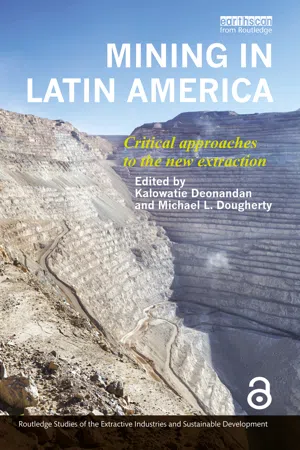
Mining in Latin America
eBook - ePub

Mining in Latin America

Critical Approaches to the New Extraction

  1. 292 pages
  2. English
  3. ePUB (mobile friendly)
  4. Available on iOS & Android
eBook - ePub

Mining in Latin America

Critical Approaches to the New Extraction

About this book

The last two decades have witnessed a dramatic expansion and intensification of mineral resource exploitation and development across the global south, especially in Latin America. This shift has brought mining more visibly into global public debates and spurred a great deal of controversy and conflict. This volume assembles new scholarship that provides critical perspectives on these issues.

The book marshals original, empirical work from leading social scientists in a variety of disciplines to address a range of questions about the practices of mining companies on the ground, the impacts of mining on host communities, and the responses to mining from communities, civil society and states. The book further explores the global and international causes, consequences and innovations of this new era of mining activity in Latin America. Key issues include the role of Canadian mining companies and their investment in the region, and, to a lesser extent, the role of Chinese mining capital. Several chapters take a regional perspective, while others are based on empirical data from specific countries including Bolivia, Brazil, El Salvador, Guatemala and Peru.

Frequently asked questions

Yes, you can cancel anytime from the Subscription tab in your account settings on the Perlego website. Your subscription will stay active until the end of your current billing period. Learn how to cancel your subscription.
No, books cannot be downloaded as external files, such as PDFs, for use outside of Perlego. However, you can download books within the Perlego app for offline reading on mobile or tablet. Learn more here.
Perlego offers two plans: Essential and Complete
  • Essential is ideal for learners and professionals who enjoy exploring a wide range of subjects. Access the Essential Library with 800,000+ trusted titles and best-sellers across business, personal growth, and the humanities. Includes unlimited reading time and Standard Read Aloud voice.
  • Complete: Perfect for advanced learners and researchers needing full, unrestricted access. Unlock 1.4M+ books across hundreds of subjects, including academic and specialized titles. The Complete Plan also includes advanced features like Premium Read Aloud and Research Assistant.
Both plans are available with monthly, semester, or annual billing cycles.
We are an online textbook subscription service, where you can get access to an entire online library for less than the price of a single book per month. With over 1 million books across 1000+ topics, we’ve got you covered! Learn more here.
Look out for the read-aloud symbol on your next book to see if you can listen to it. The read-aloud tool reads text aloud for you, highlighting the text as it is being read. You can pause it, speed it up and slow it down. Learn more here.
Yes! You can use the Perlego app on both iOS or Android devices to read anytime, anywhere — even offline. Perfect for commutes or when you’re on the go.
Please note we cannot support devices running on iOS 13 and Android 7 or earlier. Learn more about using the app.
Yes, you can access Mining in Latin America by Kalowatie Deonandan, Michael L. Dougherty, Kalowatie Deonandan,Michael L. Dougherty in PDF and/or ePUB format, as well as other popular books in Technology & Engineering & Mining Engineering. We have over one million books available in our catalogue for you to explore.

Table of contents

  1. Cover
  2. Half Title
  3. Title Page
  4. Copyright Page
  5. Table of Contents
  6. Acknowledgements
  7. List of figures
  8. List of Tables
  9. Notes on authors
  10. PART I: Introduction
  11. PART II: Conceptual approaches to excavating the new extraction
  12. PART III: The role of Canadian capital in Latin American extraction
  13. PART IV: Innovations on the ground: privatisation, people and governance
  14. PART V: Jurisprudence and the new extraction
  15. PART VI: Conclusion and ways forward