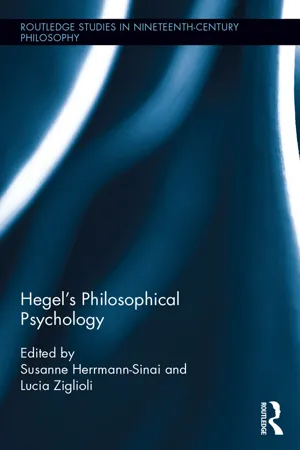
Hegel's Philosophical Psychology draws attention to a largely overlooked piece of Hegel's philosophy: his substantial and philosophically rich treatment of psychology at the end of the Philosophy of Subjective Spirit, which itself belongs to his main work, the Encyclopaedia of the Philosophical Sciences. This volume makes the case that Hegel's approach to philosophy of mind as developed within this text can make an important contribution to current discussions about mind and subjectivity, and can help clarify the notion of spirit (Geist) within Hegel's larger philosophical project. Scholars from different schools of Hegelian thought provide a multifaceted overview of Hegel's Psychology: Part I begins with an overview of Hegel's Philosophy of Subjective Spirit, which outlines both its historical context and its systematic context within Hegel's philosophy of subjective spirit. Parts II and III then investigate the individual chapters of the sections on psychology: the theoretical mind and the practical and free mind. The volume concludes by examining the challenges which Hegel's Psychology poses for contemporary epistemological debates and the philosophy of psychology. Throughout, the volume brings Hegel's views into dialogue with 20th- and 21st-century thinkers such as Bergson, Bourdieu, Brandom, Chomsky, Davidson, Freud, McDowell, Sellars, Wittgenstein, and Wollheim.
eBook - ePub
Hegel's Philosophical Psychology
- 286 pages
- English
- ePUB (mobile friendly)
- Available on iOS & Android
eBook - ePub
Hegel's Philosophical Psychology
About this book
Information
Philosophy of Subjective Spirit
1 Hegel’s Critique of Physiognomy and Phrenology
The word ‘physiognomy’ designates the features of someone’s face, especially when they are supposed to indicate the person’s character or temperament. It is also used to mean the study of facial features in order to discern people’s character or temperament. Johann Caspar Lavater, who attempted to systematise physiognomy as a science, and his critic Georg Christoph Lichtenberg, both distinguish physiognomy from what they call ‘pathognomy’. Physiognomy in the strict sense concerns the fixed features of people’s faces and the attempt to discover their relatively enduring traits from them. Pathognomy, by contrast, is a ‘Semiotik’ of the transient features of someone’s face, whether voluntary, such as winks, or involuntary, such as coughs and sneezes. It attempts to infer from these someone’s passing mental states or activities, their emotions and intentions, for example (Lichtenberg 1967, 372).1 However, as Lichtenberg admits, ‘physiognomy’ is often used to cover pathognomy as well, including both the fixed and the mobile features of faces. (Henceforth I call physiognomy in the narrower sense ‘strict physiognomy’.) Phrenology or cranioscopy was founded by Franz Joseph Gall.2 It is the study of the bumps and hollows on skulls in order to discern a person’s character. Like strict physiognomy, it deals with fixed features, but it provides no analogue of strict physiognomy’s contrast with pathognomy, since skull bumps and hollows are inevitably immobile. Phrenology could not possibly reveal someone’s transient states, unless these are necessary consequences of their enduring character.
In the third volume of his Encyclopaedia, Hegel distinguishes between strict physiognomy and pathognomy in approximately the same way as Lichtenberg does. He has some interest in and respect for pathognomy as a guide to a person’s fleeting mental states and overall character. He has little respect for strict physiognomy, except as a way of distinguishing humans from animals and Caucasians from non-Caucasians. He acknowledges that we inevitably make snap fallible judgements of people on the basis of their physiognomy, but scorns Lavater’s attempt to make a science of it.3 (His view of phrenology is even lower.) He does, however, suggest a link between pathognomy and strict physiognomy, namely that the frequent expression of an emotion such as anger may leave an indelible mark on a person’s fixed, physiognomic, features. However, he insists that a human being is free and can manipulate and dissemble pathognomic expressions, not only ‘voluntary’ ones but also those that are primarily ‘involuntary’, such as tears and laughter; such expressions are therefore a ‘contingency for the mind’, though this is also true of strict physiognomic features, which are not so open to manipulation.4 Hegel believes that a person’s actions reveal more about him than his physiognomic and pathognomic features. He also has an ambivalent attitude towards speech. On the one hand, speech is, in comparison with physiognomic and pathognomic features, the ‘more perfect expression of the mind’. Speech can represent the mind ‘in its universality’ (EPM §411 R), whereas physiognomic and pathognomic features cannot. A frown may indicate that I am thinking, but only speech can reveal that I am thinking that, say, beauty is truth. A cry may express either pain or surprise; only speech can tell us which. On the other hand, speech or ‘language’ can be manipulated as easily as pathognomic expressions. It can conceal as well as reveal thoughts.
I examine these considerations not only in Encyclopaedia III but also in the Phenomenology of Spirit.
Physiognomy and Pathognomy in the Encyclopaedia
In Encyclopaedia III, Hegel makes several references to physiognomy and pathognomy. In his account of the ‘races of mankind’ he says that ‘in the Caucasian race the aforesaid angle [viz. the angle of intersection of the horizontal and vertical lines drawn within the skull—MI] is almost or entirely a right angle. This applies particularly to the Italian, Georgian, and Circassian physiognomy’ (EPM §393 A). He also speaks of the distinctive physiognomy of individuals and families (EPM §395). He proposes a science called ‘psychical physiology’, which would deal with ‘the most familiar connections by which tears, and voice in general, namely speech, laughter, sighs, with many other particularisations lying in the direction of pathognomy and physiognomy, are formed from out of the soul’ (EPM §401 R). This science would examine ‘involuntary embodiments of the mental’, that we share, to some extent, with animals (EPM §411 A). Finally he considers specifically human, especially ‘voluntary’, expressions of the mental. The ‘trained’ human body ‘represents not itself, but the soul, of which it is the sign. As this identity of the inner with the outer, the outer being subjugated to the inner, the soul is actual; in its bodiliness it has its free shape, in which it feels itself and makes itself felt, and which, as the soul’s work of art, has human, pathognomic and physiognomic, expression (EPM §411). Such ‘expression includes, e.g., the upright figure in general, the formation especially of the hand, as the absolute tool, of the mouth, laughter, weeping, etc., and the spiritual tone diffused over the whole,’ though ‘[t]his tone is such a slight, indeterminate, and indescribable modification, because the figure in its externality is something immediate and natural, and can therefore be only an indeterminate and quite imperfect sign for the mind, unable to represent it in its universality for itself’;
for the mind [the human figure] is only its first appearance, and speech is straight away its more perfect expression. The figure is indeed the mind’s proximate existence, but in its physiognomic and pathognomic determinacy it is at the same time a contingency for the mind. To want to raise physiognomy and especially cranioscopy to the rank of sciences, was therefore one of the most vacuous notions. (EPM §411 R)
The Addition expands on this. The body comes into consideration not
with respect to its organic process, but only in so far at it is an externality posited ideally even in its reality [Dasein] and in so far as in it the soul, no longer restricted to the involuntary embodiment of its inner sensations, makes its appearance with as much freedom as it has won so far by overcoming what contradicts its ideality…. The embodiments occurring with freedom … impart to the human body a peculiar mental stamp, by which man is distinguished from animals far more than by any mere natural determinacy.
Hegel emphasises our upright posture, our ‘absolute gesture’, and the hand, this ‘tool of tools’, but particularly the face, since ‘the head is the real seat of the mental’. He considers the symbolic significance of various ‘looks and gestures’: frowning, for example, ‘proclaims anger, a concentration of oneself into oneself against an Other’. Some movements reveal character. One’s gait, for example,
must be cultivated; in it the soul must betray its mastery over the physical body. Not merely cultivation and the lack thereof, but also slackness, an affected manner, vanity, hypocrisy, etc., on the one hand, and orderliness, modesty, good sense, candour, etc., on the other, express themselves in the peculiar style of walking; so that it is easy to distinguish people from one another by their gait.
In general, a
cultivated man has a less animated play of looks and gestures than the uncultivated. Just as the former bids the inward storm of his passions to be calm, so he also observes outwardly a calm demeanour and imparts to the voluntary embodiment of his sensations a certain measure of moderation; whereas the uncultivated, lacking power over his interior, believes that he can make himself intelligible only by a luxuriance of looks and gestures…. The cultured individual does not need to be lavish with looks and gestures; he possesses in talk the worthiest and most suitable means of expressing himself; for speech is able immediately to receive and reproduce every modification of representation … / Now just as the voluntary embodiments of the mental discussed here become through habit something mechanical, something requiring no particular effort of will, so too, conversely, some of the involuntary embodiments … can also take place with consciousness and freedom. Above all the human voice belongs here; when the voice becomes speech, it ceases to be an involuntary expression of the soul. Similarly laughing, in the form of laughing at, becomes something produced with freedom. Sighing, too, is not so much something uncontrollable as something wilful. Herein lies the justification for discussing the soul-expressions just mentioned in two places,—with the merely sentient soul and also with the actual soul. This is also why we pointed out as far back as § 401 that among the involuntary embodiments of the mental there are many “lying in the direction of pathognomy and physiognomy”… The difference between these two determinations is that the pathognomic expression relates more to transient passions, whereas the physiognomic expression concerns the character, hence something permanent. However, the pathognomic becomes physiognomic when the passions in a man hold sway are not merely temporarily but permanently. The lasting passion of anger, for example, firmly ingrains itself in the face; and so too a sanctimonious nature gradually impresses itself in an indelible way on the face and on the whole bearing of the body. / Everyone has a physiognomic aspect, appears at first sight as a pleasant or unpleasant, strong or weak, personality. According to this semblance one passes, from a certain instinct, a first universal judgement on others. However, it is easy to be mistaken in this, since this exterior, encumbered predominantly with the character of immediacy, does not perfectly correspond to the mind but only in a greater or lesser degree. Consequently, an unfavourable, like a favourable, exterior can have behind it something different from what that exterior initially leads one to suspect…. and a judgement based on physiognomic expression has accordingly only the value of an immediate judgement, which can just as well be untrue as true. For this reason, people have rightly retreated from the exaggerated respect they formerly harboured for physiognomy, when Lavater created such a stir about it and when people had high hopes of a massive contribution from it to the highly regarded knowledge of human nature. Man is known much less by his outward appearance than by his actions. Even language is exposed to the fate of serving just as much to conceal as to reveal human thoughts. (EPM §411 A)
Physiognomy and Phrenology in the Phenomenology of Spirit
In his earlier work, the Phenomenology of Spirit,5 Hegel had launched a systematic critique of the two pseudosciences. He first considers physiognomy, but significantly he does not mention pathognomy by name and lumps transient pathognomy together with fixed physiognomy. This is clear from such passages as this:
These features and their movement are, according to this concept, the doing held back, remaining in the individual, and in accordance with the individual’s relation to the actual doing, they constitute its own supervision [Beaufsichtigen] and observation of the doing [Tuns], externalization [Äusserung] as reflection on the actual externalization.—The individual is therefore not dumb with regard to and in its external doing, because at the same time it is there reflected into itself, and it externalizes this reflectedness into itself; this theoretical doing, or the individual’s speech with itself about its doing, is also perceptible for others, for this speech is itself an externalization. (PS ¶317, 232)6
The features that externalise one’s supervision of one’s doing, one’s inner speech about it, must be transient pathognomic features.
Hegel knew the distinction between physiognomy and pathognomy, having read Lichtenberg and Lavater. He has, however, several reasons for ignoring it in the Phenomenology. A stronger case can be made for physiognomy, if it considers current intentions and self-monitoring, not enduring traits—and, characteristically, Hegel wants to make the strongest possible case even for a doctrine he opposes. It is hard, too, to ignore pathognomic features; they are in part responsible for fixed physiognomic features. Lavater himself compares strict physiognomy to reading a language, a language that provides a better picture of one’s soul than does ordinary spoken language. Of the segments into which he divided the silhouettes of faces, he wrote: ‘Each individual part of these segments is in itself a letter of an alphabet, often a syllable, or often an entire speech of truth-speaking nature’ (Lavater 1878, 193).7 In his initial exposition of Lavater’s theory Hegel speaks of a person’s physiognomy as a ‘language’ of this type. It is a natural extension of this to suppose that the language is spoken not only by ‘nature’ but by the person himself in what Lichtenberg called an ‘involuntary language of gestures’ [unwillkürliche Gebärdensprache] (Lichtenberg 1967, 388). It expresses, Hegel adds, the ‘individual’s speech with itself about its doing’. Finally, the integration of pathognomy into physiognomy enables Hegel to intensify the contrast between physiognomy and phrenology. Neither Lichtenberg nor Lavater could consider the relationship between the two disciplines. But Hegel presents phrenology as developing out of physiognomy. It attempts to repair a defect in physiognomy, its failure to explain why facial structure should infallibly correspond to mental features. If the face is simply a sign of the inner, expressing the individual’s speech about himself, then the subject is free to override and exploit it. This applies especially to pathognomy, but also to strict physiognomy. Phrenology provides a linking mechanism in a material organ, the brain, causally related, somehow, to the structure of the skull. This supposedly supplies the necessary relationship between the spirit and its outer manifestation that physiognomy lacked. In this respect phrenology seems to be an improvement on physiognomy. In another respect it is a deterioration. The skull is even less likely to be the ‘actuality’ (Wirklichkeit) of spirit than the fixed features of the face are, and, being immobile, the bumps and hollows of the skull cannot be quasi-linguistic signs of our inner life. The skull is dead; it does not act and it does not speak.
Hegel’s Criticisms
Because in Hegel’s account phrenology develops out of physiognomy, he considers them separately, but when his criticisms apply to both, I take them together.
Hegel’s first criticism applies only to physiognomy. He notes the contingency of the relationship between a facial feature and the character trait it supposedly expresses: it is like ‘a language whose sounds and sound-combinations are not the Thing [Sache]8 itself, but are linked with it by free wilfulness [Willkür] and are contingent for the Thing’ (PS ¶313, 230). It is not always clear what the implications of this are. Hegel’s point that a physiognomical or pathognomical sign has no special affinity to what it signifies also applies to ordinary spoken or written language. The words ‘I intend, or intended, to murder him’ have no special affinity to the intention they express, apart from the meanings assigned to them. The intention could equally well be expressed by words with different acoustic or visual properties. This does not, however, undermine the role of language as an expression of our inner life. So it would not entail that our inner life cannot be adequately expressed by physiogn...
Table of contents
- Cover Page
- Half Title Page
- Title Page
- Copyright Page
- Table of Contents
- Abbreviations
- Preface
- Part I Philosophy of Subjective Spirit
- PART II Theoretical Spirit
- Part III Practical and Free Spirit
- Part IV The Challenge of Hegel's Philosophical Psychology
- Contributors
- Index
Trusted by 375,005 students
Access to over 1.5 million titles for a fair monthly price.
Study more efficiently using our study tools.
Frequently asked questions
Yes, you can cancel anytime from the Subscription tab in your account settings on the Perlego website. Your subscription will stay active until the end of your current billing period. Learn how to cancel your subscription
No, books cannot be downloaded as external files, such as PDFs, for use outside of Perlego. However, you can download books within the Perlego app for offline reading on mobile or tablet. Learn how to download books offline
Perlego offers two plans: Essential and Complete
- Essential is ideal for learners and professionals who enjoy exploring a wide range of subjects. Access the Essential Library with 800,000+ trusted titles and best-sellers across business, personal growth, and the humanities. Includes unlimited reading time and Standard Read Aloud voice.
- Complete: Perfect for advanced learners and researchers needing full, unrestricted access. Unlock 1.5M+ books across hundreds of subjects, including academic and specialized titles. The Complete Plan also includes advanced features like Premium Read Aloud and Research Assistant.
We are an online textbook subscription service, where you can get access to an entire online library for less than the price of a single book per month. With over 1.5 million books across 990+ topics, we’ve got you covered! Learn about our mission
Look out for the read-aloud symbol on your next book to see if you can listen to it. The read-aloud tool reads text aloud for you, highlighting the text as it is being read. You can pause it, speed it up and slow it down. Learn more about Read Aloud
Yes! You can use the Perlego app on both iOS and Android devices to read anytime, anywhere — even offline. Perfect for commutes or when you’re on the go.
Please note we cannot support devices running on iOS 13 and Android 7 or earlier. Learn more about using the app
Please note we cannot support devices running on iOS 13 and Android 7 or earlier. Learn more about using the app
Yes, you can access Hegel's Philosophical Psychology by Susanne Herrmann-Sinai, Lucia Ziglioli, Susanne Herrmann-Sinai,Lucia Ziglioli in PDF and/or ePUB format, as well as other popular books in Philosophy & Mind & Body in Philosophy. We have over 1.5 million books available in our catalogue for you to explore.