eBook - ePub
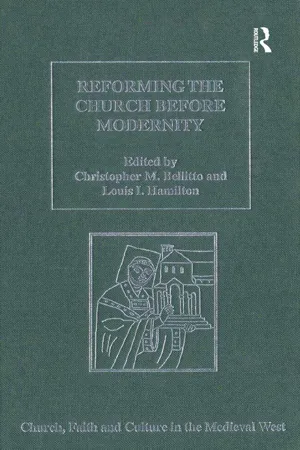
Reforming the Church before Modernity
Patterns, Problems and Approaches
- 248 pages
- English
- ePUB (mobile friendly)
- Available on iOS & Android
eBook - ePub
Reforming the Church before Modernity
Patterns, Problems and Approaches
About this book
Reforming the Church before Modernity considers the question of ecclesial reform from late antiquity to the 17th century, and tackles this complex question from primarily cultural perspectives, rather than the more usual institutional approaches. The common themes are social change, centres and peripheries of change, monasticism, and intellectuals and their relationship to reform. This innovative approach opens up the question of how religious reform took place and challenges existing ecclesiological models that remains too focussed on structures in a manner artificial for pre-modern Europe. Several chapters specifically take issue with the problem of what constitutes reform, reformations, and historians' notions of the periodization of reform, while in others the relationship between personal transformation and its broader social, political or ecclesial context emerges as a significant dynamic. Presenting essays from a distinguished international cast of scholars, the book makes an important contribution to the debates over ecclesiology and religious reform stimulated by the anniversary of Vatican II.
Social Change and Religious Reform
Chapter 1
Church Reform and Society in Late Antiquity
In 1950 I, like many Roman Catholics, was thrilled by the publication of Yves-Marie Congar’s great work Vraie et fausse réforme dans l’Église. It was like a breath of fresh air, a window being opened after a long winter to allow a whiff of spring to enter. To our despair, it was not long before it was banned by the Vatican; but it was not much more than a decade or so before it, as well as its author, were rehabilitated by Pope John XXIII and his Council. Congar’s book was a foretaste of the gale that began to blow the window wide open. Nowadays much of its argument would be so widely taken for granted as to be almost commonplace. Congar’s was a theological, not a historical, study; he was, however, more than any great theologian I can easily think of, a man of a deeply historical turn of mind, and his theological thinking was utterly penetrated by historical insight as well as a determination to unpack the riches contained in the Church’s tradition and an uncompromising fidelity to that tradition. In any discussion on reform in or of the Church, his voice is one to which we cannot afford to be deaf.
The purpose of our conference was to search for possible patterns in premodern reform movements, and I am required to consider reform in relation to social change in Late Antiquity. In this task we are immediately confronted with a paradox: the Fathers, or Late Antique Christians, do not speak of reform in or of the Church. Congar attributed this reticence to several reasons. First, he put it down to what he described as a “a very mystical notion of the Church,” one which saw the Church primarily in terms of heavenly realities, descended to earth, realised among men, but realities “whose true condition,” in Congar’s words, “is essentially heavenly.”1 It was seen as a mystery of holiness, an organised body of sacramental and priestly observance which serves as the vehicle of the Spirit. This perspective defined the approach to reform: “the problem of evil in the Church was above all that of sin.”2 Moreover, Congar argued, in the world as it was before its laicisation in modern times (which began, spiritually, in 1793),
the Church was seen as what was most excellent . . . whether faced with a pagan world . . . , or under a Christian régime, that is to say a symbiosis of temporal society and the order of faith under the tutelage of the Church, all the actuality of goodness or progress coincided perfectly with the Church and only existed in and through her. Hence the problem of evil in the Church arose only from the Church’s point of view and its own perspective, that is to say in terms of sin.3
In contrast with this ancient view of the problem of evil in the Church, Congar noted, our modern problem is different, and arises in a larger perspective (sur une base plus large): “rather than the sins of its members, what causes offence is the Church’s incomprehensions, its narrownesses, its retarded ways” (on se scandalisera de ses incompréhensions, de ses étroitesses, de ses retards).4 Our “modern” view, according to Congar, considers the problem in institutional rather than personal terms. This re-orientation was encouraged by the emergence of a strongly institutionalised sense of “the Church” which, in Congar’s view, did not emerge until the eleventh century, to grow from then until our own time.5
Not long after the appearance of Congar’s book, Gerhart Ladner published his extensive survey of the patristic idea of reform.6 The core of the study was a lexicographical survey of the terminology of reform: the meaning of reformare, renovare and their cognates. The conclusion seemed to confirm Congar’s views: the patristic concepts – and Gregory the Great’s as their final re-statement – circled around the concepts of creation and new creation, of the reformation of the image of God in man by divine grace, the restoration of sinful human beings to their lost integrity. The mechanisms through which reform was to be achieved are, as expected, teaching, preaching and sacramental agency. The strongly personal, individualistic, orientation of the patristic reform-idea implied by Ladner’s conclusion was given added weight by his comparison of Gregory VII’s concept of renewal with Gregory the Great’s in a famous paper that was eventually to follow. Ladner here spoke of “the personalistic character of Gregory [the Great]’s reform ideology” and emphasised that “the term and the idea of reform are applied [by Gregory the Great] to individuals or groups of persons, not to the Church as a whole, except indirectly in the few cases where the reform of heretics or schismatics is concerned.”7 In contrast, Gregory VII’s concept, even where the language resembles his great predecessor’s, envisages reform of the Church as such. Ladner concludes thus:
the Church reform of the Hildebrandine age went beyond personal or regional or group renewal and was directed toward the entire Church, understood both as the community of the faithful and as hierarchical institution, based on ecclesiastical law.8
Without prejudging earlier medieval reform movements which are discussed in this volume by John Howe, we may provisionally accept Ladner’s conclusion that the patristic language of reform was given a more collective ecclesiastical reference in the language of the eleventh-century reformers. But to assert that notions of reform in Late Antiquity were only seen as Christians’ personal sins could, I think, be misleading. Congar was surely right to assert that the language of personal sinfulness was the only language available to formulate notions of reform; but I am not convinced that this is quite the same thing as denying any form of consciousness of what we might call “structural” or “institutional” sin in the early Christian centuries. We may grant that there was no developed language of “reform” and “renewal” – except in reference to personal morality – and that these were not the terms in which institutional reform could be discussed; but I would wish to suggest that although reform could only be discussed in such personalistic terms, the conditions which made it necessary, and indeed the object that needed to be reformed, were clearly perceived as social, if not institutional, in nature. We need therefore to look further afield and not to be content with recording the use of the language of reform and renewal, and to investigate its meaning, but to consider other, less direct ways in which reforming concerns could appear.
The two major upheavals in the Church’s social existence, at any rate in the first millennium and a half, are of course the Constantinian revolution9 and the establishment of Christianity in the Germanic kingdoms, and it is these two transformations in the social conditions of the Church that I shall consider here. I want also to consider a third episode, one that can scarcely be called a social change, but one which nevertheless had, in my view, huge repercussions on the possibilities of reform: the Moslem conquests around the Mediterranean. So I shall concentrate on the post-Constantinian Church, both within the Empire and in the subsequent post-Roman kingdoms in western Europe; but it will be as well to begin with an earlier episode which has often been taken to be an early manifestation of a concern for reform: the Montanist movement in the later second and the third centuries. This has often been characterised as having an ecstatic and charismatic character and is contrasted with the rigidity of the official, institutional Church.10 Tertullian certainly thought the New Prophecy “a mighty reforming spirit in the Church;”11 once he contrasted the authentic Church of the Spirit with the Church of the “troop of bishops” (numerus episcoporum).12 Recent scholarship, however, has tended to dismiss, or at least to play down, the idea of Montanism as a reforming or protest movement. What is certainly true is that “for Montanists authority depended on the ‘vertical’ gift of the Paraclete, not upon the horizontal transmission of authority from pastor to pastor in apostolic continuity, mediating a valid sacramental life.”13
In the pre-Constantinian world the Church stood out as a sharply defined group. A century ago the great ecclesiastical historian Adolf von Harnack commented on the designation of Christians, common in the early centuries, as “the third race” (tertium genus):
It is indeed amazing! One had certainly no idea that in the consciousness of the Greeks and Romans the Jews stood out in such bold relief from the other nations, and the Christians from both, that they represented themselves as independent “genera”, and were so described in an explicit formula. Neither Jews nor Christians could look for a more ample recognition, little as the demarcation was intended as a recognition at all.14
I shall suggest that it is this “standing out in relief” in the surrounding society that is fundamental to the patristic conception of reform.
It is this sense of the Church’s identity in the secular world that came under threat in the course of the large-scale Christianisation of Roman society after Constantine, and, to some extent, even in the preceding decades. While Christians were an outlandish minority, suspect to outsiders, liable to sporadic persecution, their identity in the world was amply clear. The lines which marked them off from their world were imposed on them by their sheer foreignness to the world. But as Christians came increasingly to share the education, the culture, the lifestyles and tastes of their non-Christian contemporaries, so the lines of demarcation gradually melted away. As they ceased to be (visibly) aliens in their world and as the profession of Christianity became a passport to respectability, to wealth, and to privilege, so the sense of Christian identity inevitably came to be blurred. I have come to refer to the decades around AD 400, the time when this assimilation of Christianity to Roman society came to its climax, as a “crisis of identity” for Roman Christians.15 The challenge faced by “reformers” was to find a way of making the Church “stand out in relief,” with sharply defined contours in the secular world around it and to restore to Christians their sense of identity in their surroundings.
The transformation of Christianity from being the religion of a persecuted sect to that of the Roman establishment is the major social change Christianity was to undergo in the ancient world. What we might call “reforming impulses” were among the responses to this transformation. This is, however, not immediately apparent, and in order to diagnose the way reform ideas surfaced, we need to consider the ways in which Christians adjusted to the Constantinian revolution. Spiritually and intellectually they were not well prepared for the miracle which transformed their condition from that of a persecuted minority to that of a favoured and privileged group, soon to become a dominant majority. By and large, they were very ready to enjoy their new status and to receive the benefits it brought. The vast majority of the bishops and clergy did not hesitate to accept imperial favour and official patronage and, along with it, a degree of imperial influence and control over ecclesiastical affairs. Among Christian preachers and writers the notion came to be widely held that the Roman Empire and the Christian Church were divinely intended to be united and were now, since Constantine, providentially fused in a single, universal, Christian society. The Empire came to be widely seen as an image of God’s kingdom, ruled by emperors who were God’s representatives governing by his authority. There were exceptions to this readiness to identify the Church with the Empire: most obviously, those who were officially reckoned as heretical or schismatic. It was, however, against the prevailing mood of self-identification with the Christian Empire that the reforming impulses in the Church were aimed.
There is ample evidence of unease about this new state of affairs if we look for it. Signs of it sometimes become explicit in the aftermath of Constantine’s inauguration of the new order. Eusebius, the Church historian, voiced this sense of a generation gap having opened between the last of the persecuted Christians and their tolerated descendants: ...
Table of contents
- Cover
- Half Title
- Title Page
- Copyright Page
- Table of Contents
- Acknowledgements
- List of Abbreviations
- Introduction
- PART I: Social Change and Religious Reform
- PART II: The Ideas of Reform and the Intellectuals
- PART III: Clerical Reform
- PART IV: The Processes of Reform
- Index
Trusted by 375,005 students
Access to over 1.5 million titles for a fair monthly price.
Study more efficiently using our study tools.
Frequently asked questions
Yes, you can cancel anytime from the Subscription tab in your account settings on the Perlego website. Your subscription will stay active until the end of your current billing period. Learn how to cancel your subscription
No, books cannot be downloaded as external files, such as PDFs, for use outside of Perlego. However, you can download books within the Perlego app for offline reading on mobile or tablet. Learn how to download books offline
Perlego offers two plans: Essential and Complete
- Essential is ideal for learners and professionals who enjoy exploring a wide range of subjects. Access the Essential Library with 800,000+ trusted titles and best-sellers across business, personal growth, and the humanities. Includes unlimited reading time and Standard Read Aloud voice.
- Complete: Perfect for advanced learners and researchers needing full, unrestricted access. Unlock 1.5M+ books across hundreds of subjects, including academic and specialized titles. The Complete Plan also includes advanced features like Premium Read Aloud and Research Assistant.
We are an online textbook subscription service, where you can get access to an entire online library for less than the price of a single book per month. With over 1.5 million books across 990+ topics, we’ve got you covered! Learn about our mission
Look out for the read-aloud symbol on your next book to see if you can listen to it. The read-aloud tool reads text aloud for you, highlighting the text as it is being read. You can pause it, speed it up and slow it down. Learn more about Read Aloud
Yes! You can use the Perlego app on both iOS and Android devices to read anytime, anywhere — even offline. Perfect for commutes or when you’re on the go.
Please note we cannot support devices running on iOS 13 and Android 7 or earlier. Learn more about using the app
Please note we cannot support devices running on iOS 13 and Android 7 or earlier. Learn more about using the app
Yes, you can access Reforming the Church before Modernity by Christopher M. Bellitto, Louis I. Hamilton in PDF and/or ePUB format, as well as other popular books in History & World History. We have over 1.5 million books available in our catalogue for you to explore.