- 240 pages
- English
- ePUB (mobile friendly)
- Available on iOS & Android
eBook - ePub
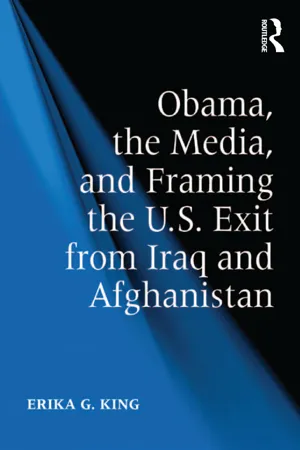
Obama, the Media, and Framing the U.S. Exit from Iraq and Afghanistan
About this book
Situating Obama's end-of-war discourse in the historical context of the 2001 terrorist attacks, Obama, the Media, and Framing the U.S. Exit from Iraq and Afghanistan begins with a detailed comparison with the Bush war-on-terror security narrative before examining elements of continuity and change in post-9/11 elite rhetoric. Erika King deftly employs two case studies of presidential and media framing - the weeks surrounding the formal announcements of Obama's December 2009 'surge-then-exit' strategy from Afghanistan and the end of combat operations in Iraq in August 2010 - to explore the role of mass media in presenting presidential narratives of war and finds evidence of an interpretive disconnect between the media and a president seeking to present a more nuanced approach to keeping America safe. Eloquently scrutinizing Obama's discourse on the U.S. exit from two post-9/11 wars and contrasting the presidential endgame frame with the U.S. mainstream media's narratives of the wars' meaning, accomplishments, and denouement provides a unique combination of qualitative content analysis and topical case studies and makes this volume an ideal resource for scholars and researchers grappling with the complicated and ever-evolving nexus of war, the president, and the media.
Information
1 Surging to Victory in the War on Terror
DOI: 10.4324/9781315598635-2
Bowing to the harsh realities of an increasingly chaotic Iraq and ever louder calls to pursue a different path in the war, President George W. Bush announced his new way forward in a January 10, 2007 primetime address to the nation. He opened his remarks with these determined words: “Tonight in Iraq, the Armed Forces of the United States are engaged in a struggle that will determine the direction of the global war on terror—and our safety here at home. The new strategy I outline tonight will change America's course in Iraq, and help us to succeed in the fight against terror” (Bush 2007a). For Bush, Iraq had always been ground zero in the existential struggle against America's terrorist adversaries, and his final two years in office would involve an intensive rhetorical push to remind the nation of why it was essential to maintain its resolve and emerge victorious.
As he had for the previous half decade, Bush presented a complete and comprehensive war narrative that conflated the conflict in Iraq with the global battle against those who had attacked the U.S. on September 11, 2001. His tale of a virtuous America so unjustly targeted and its ensuing contest against the forces of evil and repression continued unabated as he now tweaked his storyline to account for the proposed shift in strategy for Iraq. Consisting of three interrelated themes—military victory in Iraq was still attainable and vital to winning the wider conflict against terrorism; defeat would be catastrophic; and General David Petraeus, the new commander in Iraq, would chart the course to success—Bush's revamped Iraq script intertwined dire warnings about current conditions with a decidedly hopeful vision of future possibilities (see King and Wells 2009: 157–163).
Keeping America Safe in the War on Terror
To promote his strategy of increased force levels in and around Baghdad—a policy that observers quickly labeled a “surge”—Bush first highlighted the intimate connections among the deteriorating situation in Iraq, the ominous specter of global terrorism, and the dangers still confronting American national security. Dreadful consequences, he proclaimed, would come from a refusal to heed his call:
Failure in Iraq would be a disaster for the United States. The consequences of failure are clear: Radical Islamic extremists would grow in strength and gain new recruits. They would be in a better position to topple moderate governments, create chaos in the region, and use oil revenues to fund their ambitions. Iran would be emboldened in its pursuit of nuclear weapons. Our enemies would have a safe haven from which to plan and launch attacks on the American people. On September 11, 2001, we saw what a refuge for extremists on the other side of the world could bring to the streets of our own cities. For the safety of our people, America must succeed in Iraq. (Bush 2007a)
The president also repeated a key underlying argument from his initial 9/11 narrative about the profound gulf in worldview the attacks laid bare: “The challenge playing out across the broader Middle East is more than a military conflict. It is the decisive ideological struggle of our time. On the one side are those who believe in freedom and moderation. On the other side are extremists who kill the innocent, and have declared their intention to destroy our way of life” (Bush 2007a). In his State of the Union address two weeks later, Bush reminded his vast audience that America was still a nation at war, confronted by the “shoreless ambitions” of the terrorist enemy, a war that would not end until the terrorists’ “radical vision” had been eliminated:
Our enemies are quite explicit about their intentions. They want to overthrow moderate governments, and establish safe havens from which to plan and carry out new attacks on our country. By killing and terrorizing Americans, they want to force our country to retreat from the world and abandon the cause of liberty. They would then be free to impose their will and spread their totalitarian ideology …In the sixth year since our nation was attacked, I wish I could report to you that the dangers had ended. They have not …This war is more than a clash of arms—it is a decisive ideological struggle, and the security of our nation is in the balance. (Bush 2007b)
As he announced the surge, Bush's appeals thus remained firmly ensconced in what McCrisken (2001) terms the missionary strand of exceptionalist thought: The need for the U.S. not merely to eliminate those evildoers who currently threatened its security but also to provide the conditions that would allow the core values of democracy, human dignity, and equal opportunity to take root and grow. Only by so doing, Bush consistently argued, would American security be guaranteed and its mission to stand as an example for the world be fulfilled.
While the core elements of his initial war-on-terror frame remained in place, Bush did adjust his updated Iraq storyline to include a brief acknowledgment of problems with the invasion's rationale as well as missteps in the war's prosecution. His primary emphasis, however, was on leaving the past behind and exhorting all Americans to voice support for his plan to achieve a successful outcome in Iraq. An exemplary nation, he implied, could do no less than muster all its military and psychological resources toward the goal of keeping America—and the world—secure from harm even as events in Iraq had thus far failed to turn out as anticipated. America's destiny, Bush insisted, was still in its hands. Witness this passage from his State of the Union address:
This is not the fight we entered in Iraq, but it is the fight we’re in. Every one of us wishes this war were over and won. Yet it would not be like us to leave our promises unkept, our friends abandoned, and our own security at risk. Ladies and gentlemen: On this day, at this hour, it is still within our power to shape the outcome of this battle. Let us find our resolve, and turn events toward victory. (Bush 2007b)
In a press conference the following month, Bush repeated his warning of the horrendous domino effect that would cascade across the globe were the United States to fail to act at this critical juncture:
[T]o step back from the fight in Baghdad would have disastrous consequences for people in America … The Iraqi government could collapse, chaos would spread, there would be a vacuum, into the vacuum would flow more extremists, more radicals, people who have stated intent to hurt our people … What's different about this conflict than some others is that if we fail there, the enemy will follow us here. (Bush 2007c)
And in his Coast Guard commencement speech that May, Bush directly addressed those still inclined to question the link between the battle in Iraq and the war on terror. Citing newly declassified intelligence data from 2005, the president described how Osama bin Laden had possibly enlisted the assistance of a key al Qaeda operative in Iraq to help organize and plan attacks against the U.S. Other similar threats still loomed, he continued; it was therefore up to members of Congress to step up and take appropriate action:
The question for our elected leaders is: Do we comprehend the danger of an al Qaeda victory in Iraq, and will we do what it takes to stop them? However difficult the fight in Iraq has become, we must win it. Al Qaeda is public enemy number one for Iraq's young democracy, and al Qaeda is public enemy number one for America as well. And that is why we must support our troops, we must support the Iraqi government, and we must defeat al Qaeda in Iraq. (Bush 2007h)
Although the president remained careful not to promise specific results, his public remarks never wavered from the idea that success was possible in Iraq. And as the months passed, his pronouncements gradually became more positive. In March he pleaded for breathing time, noting that while it was going to require a “sustained, determined effort to succeed,” there were some “early signs that are encouraging” (Bush 2007e). The following month he reported that even though the new approach brought risks, “day by day, block by block, Iraqi and American forces are making incremental gains” (Bush 2007f). By July, even when faced with a report that the Iraqis were failing to meet a number of political and economic benchmarks, Bush stated that he saw the “satisfactory performance on several of the security benchmarks as a cause for optimism” (Bush 2007j). And by late summer, he felt sufficiently confident to declare that U.S. troops were taking the fight to “the extremists and radicals and murderers throughout the country” and were “seeing the progress that is being made on the ground” (Bush 2007k).
But even though he presented an increasingly sanguine narrative as the year wore on, Bush never clearly articulated the precise timing or exact parameters of success in Iraq, content instead to fall back upon the words he had first uttered in the aftermath of the 9/11 attacks: “Victory will not look like the ones our fathers and grandfathers achieved. There will be no surrender ceremony on the deck of a battleship” (Bush 2007a). The particulars of victory were not what mattered in Bush's endgame narrative; of far more importance was its relentlessly optimistic tone as he never failed to play upon exceptionalist sentiments that progress and improvement are core elements of America's national destiny (see McCrisken 2001) and that strategic miscalculations in the war would inevitably be made right.
Mindful of a congressional backlash against his surge policy, Bush did speak out vehemently against House and Senate proposals to redeploy the troops and block funding for the war. At best, he argued, these efforts would undermine American fighting forces’ ability to accomplish their mission; at worst, they would leave the nation vulnerable to further terrorist attacks. Imposing a “specific and random” date for troop withdrawal would, he bluntly noted, “endanger our citizens, because if we leave Iraq before the war is done, the enemy will follow us here” (Bush 2007e). He also warned that an arbitrary withdrawal date would be a betrayal to the U.S. military. Such a move would “pull the rug out from under the troops,” Bush declared in August, “just as they’re gaining momentum and changing the dynamic on the ground in Iraq” (Bush 2007k).
Integral to Bush's surge narrative was also the idea that winning the war would enhance the spread of democracy, an outcome that would make the world, and America in particular, a safer place both now and in the future. A democratic upsurge throughout the Middle East, he explained, would lead those nations to renounce terrorism, the hate-filled ideology that gave rise to violence, and the leaders who sought to spread it. As Bush proclaimed in his January address to the nation, “Victory in Iraq will bring something new in the Arab world—a functioning democracy … A democratic Iraq will not be perfect. But it will be a country that fights terrorists instead of harboring them—and it will help bring a future of peace and security for our children and our grandchildren” (Bush 2007a). Here again, the exceptionalist idea of American commitment to human rights, liberty, and the betterment of mankind—and the nation's duty to ensure the global propagation of these values—undergirded the president's national security discourse (see Jackson 2011; McCrisken 2012).
Petraeus as Savior of the Surge
The novel component of Bush's Iraq surge narrative was the starring role it assigned to General David H. Petraeus, the man he had chosen to become the new U.S. commander in Iraq. Under the president's reconstituted storyline, Petraeus essentially became the embodiment of the surge as his character, competence, and credentials were paraded before the public. With his Princeton PhD in International Relations, authorship of the Army's counterinsurgency field manual, command of the 101st Airborne Division's drive to Baghdad, and appointment as head of the Multi-National Security Transition in Iraq, the general was cast as the leading military expert on counterterrorism and the ideal choice to lead the surge. For a president whose own approval ratings had seen a steady decline, it was a perfect opportunity to transfer the media and public spotlight to this captivating new national figure who represented the best and brightest that an exceptional America had to offer.
Bush even ceded authorship of the plan on the ground to Petraeus, admonishing members of the House of Representatives in mid-February that the anti-surge resolution they had been debating would mark the first time in history that Congress had voted to send a new commander into battle and then turned around and opposed “his plan that is necessary to succeed in that battle” (Bush 2007d, emphasis added). From that point on, Petraeus owned the surge as he and the new way forward in the war were irrevocably fused in the president's official war discourse. As Bush chastised congressional Democrats the following month for erecting a legislative roadblock to the surge: “Yet at the very moment that General Petraeus's strategy is beginning to show signs of success, the Democrats in the House of Representatives have passed an emergency war spending bill that undercuts him and the troops under his command” (Bush 2007e, emphasis added). Again referring to the surge strategy as “General Petraeus's plan,” the president exhorted Congress and the public over the summer to give the commander “time to see whether or not this works” and “a chance to come back and tell us whether his strategy is working” (Bush 2007g and 2007i, emphasis added).
Congressional Democrats agreed in May to drop a withdrawal timetable from a supplemental funding request for the war in exchange for an agreement that Iraq meet a series of political and security benchmarks. The legislation specified that the president was to submit a report on Iraq's progress by September 15; it also stipulated that Petraeus and the U.S. Ambassador to Iraq, Ryan Crocker, testify before Congress in advance of Bush's report. Since Bush had given every indication that he would defer to Petraeus's assessment of Iraq, the commander's testimony would in effect become the de facto presidential report and a make-orbreak moment for the future of the surge strategy (King and Wells 2009: 194).
In response to a reporter's question at a July press conference about what the general's forthcoming report to Congress might contain, President Bush used the opportunity to promote his storyline of Petraeus as savior of the surge: “I’m going to wait to see what David has to say. I’m not going to prejudge what he may say. I trust David Petraeus, his judgment. He's an honest man. Those of you have interviewed him know that he's a straight shooter, he's an innovative thinker” (Bush 2007j).
So thoro...
Table of contents
- Cover
- Half Title Page
- Title Page
- Copyright Page
- Table of Contents
- Acknowledgments
- Introduction
- 1 Surging to Victory in the War on Terror
- 2 Disrupting, Dismantling, and Defeating Al Qaeda
- 3 War’s Surge-then-Exit through a Skeptical Media Lens
- 4 Turning the Page on Operation Iraqi Freedom
- 5 War’s Drawdown through a Censorious Media Lens
- 6 Framing War’s Indecisive End
- Bibliography
- Index
Trusted by 375,005 students
Access to over 1.5 million titles for a fair monthly price.
Study more efficiently using our study tools.
Frequently asked questions
Yes, you can cancel anytime from the Subscription tab in your account settings on the Perlego website. Your subscription will stay active until the end of your current billing period. Learn how to cancel your subscription
No, books cannot be downloaded as external files, such as PDFs, for use outside of Perlego. However, you can download books within the Perlego app for offline reading on mobile or tablet. Learn how to download books offline
Perlego offers two plans: Essential and Complete
- Essential is ideal for learners and professionals who enjoy exploring a wide range of subjects. Access the Essential Library with 800,000+ trusted titles and best-sellers across business, personal growth, and the humanities. Includes unlimited reading time and Standard Read Aloud voice.
- Complete: Perfect for advanced learners and researchers needing full, unrestricted access. Unlock 1.5M+ books across hundreds of subjects, including academic and specialized titles. The Complete Plan also includes advanced features like Premium Read Aloud and Research Assistant.
We are an online textbook subscription service, where you can get access to an entire online library for less than the price of a single book per month. With over 1.5 million books across 990+ topics, we’ve got you covered! Learn about our mission
Look out for the read-aloud symbol on your next book to see if you can listen to it. The read-aloud tool reads text aloud for you, highlighting the text as it is being read. You can pause it, speed it up and slow it down. Learn more about Read Aloud
Yes! You can use the Perlego app on both iOS and Android devices to read anytime, anywhere — even offline. Perfect for commutes or when you’re on the go.
Please note we cannot support devices running on iOS 13 and Android 7 or earlier. Learn more about using the app
Please note we cannot support devices running on iOS 13 and Android 7 or earlier. Learn more about using the app
Yes, you can access Obama, the Media, and Framing the U.S. Exit from Iraq and Afghanistan by Erika G. King in PDF and/or ePUB format, as well as other popular books in Politics & International Relations & Essays in Politics & International Relations. We have over 1.5 million books available in our catalogue for you to explore.