eBook - ePub
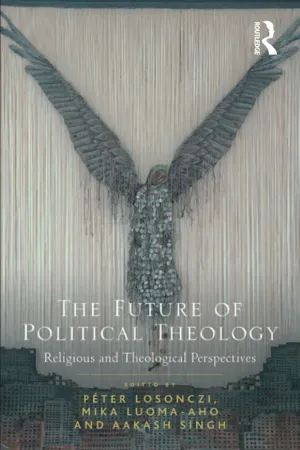
The Future of Political Theology
Religious and Theological Perspectives
- 226 pages
- English
- ePUB (mobile friendly)
- Available on iOS & Android
eBook - ePub
The Future of Political Theology
Religious and Theological Perspectives
About this book
Recent shifts in the contemporary cultural, political, and religious landscape are engendering intensive attention concerning political theology. New trends and traditional ideas equally colour these movements. Given that a medley of recent books and articles have exhaustively treated both the history and the current resurgence of political theology, we now find ourselves faced with the task of reinventing and redefining the future of political theology. This book presents a rich overview of fresh, contemporary theoretical approaches uniquely prioritizing the prospects of the future of political theology, but also making room for significant interventions from philosophy and political theory. Including prominent essays on Judaic, Islamic, Buddhist and Christian perspectives, this book balances elements from post-modern theology with more classical as well as anti-post-modern approaches.
Information
The Past of Political Theology: Concepts and Challenges
Chapter 1
The Secular Sphere in Western Theology: A Historical Reconsideration
Matthias Riedl
Introduction
The paradigm of secularization, after having dominated the social science view on religion from the 1970s to the early 1990s, has come under fierce criticism in the last two decades. Some say it is already dead. Presently—that is, since about the mid-1990s—the social sciences have flooded the book market with studies on the “resurgence of religion,” the “re-enchantment of the world,” and the like. At times, readers might have pondered how swiftly former theorists of secularization have turned into theorists of re-sacralization or de-secularization.1
Yet I’m afraid this means only replacing one misconception by another, for two reasons. First, the paradigm of secularization has not been questioned radically enough, as a radical critique would consider the historical and terminological radix, namely the concept of the “secular” as it emerges from the early western Church. The most important moment of secularization in western history is still commonly neglected: the emergence of Latin Christianity in Roman North Africa. Secondly, secularization is still considered the dominating trend of western history; some of its key events are common knowledge: the investiture controversy, humanism and the Renaissance, the Reformation, the Enlightenment, the rise of the national state, and so on. Yet other phenomena, which historians of the respective periods would consider as crucial, still are rarely accepted as key moments within the overarching master narrative; for instance, the emergence of the mendicant orders, the Devotio Moderna, Neo-Scholasticism, the periodically recurring outbreaks of apocalypticism and mysticism, and so on.
A number of publications have challenged the master narrative of secularization; I only mention two of them. Recently, Charles Taylor’s monumental work, A Secular Age, aimed “to cast down on the formerly dominant unilinear secularization theory, which sees the retreat of faith as a steady function of certain modernizing trends.”2 Taylor explained why the secular age is one of an uneasy coexistence of belief and disbelief rather than one of dying faith.3 He also showed how much developments differ between Europe and America. More than a decade earlier, Giacomo Marramao described in a genealogical study how over the last two centuries the concept of secularization, originally denoting very specific matters in canonical law, underwent dramatic shifts and expansions of its meaning. As a result the concept came to denote “the historical development of Western society from its Judeo-Christian beginnings onwards.”4 Consequently, the concept of secularization, characterized by a “structural ambivalence of meaning,” can only bring about paradoxical results when applied to a concrete historical matter:
The first paradox is the fact that the secularization of the puissance royale into a completely innerworldly sovereignty (summa legibusque soluta potestas) appears historically as the opposite of the actually intended, namely as ‘perverse effect’ of the monopoly of the sacred claimed by the church. For it results from the abolition of the sacramental value of anointment of the kings, decreed by Gregory VII in order to enforce the superiority of papal authority over royal power.5
In other words, the investiture controversy, commonly seen as one of the key events in the western process of secularization, appears from a different perspective as a process of sacralization. Can the paradox be dissolved? Yes, I think, but only by abandoning the idea of secularization as a continuous process. The abovementioned authors and many other critics have challenged simplified narratives of secularization. Yet, few of them have gone so far to say that western history is just as much characterized by sacralizing trends as by a secularizing one. Incidents of sacralization are not just periodical disruptions or setbacks in the secularization process.
The following pages are not to be seen as a scholarly study; they evidently lack sufficient scrutiny of sources and literature. They should rather be read as composing a polemical essay which attempts to challenge accustomed preconceptions of “secularization” and to suggest several alternative perspectives. Yet I do not wish to ban the concept of secularization completely but rather ask what historical processes can meaningfully be described by it. The aim of this contribution, therefore, is not polemics alone; it addresses the topic of this volume, The Future of Political Theology, from a Historian’s perspective. Historians better avoid predictions about the future. Therefore, political theology, as presented here, is a historical research program for the twenty-first century, exploring the theological foundations of western society.
My outline of this program describes five major historical phases or, perhaps better, a sequence of dominant theo-political trends. These trends do not amount to a linear narrative and their sequential character does not exclude chronological overlaps. The list of trends is anything but complete. However, it is sufficient to challenge established conceptions of the process of secularization. These theo-political trends are:
1. secularization,
2. respiritualization,
3. spiritual self-assertion,
4. decapitation, and
5. reorientation.
The provocation of the scheme is evident as secularization is the initial and not the final stage of the development. Therefore, I will focus on this first stage and deal with the other four more briefly. One more preliminary remark is necessary. By the West, I mean the civilization that emerges from the fusion of Christian theology and Latin culture. Admittedly, this description can be contested; but it has the advantage that it corresponds to the actual self-interpretation of western Christianity, at least in the Middle Ages. I’m speaking of the terms “ecclesia Latina” and “ecclesia occidentalis,” which for many centuries were considered synonymous. From this perspective, the history of western thought begins in Africa, meaning the Roman province Africa Proconsularis.
Secularization
Practically all surviving texts of the first century of Latin Christianity originate from Africa, while Christians in western Europe wrote Greek until the second half of the third century. Three theologians who, more than others, dominated western theology in the subsequent centuries were Africans: Tertullian of Carthage, who first created a Latin theological terminology, Cyprian of Carthage, who laid down the institutional principles of the western clerical Church, and finally Augustine of Hippo, who created the overarching theology of history and political theory for the western Church.6 In order to show the tremendous significance of early African Christianity within the complex of secularization, I want to refer to the earliest surviving text of Latin Christianity, the Acts of the Scillitan Martyrs.
In the year 180 AD, a group of Christians from the small town of Scillium near Carthage were brought before Proconsul Saturninus, governor of the Roman province Africa Proconsularis. One section of the interrogation reportedly went as follows:
Proconsul Saturninus: … swear by the Genius of our lord the emperor.
Speratus: I do not recognize the empire of this world (imperium huius saeculi). Rather, I serve that God whom no man has seen, nor can see, with these eyes. I have not stolen; and on any purchase I pay the tax, for I acknowledge my lord who is the emperor of kings and of all nations (dominus meus imperator regum et omnium gentium).
Proc. Saturninus: Cease to be of this persuasion.
…
Cittinus: We have no one else to fear but our Lord God who is in heaven (dominus Deus noster qui est in caelis).
Donata: Pay honour to Caesar as Caesar, but it is God we fear.7
This attitude toward the Roman Empire differs decisively from what is found in most of the Greek Christian literature of this time; it is, however, typical for African Christianity. One might compare the sentence of Speratus’ with Tertullian’s dictum that “we [Christians] have no pressing inducement to take part in your public meetings; nor is there anything more foreign to us that the affairs of the state (res publica),” as found in his Apologeticum.8 In any case, already the Acts of the Scillitan Martyrs imply the complete secularization of temporal politics. In fact, secularization could not be more complete as in Donata’s concise words: “We look at Cesar as Cesar (Caesar quasi Caesar).” He is a ruler and as such absolutely necessary. He is neither good nor evil, neither divine nor satanic. His government is a divine institution and his commands ought to be obeyed, even if they order execution; but not if they conflict with the commands of the true and invisible emperor.
In the words of Speratus: the proconsul represents the Empire of this world (imperium huius saeculi) while God is the ruler of the Oikumene. The Roman emperor sinks to the rank of a local king, limited by time and space. In the Acts of the Scillitan Martyrs, we find for the first time the term “saeculum” in the specific context that underlies the meaning of “the secular.” Saeculum, a term of probably Etruscan origins, once denoted the generational life-cycles of humanity. It was then adapted to imperial ideology under Augustus to denote the beginning of a new age. In this sense, Horace’s Carmen Saeculare is anything but a “Secular Song.” Rather it praises the sacredness of imperial time, a sacredness, however, that has been rendered meaningless by early Christianity.9 In the Acts of the Scillitan Martyrs, the concept of the secular has been completely emptied of its older religious connotations and was used to translate the New Testament term “aion.” Imperium huius saeculi means therefore the empire of this world. However, while the Hellenist term aion, especially in the context of second-century Greek religiosity, has a much more cosmological sound, the Latin translation saeculum refers exclusively to the historico-temporal world.
It is not easy to explain why early Latin Christian theology, other than the contemporary Greek Christian theology, displays this indifference toward the Empire. One explanation could be that western North Africa was one of the least Hellenized regions of the Mediterranean world, where the parallel construction of divine cosmic rule and earthly political rule was largely unknown. Additionally, pre-Roman African society did not know sacred kingship: neither the indigenous Berber tribes nor Punic merchant society knew political theologies that legitimized autocracy.
In any case, this “African attitude,” which finds little meaning in the political history of this world, is related to the second specific feature of early Latin Christian thought: the political language of the Romans is applied to the invisible sphere. God is addressed as the true dominus, the true imperator. This transcendentalization of the political vocabulary is the counter-program to the divinization of the Emperor as dominus et deus since Domitian, as well as to the imperial theology that emerged in the time of Marcus Aurelius and became dominant in post-Constantinian Greek Christianity.10 The primary loyalty of early Latin Christians is not to Rome, but to the transregional community of the Church which has an invisible ruler. Thus, they are the society of pilgrims which finds no home in this world but anticipates the Divine order of the Beyond.
Both trends of African Christian thought—the radical secularization of earthly politics and the transcendentalization of political concepts—find their most sophisticated expression in the mature work of the Church father Augustine, especially in The City of God. One of Augustine’s major theoretical achievements was the separation of historia profana and historia sacra—sacred and profane history—resulting from his doctrine of grace. The doctrine of grace says that mankind is in a gen...
Table of contents
- Cover Page
- Title Page
- Copyright Page
- Contents
- Notes on Contributors
- Foreword by Graham Ward
- Acknowledgements
- Introduction
- PART I THE PAST OF POLITICAL THEOLOGY: CONCEPTS AND CHALLENGES
- PART II POLITICAL THEOLOGY AND THE NEW THEOLOGICAL TRENDS
- PART III CONTEXTS OF POLITICAL THEOLOGY AND FUTURE PROSPECTS
- Bibliography
- Index
Trusted by 375,005 students
Access to over 1.5 million titles for a fair monthly price.
Study more efficiently using our study tools.
Frequently asked questions
Yes, you can cancel anytime from the Subscription tab in your account settings on the Perlego website. Your subscription will stay active until the end of your current billing period. Learn how to cancel your subscription
No, books cannot be downloaded as external files, such as PDFs, for use outside of Perlego. However, you can download books within the Perlego app for offline reading on mobile or tablet. Learn how to download books offline
Perlego offers two plans: Essential and Complete
- Essential is ideal for learners and professionals who enjoy exploring a wide range of subjects. Access the Essential Library with 800,000+ trusted titles and best-sellers across business, personal growth, and the humanities. Includes unlimited reading time and Standard Read Aloud voice.
- Complete: Perfect for advanced learners and researchers needing full, unrestricted access. Unlock 1.5M+ books across hundreds of subjects, including academic and specialized titles. The Complete Plan also includes advanced features like Premium Read Aloud and Research Assistant.
We are an online textbook subscription service, where you can get access to an entire online library for less than the price of a single book per month. With over 1.5 million books across 990+ topics, we’ve got you covered! Learn about our mission
Look out for the read-aloud symbol on your next book to see if you can listen to it. The read-aloud tool reads text aloud for you, highlighting the text as it is being read. You can pause it, speed it up and slow it down. Learn more about Read Aloud
Yes! You can use the Perlego app on both iOS and Android devices to read anytime, anywhere — even offline. Perfect for commutes or when you’re on the go.
Please note we cannot support devices running on iOS 13 and Android 7 or earlier. Learn more about using the app
Please note we cannot support devices running on iOS 13 and Android 7 or earlier. Learn more about using the app
Yes, you can access The Future of Political Theology by Péter Losonczi,Mika Luoma-aho,Aakash Singh in PDF and/or ePUB format, as well as other popular books in Theology & Religion & Religion. We have over 1.5 million books available in our catalogue for you to explore.