eBook - ePub
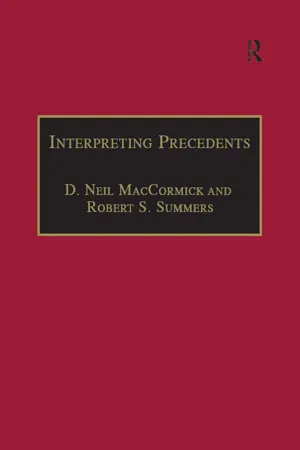
Interpreting Precedents
A Comparative Study
- 598 pages
- English
- ePUB (mobile friendly)
- Available on iOS & Android
eBook - ePub
Interpreting Precedents
A Comparative Study
About this book
This book contains a series of essays discussing the uses of precedent as a source of law and a basis for legal arguments in nine different legal systems, representing a variety of legal traditions. Precedent is fundamental to law, yet theoretical and ideological as well as legal considerations lead to its being differently handled and rationalised in different places. Out of the comparative study come the six theoretical and synoptic essays that conclude the volume.
1 | Introduction |
Precedents are prior decisions that function as models for later decisions. Applying lessons of the past to solve problems of present and future is a basic part of human practical reason. Accordingly, there is no better way for a lawyer to get at the heart of a legal system than to ask how it handles precedent. Precedent represents the law observing itself, in two senses. First, when a lawyer – judge, practitioner or legal scholar – contemplates a legal problem and inquires whether there is any precedent about this problem, what will be produced for scrutiny, should the inquiry succeed, is a record of a prior decision or decisions from the same legal system that solved, well or ill, the same or at least a similar problem. Thus one member of the system observes another member’s activity in one of the central tasks of a legal system, the problem-solving, case-deciding task. Second, there may be observance in the stronger sense of compliance; the later decision maker does not merely take note of an earlier solution, but may comply with it as a guiding model for solution of the present problem, and may do so on the ground that present observance of past rulings in like cases is the right or even the obligatory course to follow.
The body of precedents available for consideration in any legal setting represents, at its best, an accumulation of wisdom from the past. There is not always, and there certainly does not have to be, an absolutely perfect match between a new case for decision and any single precedent. More probable is it that, for any new case, a set of prior authorities provides a range of at least persuasively similar patterns which may be either adopted or adapted to solve the present problem. Precedent-based law, ‘case law’ as it is often called, is a form of law with great antiquity. The establishment of reasonably reliable tribunals for deciding disputed cases is much older than the development of the modern type of legislature. Early legislation is generally an intervention in and superimposition on some form of case law heavily based on the interpretation of general or local custom. Only later does a comprehensive codification of law through carefully designed legislation become possible, and statute law can then very largely supersede case law as the fundamental repository of basic concepts of the law. It does, however, remain necessary to interpret the codes, and they come to be glossed in a body of interpretative precedents. While one can imagine a body of pure case law as a workable legal order, it is difficult so to conceive of statute law, even under the most comprehensive codification.
Precedents, we said, are prior decisions that function as models for later decisions. Authoritative precedents are prior decisions that for some reason one ought to use as governing models for later decisions. The recognition of authoritative precedent has thus a certain backward-looking effect, to the extent that the present must be guided by what was decided in the past. But there is a forward-looking aspect to this as well; for the very existence of a practice of ascribing authority to past decisions means that one who engages in deciding a novel case does so knowing that the decision reached will itself be taken as a guide in later cases. That knowledge sets an important test for the soundness of the present decision: will it be satisfactory as a precedent? Judges are well aware that their decisions contribute to the development of the law, and they do therefore have regard to issues of policy and of principle in working towards their decisions.
As a very broad generalization, this probably holds good everywhere, but there are considerable differences at a level of greater detail. Legal systems differ markedly over the question how, and how far, they require or expect judges and others to observe precedents as governing models for decision. It therefore sheds a penetrating light on the working of a system to consider just where that very system stands on these questions, and from a comparative point of view one achieves a striking set of contrasts by looking together at one or several systems with these questions in mind. To differentiate ‘civilian’ from ‘common law’ systems is a commonplace among lawyers. It is trite learning that precedents count for less in civilian legal systems than in those of the common law, and it has sometimes been doubted whether they stand for anything much at all in the civilian systems. The present work shows the doubt to be groundless. Here it is shown that precedent counts for a great deal in civilian systems. The tendency to convergence between systems of the two types is a salient fact of the later twentieth century, although there remain real differences, some of great importance.
Nevertheless, an initial word of warning about the ‘civilian/common law’ dichotomy is also called for. As shorthand, this is a differentiation that serves a purpose, but it is both unsubtle and to a degree misleading both in terms of history and in terms of present reality. Certainly, the legal systems of Western European countries, except for England (and Wales and Ireland under English dominion), developed as modern systems heavily under the influence of a reception of ideas and even to some extent of actual legal norms from the ancient Roman civil law as that was studied in renaissance and early modern universities. English law was developed in a quite unique way through the Inns of Court and the Chancery and acquired a robust native quality very much less under Roman influence than was common elsewhere, even in neighbouring Scotland, which until the end of the eighteenth century worked much more with the Roman law paradigm than with an English system that was already in full maturity in the eighteenth century. Then, under Napoleon, France adopted codes in the first decade of the nineteenth century and, partly by conquest, partly by their own inherent prestige, the codes, or codes closely modelled on them, were adopted in other places, especially in the European countries of the romance languages, as well as in French or francophone territories beyond Europe. Germany, despite early precocity, rejected codification and sustained that rejection until after the unification of a German Empire under Prussian hegemony at the end of the nineteenth century, and the German codes when introduced were a new production, no mere gloss on the Code Napoléon. During the nineteenth century, German legal science as practised in the great university law faculties attained very high prestige, involving deep studies of the usus modernus Pandectarum, the modern usage of the body of (Roman) law based on Justinian’s Digest. This influence was strongly felt in the Nordic countries, which, like the United Kingdom, never produced comprehensive codifications, though most of the modern law on topics of importance has some statutory foundation. The Nordic countries have strongly civilian-influenced systems of mainly statutory law and, if the ultimate basis of the systems lies in the ancient customs of the Scandinavian peoples, these are now almost entirely overlaid by modernizations partly of purely domestic construction, partly imported. Meanwhile, there has been a great growth in both the relative importance and the extensiveness of statutory law in the countries of the common law tradition.
It is thus at best misleading to think that there is a unified ‘civilian’ type of legal system standing in simple contrast to ‘common law’ countries like the United Kingdom (along with those countries of the Commonwealth that adopted the English common law and have adapted it to their own preferences over time) and the United States. It is important to remember that the internal legal dualism of the UK leaves Scots law as a system with civilian roots but at the present time a largely ‘common law’ approach to legal methodology, and that Louisiana has, in important respects, a codified civil law system within the USA, just as that within Canada, Quebec uses the code civil. On the other hand, the ‘civilian’ systems contain several different families and distinct histories, including for some a history of long submersion in a variety of other legal traditions, as has been the fate of Finland and Poland until, and to a degree during, the twentieth century. We do use the ‘civilian versus common law’ contrast as basic terms of reference throughout much of the rest of this book; but this is acknowledged to be a rather crude distinction taken in gross, and the authors have tried to ensure that more subtle differentiations are used whenever these are required. We hope that no error will have crept in from an unwarranted over usage of the simple dichotomy.
The legal systems of contemporary states and federations are formidably complex and many-faceted. They can be viewed in many perspectives – as adjuncts of the economic system, as frameworks for and products of the political system, as sites of social interaction, as tools in the power play of mighty interests, and so on. One available perspective is that which sees them as quite particularly theatres of practical reason and deliberation. In this perspective they belong, however imperfectly, to the realm of rational order, and they contribute to society a rational system for structuring mutual expectations and interactions. Max Weber (Weber, 1954) and his followers have argued that the emergence of rational legal order is a special feature of commercial and then capitalist societies, so a view of law as participating in rational order and practical reason is not necessarily at odds with some of the other approaches possible – but it is different. And it is the perspective in which the present set of studies belongs.
One conception of legal rationality ties it strongly to statute law and to codification. A modern code is ordered in a rational way into chapters, sections, subsections. The basic ideas of the law are encompassed within well-structured texts written in plain French or plain German or plain Spanish or whatever. Citizens and officials have the same access to the basic rules of the system, and legal certainty and the security of legal subjects in awareness of their rights and confidence about their adequate judicial or administrative protection set a framework for the rational conduct of the business of civil society under the protection of a rationally administered state. This ideal of rational order is then apt to be contrasted with the muddle of the common law, where the rules and principles for the conduct of affairs have to be grasped from a reading of a colossal library of cases that are often intelligible only to people who have already considerable legal learning. Although much law in common law countries is statutory, the statutes are usually built on a foundation of case law, rather than the cases being of significance only as a commentary on the code in which all fundamentals are determined.
The contrast just drawn has real importance, though like all such contrasts it probably exaggerates the two extreme cases contrasted. One way to differentiate the statute law and the case law styles is through the contrast between ‘constructivist’ and ‘critical’ rationalism. (See Hayek, 1975.) Statute law requires, of course, a legislature to enact it; there must be a carefully planned project for enactment, followed by debate, and decision laying down all at once a whole scheme of legal norms. For this to work well, the promoters and drafters of a statute have to have foreseen well all manner of possibilities that will arise and be covered by this statute, and have to have worked out how to fit its provisions in alongside the existing law so far as not repealed and superseded by the present enactment. The elaboration of law through precedent is usually a slower, more evolutionary business, in which by an incremental process small adjustments are made case by case, usually never more than necessary for solving the problem in each case, always correctable in the light of experience through overruling of discovered mistakes by highest-level appeal courts, nowadays universally empowered to correct also their own prior errors. The method of statute requires the use of reason to work out a large plan in advance; the method of precedent applies critical intelligence to reasoning out the best new decision in light of the prior ones, in light of what is special about the case at hand, and in light of the need to maintain a coherently principled body of law.
Each of these methods at its best is a general type of rationality in social action, not only in the law. Each is a way of constituting what Summers calls ‘authority reasons’ for action (Summers, 1978, p.724). In relation to law, it would be beside the point, really, to ask which is ‘the best’ use of reason, ‘the best’ kind of rationality. No contemporary legal order is conceivable that does not make large use of both. At most, the issue is how best to balance the two in a well-working system, and that in turn may not admit of any universal answer. Institutions and their history and the legal traditions that have grown up around them will profoundly affect what is possible and desirable as a path of development for any given legal system.
In any event, for the student of practical reason in human affairs, the study of lawyers’ use of precedent has a magnetic fascination. Law has in times past been considered a kind of ‘written reason’ or, by the greatest Scots authority of the early modern law, ‘reason itself as it is versant about the rights of man’ (cf. Stair, 1995, I.1.1). Neither such view needs be swallowed whole, but each has enough suggestiveness to encourage close inquiry into the questions how and why lawyers reason in relation to their and their peers’ past decisions when they come to arguing or deciding new cases, or solving problems in ways that save the labour, anxiety and expense of litigation in court. Is it, and if so in what way or on what ground, rational or reasonable to treat past patterns of decision as supplying a set of convincing reasons for use in later cases? Or as yielding presumptively or even absolutely governing patterns or indeed rules for the present and the future? How close must the resemblance be? Should rules and principles – rules or principles – be explicitly stated in earlier decisions to provide express guidelines for later decisions, or is it enough just to state reasons for the particular case, leaving the later decision maker to figure out the relevance of the old decision, given its factual setting, to the new one, given its facts, untrammelled by such perhaps premature pronouncements? When and by what means can the later decision maker escape the constraints of a decision that seems wrong if applied to the present case? If there are other authoritative (or more authoritative) norms governing decisions – the provisions of a constitution or a code or a statute – how should reasoning with precedents interact with interpreting and applying norms of this kind? Should it fall silent in face of them?
Questions such as these can be multiplied almost infinitely, and they can certainly be set in stricter order, as we shall see. But to ask them even in an initially unstructured way is sufficient for the purpose of pressing home the claim that in them lie strong grounds for thinking the study of precedent essential to grasping the character of law as a rational enterprise, one guided by practical reason. Again, since lawyers carry out their reasoning in quite special institutional settings with quite individual histories and unique contemporary political and social contexts, we expect local differences in the way such matters are handled; tracking a presumptively common rationality through a variety of institutional settings ought to enrich greatly both our comparative insight into differences of institutional rationality and rationale, and our understanding of the fundamentals of reason in law, if there are any.
The present group of authors – the ‘Bielefelder Kreis’ as we have audaciously called ourselves in gratitude for sponsorship of the Zentrum für interdisziplinäre Forschung (‘ZiF’) in the University of Bielefeld – have a particular interest in just such an approach from the perspective of practical reason and discourse. For the group comprises legal theorists, philosophers of law and comparatists united by an interest in the comparative and theoretical exploration of aspects of reasoning in different legal systems. There is no single doctrine or set of tenets about legal reasoning or general legal theory to which each of the group subscribes, no ‘party line’. But there is a sufficient community of interest and of orientation to make possible a common approach to the task of system comparison.
The sufficiency of the group’s common purpose has been tested before, in the preparation of the book, Interpreting Statutes: a Comparative Study (1991) to which the present work is deliberately presented as a sequel. The methodology in use is substantially the same as in the earlier work, though experience has made possible some further refinement of it. Methodologically central to both projects has been the idea that every effort should be made to compare like with like (‘functional equivalents’). It is easy for scholars who write about different legal systems aiming at making comparisons between them to operate at cross-purposes, raising grossly or subtly different points in similar but not identically interpreted terms and then to (mis)compare them in an inevitably misleading way. The main basis of the group’s attempt to avoid this in each of the projects has been the posing and refining of a set of suitable common questions addressed to the relevant subject matter in each of the legal systems covered by the project, a task in itself formidable in terms of focus, criteria, concepts and terminology. The aim has been ideally to pose questions which cover the whole relevant field, and which enable scholars working on a particular system to inquire in a way that is relevant to the material available in the system and to report back to the group as a whole in such terms that each report, taken country by country (and then also including the European Union in the present, though not the previous, project), really does address the same topics from the same general viewpoint as every other.
Settling a satisfactory set of question topics is far from easy. It is not a task to be carried out arbitrarily, nor was it. For the present project, the agreed topics cover six main areas: the institutional and systemic context in which precedents are used; the concept of the binding character or other normative force that is ascribed to precedents in that context; the rationale for recognizing precedents as authoritative; the identification of the particular element in a precedent to which special authority attaches; the accepted grounds on which and methods by which it is permissible to depart from ostensibly binding precedents; and finally, critical evaluations of practice in relation to precedent. The process of settling them was a four-stage process. It started at a group meeting in ZiF (Bielefeld) in June 1992 primarily dedicated to a critical reading and discussion of Interpreting Statutes and to discussing whether elements of that project could be developed in new directions in the light of constructive criticisms. It was followed out at a further group meeting at Cornell Law School in April 1993, at which the decision to proceed with a project on precedent crystallized and preliminary discussion of the topics and problems requiring investigation took place, after which members of the group prepared a first version of the questions that would be used to give a common structure for inquiring about the usage of precedent in each of the countries covered by the project. Over the following year, first drafts were prepared giving an account of practice concerning precedent in each of these countries, and a four-day meeting was held in June 1994, first at the University of Bologna and then at the European University Institute in Florence, to discuss critically each of the draft chapters in their then-achieved form and, yet more urgently, to review critically the draft questions in the light of the attempts made to apply them without strain or distortion to the local materials available in each jurisdiction. In light of these discussions, substantial refinements were agreed to the questions, and over the ensuing months further drafts of answers were prepared. In June 1995, a two-day meeting was held in the University of Bologna to scrutinize, discuss and mutually criticize or clarify the country-by-country essays, and to select and agree on the preparation of common general chapters drawing out the comparative and theoretical lessons derivable therefrom.
The dialectic of jointly working out questions through extended discussion, then individually preparing work under their guidance, then gathering again to discuss critically both the questions and the work prepared in response to them, then further refining both, brought about real benefits for the pursuit of the present legal-scientific and legal-theoretical enterprise. It gave participants in the project an agreed and commonly understood conceptualization of the inquiry, a shared method of inquiry, and to an extent a common mode or framework of thought. The share...
Table of contents
- Cover
- Half Title
- Title Page
- Copyright Page
- Table of Contents
- Preface and Acknowledgements
- Series Preface
- 1 Introduction
- 2 Precedent in the Federal Republic of Germany
- 3 Precedent in Finland
- 4 Precedent in France
- 5 Precedent in Italy
- 6 Precedent in Norway
- 7 Precedent in Poland
- 8 Precedent in Spain
- 9 Precedent in Sweden
- 10 Precedent in the United Kingdom
- 11 Precedent in the United States (New York State)
- 12 Precedent in European Community Law
- 13 Institutional Factors Influencing Precedents
- 14 The Binding Force of Precedent
- 15 Rationales for Precedent
- 16 What is Binding in a Precedent
- 17 Departures from Precedent
- 18 Further General Reflections and Conclusions
- Appendix: Final Version of the Common Questions, Comparative Legal Precedent Study, September 1994
- About the Authors
- Index
Trusted by 375,005 students
Access to over 1.5 million titles for a fair monthly price.
Study more efficiently using our study tools.
Frequently asked questions
Yes, you can cancel anytime from the Subscription tab in your account settings on the Perlego website. Your subscription will stay active until the end of your current billing period. Learn how to cancel your subscription
No, books cannot be downloaded as external files, such as PDFs, for use outside of Perlego. However, you can download books within the Perlego app for offline reading on mobile or tablet. Learn how to download books offline
Perlego offers two plans: Essential and Complete
- Essential is ideal for learners and professionals who enjoy exploring a wide range of subjects. Access the Essential Library with 800,000+ trusted titles and best-sellers across business, personal growth, and the humanities. Includes unlimited reading time and Standard Read Aloud voice.
- Complete: Perfect for advanced learners and researchers needing full, unrestricted access. Unlock 1.5M+ books across hundreds of subjects, including academic and specialized titles. The Complete Plan also includes advanced features like Premium Read Aloud and Research Assistant.
We are an online textbook subscription service, where you can get access to an entire online library for less than the price of a single book per month. With over 1.5 million books across 990+ topics, we’ve got you covered! Learn about our mission
Look out for the read-aloud symbol on your next book to see if you can listen to it. The read-aloud tool reads text aloud for you, highlighting the text as it is being read. You can pause it, speed it up and slow it down. Learn more about Read Aloud
Yes! You can use the Perlego app on both iOS and Android devices to read anytime, anywhere — even offline. Perfect for commutes or when you’re on the go.
Please note we cannot support devices running on iOS 13 and Android 7 or earlier. Learn more about using the app
Please note we cannot support devices running on iOS 13 and Android 7 or earlier. Learn more about using the app
Yes, you can access Interpreting Precedents by D. Neil MacCormick, Robert S. Summers, Arthur L. Goodhart, D. Neil MacCormick,Robert S. Summers,Arthur L. Goodhart in PDF and/or ePUB format, as well as other popular books in Law & Law Theory & Practice. We have over 1.5 million books available in our catalogue for you to explore.