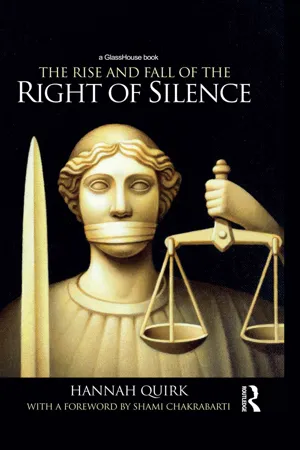
Within an international context in which the right to silence has long been regarded as sacrosanct, this book provides the first comprehensive, empirically-based analysis of the effects of curtailing the right to silence. The right to silence has served as the practical expression of the principles that an individual was to be considered innocent until proven guilty, and that it was for the prosecution to establish guilt. In 1791, the Fifth Amendment to the US Constitution proclaimed that none 'shall be compelled in any criminal case to be a witness against himself'. In more recent times, the privilege against self-incrimination has been a founding principle for the International Criminal Court, the new South African constitution and the ad hoc International Criminal Tribunals for Rwanda and the former Yugoslavia. Despite this pedigree, over the past 30 years when governments have felt under pressure to combat crime or terrorism, the right to silence has been reconsidered (as in Australia), curtailed (in most of the United Kingdom) or circumvented (by the creation of the military tribunals to try the Guantánamo detainees). The analysis here focuses upon the effects of the Criminal Justice and Public Order Act 1994 in England and Wales. There, curtailing the right to silence was advocated in terms of 'common sense' policy-making and was achieved by an eclectic borrowing of concepts and policies from other jurisdictions. The implications of curtailing this right are here explored in detail with reference to England, Wales and Northern Ireland, but within a comparative context that examines how different 'types' of legal systems regard the right to silence and the effects of constitutional protection.
- 232 pages
- English
- ePUB (mobile friendly)
- Available on iOS & Android
eBook - ePub
The Rise and Fall of the Right of Silence
About this book
Information
Table of contents
- Cover
- Title
- Copyright
- Dedication
- Contents
- Foreword
- Acknowledgements
- Table of cases
- Introduction
- 1 The right of silence – a benchmark of justice?
- 2 The right of silence – a crime control target?
- 3 Police custody, cop culture and the caution
- 4 A ‘fundamental dilemma’: the undermining of legal representation at the police station
- 5 Silence in court
- 6 Conclusion: the transformed landscape of the criminal trial
- Legislation: Criminal Justice and Public Order Act 1994 (as enacted)
- Methods
- Bibliography
- Index
Trusted by 375,005 students
Access to over 1.5 million titles for a fair monthly price.
Study more efficiently using our study tools.
Frequently asked questions
Yes, you can cancel anytime from the Subscription tab in your account settings on the Perlego website. Your subscription will stay active until the end of your current billing period. Learn how to cancel your subscription
No, books cannot be downloaded as external files, such as PDFs, for use outside of Perlego. However, you can download books within the Perlego app for offline reading on mobile or tablet. Learn how to download books offline
Perlego offers two plans: Essential and Complete
- Essential is ideal for learners and professionals who enjoy exploring a wide range of subjects. Access the Essential Library with 800,000+ trusted titles and best-sellers across business, personal growth, and the humanities. Includes unlimited reading time and Standard Read Aloud voice.
- Complete: Perfect for advanced learners and researchers needing full, unrestricted access. Unlock 1.5M+ books across hundreds of subjects, including academic and specialized titles. The Complete Plan also includes advanced features like Premium Read Aloud and Research Assistant.
We are an online textbook subscription service, where you can get access to an entire online library for less than the price of a single book per month. With over 1.5 million books across 990+ topics, we’ve got you covered! Learn about our mission
Look out for the read-aloud symbol on your next book to see if you can listen to it. The read-aloud tool reads text aloud for you, highlighting the text as it is being read. You can pause it, speed it up and slow it down. Learn more about Read Aloud
Yes! You can use the Perlego app on both iOS and Android devices to read anytime, anywhere — even offline. Perfect for commutes or when you’re on the go.
Please note we cannot support devices running on iOS 13 and Android 7 or earlier. Learn more about using the app
Please note we cannot support devices running on iOS 13 and Android 7 or earlier. Learn more about using the app
Yes, you can access The Rise and Fall of the Right of Silence by Hannah Quirk in PDF and/or ePUB format, as well as other popular books in Droit & Droits civiques en droit. We have over 1.5 million books available in our catalogue for you to explore.