eBook - ePub
The Internationalisation of Corruption
Scale, Impact and Countermeasures
- 304 pages
- English
- ePUB (mobile friendly)
- Available on iOS & Android
eBook - ePub
The Internationalisation of Corruption
Scale, Impact and Countermeasures
About this book
Corruption scandals hit the headlines all around the world, across a diverse range of institutional, organisational and cultural settings. Corruption is a major obstacle to political, social and economic development - its 'internationalisation' has had profound implications for counter corruption efforts. The Internationalisation of Corruption provides readers with an analytical framework with which to approach the issue of corruption in international affairs, from the perspective of international studies as an interdisciplinary space in the social sciences. The authors also examine the implications of corruption in world politics, international business and global finance; how corruption is linked to transnational crime networks; and the consequences of corruption for international development and world health. The Internationalisation of Corruption addresses the following questions: ¢
Information
1
Introduction
1 Background
In recent years, corruption scandals have hit the headlines all around the world, across a diverse range of institutional, organisational and cultural settings. These series of events have exploded the myth that corruption is a problem which is confined to a specific sector or to the developing world.
The costs of corruption are significant and affect people worldwide. Analysts have linked corruption with political instability, human rights violations, the exacerbation of poverty, the erosion of public confidence in institutions and many other negative outcomes. It has also been identified as a major obstacle to political, social and economic development in many parts of the world.
The increasing complexity of corrupt transactions presents significant challenges for those working in the field of counter corruption. In a globalised world characterised by increasing flows of goods, capital, people and knowledge, corrupt activity not only takes place within national boundaries but also across them. Furthermore, the broadening and deepening of political and economic integration means that events in one part of the world polity can often have knock-on effects elsewhere; even when corruption occurs at either local or national level, its consequences can resonate globally.
The ‘internationalisation’ of corruption has profound implications for counter corruption efforts, which have traditionally fallen within the remit of national politics and law-making. The proliferation of corruption transnationally has destroyed the notion that corruption is a domestic political issue which can be dealt with by individual countries alone, and is increasingly perceived as a problem which can only be addressed collectively by a collaborative approach between international actors.
Indeed, as the international community strives to meet its Millennium Development Goals (MDGs), tackling corruption has been placed firmly on its agenda. Over the past decade, therefore, visible attempts have been made to collectively counter this threat, including the creation of several international conventions and treaties in this policy area.
It is in this context that there has been a growing interest in the subject of corruption, internationally, as well as a burgeoning workforce of professionals tasked with fighting corruption in their respective fields. This includes, for example, counter corruption specialists in public and private sector organisations, investigative and policing personnel with roles in counter corruption and policy/law makers with responsibilities for countering corruption.
Correspondingly, governments and other organisations are investing more and more in the expansion of ‘knowledge’ in this important area of study. The creation of the International Anti-Corruption Academy – the world’s first educational institute dedicated to fighting corruption – is indicative of this trend, as is the emergence of several bespoke degree programmes on the subject and numerous initiatives to professionalise the investigation of corruption.
Despite the growing interest of governments, organisations and academic institutions in addressing this worldwide problem, literature on corruption is relatively sparse. As Lambsdorff (2007: 1) notes: ‘Corruption, the misuse of public power for private benefit, turns out to be a relatively new challenge for social sciences. It has been an issue for politics and society for many centuries, but its systematic scientific treatment is rather novel.’
This text is therefore intended to offer a timely contribution to literature in this field, by providing an accessible, entry-level introduction to this area of study.
The complex nature of corruption and the multiple levels at which it pervades international society means that the subject can be approached from a wide range of academic disciplines; by its very nature, the subject is interdisciplinary. The text will develop an inclusive and broad-based understanding of corruption from the perspective of international studies as an interdisciplinary space in the social sciences. The book is written from a social science perspective, making it accessible to anyone approaching the study of corruption from any one of the different disciplinary traditions.
2 Defining Corruption
One of the difficulties of examining corruption from an international perspective is the challenge of achieving a common definition of the term. Indeed, definitions employed by different nations, legal systems, organisations and cultures can vary. As Iyer and Samociuk (2006: 2) note, ‘there are dozens of definitions of … corruption in use around the world’. For example, Table 1.1 demonstrates the range of definitions which are currently employed internationally. This is by no means an exhaustive list but indicates the nuances created by the existence of different definitions.
Table 1.1 Definitions of corruption from around the world
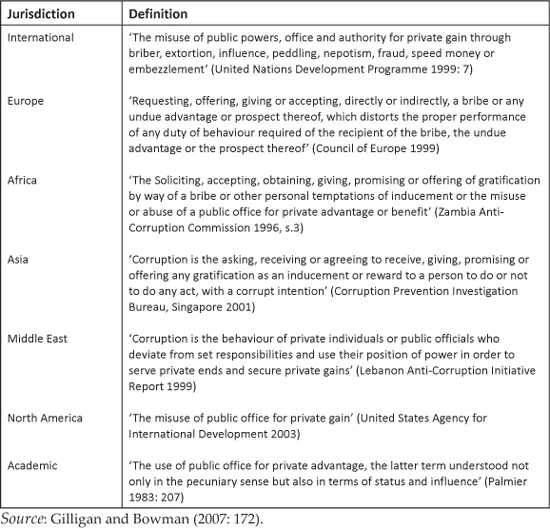
Tanzi argues that an increasingly common definition of corruption is the ‘abuse of public power for private benefit’ (Tanzi 1998: 564). It has been suggested by some that this definition should be extended, since it cannot be applied to all types of corruption. Corruption can also be committed not only for private gain but, as Tanzi points out, ‘for the benefit of one’s party, class, tribe, friends, family, and so on’ (Tanzi 1998: 564). Furthermore, this definition does not address the problem of corruption in the private sector, or the links between private and public sector corruption, such as the role of the private sector in fostering corruption in the public sector. Not only public officials may be tempted by bribes, but also those in positions of trust or authority in private corporations, NGOs or charities. The Asian Development Bank (2008), for example, has addressed some of the above issues by defining corruption as ‘the abuse of public or private office for personal gain’. The Bank also provides a more comprehensive definition: ‘Corruption involves behavior on the part of officials in the public and private sectors, in which they improperly and unlawfully enrich themselves and/or those close to them, or induce others to do so, by misusing the position in which they are placed’ (Asian Development Bank 2008).
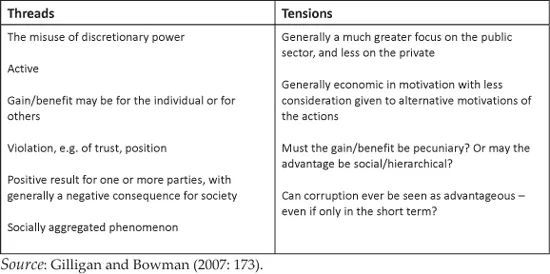
As the above discussion demonstrates, while it is possible to identify commonalities in terms of respective definitions, there remain tensions between competing classifications. Table 1.2 demonstrates some of these commonalities and tensions.
Table 1.2 Common threads and tensions in defining corruption
In addition to defining the term itself, analysts have sought to provide typologies of corruption; in other words, defining which types of behaviour can be classified as ‘corrupt’. In this sense, corruption is often used as an umbrella term to refer to a range of specific illicit activities. For example, Langseth (2006) lists different types of corruption:
• ‘grand’ corruption
• ‘petty’ corruption
• ‘active’ corruption
• ‘passive’ corruption
• bribery
• embezzlement
• theft
• fraud
• extortion
• abuse of discretion
• favouritism
• nepotism, and
• improper political contributions.

Even within the above categories, definitional variations abound. Taking fraud, for example, a report published by the NHS Counter Fraud and Security Management Service (NHS CFSMS 2006) identified a range of different national definitions for fraud. These are highlighted in Table 1.3.
Table 1.3 National definitions of fraud
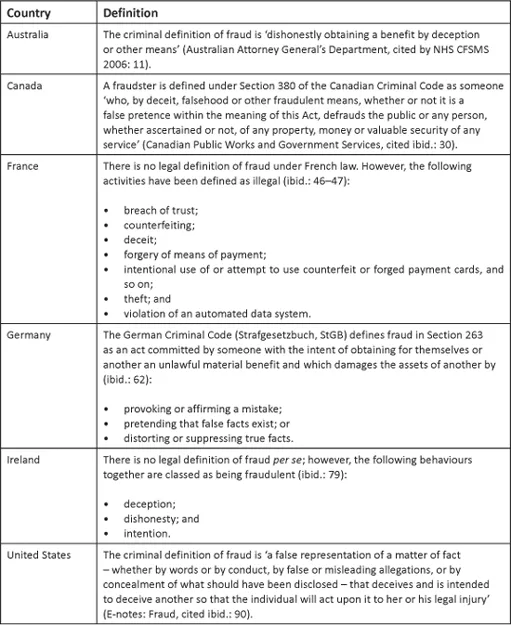
Differences notwithstanding, there is a degree of convergence between these definitions. For example, as the NHS Counter Fraud and Security Management Service report points out, ‘the main common elements that constitute an offence of fraud are dishonesty, deceit, deception and intent’ (NHS CFSMS: 6).
Due to the different interpretations of corruption, operationalising the concept ‘corruption’ is often deemed to be challenging. For example, some question whether it is possible to be compare incidences of corruption in different countries if their conceptions of what constitutes corrupt acts differ. These issues will be considered in greater detail throughout the text. However, the purpose of this introduction is not to resolve these issues of definition, but to offer some conceptual caveats. It is perhaps worth noting the sentiments of a prominent anti-corruption scholar, Johann Graf Lambsdorff (2007: 15):
Definitions of corruption can be discussed at length without necessarily providing an actual value to the reader. Still some researchers display their endeavours in this area. They are willing to go into time-consuming debate and are fierce in preferring one approach to another. Such debate, however, tends to absorb much of the energy that is desperately needed elsewhere. Recognising this, some colleagues have started to avoid definitions of corruption, claiming that most cases of corruption are unambiguously perceived by most observers.

3 The Study of Corruption in an International Context
Analysts engaged with the study of corruption in an international context have sought to answer a number of different questions. For example:
• Is it possible to measure the scale of corruption globally?
• Is it possible to identify the causes of corruption?
• What is the impact of corruption?
• To what extent does corruption exist in different parts of the world?
• How can the international community effectively counter corruption?
• Who are the actors involved and what progress is being made?
• Which sectors are most affected by corruption, internationally?
• Which international transactions are vulnerable to corruption, and which actors are involved?
This text will give an introduction to the above themes.
4 Structure of the Book
PART I – SCOPE AND IMPACT OF CORRUPTION
Part I introduces perspectives on the scale and impact of international corruption. It considers the various surveys and measurement methods employed, and the impact of these levels of corruption around the world.
CHAPTER 2 – SCALE AND MEASUREMENT
This chapter considers the importance of measuring corruption, internationally. It introduces some measurement methods and discusses the relative merits of these approaches, while also looking at the costs of corruption.
CHAPTER 3 – CAUSES AND CONSEQUENCES
This chapter introduces perspectives on the causes and consequences of international corruption. It concludes by highlighting some of the particularly grave effects that these illicit activities have on economic, social and political development in the developing world.
PART II – CHALLENGING CORRUPTION
Part II introduces the response of the international community to corruption. It considers the roles of state and non-state actors and their interaction, and the counter measures that have been used to combat international corruption.
CHAPTER 4 – COUNTERING CORRUPTION: THE ROLE OF STATE ACTORS
This chapter considers the role of state actors in challenging corruption. It examines the nature and evolution of international regimes and international law, including developments in this field in terms of international conventions tackling international corruption, and introduces some of the critical assessments which have been made in relation to these approaches.
CHAPTER 5 – COUNTERING CORRUPTION: THE ROLE OF NON-STATE ACTORS
This chapter focuses on the role of non-state actors, or Non-Governmental Organisations (NGOs), and their efforts to counter international corruption. It also considers how these organisations interact with the international regimes and regulatory frameworks outlined in Chapter 4.
PART III – SECTOR ANALYSES AND CASE STUDIES
Part III introduces some of the sectors affected by international corruption, including politics, business, finance, transnational organised crime, international aid and world health. Each chapter includes detailed case studies and examples to highlight some of the issues identified in relation to each secto...
Table of contents
- Cover Page
- Half Title Page
- Title Page
- Copyright Page
- Table of Contents
- List of Figures, Tables and Lists
- List of Abbreviations
- About the Authors
- Foreword
- Chapter 1 Introduction
- Part I Scope and Impact of Corruption
- Part II Challenging Corruption
- Part III Sector Analyses and Case Studies
- Bibliography
- Index
Trusted by 375,005 students
Access to over 1.5 million titles for a fair monthly price.
Study more efficiently using our study tools.
Frequently asked questions
Yes, you can cancel anytime from the Subscription tab in your account settings on the Perlego website. Your subscription will stay active until the end of your current billing period. Learn how to cancel your subscription
No, books cannot be downloaded as external files, such as PDFs, for use outside of Perlego. However, you can download books within the Perlego app for offline reading on mobile or tablet. Learn how to download books offline
Perlego offers two plans: Essential and Complete
- Essential is ideal for learners and professionals who enjoy exploring a wide range of subjects. Access the Essential Library with 800,000+ trusted titles and best-sellers across business, personal growth, and the humanities. Includes unlimited reading time and Standard Read Aloud voice.
- Complete: Perfect for advanced learners and researchers needing full, unrestricted access. Unlock 1.5M+ books across hundreds of subjects, including academic and specialized titles. The Complete Plan also includes advanced features like Premium Read Aloud and Research Assistant.
We are an online textbook subscription service, where you can get access to an entire online library for less than the price of a single book per month. With over 1.5 million books across 990+ topics, we’ve got you covered! Learn about our mission
Look out for the read-aloud symbol on your next book to see if you can listen to it. The read-aloud tool reads text aloud for you, highlighting the text as it is being read. You can pause it, speed it up and slow it down. Learn more about Read Aloud
Yes! You can use the Perlego app on both iOS and Android devices to read anytime, anywhere — even offline. Perfect for commutes or when you’re on the go.
Please note we cannot support devices running on iOS 13 and Android 7 or earlier. Learn more about using the app
Please note we cannot support devices running on iOS 13 and Android 7 or earlier. Learn more about using the app
Yes, you can access The Internationalisation of Corruption by Clare Fletcher,Daniela Herrmann in PDF and/or ePUB format, as well as other popular books in Droit & Commerce Général. We have over 1.5 million books available in our catalogue for you to explore.