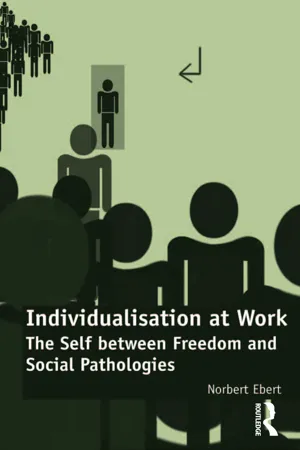
- 196 pages
- English
- ePUB (mobile friendly)
- Available on iOS & Android
eBook - ePub
About this book
Individualisation has become an ambiguous, but defining feature of late modern societies and while it is in part characterised by an increase in individual autonomy and a sense of liberation, individuals are equally required to negotiate a fragmented, pluralised and ambiguous social order by themselves. This book sheds light on the processes and nature of contemporary individualisation, specifically exploring the manner in which it unfolds under conditions of contemporary network capitalism. With attention to the modern workplace, where the individual and the organisation meet directly, but also in the wider community, Individualisation at Work reveals individualisation to become an ideological and ambiguous process of liberation, as conditions of marketisation and corporatisation transform the emancipatory qualities and motivations that define individualisation into a means for the coordination and reproduction of systemic imperatives, which are realised by individuals' qualities and capacities for self-realisation. A rigorous theoretical study, illustrated with interview material gathered amongst managers from internationally operating corporations, this book will appeal to sociologists with interests in work and organisations and the theory of contemporary modernity.
Information
Chapter 1
Structural Individualisation
This chapter establishes the broad context for my argument by examining the structural underpinnings of the relationship between the individual and society in late modernity. I argue that what underpins the relationship between the individual and society is a proliferation of functional and normative ambiguities. In order to demonstrate this, I will concentrate on three main points:
First, structural differentiation did not come to a halt with the rise of modernity. Indeed, I contend that with ongoing processes of structural differentiation late modern societies can no longer be described as simply functionally differentiated; increasingly these societies are hyper-differentiated. Secondly, the origins of both functional and normative forms of differentiation are concrete social relationships. These relationships rest on communicative action that in late modernity goes beyond the uncoupling of systems and lifeworld, thus leading not only to systemic hyper-differentiation but also to hypertrophied lifeworlds1, that is, a normative overload that does not or has not yet translated into stable communicative structures. In this a fundamental ambiguity emerges as individuals gain more autonomy, while also becoming subject to a greater risk of instrumentalisation. Thirdly, under these circumstances, the ties between individuals and society increasingly come to manifest themselves as a web of systemic imperatives that can no longer be described as ‘institutionalised individualism’ or as individual responses to systemic dependencies. Individualisation becomes an ambiguous process. While it is structurally enabled, it is also more and more systemically organised. This puts individuals increasingly at risk of becoming active hubs not only for systemic coordination, but also for the reproduction of their own systemic dependence.
1. From Structural Differentiation to Hyper-differentiation?
As modern society began to take shape, sociologists became ever more able to distinguish, in both theoretical and empirical ways, amongst the various components that constituted this modern society. In this, the theory of structural differentiation, although not all-encompassing, has become one of the most useful sociological ‘tools’ for the analysis of various aspects of social change, be it in pre-modern, modern or late modern societies. In general terms, Alexander and Colomy get to the heart of structural differentiation when they write: ‘The process of differentiation refers to tendencies that societies have, when certain background conditions are present, to respond to social conflicts or abrupt disruptions by developing more specialised structures’ (1985: 15).
My argument here is concerned in particular with the consequences of social change in late modernity underpinning individualisation, the economy and integration (Schimank 1996: 14). These consequences manifest in a strikingly distinctive fashion in the general shifts towards marketisation, towards the increased relevance of corporations and towards work-organisational changes (these ideas will be discussed in greater detail in Chapters 3, 4, 5 and 6). This is the terrain in which I will locate my investigation to exemplify how the negotiation of functional and normative processes becomes a task which characterises individualisation today. Given the relevance of the economy and work in contemporary society, these developments hardly remain confined to the economic sphere; indeed, they spill over into a variety of other areas of everyday life, such as the family, friendships or in leisure activities.
Georg Simmel’s (1890) discussion of the inseparability of ‘Vergesellschaftung’ (socialisation as continuous formation of society) and ‘Individualisierung’ (individualisation), Ferdinand Toennies’ differentiation between ‘Gemeinschaft’ and ‘Gesellschaft’ (1955) and Émile Durkheim’s analysis of changing social divisions of labour (1964) were among the first sociological works to point to the complex interplay of structural differentiation, individualisation and social integration. These, of course, have not been the only ones to highlight this interplay. Indeed, it was Max Weber in particular who was most concerned with an increasingly fragmented and pluralised modern society. His approach offers much for the present investigation of the characteristics of late modernity, as well as the ambiguities characterising the relationship between systems and lifeworlds.
Max Weber conceptualised the differentiation running through modern society on the basis of incompatible and largely autonomous value spheres (1978 [1946]: 147), with each autonomous sphere driven by its ‘own specific mode of rationality’ (Brubaker 1984: 30). Thus, the sphere of law strives for justice, the sphere of science searches for truth, the sphere of economy maximises profits, the sphere of politics seeks power, while art works towards ultimate beauty. Accordingly, multiple, parallel, contradictory and conflicting logics of rationalisation operate in contemporary society (Brubaker 1984: 9). Importantly, these conflicting value spheres, based on various types of purposive rationality, challenge individuals’ sense of coherence and continuity. They trigger what could be called an ‘inner differentiation’ that puts processes of individualisation at risk of being ‘organised’ by external and systemic forces (Brubaker 1984: 68). For Weber, it was the process of parallel rationalisation that sat at the heart of fragmentation and pluralisation. Following and building on Weber, I am arguing in this section that late modern society is not only functionally and normatively differentiated, but functionally as well as normatively hyper-differentiated, generating ambiguities between the various spheres of action.
My concern here is not with the emergence of incommensurable value spheres with the rise of modernity, but with the ongoing structural differentiation between and within those value spheres, and their effect on individuals. Weber provides us with a theoretical starting point for the understanding of hyper-differentiation as a major source of ambiguities, and as a central characteristic of late modern society. While the consequences of hyper-differentiation are widely celebrated as an increase in individual choice, I contend instead that while individuals enjoy hitherto unheard-of standards of living, the risk of instrumentalisation, of being trapped in all-consuming processes of rationalisation and bureaucratic organisation (something Weber referred to as an ‘iron cage’ (1974[1930]: 181), has equally increased.
Talcott Parsons has built upon and reconceptualised Weber’s ideas in a variety of interesting ways. Although not opposed to the concept of structural differentiation, he took a more ‘harmonising’ approach. While differentiation – according to him – leads to the emergence of various systems in society, ‘functional prerequisites’ (Parsons 1963: 348) are supposed to realise ‘harmonising’ ‘normative orientations’. The problem is, however, that a ‘harmonising’ normative approach no longer holds for late modern society as ongoing processes of structural differentiation cannot but lead to a normative pluralisation and fragmentation. Thus, hyper-differentiation also means that ambivalent or contradictory norms and values might be realised.
Some aspects of Parsons’ systemic approach can be found – alongside considerable contributions from Durkheim and Weber – in the work of Niklas Luhmann. For Luhmann, modern societies are characterised by subsystems which are of equal importance for the reproduction of society. One of Luhmann’s main concerns was to analyse how we engage with complexity that is the proliferation of ambiguities in contemporary network capitalism and work-organisation (Chapter 4). ‘The world does not pose a problem in terms of its ontology, but regarding its complexity’ (1974: 115, my translation), writes Luhmann, and therefore considers the formation of systems as a consequence of the human condition. Social systems compensate for the lack of instincts by reducing complexity, while they also provide orientation through the formation of institutions and organisations. As Luhmann suggested,
The function of social systems is to capture and reduce complexity. They help to mediate between the external complexity of the world and the anthropologically very restricted ability of human beings to consciously process experiences. (1974: 116, my translation)
This suggestion leads us to a paradoxical situation that has been pointed out by Habermas: the reduction of complexity through one system increases the complexity of the world for other systems. Hence, reducing complexity also increases complexity (Schimank 1996: 138). This is precisely what characterises the structure of late modern societies: differentiation leads to further differentiation resulting in hyper-differentiation. As I will argue later in this chapter, late modern lifeworlds are not far behind when it comes to an increase in complexity and ambiguity.
A more detailed look at some of Luhmann’s ideas can bring my argument regarding hyper-differentiation and the resulting ambiguities more to the fore; Luhmann’s ideas will also be relevant at various points later in the discussion, particularly in the assessment of work-organisational changes in Chapters 5 and 6. In particular, Luhmann’s ideas of self-referential ‘autopoietic systems’ (1996: 57) and ‘selections’ (1996: 195, 588) are most important. Echoing Weber, Luhmann described structural differentiation along the lines of incommensurable ‘binary codes’, such as truth vs. lies, justice vs. injustice, solvency vs. insolvency, power vs. powerlessness. These constitute the general sources for the formation of systems on the basis of ‘selections’ (1996: 195, 588) which on an organisational level equates to decisions (see Chapter 4). As the orienting guidelines for reducing complexity, these binaries specify the autopoietic reproduction of a particular subsystem. That is, systems reproduce and differentiate themselves only in reference to themselves and – in contrast to Durkheim and Parsons – not necessarily as part of a bigger whole fulfilling one particular function in the realisation of a coherent normative infrastructure. Self-referentiality can thus be considered the cornerstone of systemic continuity, a point particularly interesting when we consider corporations (as discussed in Chapter 4), but also important in relation to the role of the state and the economy (as discussed in Chapter 3).
Importantly, binary codes alone are not a sufficient force to drive structural differentiation. Accordingly, Luhmann completes them with programs (1996: 432), formal organisations, and, similar to Parsons and Habermas, with symbolically generalised media like money, power or truth (1996: 222). Formal organisations create their own systemic continuity by enforcing a program independent of persons. In Luhmann’s conceptualisation, systemic differentiation and the omnipresence of organisations go hand in hand.
All this is relevant for the present discussion because ‘self-referentiality’ and ‘selections’ can be looked upon as fundamental sources of ambiguity in conditions of late modernity. On the one hand, systems try to secure their own existence and continuation by differentiating themselves from other systems, whilst on the other, this also means de-differentiation, within systems, subsystems and organisations, by way of aligning components and elements of the environment to one particular systemic or organisational logic. Thus hyper-differentiation intensifies the friction between systemic differentiation (increasing complexity) and de-differentiation (reducing complexity). The resolution of one problem through further differentiation might cause counterproductive differentiations somewhere else and vice versa. Hence a paradox: what structurally underpins individualisation is the concurrence of hyper-differentiation and de-differentiation, which, moreover, increasingly collide on an organisational and individual level, leaving individuals to deal with the resulting ambiguities.
It is along similar lines that Ulrich Beck coined the term ‘second’ or ‘reflexive modernity’ (see e.g. 2003; 2001); this he defines as a further ‘modernisation of modern societies’ (1995: 187) and a ‘radicalisation of modernity that dissolves the premises and contours of the industrial society and opens up avenues into another modernity – or counter modernity’ (1994b: 23, my translation). The commonality linking first and second modernity is that of structural differentiation as the ‘engine room’ of social change. Beck and others have argued that structural differentiation does not disappear with second or late modernity, but that it becomes subject to the very processes it itself is based on, that is, modernisation, rationalisation and differentiation. The structural differentiation that led to the rise of first modernity also came with certain unwanted side-effects or irrationalities that can no longer be resolved with further differentiation or rationalisation (1994b: 34, 38). Hence, differentiation itself becomes an ambiguous issue that can no longer be resolved by more of the same (Beck 1996: 46). If resolution was to succeed, modernity might run the risk of destroying its own basis (Schroer 2000: 387). Again, and most importantly, the negotiation of and engagement with these ambiguities is shifted onto individuals.
As we have seen, hyper-differentiation is paradoxical. Firstly, structural differentiation continues to be the driving force of social change, which is why Beck sees ‘second modernity’ as a continuation of – not a break with – modernity. Differentiation does not stop with the emergence of incommensurable value spheres, but these spheres themselves are subject to further differentiation. Secondly, the continuation of structural differentiation leads to both a functional and normative fragmentation and pluralisation of industrial society (Beck 1994b: 28). The paradox of hyper-differentiation comes fully to the fore with increasingly complex and functionally independent systems and their organisations, while at the same time lacking, or even demanding, coordination by individuals.
So far, my argument is that late modern society is characterised by a shift from structural differentiation aiming to reduce complexity to a hyper-differentiation, resulting in an increase in complexity and ambiguity. The functional pluralisation and fragmentation of society intensifies frictions along the systemic intersections of late modern society. Although not clear-cut, these boundaries increasingly emerge between individuals and organisations.
2. Beyond the Uncoupling of Systems and Lifeworld?
Hyper-differentiation and its effects, however, can only be fully grasped if their origins and normative underpinnings are not only anchored in, but emerge from, concrete social relationships. I will address this with the help of Jürgen Habermas’s differentiation between systems and lifeworld. Habermas did not dismiss the ideas of the classical theorists, or of Parsons or Beck; rather, he raised fundamental questions regarding a theory of modernity, useful for the present. In Habermas’s opinion such a theory must be able to explain what leads to the emergence of systems and to hyper-differentiation. He identified communicative action as the fundamental process of structural differentiation, or for him, the ‘uncoupling of systems and lifeworld’ (1987: 153). In contrast to the classical theorists and Parsons, this enabled him to both pinpoint the causes for possible distortions, malfunctions and social pathologies, and also raise hope for emancipation on the basis of social interaction.
According to Habermas, structural differentiation can be readily described as both a growing social division of labour and an increasing release of purposive rationality. Importantly, structural differentiation cannot, according to this schema, be separated from the question of its origins, which he sees as lying in communicative action. By establishing a dialectical relationship between the individual and society – built on a basis of communication – as the primary paradigm of social evolution, Habermas has been able to account not only for structural differentiation, but also for the formation of the normative infrastructure of society. This is in stark contrast to Parsons. That is, Habermas matches the systemic processes of structural differentiation with ongoing communicative processes, which he describes as the ‘rationalisation of the lifeworld’. For him, communicative action fundamentally underpins the dialectical relation between individual and society from which both systems and lifeworld emerge.
Under the functional aspect of mutual understanding, communicative action serves to transmit and renew cultural knowledge; under the aspect of coordinating action, it serves social interaction and the establishment of solidarity; finally, under the aspect of socialisation, communicative action serves the formation of personal identities. The symbolic structures of the lifeworld are reproduced by way of the continuation of valid knowledge, stabilisation of group solidarity, and socialisation of responsible actors … Corresponding to these processes of cultural reproduction, social integration, and socialisation are the structural components of the lifeworld: culture, society, person. (Habermas 1987: 137–38)
The lifeworld represents the communicatively established normative infrastructure of society, operating as a stock or reservoir of taken-for granted knowledge which always exists unproblematically, but which can always be communicatively problematised and potentially re-negotiated (Habermas 1987: 124). As such, it encompasses both values and norms. This conception allows a first glimpse on what the term ‘organised’ means, namely the eclipse or instrumentalisation of the possibility to negotiate norms and values.
Most importantly for my discussion, communicative action is also the starting point for the emergence of systems. Like individual and society, systems and lifeworld are distinct but not separate. As a result of ongoing processes of rationalisation, the lifeworld gains levels of complexity that finally result in a communicative overload, where language is partly replaced by ‘steering media’ such as money and power.
The rationalisation of the lifeworld makes possible a heightening of systemic complexity, which becomes so hypertrophied that it unleashes system imperatives that burst the capacity of the lifeworld they instrumentalised. (Habermas 1987: 155)
This is exactly the case when concrete social relationships become not only mediated (see Calhoun 1992), but have to be mediated in order to be socially manageable. Yet they are still social relationships. The reduction of complexity in the lifeworld is the starting point for the uncoupling of systems and lifeworld. On this point Habermas agrees with Luhmann. However, for Habermas systems emerge from the dialectical relation between individuals and society, while for Luhmann, ‘systems theory … has no need for a concept of the subject. It replaces it with the concept of self-referential systems’ (1995: 29).
Following Habermas, contemporary hyper-differentiation is the result of a hyper-rationalised, hypertrophied (normatively overloaded) lifeworld that is caught up in the process of finding and forming appropriate steering media and systemic structures in order to reduce the ‘new’ complexity. Thus late modern society is not only structurally hyper-differentiated, but is also normatively overloaded and thus characterised by a hypertrophied lifeworld. This suggests that we are living in a period of structural and normative transition that goes beyond the uncoupling of systems and lifeworld on a meta-level. That is, the uncoupling of systems and lifeworlds also operates on organisational and individual level...
Table of contents
- Cover Page
- Title Page
- Copyright Page
- Contents
- Preface
- Introduction
- 1 Structural Individualisation
- 2 Normative Individualisation
- 3 The Individualisation of Society
- 4 The Individualisation of Organisations
- 5 Managing Individualisation at Work
- 6 Organising Individualisation at Work
- Conclusion Organised Individualisation
- Bibliography
- Index
Trusted by 375,005 students
Access to over 1.5 million titles for a fair monthly price.
Study more efficiently using our study tools.
Frequently asked questions
Yes, you can cancel anytime from the Subscription tab in your account settings on the Perlego website. Your subscription will stay active until the end of your current billing period. Learn how to cancel your subscription
No, books cannot be downloaded as external files, such as PDFs, for use outside of Perlego. However, you can download books within the Perlego app for offline reading on mobile or tablet. Learn how to download books offline
Perlego offers two plans: Essential and Complete
- Essential is ideal for learners and professionals who enjoy exploring a wide range of subjects. Access the Essential Library with 800,000+ trusted titles and best-sellers across business, personal growth, and the humanities. Includes unlimited reading time and Standard Read Aloud voice.
- Complete: Perfect for advanced learners and researchers needing full, unrestricted access. Unlock 1.5M+ books across hundreds of subjects, including academic and specialized titles. The Complete Plan also includes advanced features like Premium Read Aloud and Research Assistant.
We are an online textbook subscription service, where you can get access to an entire online library for less than the price of a single book per month. With over 1.5 million books across 990+ topics, we’ve got you covered! Learn about our mission
Look out for the read-aloud symbol on your next book to see if you can listen to it. The read-aloud tool reads text aloud for you, highlighting the text as it is being read. You can pause it, speed it up and slow it down. Learn more about Read Aloud
Yes! You can use the Perlego app on both iOS and Android devices to read anytime, anywhere — even offline. Perfect for commutes or when you’re on the go.
Please note we cannot support devices running on iOS 13 and Android 7 or earlier. Learn more about using the app
Please note we cannot support devices running on iOS 13 and Android 7 or earlier. Learn more about using the app
Yes, you can access Individualisation at Work by Norbert Ebert in PDF and/or ePUB format, as well as other popular books in Social Sciences & Sociology. We have over 1.5 million books available in our catalogue for you to explore.