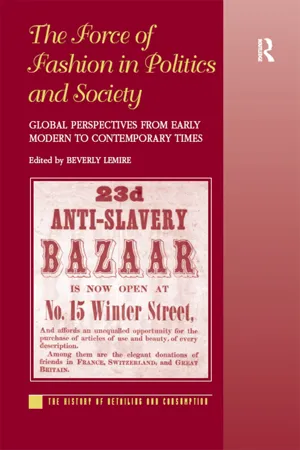
eBook - ePub
The Force of Fashion in Politics and Society
Global Perspectives from Early Modern to Contemporary Times
- 298 pages
- English
- ePUB (mobile friendly)
- Available on iOS & Android
eBook - ePub
The Force of Fashion in Politics and Society
Global Perspectives from Early Modern to Contemporary Times
About this book
Throughout history, fashion has emerged as one of the most powerful driving forces determining the political, economic and social ramifications of the production, distribution and circulation of goods. Indeed fashion, especially in relation to clothing and textiles, shapes the relationship between self and society in unique ways. In this light, the collected papers in this volume position fashion as the lens - the critical mediating force - through which to analyse and understand cultural, economic and political shifts within a broad spectrum of societies in Europe, Asia, Africa and America from the seventeenth to twenty-first centuries. Topics include a seventeenth-century failing fashion region, the material politics of marketing American abolitionist fashions, the construction of a fashionable ethos for French perfumes, and the use and meanings of clothing and textiles in the politics of Nigerian silk robes and early modern domestic décor in Europe. This volume represents an important shift in scholarship towards a more in-depth understanding of the role of fashion in early modern and modern times and will appeal to international readers interested in material culture, fashion, consumer studies and cultural anthropology, among other areas.
Chapter One
Introduction Fashion and the Practice of History: A Political Legacy
This interdisciplinary volume contributes to a wider comparative assessment of fashion, a multi-faceted phenomenon, expressed in various cultural forms. Fashion as a catalyst of material change, as a visible sign of distinction, has a complex past and an equally dynamic and contentious present. Though fashion’s impact is not restricted to dress, the ebb and flow of clothing styles have historically been the most controversial of all the practices in virtually every cultural community. Political economies and cultural discourses of fashion present equally fertile dynamics, having shaped industries, defined communities and sparked conflicts. Yet, the study of fashion is still not comfortably situated within all precincts of the academy. This omission is illustrated, for example, in a recent volume on global history;1 the absence of ‘fashion’ in the subject index reflects the still partial recognition of this pivotal topic, despite the fact that the themes addressed in this text, like the global trade in sugar or the industrialization of textile production, were themselves shaped by the social and cultural forces of fashion in various regions of the world. Scrutinized and problematized in some academic quarters, fashion is ignored and disdained in others reflecting the historic discomfort with this subject area in much of the academy. Gaps in scholarship proliferate as a result. At the same time issues surrounding expressions of fashion have frequently been highly politicized. Gender, institutional and imperial politics were among the dynamics that shaped the scholarly reception of this subject, leading to its acceptance (or rejection). However the tide is turning and the intricate cultural and economic forces underlying this phenomenon are more broadly recognized. The chapters included here reflect this new scholarly trajectory reclaiming fashion from the margins, exploring its cultural, economic and social force across time and place. Fashion has shaped markets, defined material priorities and brought profit or loss to its mediators; the fashion for one commodity over another defined consumer markets. These and other topics are explored in this collection. Before introducing these findings, however, it is useful to consider the history of the study of fashion more generally and reflect on its variable position within the academy. My focus will be on the English-language tradition of this scholarship with most specific examples arising from Britain and America.
The Study of Fashion
For much of the twentieth century fashion hovered uneasily within the precincts of the modern academy, largely excluded from serious consideration, much like a well-dressed young woman at an inter-war tutorial, too often ignored when there were high-minded conversations among ‘serious’ men. The ephemeral essence of fashion and its implied frivolousness allowed many to rationalize this disregard. Consumption may indeed be ‘the sole end and purpose of all production’, as Adam Smith averred.2 However, the role of fashion in shaping and expressing consumer drives garnered scant attention among academicians for generations. At odds with the major intellectual trajectories of Marxists and liberals, dominant through much of the century, neither camp ascribed importance to this phenomenon, while some were actively hostile to any close analysis of this subject. Clothing, as the most evident manifestation of fashion’s force, was similarly neglected within academic circles. This broad disregard or antipathy was of long standing, rooted in the anti-luxury stance found in many religious traditions, which included clear gender biases towards women as the apparent agents of temporal desires. Amanda Vickery observes that: ‘[s]ocial commentators and moralists have long associated men with the spiritual [or intellectual] world and women with the material. Reputedly man’s inferior in reason and public virtue, women have been relentlessly derided for their petty materialism and love of ostentation … an allied tradition of socialist analysis imbued with a similar Puritanism, has habitually contrasted the cultures of production and consumption.’3 Thus, irrespective of religious or political creed, there was a deeply held consensus on the triviality of the shifting material forms that were reflections of fashion, a view that was mirrored in twentieth-century scholarly communities.4 This outlook may in fact explain the persistence of Thorstein Veblen’s interpretation of fashionable consumer practice in the late nineteenth-century American society in which he lived; the explanatory term he coined was ‘conspicuous consumption’ and he proposed simple emulation as the driving force behind the most evident consumer practices, offering a particular gendered interpretation of a process that he viewed in largely negative terms.5 His analysis fit easily with the established analytical traditions, as they existed. Yet, despite the long and varied cultural aversion towards the study of fashion, occasional individuals or networks of scholars sought to unravel the puzzling and variable features of its origins, affected communities and political contexts. A contemporary of Veblen, Caroline Foley opined in her 1893 article that the ‘study of the consumer … is once more occupying the attention of economic science in England’ in a way that was ‘more disinterested and genuine than in the past’.6 The social scientist Georg Simmel approached this subject at the turn of the twentieth century from much the same perspective as Veblen, though offering several additional points on the question. Among other things Simmel observed that fashion was to be found more typically in what he termed ‘higher civilizations’, where the ‘foreignness’ of objects added to their attraction, rather than detracting – Simmel defined fashion as purely western and did not suppose it would arise elsewhere.7 The physical changes evident in turn of the century Europe and America doubtless sparked these contemporary assessments. There was, at that same time, a small but important series of studies published by Johns Hopkins University Press. Across the first three decades of the twentieth century historians began to unravel the legislative and cultural interactions of sumptuary legislation enacted from England through Central Europe.8 Sumptuary acts and decrees mirrored innovations in style and social self-fashioning. Thus this handful of volumes denotes truly pioneering efforts from at least one sector of the English language academy to understand this phenomenon, an intellectual endeavour that did not reach full fruition and found few followers during that era. A full generation later, in the 1960s there was a further brief flurry of interest in the topic of fashion in business history, where authors promoted the importance of this factor in assessing the development of markets over time.9 But few university scholars rushed to engage in this research.
In fact, for much of the twentieth century, with these exceptions, the greatest extent of fashion research was undertaken in entirely different institutional venues, by museum curators and curatorial staff, many of whom were trained in the art history tradition, or were inspired by nationalist antiquarianism in the acquisition and study of collections of dress. Museums began establishing collections of textiles and dress from the later 1800s and built their holdings through the twentieth century. Most of these foundational collections were acquired by major museums from a predominantly male cohort of collectors;10 these objects were then catalogued and placed within a narrative framework by an initially male curatorial staff. Their priorities were typically to assemble and catalogue according to aesthetics criteria of quality and/or nationalistic priorities; these privileged a French silk gown over worn linen shifts for example, or the English-made silk brocade suit rather than a middle-ranked woman’s apparel. Cataloguing and collecting concerns were founded on clear aesthetic priorities, which became the basis of clothing analysis. Emulation figured as the driving force of fashion, typically originating in metropoles like Paris and arriving in dilute forms in provincial circles or ranks below the court aristocracy. Curators sought to construct their collections, filling in national narratives with key exemplary pieces. Indeed, the current curator of Colonial Williamsburg, Linda Baumgarten, acknowledges that the survival of garments in museum collections in general ‘favors the beautiful and the unusual’, while ‘art museum’s holdings may be limited to high style and designer examples’.11 Publications produced from these institutions often focused on the cut, structure and fabric composition of garments, along with the shifts in form over time and celebrated elite dress and the social environs of its use.12 Literary sources, diaries and paper from prominent families were scoured for mention of apparel. And works by specialists like Cecil Willett and Phillis Cunnington, whose private collection became the basis for the Platt Hall Gallery of Costume in Manchester, produced shelves of books dating the characteristics of garments specific to time, place and rank. These antiquarian labours were undoubtedly important and provided a foundation from which later scholars could build. Unfortunately, the preoccupations encouraged by this style of work allowed for little or no engagement with scholarly concerns of the day, as for example, the early studies on women’s history, the interest in cross-cultural contact through trade, or the growth of the Annales school of history in France.13 Prolific authors, C. Willett and Phillis Cunnington began the Handbook of English Costume series in 1952 with the medieval era and proceeded to produce annotated catalogues on the components of dress through succeeding centuries, while also assessing occupational apparel. Some of their volumes are similar in structure to the systematic empirical enumerations of insects or plants; while other volumes included more thematic treatments.14 Court fashions and the exquisite aesthetics of European elites likewise inspired other authors of the same generation like François Boucher. This work helped define the connoisseurship priorities among curators. Few considered these topics in university settings.15 For all their enthusiasm and insights, the travails of these authors and the increasing number of female curators at work in post-war museums were largely ignored by academicians and had little if any impact on university courses or research priorities. Their work was judged to be of little interest in academic disciplines. The focus of those working with collections was very different from that found in universities. Moreover, in the third quarter of the twentieth century, few historians accepted that fashion was a legitimate topic worthy of serious study. They were not alone in this view. Anthropologists of the mid-twentieth century were also reticent to turn their attention to popular or fashionable dress (historical or contemporary).16
The neglect of the study of fashion within the discipline of history was less a benign response than a reflection of resistance to ideas, issues or communities outside established academic traditions. As the 1970s dawned, this topic of research was virtually absent in economic and social history, one of the most dynamic fields in the discipline at that time. Joan Thirsk, a historian of early modern England, challenged her colleagues to think more widely on subjects of economic and social change. In 1973, she noted the now glaring gap in scholarship and identified the cause, writing that:
Fashion is accorded a lowly place by economic historians when they account for the rise of the clothing industries and the changing direction of their trade. They prefer to look for sterner economic explanations, such as the debasement of the coinage, war, new customs tariffs, and occasionally bad (or good) craftsmanship. Thus they turn their back on the evidence of contemporaries, and on the evidence of their own eyes in the modern world.17
Thirsk’s comments reflect a frustration with the contemporary academic consensus and she went on to offer an example of what scholarship in this field could be, with a lively and discerning study of the role of fashion in the spread of new styles of hosiery in late Elizabethan London. Her’s was a rather lonely initiative at this stage. University-based scholars were generally unwilling to engage with this issue, especially as related to dress, except in its most disembodied, aggregate form such as in the production levels of textiles, volumes of cloth traded, organization of labour, or the mechanics of production. Library shelves are filled with scholarly output of this sort, where considerations of the market stopped at questions of taste or avoid altogether considerations of the cultural dynamics of style. Moreover, there was very little formal collaboration between universities and museums, the site where most fashion research was being conducted. New academic programmes were developing on the history of dress; however, in many instances these were based in Departments of Home Economics or in other sections of the university without the academic authority of long-established fields. At least one author has characterized former academicians, dismissive of these initiatives, as dominated by a pervasive misogyny that gave little value to the material connoisseurship of curators or the knowledge developing in other precincts. Lou Taylor argues that: ‘much of this academic criticism [of dress studies] came from male staff of “old” universities and was directed at a field still largely in the hands of women or gay men mostly in museum-based jobs or in “new” universities’.18 Thus, within the UK universities, a major sector of the economy and a vital facet of human experience remained largely unexamined.
Change was underway, however. In England, one of the new mediating forces was the Pasold Research Fund. Established by the successful textile and clothing industrialist, Eric Pasold, this body was set in motion in the late 1960s and the initial Director, Ken Ponting, began to forge new links between museums and universities, with a focus on the history of textiles and dress. The beginnings of a fruitful interdisciplinary exchange were launched.19 Negley Harte, who succeeded as Director, also advocated a closer collaboration of those working in the field, a process that was very much in its infancy. Harte acknowledged at the time that: ‘The work of scholars approaching the history of dress from the point of view of the history of art or the history of material culture … has not been integrated into economic or social history.’ He likewise noted that the study of fashion was too commonly ‘isolated from the rest of history’. However, Harte was also scathing about what he saw as the deficiencies of ‘dress-studies’ programmes; yet despite his comments, there can be no doubt about the efforts expended to bridge an academic chasm. Recognition was growing that these barriers needed to be addressed.20 Further Pasold-funded conferences followed on a routine basis through the 1980s and 1990s, setting an example of inter-institutional collaboration that others followed. A sea chang...
Table of contents
- Cover
- Half Title
- Title Page
- Copyright Page
- Table of Contents
- General Editor’s Preface
- List of Figures, Maps and Tables
- List of Illustrations
- Notes on Contributors
- Acknowledgements
- 1 Introduction: Fashion and the Practice of History A Political Legacy
- Part One Fashion Practice in Early Modern Europe
- Part Two The Politics and Practice of Fashion in the Long Nineteenth Century
- Part Three Fashion Strategies, Global Practice
- Bibliography
- Index
Trusted by 375,005 students
Access to over 1.5 million titles for a fair monthly price.
Study more efficiently using our study tools.
Frequently asked questions
Yes, you can cancel anytime from the Subscription tab in your account settings on the Perlego website. Your subscription will stay active until the end of your current billing period. Learn how to cancel your subscription
No, books cannot be downloaded as external files, such as PDFs, for use outside of Perlego. However, you can download books within the Perlego app for offline reading on mobile or tablet. Learn how to download books offline
Perlego offers two plans: Essential and Complete
- Essential is ideal for learners and professionals who enjoy exploring a wide range of subjects. Access the Essential Library with 800,000+ trusted titles and best-sellers across business, personal growth, and the humanities. Includes unlimited reading time and Standard Read Aloud voice.
- Complete: Perfect for advanced learners and researchers needing full, unrestricted access. Unlock 1.5M+ books across hundreds of subjects, including academic and specialized titles. The Complete Plan also includes advanced features like Premium Read Aloud and Research Assistant.
We are an online textbook subscription service, where you can get access to an entire online library for less than the price of a single book per month. With over 1.5 million books across 990+ topics, we’ve got you covered! Learn about our mission
Look out for the read-aloud symbol on your next book to see if you can listen to it. The read-aloud tool reads text aloud for you, highlighting the text as it is being read. You can pause it, speed it up and slow it down. Learn more about Read Aloud
Yes! You can use the Perlego app on both iOS and Android devices to read anytime, anywhere — even offline. Perfect for commutes or when you’re on the go.
Please note we cannot support devices running on iOS 13 and Android 7 or earlier. Learn more about using the app
Please note we cannot support devices running on iOS 13 and Android 7 or earlier. Learn more about using the app
Yes, you can access The Force of Fashion in Politics and Society by Beverly Lemire in PDF and/or ePUB format, as well as other popular books in History & World History. We have over 1.5 million books available in our catalogue for you to explore.