eBook - ePub
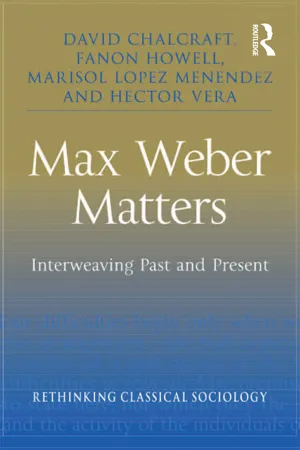
Max Weber Matters
Interweaving Past and Present
- 334 pages
- English
- ePUB (mobile friendly)
- Available on iOS & Android
eBook - ePub
Max Weber Matters
Interweaving Past and Present
About this book
This volume clearly communicates that Weber's influence is of great significance to the history of social science, and to appreciating the theoretical work of other social scientists in the modern age. Its insightful and timely publication comprises topical and innovative work discussing Weber in a range of historical and contemporary questions including: the controversy surrounding the Da Vinci code; the charismatic role of martyrs; the nuclear weapons strategy in a post-cold-war age and the affinity between Hindu belief systems and disenchanted computer science. Max Weber Matters illustrates the multidisciplinary and continued relevance of Weber's work and will be of interest to scholars across a range of disciplines, including historians, sociologists, political scientists and social theorists.
Information
Interweaving Past and Present: Setting the Scene
Chapter 1
Why Hermeneutics, the Text(s) and the Biography of the Work Matter in Max Weber Studies
David J. Chalcraft
1. In What Ways Does Weber Matter?
There is no question that Max Weber matters. No one, not even Weber’s detractors, (e.g. Lewis 1975; Andreski 1984; Giddens 1984; Rosaldo 1993) would claim that his work has not been important for the foundation of the human sciences. Nor would anyone claim that his work was unimportant to the history of sociology. Neither would any one claim that his work is no longer relevant to contemporary students and practitioners in a range of subjects including sociology and history.
A distinction needs to be drawn, however, between Weber mattering as a founder and Weber mattering as a constant methodological, conceptual and theoretical partner in current work in everyday contemporary sociology. One needs to ask: is Weber both an historical and a contemporary figure, read for how the present as much as the past can be illuminated through his contributions or only of importance because sociology and its development cannot be understood without appreciating his ideas and their role in the history of the discipline ?
The question that matters, then, is the way in which Weber matters to contemporary work. From one quite common perspective, the enquirer wants to know which ideas of Weber’s (if any) have stood the test of time, transcend their original contexts, and continue to inform, direct and exercise contemporary academics and policy makers. This sounds like a perfectly reasonable question to pose. It must be a reasonable question given the frequency with which it is asked, especially in sociological circles. Within historical circles it might be imagined that contemporary significance is only one reason why a body of work might be studied. Given sociological interest in the contemporary and the commitment of many carriers of the sociological vocation to seek to understand if not ameliorate contemporary problems it is not surprising that such a ‘presentist’ approach can dominate. However, as will become apparent, there are a number of assumptions entangled with approaching the sociological classics solely or mainly for the help they can offer us now which need unravelling. It is sensible to spend some time considering these assumptions so as to be able to retain a hold on the present situation whilst engaging with texts from the past. It is important to be clear on these hermeneutical issues if past and present are to be interwoven in successful fashion.
Of course, the past is not something with which sociology is completely unfamiliar. Sociology has always had its historical dimension: sociologists look back as well as forward in an effort to illuminate the specificities of the present. But more often than not, sociology has had its Janus-face turned towards the contemporary. The historical face of sociology is the dark side of the moon. Of those sociologists who did not ‘retreat into the present’, the work of Foucault and of Elias stands out. But the classical sociologist who stands out most impressively in this regard is Max Weber, whose interweaving of past and present is as much the subject of this volume as how contemporary scholars interweave past and present when doing sociology with his ideas in mind. The subject of this chapter is to consider some methodological issues of interweaving past and present ourselves whilst engaging with Weber’s work, which is accomplished whilst engaging with central questions in the analysis of historical and contemporary social worlds.
The assumptions of the approach to sociological theories, concepts and analysis that associates scientific or educational value with only those ideas that speak directly to the present include the following notions which, when corrected of their vulgarity, do enable the reader of the sociological classics to keep a firm foothold in the shifting sands of the contemporary, as will be seen. The naïve presentist (Siedman 1983) approach suggests that there is a clear difference between ideas as carried in texts from a previous epoch and ideas that can address the present (contemporary interpretative issues, pressing social concerns, major social changes), and that the choice to be made between past and present is urgent. It suggests that it is possible to form more or less shared judgements on what is valuable and what is not from the perspective of the present. It suggests that it is possible to abstract without damage certain ideas from a wider textual or past historical context. It suggests that if nothing transcends from the scholarship of the past up to and including the present that those past ideas are to be forgotten. It suggests that what is found to transcend now has transcended in the past and may well so transcend in the future. All of these notions are open to question from the perspective of hermeneutics and the study of the history of ideas. Whilst it is essential to approach the texts of the past with interpretative questions, it is equally essential to hope that the past texts can offer assistance. This implies that an encounter with the texts of the past is rooted in the possibility of dialogue. When the continuing significance of a body of thought is reduced to the too simple formulation of an impatient contemporary reader bent on swift solutions to their empirical or theoretical conundrums, it seems to me the possibility of dialogue and transformation of understanding is under severe strain. There is value in engaging with all thinkers and texts in the classical canon irrespective of their current status in the discipline as a whole; and justifications for doing so, or the rewards that one might gain, vary depending on the case and the context in which reading is taking place. Taken together, all the rewards that can be derived from engagement constitute a rationale for reading the classics of sociological, political and cultural studies in general, and reading Max Weber in particular.
Before proceeding to consider in more depth some of the more recent developments in Weber studies that aid the effective interweaving of past and present, it is helpful to introduce some other distinctions to clarify the meaning of ‘Max Weber matters’.
Whilst considering whether and how Max Weber matters it is advisable to appreciate that a scholar might agree that a Weberian tradition is considered the most fruitful without thereby uncritically accepting all that Weber wrote nor feeling that all answers were satisfactory or all research problems clearly formulated (e.g. Whimster 2007, 9). It is always important to distinguish fascination with Weber’s work from advocacy of his position. Such a meaning underlies the distinction between Weberian sociology, on the one hand, and Weberology on the other: the latter is steeped in the scholarship but does not imply advocacy, although deep immersion in the texts of one perspective might make that perspective, after a time, almost second nature to the exegete. Within sociology it is more likely that scholars in the Weberian tradition have made conscious decisions to be ‘Weberian’ and do not justify their work by reference to an historical interest in Weber.
Indeed, some scholars do seem to subscribe to the notion that Weber matters largely on account of the failure of other ‘systems’ of thought. Other systems of thought have been shown to matter less to contemporary theorists or contemporary conditions on account of their inability to explain or predict, or on account of their own internal contradictions. In this somewhat zero-sum game, Weber ‘wins’ and comes to matter when other alternatives no longer have claims to stake, have not stayed the course of time or whose own formulations are somewhat lacking.1 Of course it must not be forgotten that for many readers of Weber, the questions at stake are rather urgent and the interest in Weber is not merely an intellectual curiosity, as it might also legitimately be for others.
Often Weber has come to matter at a particular time on account of the work of a particular scholar or group of scholars who have through significant and powerful interpretations/presentations of his work, brought it to the attention of others (e.g. Parsons 1937; Gerth and Mills 1948, Bendix 1962; Giddens 1971; Habermas 1984; Schluchter 1981, 1989; Swedberg 1998; Hennis 2002a, 2002b). Weber is often thought to matter in the wake of a renascence inspired by particular readings of his oeuvre, which set the agenda for Weberian sociology for a period of longer or shorter duration. These readings of Weber of course are persuasive because they capture the current intellectual trends or developments in political, social and cultural life and make a major contribution to the interweaving of past and present. Scholars have continually brought contemporary questions and concerns to the house of Weber’s texts, and their questions have provided a key to open the door. On so many occasions, however, on account of the diversity of Weber’s work or account of the limitations of the interpreter, a door has been opened onto only one or more of the rooms of that house; those rooms themselves may have not been visited for a considerable time, or ever before, and the treasures found within necessitate a close attention that does not permit dwelling in the entire building. Other sociological visitors to the house of Weber’s texts, if I can continue to extend this metaphor, armed with this new introduction/interpretation, tend to dwell in the same rooms and marvel long and hard, getting every ounce of meaning and pleasure under the new vista, until such time as new events or theoretical fashions suggest that the coverings be placed back on the content and the door closed once again for the foreseeable future.
It is important, therefore, to distinguish which dimensions of Weber’s oeuvre one has in mind when considering the degree to which his ideas and formulations continue to matter in the form of a legacy in contemporary social science. Weber’s contributions – whether intentional or not – to the various branches of sociology and history, are so varied that it is conceivable that whilst he might be considered rather out of date in some quarters, his ideas appear fresh or have been freshly re-discovered, or discovered for the first time, in some other corner of the academic universe. And of course, in either of these situations, a consensus is unlikely to exist, with Weber always having his defenders and his detractors. It is important for all subject specialists to be able to distinguish between the enduring and the ephemeral and especially not to throw the proverbial baby out with the bath water. For example, whilst the India study suffers from the nature of its sources, from Weber’s orientalism, from his question-specific enquiry into the rise of western rationalism, and, for readers of English from a translation in obvious need of replacement, it is still the case that a scholar can work creatively and productively within this field with a Weberian approach (Gellner 2001).
The proceeding discussion leads us to consider what is perhaps the central interpretative dilemma facing all Weber interpreters and which lies at the heart of the matter of the manner in which Max Weber matters to contemporary readers. It is also at the heart of the hermeneutical and practical issue of how to effectively interweave past and present. Namely, the interpretative dilemma is whether Weber matters as a central contributor to the demarcation and analysis of specific substantive areas of enquiry that may wax and wane, or that he/his work matters as the representative of a particular research paradigm or sociological project whose questions and rationale are shared by those contemporary sociologists who claim the label Weberian (e.g. Nelson 1974; Tenbruck 1989; Kalberg 1994; Hennis 2002a, 2002b).
The answer to the question whether Max Weber matters is, then, a complex one and it depends when (at what period in the history of sociology) it is being asked, to whom the question is posed, and about which aspects of Weber’s overall legacy might actually be in mind. The manner in which Weber has mattered to sociology varies from place to place (Albrow 1993) and from time to time (Whimster 2001). So that some order can be placed on this diversity it is helpful to develop an ideal typical contrast between what can be called ‘the older Weber studies’ and the ‘newer Weber studies’. Once this has been achieved, the chapter concludes with an illustration of the importance of the text and the biography of the work for engaging with Weber’s work in the spirit of the hermeneutical positions presented throughout and in the light of the need to interweave past and present.
2. Towards a New Weber Studies. Interpretative Choices and How Weber Matters
Whilst it is not possible to speak ideal typically of an ‘older Weber Studies’ and a ‘newer Weber studies’ without imposing too much order on a much more diverse and varied reception history, it is perhaps still helpful to outline such a contrast if only to provide some direction to the discussion, and some indication of the variety of ways Weber has or can matter. The main advantage is that it brings out elements of the choices with which many interpreters of Weber are faced: their solutions to these dilemmas, or indeed whether they recognize the need for choice at all, will be related to how, for them, Weber matters. Importantly, the main dilemma that I think is central to current practise, is between attempting to work within a so-called Weber Paradigm/Research Programme/Thematic Unity approach to Weber’s life and work, and the more common and established ‘golden nuggets’ or ‘greatest hits’ approach to a selection of Weber’s texts and to particular sections within those texts. This dilemma has emerged from a number of sources including the range of Weber’s own work, the transmission history of his texts, the nature of the sociological appropriation of Weber’s work, and the current institutional and disciplinary constraints sociologists working with Weber (consistently or intermittently) face.
To begin with, an impression gained when reading Parsons in the period from 1930 to the mid-1950s, and also Bendix in the early 1960s, is that there is a modernist confidence in having analysed and understood Weber, to have incorporated him into contemporary theoretical discourse and firmly established his importance. This confidence can also be seen in the myriad textbooks that now dominate the market whose treatment of Weber cannot be solely attributed to the needs of mass education. The interpretation of Weber and the confidence in that interpretation had to be constructed over time (Kaesler 1988, 197–216). In earlier decades there are examples of introductions to sociology in which the name of Weber, let alone any other ‘classic’, is totally absent (e.g. Reuter and Hart 1933).
It is in recent decades that it was appreciated that images of Weber and the interpretations they occasioned were contextual and contingent (Tribe 1988; Eliason 2002) and moreover that the earlier conf...
Table of contents
- Cover Page
- Title Page
- Copyright Page
- Contents
- List of Figures
- List of Tables
- List of Contributors
- Series Editors’ Preface
- Introduction: Interweaving Past and Present
- PART 1: INTERWEAVING PAST AND PRESENT: SETTING THE SCENE
- PART 2: PHILOSOPHICAL DIALOGUES
- PART 3: THEORIZING RATIONALITY AND PROCESSES OF RATIONALIZATION
- PART 4: THE CULTURE OF CAPITALISM: PAST AND PRESENT
- PART 5: STUDIES IN THE SOCIOLOGY OF LEGITIMACY
- PART 6: CONSCIOUSNESS, HISTORY, RELATIVISM AND THE INTERWEAVING OF PAST AND PRESENT
- Index
Trusted by 375,005 students
Access to over 1.5 million titles for a fair monthly price.
Study more efficiently using our study tools.
Frequently asked questions
Yes, you can cancel anytime from the Subscription tab in your account settings on the Perlego website. Your subscription will stay active until the end of your current billing period. Learn how to cancel your subscription
No, books cannot be downloaded as external files, such as PDFs, for use outside of Perlego. However, you can download books within the Perlego app for offline reading on mobile or tablet. Learn how to download books offline
Perlego offers two plans: Essential and Complete
- Essential is ideal for learners and professionals who enjoy exploring a wide range of subjects. Access the Essential Library with 800,000+ trusted titles and best-sellers across business, personal growth, and the humanities. Includes unlimited reading time and Standard Read Aloud voice.
- Complete: Perfect for advanced learners and researchers needing full, unrestricted access. Unlock 1.5M+ books across hundreds of subjects, including academic and specialized titles. The Complete Plan also includes advanced features like Premium Read Aloud and Research Assistant.
We are an online textbook subscription service, where you can get access to an entire online library for less than the price of a single book per month. With over 1.5 million books across 990+ topics, we’ve got you covered! Learn about our mission
Look out for the read-aloud symbol on your next book to see if you can listen to it. The read-aloud tool reads text aloud for you, highlighting the text as it is being read. You can pause it, speed it up and slow it down. Learn more about Read Aloud
Yes! You can use the Perlego app on both iOS and Android devices to read anytime, anywhere — even offline. Perfect for commutes or when you’re on the go.
Please note we cannot support devices running on iOS 13 and Android 7 or earlier. Learn more about using the app
Please note we cannot support devices running on iOS 13 and Android 7 or earlier. Learn more about using the app
Yes, you can access Max Weber Matters by David Chalcraft,Fanon Howell,Marisol Lopez Menendez,Hector Vera in PDF and/or ePUB format, as well as other popular books in Social Sciences & Sociology. We have over 1.5 million books available in our catalogue for you to explore.