eBook - ePub
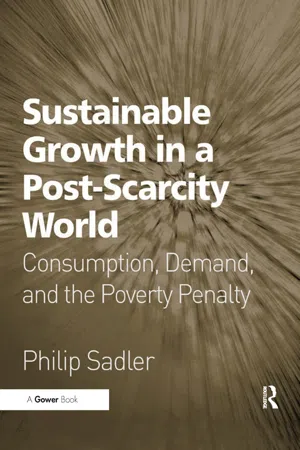
Sustainable Growth in a Post-Scarcity World
Consumption, Demand, and the Poverty Penalty
- 264 pages
- English
- ePUB (mobile friendly)
- Available on iOS & Android
eBook - ePub
Sustainable Growth in a Post-Scarcity World
Consumption, Demand, and the Poverty Penalty
About this book
Over 20 years ago Philip Sadler, then head of a leading British business school, wrote Managerial Leadership in the Post-Industrial Society. In it he predicted that business would experience the most radical transformation since the Industrial Revolution of the 19th century. This transformation has now taken place. In his latest book, Sustainable Growth in a Post-Scarcity World, Sadler charts developments once envisaged by Keynes, Chase, Galbraith and Packard, and more recent radical thinkers such as Chris Anderson. Sadler describes how many goods and services have moved from relative scarcity to relative abundance, and asks how this trend can be reconciled with the global issues of population growth and climate change. He assesses the impact of new technologies, new energy sources, new materials and the development of artificial intelligence, on business, government and economics, and discusses the challenges ahead - the creation of new business models, the need to meet people's legitimate expectations of improved living conditions while avoiding environmental catastrophe, and the need to adapt ideas developed in scarcity to conditions of abundance. Why is it that in countries foremost in creating post-scarcity conditions, millions are still in poverty, and billions, worldwide, still lack basic necessities of life? Philip Sadler agrees with those who say the relief of global poverty cannot rely on aid and corporate philanthropy. He explores the idea of re-engineering products and delivering them into bottom-of-the-pyramid (BOP) markets, and concludes that the more global companies take this route, as some are already doing, the more profitable they will find it, and this will in turn help the poorest people who currently pay more for goods and services - the 'poverty penalty' - than the rich.
Information
PART 1The Coming of Post-scarcity Society
1 The Post-Scarcity Paradox
DOI: 10.4324/9781315611518-1
Introduction
This book is about the next big shift in the nature of the economic and social system within which we live and work, and about its causes and its consequences. In particular it is about its implications for sustainability.
It will be a bigger shift than we have previously experienced; bigger than the industrial revolution, bigger than the digital revolution that has brought us the internet and connected us all together. It will unravel between now and 2050, but it is already under way. Politicians and business leaders who are trapped in the mindsets of today’s world will not be fully aware of this shift until it is well advanced. Once they become aware many will resist it strongly.
As individuals and as members of institutions of many kinds we have strong vested interests in the present system – it provides us with jobs; it offers a good return on our savings even if it does not consistently fulfil that promise; it gives the majority of people in the developed countries a lifestyle that their grandparents would have not even imagined to be possible; and it enables a few to become extremely wealthy. Businesses, particularly large global corporations and financial institutions have particularly strong vested interests in the existing arrangements, which protect their markets and their profits.
As the shift gathers pace, however, it will involve what Schumpeter (1942) described as ‘creative destruction’ on a larger scale than has been seen previously. As in previous waves of change great companies will fail, whole industries will disappear, regions that were once prosperous will become depressed, new elites will emerge and existing ones will be obliterated.
At the same time the change will give rise to whole new industries, new fields of employment, new investment opportunities and new entrants to the group of the world’s top one hundred companies.
The new system will be known as the post-scarcity society. It will, in many respects, be an age of abundance. It will bring mankind huge benefits but at the same time a whole new set of threats and dilemmas.
The Main Challenges
In what follows I will explain what is meant by a post-scarcity society and provide the evidence for the fact that it is coming about. Among the many issues it will give rise to I will address five:
- As the abundance of goods and services continues to grow, how do we deal with the economic and social consequences?
- How do we spread the enjoyment of the fruits of greater abundance to the poorer countries of the world?
- Given the growing levels of consumption implied by the above, how do we cope with the impact on the environment generally and on the world’s climate in particular?
- What response to these issues can we expect from business organizations?
- What are the prospects for system change?
A Dysfunctional System
In those parts of the world where it has prevailed, the market economy has driven economic growth, lifting the living standards of millions of people. But the world is now undergoing a period of unprecedented change. In some respects it is nearing a tipping point and it is becoming clear that the current institutions and practices which the market facilitates are leading to unsustainable outcomes. There are major issues which the market has not resolved – particularly climate change, areas of persistent poverty, water shortages, exhaustion of fishing stocks and abuse of human rights.
The market operates within a wider system – a system which incorporates three sub-systems: the economic, the social-political and the environmental. The London-based think tank Tomorrow’s Company (2008) has coined the term ‘the triple context’ to refer to this overarching system. It is a way of expressing the fact that there are three distinct but interdependent systems – environmental, socio-political and economic – which continually interact to create, on a global scale, an all-encompassing system resulting from the complex feedback loops existing between the three sub-systems.
Zadek (2001) makes a similar point. ‘Social, environmental and economic gains and losses arising from particular business processes cannot simply be added up. We do not know, for example, whether an additional four weeks of employee training, minus a dozen or so trees, plus a ton of profit, add up to more or less sustainable development … In fact we do not and probably cannot know enough about the system to understand in this sense the relationship between the activities of one organization and the whole system.’
As Elkington (1998) has pointed out, ‘Systems thinking tells us that sustainability cannot be defined for a single corporation. Instead, it must be defined for a complete economic-social-ecological system, and not for its component parts.’
The Components of the System
The Global Economy
The global economy can be viewed as consisting of three inter-related sub systems:
- The ‘real economy’ – producing goods and services that meet human needs and wants.
- The financial services industries, which facilitate the provision of capital for the real economy on the one hand and the provision of credit for consumers on the other.
- What Professor Susan Strange (1997) has dubbed the ‘casino economy’, the largely speculative activities of those in the financial sector which are unrelated to the production of goods and services.
As the so-called credit crunch crisis of 2008–2009 developed, many commentators around the world attributed blame to the operations of the casino economy and the use of derivatives in particular, coupled with the fact that financial services institutions such as retail banks and mortgage societies became involved in casino-type operations.
The Social and Political Systems
Social and political systems are the human element: the people on the Earth and the political and social institutions that govern their interaction. There is, of course, no global socio-political system in the same way that there is a global economy or a global natural world. Each society has its own set of values, characteristic lifestyles, traditions, mores and institutions. Unsustainable systems are characterized by oppression, corruption, crime, extremes of inequality and poor human rights. They also tend to have weak, fragile economies and poor records in such matters as pollution, conservation of species and deforestation. Economic activity is in many cases sustained only by virtue of rich natural resources – oil or diamonds, for example.
Within the past few decades we have seen the collapse of a number of unsustainable systems such as the Soviet bloc and the former Yugoslavia. Currently Zimbabwe is close to collapse. Within the foreseeable future we can expect the breakdown of the existing socio-political systems in a number of countries, including North Korea, Iran and Burma (Myanmar).
The Natural Environment
The natural environment can be defined as landscapes, flora and fauna, freshwater and marine environments, geology and soils. It is persistently under pressure from a range of threats, many of which have been evident for more than a century. These include the sheer pressures created by population increases, the clearance of woodland for settlements or for agriculture, the various forms of pollution produced as one country after another has industrialized, the mindless harvesting of fishing stocks and the unthinking exploitation of a wide range of non-renewable resources. Further economic growth, if it is to be sustainable, needs to be accompanied by deliberate action to protect the structure, functions and diversity of the world’s natural systems on which our own species depends.
Currently, however, the main focus under this heading is on global warming, not only because of its possible consequences for almost every other aspect of the natural world but also because of its implications for the future path of economic growth and socio/political stability
Changing the System
Today, beyond any doubt, the necessity to change in the interests of sustainability is increasingly widely accepted. Changing the global system, however, cannot be brought about by the isolated actions of nations acting alone or of individual companies trying to be a force for good. Nor does it result from advocacy, however persuasive. If efforts to achieve sustainability are to be effective, governments, international agencies, multinational companies, NGOs and other bodies must work together.
What history teaches us is that man does not change arbitrarily; he does not transform himself at will on hearing the voices of inspired prophets. The reason is that all change, in colliding with the inherited institutions of the past, is inevitably hard and laborious; consequently it only takes place in response to the demands of necessity. For change to be brought about it is not enough that it should be seen as desirable; it must be the product of changes within the whole network of diverse causal relationships which the determine the situation of man. (Durkheim, 1984)
The Shift to a Post-Scarcity World
The world’s most highly developed economies are now capable of producing huge amounts of material wealth in the form of goods and services with the aid of a relatively small percentage of the population and are moving at an accelerating pace towards a state of post-scarcity, an age of abundance, a state in which an ever wider range of economic goods and services are available in abundant supply and at extremely low cost.
In the early days of industrialization most goods and services were expensive relative to average earnings and were produced by the masses of the working class for consumption primarily by the middle and upper classes.
However, huge strides in productivity growth have led to greatly reduced costs of production, while markets have expanded well beyond national boundaries, creating greater economies of scale. In recent years the impact of productivity has been augmented by the globalization of manufacturing and the accompanying very rapid increase in the supply of cheap labour as a result of the rapid industrialization of Asian countries. The consequent intensification of competition is causing prices of a wide range of goods to fall to the marginal cost of production. At the same time, rises in real wages in the developed countries have placed an increasing range of goods and services which until relatively recently were restricted to the middle and upper classes within the reach of ordinary working people. Obvious examples include air travel, foreign holidays, cruises, eating out, sound systems, home cinemas, central heating and personal computers.
This shift, from relative scarcity to relative abundance, has been progressing steadily for many years. It was first pointed out in America before the Second World War, notably by John Maynard Keynes (1963) and Stuart Chase (1934) whose ideas, along with those of others are described in the next chapter.
A consequence of the development of abundance over the past few decades has been the shift in emphasis from managing production to managing consumption. In modern manufacturing enterprises the numbers of employees directly engaged in production is remarkably small. The majority are employed in functions such as sales, marketing, public affairs, human resources, finance and accounting, and, more recently, in corporate social responsibility. As productivity has grown, jobs have not only shifted from production to other functions, but they have also shifted from the private sector to the public sector.
Henry Ford’s great vision was that he saw mass production and its impact on productivity merely as a means to the end of mass consumption; hence the model T, designed so that every American family would be able to afford a motor car.
I hold that it is better to sell a large number of cars at a reasonably small profit … I hold this because it enables a larger number of people to buy and enjoy the use of a car and because it gives a larger number of men employment at good wages. Those are the two aims I have in life. (Ford, 1929)
Huge reductions in costs have been achieved despite the fact that the supply of most things involves massive expenditure on distribution. As well as wholesalers’ and retailers’ mark-ups there are the costs of building brand identity, advertising, marketing, packaging and promotion and the costs of physical movement of goods. For most goods today the costs of distribution far outweigh the costs of production.
Companies, either individually or acting in concert, engage in a variety of practices to create a degree of artificial scarcity with the aim of maintaining prices. These include restriction of production, (for example in diamond mining, agriculture, and oil extraction), branding, (particularly in relation to fashion goods), and patents, (most noticeably in software and pharmaceuticals) and planned obsolescence. Some things remain relatively expensive artificially because of taxes imposed by governments – Scotch whisky, for example. What companies are doing in the face of growing abundance will be discussed in Chapter 10.
The Future Development of Abundance
We are in the early stages of a new era that has the potential to be one of even greater abundance. Its growth is being driven by new technologies which are developing at an exponential rate. These technologies include the development of computing power and speed, biotechnology, nanotechnology and technologies as yet dimly perceived that are the result of convergence of the aforementioned. At some point in the second half of this century, molecular manufacturing may well have become a reality.
The coupling of molecular manufacturing with appropriate programming tools could ultimately bring about a revolution that is being termed ‘personal manufacturing.’ Personal nanofactories (PNs) already have been envisioned and are likely to be similar in look and ease of use to a printer or microwave oven. 3D printers, which can produce three-dimensional objects in colour, are already in use. They cost now about $20,000 dollars. If mass-produced they could sell for about £1,000 each.
Meanwhile, computing power – information management – continues to expand exponentially even as its cost drops precipitously. Today, an increasing range of ‘intelligent’ products contain greater and greater information content at lesser and lesser cost. These developments are discussed in Chapter 5.
The Post-Scarcity Paradox
Poverty in the Developed Countries
The paradox is that in those...
Table of contents
- Cover
- Half Title Page
- Title Page
- Copyright Page
- Contents
- Preface
- PART 1 THE COMING OF POST-SCARCITY SOCIETY
- PART 2 SUSTAINABILITY
- PART 3 THE POVERTY TRAP
- PART 4 THE RESPONSE OF BUSINESS
- PART 5 SYSTEM CHANGE
- References
- Index
Trusted by 375,005 students
Access to over 1.5 million titles for a fair monthly price.
Study more efficiently using our study tools.
Frequently asked questions
Yes, you can cancel anytime from the Subscription tab in your account settings on the Perlego website. Your subscription will stay active until the end of your current billing period. Learn how to cancel your subscription
No, books cannot be downloaded as external files, such as PDFs, for use outside of Perlego. However, you can download books within the Perlego app for offline reading on mobile or tablet. Learn how to download books offline
Perlego offers two plans: Essential and Complete
- Essential is ideal for learners and professionals who enjoy exploring a wide range of subjects. Access the Essential Library with 800,000+ trusted titles and best-sellers across business, personal growth, and the humanities. Includes unlimited reading time and Standard Read Aloud voice.
- Complete: Perfect for advanced learners and researchers needing full, unrestricted access. Unlock 1.5M+ books across hundreds of subjects, including academic and specialized titles. The Complete Plan also includes advanced features like Premium Read Aloud and Research Assistant.
We are an online textbook subscription service, where you can get access to an entire online library for less than the price of a single book per month. With over 1.5 million books across 990+ topics, we’ve got you covered! Learn about our mission
Look out for the read-aloud symbol on your next book to see if you can listen to it. The read-aloud tool reads text aloud for you, highlighting the text as it is being read. You can pause it, speed it up and slow it down. Learn more about Read Aloud
Yes! You can use the Perlego app on both iOS and Android devices to read anytime, anywhere — even offline. Perfect for commutes or when you’re on the go.
Please note we cannot support devices running on iOS 13 and Android 7 or earlier. Learn more about using the app
Please note we cannot support devices running on iOS 13 and Android 7 or earlier. Learn more about using the app
Yes, you can access Sustainable Growth in a Post-Scarcity World by Philip Sadler in PDF and/or ePUB format, as well as other popular books in Commerce & Commerce Général. We have over 1.5 million books available in our catalogue for you to explore.