eBook - ePub
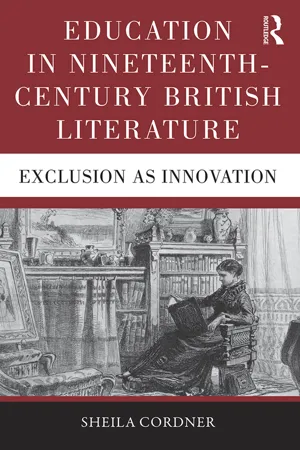
Education in Nineteenth-Century British Literature
Exclusion as Innovation
- 160 pages
- English
- ePUB (mobile friendly)
- Available on iOS & Android
eBook - ePub
About this book
Sheila Cordner traces a tradition of literary resistance to dominant pedagogies in nineteenth-century Britain, recovering an overlooked chapter in the history of thought about education. This book considers an influential group of writers - all excluded from Oxford and Cambridge because of their class or gender - who argue extensively for the value of learning outside of schools altogether. From just beyond the walls of elite universities, Jane Austen, Elizabeth Barrett Browning, Thomas Hardy, and George Gissing used their position as outsiders as well as their intimate knowledge of British universities through brothers, fathers, and friends, to satirize rote learning in schools for the working classes as well as the education offered by elite colleges. Cordner analyzes how predominant educational rhetoric, intended to celebrate England's progress while simultaneously controlling the spread of knowledge to the masses, gets recast not only by the four primary authors in this book but also by insiders of universities, who fault schools for their emphasis on memorization. Drawing upon working-men's club reports, student guides, educational pamphlets, and materials from the National Home Reading Union, as well as recent work on nineteenth-century theories of reading, Cordner unveils a broader cultural movement that embraced the freedom of learning on one's own.
Information
1
Educational Machinery
Throughout the nineteenth century, politicians, religious leaders, and literary authors celebrated the expanded educational opportunities for women and the working classes in Britain. Yet a persistent tradition of writers tells a dramatically different story. This book captures an overlooked chapter in the history of thought about education in which literary authors remind us of the value in learning outside of schools. Jane Austen, Elizabeth Barrett Browning, Thomas Hardy, and George Gissing were all excluded from elite universities because of their class or gender.1 Their position as outsiders and their intimate knowledge of Oxford and Cambridge through brothers, fathers, and friends gave them a unique perspective from which to critique existing institutions. This study tells the story of how these writers—these “educational outliers”—imagined alternatives to educational systems. Whereas most schools focused on only one class or gender, these authors experimented with pedagogical approaches that could be universally accessible. Barrett Browning’s “novel-poem” Aurora Leigh (1856), for instance, explores the idea that the working-class Marian Erle, who learns to read by piecing together fragmentary texts “toss[ed]” to her by a “pedlar,” can adopt an experiential pedagogy like that of the privileged-class Aurora (III.972, 969). Educational outliers also satirize pedagogies of rote memorization, which they identify in schools for the masses as well as in universities for the elite, offering instead new strategies to open students’ minds. In Tess of the D’Urbervilles (1891), for example, Hardy describes the “mental limitations” of Angel’s Cambridge-educated brothers in mocking them as “such unimpeachable models as are turned out yearly by the lathe of systematic tuition,” and he explores a model of autodidacticism instead (156). Departing from institutional learning that can prevent people like Angel’s brothers from associating with “persons who were neither University men nor churchmen,” the writers in this book stress the cultivation of empathy as an essential component of broader reform (156).
What sets educational outliers apart from other writers who critique institutional learning is that they envision going outside of institutions.2 They imagine what it would be like to abandon existing educational models by “unteaching,” that is, the act of educating with the specific aim of dismantling habits commonly learned in schools. These writers attempt to undo the modes of reading and learning with which nineteenth-century readers were often inculcated by educational institutions. Educational outliers “unteach” in two different ways. Austen and Barrett Browning write in a style that encourages readers to let go of their reliance on widespread approaches to reading. Hardy and Gissing depict specific characters who realize they need to “obliterate” what they have been previously taught (Hardy, Tess of the D’Urbervilles 116). By calling attention to our own habits of reading and absorbing knowledge, educational outliers help us grasp the ways we expand our minds to think imaginatively. They also show the danger of shutting off this potential. In doing so, they investigate the role literature plays in unteaching readers.
The radicalism of these authors becomes clear when we read them alongside the rhetoric of nineteenth-century educational discourse, which relies relentlessly on the metaphor of educational systems as machines that eliminate the possibility of students’ imaginative thinking. In order to demonstrate the extraordinary pervasiveness of this rhetoric, this study considers not only educational writings but also workingmen’s club reports, university examinations, parliamentary debates, student guides, and college newspapers. Given the preoccupation with education as a subject of debate in the nineteenth century, it is surprising that more scholars of nineteenth-century Britain have not explored the ramifications of educational reform on the period’s literature.3
The authors at the heart of this book concern themselves with education on many levels of schooling. This study focuses on their explicit critiques of elite secondary and university education, encapsulated by “Oxbridge,” because that is where these authors register most sharply the manifestations of a system that reinforces class, gender, and racial biases. The term “Oxbridge” was originally used in nineteenth-century literature to describe a fictional university, but starting in the twentieth century, it became more broadly used to discuss the unique education offered by Oxford and Cambridge as distinguished from that of other universities (OED). It often becomes difficult for writers to critique Oxbridge without also faulting the newer schools that have emulated the older system’s emphasis on examinations. In the chapters that follow, the authors’ critiques of specific Oxbridge schools as well as educational reform more generally become inextricably linked. Their work demonstrates the spectrum of literary writers’ engagement with education reform. Barrett Browning’s ideas, for instance, inspired interest in nineteenth-century supporters of women’s education such as Barbara Leigh Smith Bodichon and Clara Collet (Dalley 538–9). The Times Educational Supplement lists Hardy—rather ironically, but tellingly nonetheless—as a member of “the Provisional Committee to further University Education in the South-West” (400).
Stepping Outside of School
Educational outliers offer insight that can only come from outsiders. Scholar-educators today face challenges when thinking critically about institutions in part because they cannot easily adopt the position of an outsider. The authors discussed in this project are poised for educational innovation because they occupy a position outside of the academy. They call attention to the habits of academics within institutions.4 Recent studies of the history of reading—particularly reading in the nineteenth century—have urged literary scholars to become attuned to their professional investment in their own reading practices (Best & Marcus; Price; Dames 2011). These studies encourage academics to evaluate their own institutionally rewarded modes of encountering texts. Much like these scholars on reading, the nineteenth-century authors discussed in this book attempt to make the academic practices ingrained in educational institutions more transparent.
Almost all of the authors in this study condemn the classism that institutional approaches to learning perpetuate on a visible or invisible level. These writers critique an Oxbridge education that honors students who display most prominently what Pierre Bourdieu would call “ease” (Bourdieu 21). Bourdieu highlights the class biases enabled by universities that congratulate privileged students. Though one may enter an elite college, one’s earlier educational background never really becomes irrelevant. He analyzes obituaries of professors, noting that those who originated from lower classes are described not in terms of intellect or brilliance but in terms of the intense labor they had to complete in order to become successful (46–7). Even self-evaluations by professors, Bourdieu notes, echo this pattern. When professors talk about “ease” or “natural” talent, he says, they are really referring to the “particular mode of acquisition” (21). What we call “ease,” Bourdieu reminds us, is privilege. Those who grew up with academic culture in their family—for whom this is the native culture—feel more at ease. Bourdieu’s ideas are useful for analyzing the work of writers who criticize schools that promote a curriculum reflecting the goals and cultural values of the privileged classes. The chapters that follow show that by establishing a personal connection with the material they learn, educational outliers try to counteract the detached ease of Oxbridge students operating as part of an academic “machine.”
The Age of Machinery
Witnessing the proliferation of schools on the elementary, secondary, and higher education levels throughout the nineteenth century, educational outliers register the alarming mechanization of education. In his 1829 “Signs of the Times,” Thomas Carlyle echoes Jane Austen’s work and foresees the later critiques by Elizabeth Barrett Browning, Thomas Hardy, and George Gissing. He discusses how the “Age of Machinery” has impersonalized and systematized even the “internal and spiritual” aspects of life: “everything has its cunningly devised implements, its pre-established apparatus; it is not done by hand, but by machinery” (34, 35). The individual no longer controls her own thoughts; impersonal institutions dictate her thinking. Carlyle turns to the example of educational systems, alluding to Joseph Lancaster, who promoted the monitorial system as a way to streamline education for the masses: “thus we have machines for Education: Lancastrian machines; Hamiltonian machines; monitors, maps, and emblems” (35).5 Carlyle satirizes England’s approach to education as something that happens outside of oneself, set apart from the individual. His characterization of education in terms of industrial machinery anticipates the many reprises of schools as machines later in the century.
Throughout the nineteenth century, we observe the attempt to recover what Carlyle had earlier warned would be lost. He describes the state of education in his time:
Instruction, that mysterious communing of Wisdom with Ignorance, is no longer an indefinable tentative process, requiring a study of individual aptitudes, and a perpetual variation of means and methods, to attain the same end; but a secure, universal, straightforward business, to be conducted in the gross, by proper mechanism, with such intellect as comes to hand.
(35)
In Carlyle, we notice skepticism toward the current brand of institutional learning. Carlyle suggests that by accepting the new systems of mass education, society loses an “indefinable tentative process” focused on “individual aptitudes” with varied “means and methods.” Under the new one-size-fits-all model, students lose an opportunity to explore ideas using their own unique learning styles. They no longer have a chance to experience education on a personal level. Many of the authors considered in this study use their outsider status from institutions to recover in their writing the approaches that Carlyle mourns as lost. Whereas subsequent chapters focus on literary writers outside of schools who critique the widespread standardization and reliance on rote memorization, this chapter reveals that a similar movement took shape within new and old educational institutions.
Literature That Unteaches Readers
The authors discussed here are part of a broad tradition of nineteenth-century literature responding to institutional education. By the early nineteenth century, a debate was already brewing between advocates of Romantic self-education such as Jean-Jacques Rousseau and William Wordsworth and reformers in favor of fact-based education including Patrick Colquhoun, author of A New and Appropriate System of Education for the Labouring People (1806), Andrew Bell, Joseph Lancaster, and, in the second half of the century, Robert Lowe.6 From as early as Romantic writers such as Jean-Jacques Rousseau and William Wordsworth, we see how authors imagine ways literature can unteach their readers. Rousseau’s Émile learns from experience that he gains apart from books, and Wordsworth’s speaker in “The Tables Turned” (1798) resists a pedantic focus on books, emphasizing experiential education instead. He cries, “Up! up! And Quit your Books,” making the suggestion to “Let Nature be your teacher” (Wordsworth, “Tables Turned” 1, 16). Wordsworth incites readers to consciously work against the modes of learning in which they have been trained. In The Prelude (1850; first version 1805), he went on to explore experiential education in more detail. Like Wordsworth, who invites us to “quit” the ways in which we have been taught, later writers recount experiences that have helped them dismantle their academic modes of reading. For example, Wordsworth’s poetry has the effect of unteaching John Stuart Mill, prompting him to let go of the habits of analysis that stand in the way of cultivating his emotional life.
Numerous authors recall negative encounters with institutional education, recounting experiences that constrict their minds. Writing as insiders within ancient universities, Cambridge-educated Alfred Lord Tennyson and Oxford-educated Matthew Arnold complain about the stifling effects of their university education. In an 1828 letter to his aunt, Tennyson writes about the lack of inspiration he feels as a student at Cambridge:
I am sitting Owl-like and solitary in my rooms (nothing between me and the stars but a stratum of tiles) the hoof of the steed, the roll of the wheel the shouts of drunken Gown and drunken Town come up from below with a sea-like murmur.… [author’s ellipsis] I know not how it is but I feel isolated here in the midst of society. The country is so disgustingly level, the revelry of the place so monotonous, the studies of the University so uninteresting, so much matter of fact—none but dryheaded calculating angular little gentlemen can take much delight in [Logarithms] …
(22–3)
In the midst of an academic community, Tennyson feels isolated from his “dry-headed” classmates. This isolation discourages him instead of inspiring him to develop his intellectual independence.
Arnold laments the lack of his generation’s creative potential in “The Buried Life” (1852): “But hardly have we, for one little hour, / Been on our own line, have we been ourselves—/” (59–60). Having received an extensive classical education from a very young age as the son of Rugby School’s headmaster, Arnold expresses the burden he feels from previous traditions of knowledge. In “The Scholar-Gipsy” (1853), Arnold paints a portrait of modern society as diseased, describing “its heads o’ertax’d” and the “strong… infection of our mental strife” (205, 222). He adapts a seventeenth-century “story of the Oxford scholar poor, / Of pregnant parts and quick inventive brain, / Who, tired of knocking at preferment’s door” left the university to “learn the gipsy-lore” with that “wild brotherhood” (33–5, 37, 38). Arnold capitalizes on this story that takes as its starting point the unfortunate situation of needing to leave Oxford because of financial circumstances and uses it to imagine what one would learn if one abandoned Oxbridge altogether. In “Stanzas from the Grande Chartreuse” (1855), the speaker describes how his education constrained his potential: “For rigorous teachers seized my youth, / And purged its faith, and trimm’d its fire” (67–8). Arnold has received an education of “trimming” and “purging.” His schooling has robbed him of something.
In order to arrive at their individual revelations, John Stuart Mill and John Henry Newman both needed to step outside their trained academic modes of thinking. They turned to literature, which had the effect of unteaching what they had been previously taught. In his Autobiography (1873), when Mill describes the period of his breakdown, he recounts how he read “accidentally, Marmontel’s ‘Mémoires,’ and came to the passage which relates his [Marmontel’s] father’s death” (99). He continues, “a vivid conception of the scene and its feelings c...
Table of contents
- Cover
- Title
- Copyright
- Dedication
- Contents
- List of Figures
- Acknowledgments
- 1 Educational Machinery
- 2 “Scrambling” into an Austen Education
- 3 Radical Education in Aurora Leigh
- 4 “I Will Do without Cambridge”: Thomas Hardy’s Autodidacts
- 5 Neither Inside nor Outside in George Gissing
- Conclusion
- Appendix 1: Excerpt from The Loiterer; facsimile of issue 8 (1789)
- Appendix 2: Excerpts from The Popular Educator; facsimile of 1.2 (1852)
- Appendix 3: National Home Reading Union program (1890)
- Appendix 4: Excerpt from George Gissing’s Thyrza (1887)
- Works Cited
- Index
Trusted by 375,005 students
Access to over 1.5 million titles for a fair monthly price.
Study more efficiently using our study tools.
Frequently asked questions
Yes, you can cancel anytime from the Subscription tab in your account settings on the Perlego website. Your subscription will stay active until the end of your current billing period. Learn how to cancel your subscription
No, books cannot be downloaded as external files, such as PDFs, for use outside of Perlego. However, you can download books within the Perlego app for offline reading on mobile or tablet. Learn how to download books offline
Perlego offers two plans: Essential and Complete
- Essential is ideal for learners and professionals who enjoy exploring a wide range of subjects. Access the Essential Library with 800,000+ trusted titles and best-sellers across business, personal growth, and the humanities. Includes unlimited reading time and Standard Read Aloud voice.
- Complete: Perfect for advanced learners and researchers needing full, unrestricted access. Unlock 1.5M+ books across hundreds of subjects, including academic and specialized titles. The Complete Plan also includes advanced features like Premium Read Aloud and Research Assistant.
We are an online textbook subscription service, where you can get access to an entire online library for less than the price of a single book per month. With over 1.5 million books across 990+ topics, we’ve got you covered! Learn about our mission
Look out for the read-aloud symbol on your next book to see if you can listen to it. The read-aloud tool reads text aloud for you, highlighting the text as it is being read. You can pause it, speed it up and slow it down. Learn more about Read Aloud
Yes! You can use the Perlego app on both iOS and Android devices to read anytime, anywhere — even offline. Perfect for commutes or when you’re on the go.
Please note we cannot support devices running on iOS 13 and Android 7 or earlier. Learn more about using the app
Please note we cannot support devices running on iOS 13 and Android 7 or earlier. Learn more about using the app
Yes, you can access Education in Nineteenth-Century British Literature by Sheila Cordner in PDF and/or ePUB format, as well as other popular books in Education & Education Theory & Practice. We have over 1.5 million books available in our catalogue for you to explore.