- 280 pages
- English
- ePUB (mobile friendly)
- Available on iOS & Android
eBook - ePub
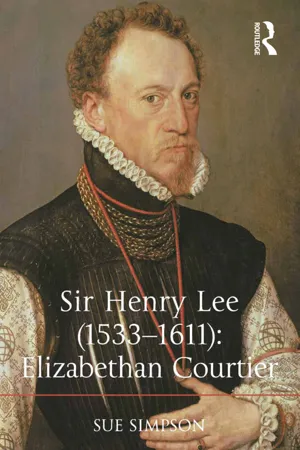
Sir Henry Lee (1533-1611): Elizabethan Courtier
About this book
A favourite of Queen Elizabeth I, Sir Henry Lee was known as 'the most accomplished cavaliero' in England. This handsome, entertaining and highly convivial gentleman was an important participant in life at court as Elizabeth's tournament champion. He created the spectacular Accession Day tournaments held annually before London crowds of more than 8,000 people, was Lieutenant of Elizabeth's palace at Woodstock, and Master of the Armoury at the Tower of London during the Spanish Armada. This is the only biography of Sir Henry Lee in print, and explores the interaction of politics, culture and society of the Elizabethan court through the eyes of a popular and long-serving courtier. Indeed, few other courtiers managed to live such a long and satisfying life, and although this study of Sir Henry's life shows a diverse nature typical of many Elizabethan gentlemen - his travels to the courts of Italy, his knowledge of arms and armour, his delight in the world of emblems and symbolism, his close association with Philip Sidney, and his intimate relationship with a notorious woman at least thirty years his junior - it also questions what it meant to be a courtier. Was the game actually worth the candle?
Chapter 1
The Making of a Courtier Gentleman, 1533–1573
Sir Henry Lee can best be described as a courtier gentleman, belonging to the upper ranks of the gentry class and having the personality and talent to achieve a position at Court. Gentlemen of Lee’s standing were not necessarily created; they often came from generations of birth and breeding but were trained from an early age to be conscious of their duties, responsibilities and privileges. Courtiers, on the other hand, could be and were created. To be a successful courtier, one needed contacts at Court, the higher placed the better. If one did not want merely to haunt the corridors of power, importuning for any office that might return a living, one needed to offer a talent acceptable and flattering to the reigning monarch. Above all, one needed the money to sustain the lifestyle, and the ambition, for a career at Court where fortunes could be fickle and could change immediately with the death of a monarch. Sir Henry Lee was thirty-seven by the time he received the first recorded sign of royal favour from Elizabeth I, past the midpoint of man’s allotted lifespan and relatively advanced for the life expectancy of the day. His long Court career owed more to his longevity than to an early start. A study of the first half of Lee’s life illustrates how he most probably acquired the values that remained with him all his life, how his initially promising Court career was cut short by a change of monarch and how, with discretion, he was able to return to royal favour on his own terms.
Lee’s Early Life, 1533–1553
The aspirations and values of a Tudor gentleman in his formative years were influenced by many factors. At this distance in time, it is necessary to rely more on conjecture than evidence when attempting to identify the influences that could have operated upon the young Henry Lee. Certain possibilities can, however, be suggested, such as his own family traditions, his education, the influence of popular conduct books, the society in which he grew up and the circumstances of his wardship.
The traditions within Lee’s immediate family clearly contributed to the two guiding principles that remained constant throughout his life – loyalty and service to the monarch and commonweal, and faithful stewardship of his own estates. Born around March 1533, Henry Lee was the first son of Anthony Lee and Margaret Wyatt. Both his mother and father came from families well established at Court, loyal to the Tudors and regarding practical service at Court as the norm rather than the exception. Anthony Lee’s father, Sir Robert Lee of Quarrendon, Buckinghamshire, had served at Court in his younger days as Gentleman Usher at the Court of Henry VII, Yeoman Usher to Princess Mary by 1508 and a Gentleman Usher of the Chamber by 1512.1 Anthony Lee was Gentleman Usher of the Bedchamber to Henry VIII by 1533, while his wife Margaret Wyatt served Anne Boleyn in a similar capacity.
It was probably from the Wyatts that Lee derived his ambition to do something more for his Queen than merely a gentleman’s duty to attend Court periodically. The tradition of royal service was paramount in the Wyatt family; Lee’s maternal grandfather Sir Henry Wyatt had been loyal to the young Henry Tudor before his victory at Bosworth in 1485 and subsequently had served him in a military capacity in the north of England. He was Master of the King’s Jewels from 1488 to 1524, Councillor in 1504 and an executor of Henry VII’s will in 1509. Wyatt remained at Court as Councillor to Henry VIII until his retirement in 1533.
Henry Lee was born and spent his early years at Allington Castle in Kent, the home of his grandfather and his uncle, Sir Thomas Wyatt, a loyal servant to Henry VIII as Esquire of the King’s Body and as an ambassador (see Appendix 1 for the family tree). Whereas Lee, as a child of three, would have known little of the tension in May 1536 when Sir Thomas was implicated in the fall of Anne Boleyn and thrown into the Tower of London, he might have sensed the family’s relief at Sir Thomas’s release into his father’s supervision in June. The excitement of the King’s visit to Allington on 31 July 1536 would have been memorable. Henry Lee was not yet four when his grandfather died on 10 November 1536, and whereas he would have had somewhat limited personal memories of Sir Henry Wyatt, anecdotal stories of this beloved patriarch appear to have been kept evergreen in the family.2 Sir Henry Wyatt’s reputation for integrity and honesty in royal service is recorded in both the letters of his son, Sir Thomas Wyatt, and the testimony of Polydore Vergil, the contemporary chronicler.3 Together, they create a vivid image of Sir Henry Wyatt, ‘welbelouid of many, hatid of none’.
In November 1536 Allington Castle and the guardianship of the Lee children passed officially to Sir Thomas Wyatt, although most of his time was spent travelling as ambassador to the court of Emperor Charles V. Lee’s own parents were still at Court, and at some point young Henry Lee would have known of the brief confinement of his father, Anthony Lee, on 2 October 1537 for ‘consenting to the steling of certain the King’s hawkes’.4 Thanks to Henry Lee’s mother, Margaret, ‘suying for his deliverance’ with the King at Windsor on 10 October 1537, Anthony Lee was released. Their relief must have been tangible, as Thomas Cromwell, the King’s secretary and chief minister, remarked that ‘they be both merry and the King’s Highness is now again good lorde unto him’.5 The Lees showed their gratitude to the King’s minister by naming their youngest son Cromwell Lee.
Thomas Cromwell had also been the chief patron and protector to Sir Thomas Wyatt, and, with the fall and execution of Cromwell in 1540, Wyatt was at the mercy of the many enemies he had made at Court. He was arrested on a charge of treason in January 1541 and taken bound and handcuffed to the Tower. Allington Castle was cleared on the orders of the Council, and from an inventory of persons residing there, it is clear that the Lee children, now numbering at least four – Henry, Robert, Thomas and Cromwell – had already moved. As Anthony Lee had come into his inheritance at Quarrendon on the death of his father Sir Robert Lee on 23 February 1539, it is reasonable to surmise that his growing family had reassembled there.
How much of this the young Henry Lee would have known is conjectural. He was seven when he left Allington, the eldest child in a highly politicized family. If he knew little at first hand, family experience would have warned him that royal service was rife with pitfalls, jealousy and rivalries, and that the financial returns were far from guaranteed. Lee’s uncle, Sir Thomas Wyatt, was released from the Tower and rehabilitated into royal service by 1541, but he died in debt, many miles from home and was buried in a stranger’s vault in Sherborne, Dorset, in 1542. It may have been Lee’s awareness of this, as well as his family pride in his uncle’s achievements, that led him in 1609 to leave money in his will for a tomb to be constructed for Sir Thomas Wyatt at Quarrendon. The order was never carried out.
The prosaic but more profitable virtues of land ownership and development came from the Lee family traditions, and Henry Lee knew that, as first-born son, he would eventually inherit the entailed Lee estates. The acknowledged founder of Lee’s landed fortunes was his grandfather, Sir Robert Lee. The Lee family had begun to feature as leaseholders of the manor of Quarrendon from 1438, and it became their property by a grant of socage in 1512.6 After pursuing an interesting if somewhat unprofitable career at Court in his early years, Robert Lee inherited the freehold of Quarrendon in October 1516 and was knighted in 1522. Sir Robert chose to turn his back on the Court, choosing the less flamboyant but more lucrative path of landholder and sheep-farmer. If Sir Robert Dormer, a near-neighbour, could be described by Henry Machyn as ‘the grete shepe-master in Oxfordshyre’, the same might well have been said of Sir Robert Lee in Buckinghamshire who, like many gentleman graziers, was busy enlarging and consolidating his lands.7
Quarrendon, Sir Robert’s principal manor, was held in knights’ service to the Crown, and by 1526 he had acquired land at nearby Burston, Weedon, Hardwick and Fleetmarston where the Lees already had interests.8 Quarrendon was prime pasture land, and Sir Robert Lee followed the contemporary custom of converting arable land to pasture. With rising prices for wool, there was an ever-present temptation to enclose land and, despite Wolsey’s commission of enquiry in 1517 which mentioned Robert Lee twice in this context, Fleetmarston and Quarrendon itself were enclosed.9 Sir Robert later obtained a licence to export wool to Calais in 1533, laying the foundations for solid family income and possessions.
It was also from his grandfather that Henry Lee derived the inestimable advantage of good family connections (see Appendix 2 for details). Sir Robert Lee married twice. After the death of his first wife, he used his Court connections in 1521 to marry Lettice Penistone, widow of Robert Knollys and mother of Sir Francis Knollys who married Katharine Carey, daughter of Mary Boleyn. This was the most advantageous marriage the Lees ever made and it eventually linked Sir Henry Lee not only with the Knollys and Carey families at Court, but also to Lord Hunsdon, Queen Elizabeth’s cousin, and to the Queen herself. Through the usual Court web of nuptial connections, the Lees later became connected to the Earls of Essex and the Earl of Leicester.
The Lees were also linked by marriage to the Cookes, a relationship which would bring them into kinship with the Cecils, the Hobys and the Killigrews, influential families at the Court of Queen Elizabeth. Sir Robert’s first marriage had produced a son and heir, Anthony. His second marriage would produce a son and two daughters. It also had the effect of keeping Anthony Lee and his family away from Quarrendon until his father’s death.
Anthony Lee, like his father before him, had followed a somewhat limited Court career, but was knighted in 1539 and rode with other knights to receive Anne of Cleves between Blackheath and Greenwich in January 1540.10 On his father’s death in February 1539, Anthony had inherited the manor of Quarrendon, and Lettice, as his father’s widow, received a life interest in Burston, which she later returned to her stepson.11 Sir Anthony Lee was happy to retire with his family to his Buckinghamshire estates, and John Leland described Quarrendon as standing in ‘the myddle parte of the vale of Ailesburie … fruitful for pasture … where Mr Leigh hath a goodly house with Orchards and a parke’.12 Although Sir Anthony preferred to remain at home, he was still described as the King’s servant in 1542 and sat as member of parliament for Buckinghamshire in the parliaments of 1542 to 1545 and of 1547 to 1549.13 As one of the leading county gentlemen, he took musters for the Aylesbury hundred of Buckinghamshire and provided great horses, light horses, demi-lances, archers and arquebusiers for the King’s service.14
Sir Anthony Lee also generated more complications for his future heirs. He had four sons – Henry, Robert, Thomas and Cromwell – by Margaret Wyatt. At what point Margaret Wyatt died is unknown, but by the time of Anthony Lee’s second marriage in May 1548 to Anne Hassall, he already had two illegitimate sons by her, Richard and Russell alias Hassall. Sir Anthony also had four daughters, but it is unclear from his will who was their mother. When Sir Anthony Lee died on 24 November 1549, he made provision for all his children but left his lands and ‘all my horses, greyhounds, spanyells, geldings and mares’ to ‘Harry Lee my sonne’.15 At sixteen, Henry Lee was already identified as someone with a marked preference for an active and sporting life. Thus, if Lee inherited both an appetite for royal service and knowledge of its pitfalls from his Wyatt lineage, it was from his Lee inheritance that he gained the highly profitable estates that would finance his aspirations at Court.
By the terms of Sir Henry Wyatt’s will of 1536 Henry Lee had received ‘yerely duringe his nonage tenne poundes, and in lykewyse unto Robert Lee his brother during his nonage yerely tenne markes towards a...
Table of contents
- Cover Page
- Title Page
- Copyright Page
- Contents
- Dedication
- List of Illustrations
- Acknowledgements
- List of Abbreviations
- Introduction
- 1 The Making of a Courtier Gentleman, 1533–1573
- 2 ‘The Queen’s Knight’: Sir Henry Lee and the Elizabethan Tournaments
- 3 The Relationship between Sir Henry Lee and Elizabeth I, 1570–1603
- 4 Master of the Armoury, 1580–1611
- 5 The Life of a Tudor Gentleman: Lee’s Personal Estates and Financial Position
- 6 Sir Henry Lee’s Family, Mistress, Friends and Art Collection
- 7 Sir Henry Lee in the Reign of James I, 1603–1611
- 8 An Evaluation of ‘The Most Accomplished Cavaliero I Have Ever Seen’
- Appendices
- Glossary
- Bibliography
- Index
Trusted by 375,005 students
Access to over 1.5 million titles for a fair monthly price.
Study more efficiently using our study tools.
Frequently asked questions
Yes, you can cancel anytime from the Subscription tab in your account settings on the Perlego website. Your subscription will stay active until the end of your current billing period. Learn how to cancel your subscription
No, books cannot be downloaded as external files, such as PDFs, for use outside of Perlego. However, you can download books within the Perlego app for offline reading on mobile or tablet. Learn how to download books offline
We are an online textbook subscription service, where you can get access to an entire online library for less than the price of a single book per month. With over 1.5 million books across 990+ topics, we’ve got you covered! Learn about our mission
Look out for the read-aloud symbol on your next book to see if you can listen to it. The read-aloud tool reads text aloud for you, highlighting the text as it is being read. You can pause it, speed it up and slow it down. Learn more about Read Aloud
Yes! You can use the Perlego app on both iOS and Android devices to read anytime, anywhere — even offline. Perfect for commutes or when you’re on the go.
Please note we cannot support devices running on iOS 13 and Android 7 or earlier. Learn more about using the app
Please note we cannot support devices running on iOS 13 and Android 7 or earlier. Learn more about using the app
Yes, you can access Sir Henry Lee (1533-1611): Elizabethan Courtier by Sue Simpson in PDF and/or ePUB format, as well as other popular books in History & British History. We have over 1.5 million books available in our catalogue for you to explore.