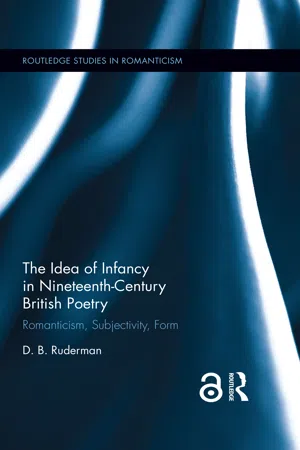
The Idea of Infancy in Nineteenth-Century British Poetry
eBook - ePub

The Idea of Infancy in Nineteenth-Century British Poetry

Romanticism, Subjectivity, Form

  1. 274 pages
  2. English
  3. ePUB (mobile friendly)
  4. Available on iOS & Android
eBook - ePub

The Idea of Infancy in Nineteenth-Century British Poetry

Romanticism, Subjectivity, Form

About this book

This book radically refigures the conceptual and formal significance of childhood in nineteenth-century English poetry. By theorizing infancy as a poetics as well as a space of continual beginning, Ruderman shows how it allowed poets access to inchoate, uncanny, and mutable forms of subjectivity and art. While recent historicist studies have documented the "freshness of experience" childhood confers on 19 th -century poetry and culture, this book draws on new formalist and psychoanalytic perspectives to rethink familiar concepts such as immortality, the sublime, and the death drive as well as forms and genres such as the pastoral, the ode, and the ballad. Ruderman establishes that infancy emerges as a unique structure of feeling simultaneously with new theories of lyric poetry at the end of the eighteenth century. He then explores the intertwining of poetic experimentation and infancy in Wordsworth, Anna Barbauld, Blake, Coleridge, Erasmus Darwin, Sara Coleridge, Shelley, Matthew Arnold, Tennyson, and Augusta Webster. Each chapter addresses and analyzes a specific moment in a writers' work, moments of tenderness or mourning, birth or death, physical or mental illness, when infancy is analogized, eulogized, or theorized. Moving between canonical and archival materials, and combining textual and inter-textual reading, metrical and prosodic analysis, and post-Freudian psychoanalytic theory, the book shows how poetic engagements with infancy anticipate psychoanalytic and phenomenological (i.e. modern) ways of being in the world. Ultimately, Ruderman suggests that it is not so much that we return to infancy as that infancy returns (obsessively, compulsively) in us. This book shows how by tracking changing attitudes towards the idea of infancy, one might also map the emotional, political, and aesthetic terrain of nineteenth-century culture. It will be of interest to scholars in the areas of British romanticism and Victorianism, as well as 19th-century American literature and culture, histories of childhood, and representations of the child from art historical, cultural studies, and literary perspectives.

"D. B. Ruderman's The Idea of Infancy in Nineteenth-Century British Poetry: Romanticism, Subjectivity, Form is an interesting contribution to this field, and it manages to bring a new perspective to our understanding of Romantic-era and Victorian representations of infancy and childhood.

…a supremely exciting book that will be a key work for generations of readers of nineteenth-century poetry."

Isobel Armstrong, Birkbeck, University of London

Victorian Studies (59.4)

Trusted by 375,005 students

Access to over 1.5 million titles for a fair monthly price.

Study more efficiently using our study tools.

Information

Publisher
Routledge
Year
2016
Edition
1
eBook ISBN
9781317276487

Table of contents

  1. Cover
  2. Half-Title Page
  3. Routledge Studies in Romanticism
  4. Title Page
  5. Copyright Page
  6. Dedication Page
  7. Table of Contents
  8. List of Figures
  9. Acknowledgments
  10. Introduction: “Infant Bud of Being”
  11. 1 “Blank Misgivings”: Infancy in Wordsworth’s Ode
  12. 2 “When I First Saw the Child”: Reverie in Erasmus Darwin and Coleridge
  13. 3 Merging and Emerging in the Work of Sara Coleridge
  14. 4 Bodies in Dissolve: Animal Magnetism and Infancy in Shelley
  15. 5 Stillborn Poetics and Tennyson’s Songs
  16. Afterword: “An Echo to the Self”: Augusta Webster’s Psychoanalytic Thought
  17. Bibliography
  18. Index

Frequently asked questions

Yes, you can cancel anytime from the Subscription tab in your account settings on the Perlego website. Your subscription will stay active until the end of your current billing period. Learn how to cancel your subscription
No, books cannot be downloaded as external files, such as PDFs, for use outside of Perlego. However, you can download books within the Perlego app for offline reading on mobile or tablet. Learn how to download books offline
Perlego offers two plans: Essential and Complete
  • Essential is ideal for learners and professionals who enjoy exploring a wide range of subjects. Access the Essential Library with 800,000+ trusted titles and best-sellers across business, personal growth, and the humanities. Includes unlimited reading time and Standard Read Aloud voice.
  • Complete: Perfect for advanced learners and researchers needing full, unrestricted access. Unlock 1.5M+ books across hundreds of subjects, including academic and specialized titles. The Complete Plan also includes advanced features like Premium Read Aloud and Research Assistant.
Both plans are available with monthly, semester, or annual billing cycles.
We are an online textbook subscription service, where you can get access to an entire online library for less than the price of a single book per month. With over 1.5 million books across 990+ topics, we’ve got you covered! Learn about our mission
Look out for the read-aloud symbol on your next book to see if you can listen to it. The read-aloud tool reads text aloud for you, highlighting the text as it is being read. You can pause it, speed it up and slow it down. Learn more about Read Aloud
Yes! You can use the Perlego app on both iOS and Android devices to read anytime, anywhere — even offline. Perfect for commutes or when you’re on the go.
Please note we cannot support devices running on iOS 13 and Android 7 or earlier. Learn more about using the app
Yes, you can access The Idea of Infancy in Nineteenth-Century British Poetry by D.B. Ruderman in PDF and/or ePUB format, as well as other popular books in Literature & English Literary Criticism. We have over 1.5 million books available in our catalogue for you to explore.