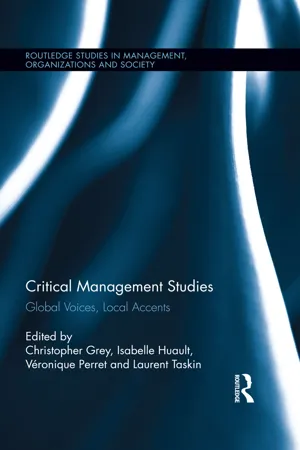
Critical Management Studies (CMS) is often dated from the publication of an edited volume bearing that name (Alvesson and Willmott, 1992). In the two decades that have followed, CMS has been remarkably successful in establishing itself not just as a 'term' but as a recognizable tradition or approach. The emerging status of CMS as an overall approach has been both encouraged and marked by a growing range of handbooks, readers and textbooks. Yet the literature is dominated by writings from the UK and Scandinavia in particular, and the tendency is to treat this literature as constituting CMS. However, the meaning, practice, constraints and context of CMS vary considerably between different countries, cultures and language communities. This volume surveys fourteen various countries and regions where CMS has acquired some following and seeks to explore the different ways in which CMS is understood and the different contexts within which it operates, as well as its possible future development.
eBook - ePub
Critical Management Studies
Global Voices, Local Accents
- 244 pages
- English
- ePUB (mobile friendly)
- Available on iOS & Android
eBook - ePub
Critical Management Studies
Global Voices, Local Accents
1
Australia and New Zealand
Drawn Together Yet Worlds Apart?
Some of the differences between Australia and New Zealand as far-flung former colonies of Great Britain are obvious: while settlement of the former was prompted by the crisis of where to send convicts and undesirables following the American War of Independence, the latter was always a destination for free settlers, even before it separated from the Colony of New South Wales in 1841. A less well-known difference is in the way these countries have treated their respective first peoples, where New Zealand’s 1840 Treaty of Waitangi establishing Māori land rights and Australia’s policy of Terra Nullius or “empty land” legitimating the genocide of entire indigenous populations (Tatz, 2003) stand in stark contrast. Indeed, to be true to the spirit of Waitangi we should, more correctly, refer to Aotearoa rather than to New Zealand. Yet today, setting aside the way we fire jokes across the Tasman Sea about each other’s alleged primitive ways, both countries are poster children for the modern integrated and globalized economy and both possess vibrant and internationally active academic communities of critical scholars. Indeed, New Zealand and Australia were striding ahead of the pack when Thatcher or Reagan were barely out of their neo-liberal economic policy blocks. In this way, both countries have been fertile incubators for Critical Management Studies, and this chapter shows how, in contrasting ways, each one has contributed to the development of this emerging movement. Graham Sewell begins with his reflections on Australia and then Deborah Jones and Craig Pritchard together offer their perspective from New Zealand.
Australia (Graham Sewell)
Southern Theory from a Great Southern Land?
Growing up in Britain, my knowledge of Australia, like most Britons, was acquired through the kind of distorting prism that only the resident of a former colonial power possesses, where my attitudes toward the Great Southern Land were simultaneously romanticized and patronizing. Even as an undergraduate, I remember being disappointed to discover on reading Asa Briggs Victorian Cities that Melbourne was actually a well-established and sophisticated metropolitan conurbation with unpredictable weather rather than a sunburnt outback town surrounded by red desert as far as the eye could see (a view developed exclusively through the voracious consumption of Smiley films and The Sundowners, all of which were screened by the BBC on high rotation). Worse still—considering I was in my mid-twenties, a PhD student, and an official guest at a major US university—I remember asking my host whether he liked rugby after he told he was from Melbourne (at that time rugby union was played almost exclusively in parts of New South Wales and Queensland, and then it was restricted to a few expensive suburbs and a smattering of elite private schools). Although in hindsight this looks hopelessly ill informed, I don’t think it was unusual for the time. For example, in the mid-1990s, when I told a very senior colleague I was giving up an orthodox British academic trajectory to move to Australia, his response was a combination of bemusement and disbelief. “You know it will be the end of your career, don’t you?” he finally managed to splutter. Perhaps if I had read for a different degree or been interested in researching a different topic for my PhD then I would have been more aware of Australia’s contradictory history of radical working-class politics and its status as a loyal vassal, first of British, then US cultural, political, and economic imperialism. I might even have been aware of its more recent and important contributions to the social sciences, the humanities, and cultural studies through the efforts of the likes of Elizabeth Grosz, Raewyn Connell, and Bryan S. Turner that have become part of what Connell (2007) herself calls “Southern Theory”. Perhaps I would have also been aware that a small but significant part of the Australian population were institutionally condemned to be second-class citizens for, in terms of the mistreatment of its first peoples, Australia has always been truly “world-class”.
Elsewhere I have been involved in producing something akin to Southern Theory as part of Australia’s contribution to Critical Management Studies (see Clegg et al., 1999) but for this chapter, I am adopting a much more traditional approach that combines an orthodox chronological take on the history of ideas with an unashamedly selective list of authors. While Australia may not yet have produced coherent versions of the social sciences or the humanities in the same way that France has produced the Regulation School or Germany the Frankfurt School (Connell’s Southern Theory notwithstanding) there have certainly been immigrants and emigrants that have made many distinguished contributions to Critical Management Studies. This is fitting for such a relatively new country (it was first possible to become a citizen of a distinct sovereign nation rather than a subject of the British Empire only as recently as 1948) because what it means to be Australian these days owes so much to our continuously ambivalent stance toward migration, both inward and outward. In light of this, I shall be using the themes of immigration and emigration as the organizing framework for my section of this chapter. I will start in an unlikely place: Harvard University and the Human Relations School of Elton Mayo and his acolytes. Although by any stretch of the imagination this could never be described as an embryonic form of Critical Management Studies, I shall show that Mayo’s formative years in Australia did much to shape the Human Relations School’s attitudes towards work organization and, thus, set in train much of what Critical Management Studies actually criticizes. I shall then go on to look at the Australian influence on the Tavistock Institute’s take on human relations before bringing matters right up to date by reflecting on the foundation on the Critical Management Studies division of the Academy of Management. I shall then conclude this section’s focus on Australia by examining the contribution made by immigrants to the country in the broad area of Critical Management Studies. Prominent amongst these will be Stewart Clegg through his sustained interest in power relations and Cynthia Hardy through her important theoretical and empirical work using discourse analysis.
Everywhere You Go, Always Take the Weather with You:1 Australia’s Critical Management Émigrés
Dorothy Mackellor wrote the best known poem about the Australian bush, not in the “sunburnt country” she so memorably invoked in My Country, but while living in London. It was published in 1919 in that bastion of the conservative British Establishment, the Spectator. In the same year, another conservative—originally from Adelaide but by then a lecturer in philosophy and ethics at the University of Queensland—published his first substantial ork, Democracy and Freedom. The author was Elton Mayo, and he had produced a treatise on political theory that contained a trenchant critique of socialism along with a defence of the minimal state (obviously pressing topics at the time so soon after the 1917 October Revolution) that drew on the likes of J. S. Mill and Herbert Spencer. It is very much a book of its time, and I wouldn’t recommend it as light holiday reading now but its fourth chapter provides a crucial insight into the development of Mayo’s later thinking; much like Mackellor in London, when Mayo was sitting in his office at Harvard, he must have often been thinking back to his formative experiences in Australia and the apparently recondite industrial relations problem of compulsory arbitration. In short, Mayo’s abiding dislike of organized labour was clearly expressed through his critique of a uniquely antipodean way of dealing with workplace conflict.
Building on developments in New Zealand and the independent colonies of New South Wales and South Australia, in 1904, the recently federated Australian Commonwealth “… made class warfare into a legal process” (Rowse, 2004, p. 17) through an Act of Parliament that, among other things, created a legally binding system for resolving industrial disputes. This infuriated Mayo, who wrote,
So far as arbitration encourages the mutual discussion of difficulties between masters and men, the effect is excellent… But the notion of an Arbitration Court goes far beyond this… Its primary assumption is that the interests of masters and men cannot be made identical, that the intervention of an intermediary is necessary in the general interest. This assumption serves in practice to stereotype the breach and to multiply the causes of dispute; arbitration courts have the effect of recognising and legalising social disintegration.
(Mayo, 1919, pp. 47–48)
While Australian scholars (e.g. Gillespie, 1991, Bruce and Nyland, 2011) have long pointed to baleful ideological influence that Mayo exerted over the subsequent development of the Human Relations School (and, thus, over much of mainstream management studies for the best part of a century), nothing quite captures his position in such a succinct form as this quote. Spontaneous rational debate between employers and employees is to be encouraged (to be fair, I am assuming that the terms “masters” and “men” simply reflect the conventions of the time), but the intrusion of third parties such as unions, let alone the state, into such relations are to be abhorred because they only serve to undermine a meeting of minds over what ought to be quite obvious unitary interests. In this respect, it could be argued that much of what Critical Management Studies sets itself against—the belief that cooperation, consent, and harmony somehow are (or should be) the natural state of organizations and, as a consequence, conflict, coercion, and discord are pathological manifestations of irrational thinking and behaviour—at least had some of its origins in the founding of Australia as an independent modern state.
Although its shares part of its name with an intellectual and political movement forever associated with Elton Mayo, the Tavistock Institute of Human Relations represents a subtly different take on social cohesion in organizations. To be sure, it was founded with a grant from that prime instrument of US imperialism, the Rockefeller Foundation, and some of its earliest contributors such as Alfred Bion and Elliott Jacques shared Mayo’s interest in psychotherapeutic responses to individual cases of neurosis in organizational settings (see Trist and Murray, 1990). Others such as Eric Trist, however, also started with an interest in psychoanalysis. With Kenneth Bamford, he adopted a much more critical view of the operation of group dynamics in organizations, recognizing an important source of conflict in the workplace was the drive, as part of the quest for productivity in post-war Britain, toward increased mechanization that consequently eroded employees’ autonomy (see Trist and Bamforth, 1951). Although they never explicitly adopted a Marxist approach, Trist and Bamforth’s critique thus anticipated some of the arguments of labour process theory’s “deskilling thesis” (Braverman, 1974), and it was as part of this vibrant intellectual milieu that two Australians made important early contributions to the British variant of the human relations movement. The first of these was the Sydney-born J. A. Barnes who had a considerable career as a sociologist and social anthropologist at major universities in Australia and Britain. It was while he was at the London School of Economics, however, that he made the contribution in which we are most interested, for it was from here that he published an article in the institute’s flagship journal, Human Relations, in which he coined the phrase, “social network analysis” (Barnes, 1954). Unlike many of his successors in the burgeoning world of social network analysis in management studies, his two-year study of a tiny Norwegian fishing village included an explicit consideration of the role played by class in creating the social stratification that enabled local elites to hold sway in the control and distribution of resources. I would contend that, if only today’s advocates of social network analysis would emulate Barnes’s interest in class, it could rightly become an important part of the Critical Management Studies family.
The second Australian I wish to mention in relation to the Tavistock Institute is Fred Emery who made many and varied contributions to the development of management thinking in the second half of the twentieth century (see Heller, 1997). Emery was the son of a Western Australian sheep shearer and was an active member of the Communist party in Australia and later in Britain until he resigned after Soviet invasion of Hungary in 1956. Although he initially saw himself primarily as a psychologist, he also undertook developmental work in remote Aboriginal communities before moving to the Tavistock Institute in 1951 where he embarked on a fruitful and (by all accounts) sometimes tempestuous period of work. Speaking to people who knew him well, some colleagues found him difficult to get on with (probably for the same reasons that others loved him), and Heller (1997) politely alludes to this in Emery’s obituary. This genius, for upsetting the “establishment”, later came to a head at the Australian National University (ANU) in the mid-’70s when he was denied tenure after publishing a government-commissioned report (with, it has to be said, numerous co-authors) containing a passing references to what can best be described as “unconventional” ideas about the effects of watching television on children’s brain plasticity (Emery et al., 1975). By the standards of some of the more outlandish claims made today by social scientists jumping on the neuroscience bandwagon, these ideas may seem innocuous; but according to his friends, he was nothing short of hounded out of Australia’s preeminent university at the time by narrow-minded, petty, and envious scientists who felt threatened by this tiny incursion into their bailiwick. Perhaps his famed Australian directness was a little too Australian and a little too direct for the blue bloods of the ANU. It is fair to say, however, that the same friends also acknowledged that Emery’s confrontational style with intellectual opponents did not make his predicament any easier. It is sad that his university career suffered such an inglorious end as, by then, he should have been hailed as an august elder statesman of management studies after his seminal contributions on topics such as “open” and “closed” systems, environmental turbulence, and information theory (see Emery and Trist, 1965; Ackoff and Emery, 1972). Later on he also became a pioneering champion of sustainability but, as far as critical management scholars are concerned, his main legacy is as a tireless advocate of industrial democracy (see Emery and Thorsrud, 1976). This work was itself controversial in that it found the compulsory presence of employee representatives on company boards in many European countries had little real positive effect on the predicament of shop floor workers at the very time that British trades unions were campaigning for this very thing. He went as far as to contend that legislating to put workers on boards was worse than useless, as it diverted attention from making meaningful reforms to work organization on the shop floor (although he did later moderate this view—Heller, 1997). Some trades unionists who were active at the time have told me that this research played a small but not inconsequential role in killing off the industrial democracy movemen...
Table of contents
- Cover
- Title
- Copyright
- Contents
- List of Figures and Table
- Acknowledgements
- List of Contributors
- Introduction: Beginning a Conversation
- 1 Australia and New Zealand: Drawn Together Yet Worlds Apart?
- 2 Non-Managerial Management Scholarship in Belgium, the Netherlands and Luxemburg
- 3 “CMS, Canada & the Network”: An Actor-Network Analysis
- 4 CMS with a Local Accent: Is Critical Management Education Possible in China?
- 5 The Awakening of Critical Management Studies in France: Mimicry or a Process of Coming Out?
- 6 Critical Scholarship in Management and Organization Studies in German-Speaking Countries: An Overview and Historical Reconstruction
- 7 From Anti-Managerialism to Over-Managerialism: How Critical Management Studies in Israel Were Exiled from Local Business Schools and Emerged Elsewhere
- 8 Italian Voices from the Outside: The Context for CMS in Italy
- 9 Self-Problematization and Relational Problematization: A Critical-Constructive Approach in the Japanese Context
- 10 CMS in Scandinavia: A Hitchhiker’s Guide to the Realm of the Scandocrits
- 11 CMS in the Periphery: A Look at South America
- 12 The Ghost in the System: Critical Management Studies in Turkey
- 13 CMS in the United Kingdom
- 14 Galumphing and Critical Management Studies: Perspective and Paradox from the United States
- Conclusion: Diverse Accents, Common Voice?
- Index
Trusted by 375,005 students
Access to over 1.5 million titles for a fair monthly price.
Study more efficiently using our study tools.
Frequently asked questions
Yes, you can cancel anytime from the Subscription tab in your account settings on the Perlego website. Your subscription will stay active until the end of your current billing period. Learn how to cancel your subscription
No, books cannot be downloaded as external files, such as PDFs, for use outside of Perlego. However, you can download books within the Perlego app for offline reading on mobile or tablet. Learn how to download books offline
Perlego offers two plans: Essential and Complete
- Essential is ideal for learners and professionals who enjoy exploring a wide range of subjects. Access the Essential Library with 800,000+ trusted titles and best-sellers across business, personal growth, and the humanities. Includes unlimited reading time and Standard Read Aloud voice.
- Complete: Perfect for advanced learners and researchers needing full, unrestricted access. Unlock 1.5M+ books across hundreds of subjects, including academic and specialized titles. The Complete Plan also includes advanced features like Premium Read Aloud and Research Assistant.
We are an online textbook subscription service, where you can get access to an entire online library for less than the price of a single book per month. With over 1.5 million books across 990+ topics, we’ve got you covered! Learn about our mission
Look out for the read-aloud symbol on your next book to see if you can listen to it. The read-aloud tool reads text aloud for you, highlighting the text as it is being read. You can pause it, speed it up and slow it down. Learn more about Read Aloud
Yes! You can use the Perlego app on both iOS and Android devices to read anytime, anywhere — even offline. Perfect for commutes or when you’re on the go.
Please note we cannot support devices running on iOS 13 and Android 7 or earlier. Learn more about using the app
Please note we cannot support devices running on iOS 13 and Android 7 or earlier. Learn more about using the app
Yes, you can access Critical Management Studies by Christopher Grey,Isabelle Huault,Véronique Perret,Laurent Taskin in PDF and/or ePUB format, as well as other popular books in Business & Business General. We have over 1.5 million books available in our catalogue for you to explore.