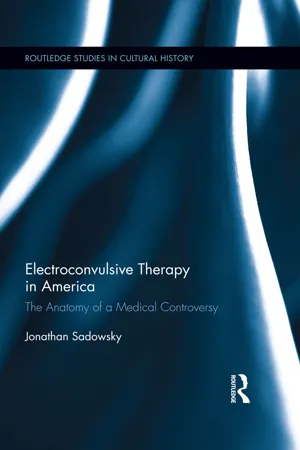
Electroconvulsive Therapy is widely demonized or idealized. Some detractors consider its very use to be a human rights violation, while some promoters depict it as a miracle, the "penicillin of psychiatry." This book traces the American history of one of the most controversial procedures in medicine, and seeks to provide an explanation of why ECT has been so controversial, juxtaposing evidence from clinical science, personal memoir, and popular culture. Contextualizing the controversies about ECT, instead of simply engaging in them, makes the history of ECT more richly revealing of wider changes in culture and medicine. It shows that the application of electricity to the brain to treat illness is not only a physiological event, but also one embedded in culturally patterned beliefs about the human body, the meaning of sickness, and medical authority.
eBook - ePub
Electroconvulsive Therapy in America
The Anatomy of a Medical Controversy
- 172 pages
- English
- ePUB (mobile friendly)
- Available on iOS & Android
eBook - ePub
1
Origins and Origin Myths
As knowledge of electricity grew in modern Western societies, an ambivalent fascination developed. A mysterious force with unknown and seemingly limitless potential, some thought it the source or essence of life itself. By that measure, it was also something to be feared. Witness the birth of such a monster:
It was on a dreary night of November that I beheld the accomplishment of my toils. With an anxiety that almost amounted to agony, I collected the instruments of life around me, that I might infuse a spark of being into the lifeless thing that lay at my feet… I saw the dull yellow eye of the creature open; it breathed hard, and a convulsive motion agitated its limbs.1
A spark, a convulsion, a lifeless form brought to life: although the doctor here, in Mary Shelley’s Frankenstein, is trying to bring to life matter that is literally dead, rather than suffering the figurative death of severe mental illness, the passage is eerily similar to ECT in certain respects.
In the novel, upon encountering Doctor Frankenstein later, the monster describes the period following his awakening in terms that could well have come from an ECT patient, without even a change in diction:
It is with considerable difficulty that I remember the original era of my being; the events of that period appear confused and indistinct. A strange multiplicity of sensations seized me, and I saw, felt, heard, and smelt at the same time…2
The reason to raise the Frankenstein story in connection with ECT is not, however, to suggest that Shelley somehow anticipated the therapy or influenced its development. It does, however, show that before ECT was invented, its main ingredient—electricity—had rich connotations with modernity, Romanticism, and also with mad science, science gone haywire—although, as Susan Lederer has argued, the monster’s sensitivity and other details from the story suggest that Shelley had a more nuanced agenda.3 And cultural associations between this scene and ECT may run very deep. In the film version of One Flew Over the Cuckoo’s Nest, the protagonist returns to the ward from his ECT treatment, walking with what had become cinematically familiar as the Frankenstein monster gait.4 But this association does not show that resistance to ECT can be reduced to an irrational cultural memory. Not only would this misread the history of ECT, it would misread the significance of the Frankenstein story. Scientific and medical progress is double-edged, and this is why Shelley’s story has resonance.
Electricity and the Body
Electroconvulsive therapy is a dense term, and even the question of which part of it should be stressed is potentially controversial. From a historical point of view, is it ELECTRO-convulsive therapy, one best placed in the history of uses of electricity in medicine?5 Or is it electro-CONVULSIVE therapy, one best placed in the history of induced convulsions?6 Electrical treatments for mental illnesses have a long history, dating back at least to the eighteenth century, and they have had a variety of clinical rationales. These various rationales have included aversive therapy (creating unpleasant associations with an impulse or activity), replenishing life force, and simple fright. Inducing convulsions, though, had a completely different rationale. Meduna’s chemical convulsive therapy was based on the proposed antagonism between schizophrenia and epilepsy. This is one of those areas, though, where polarized debate conceals the complexity. ECT’s clinical origins cannot be cordoned off from the history of electricity in medicine, and regarded simply as a technical modification of other convulsive therapies. But even if it could, the history of electricity and its relationship to the human body would remain relevant, because it is a source and reflection of ambivalent cultural symbolism about what our bodies and minds are made from, and who we are. Placing ECT’s origins solely in the tradition of electrical therapies, however, would require us to ignore the clinical rationale—what early practitioners thought they were doing, and why—entirely.
From the beginnings of European progress in harnessing electricity for practical technologies, it was applied to human bodies. And in these beginnings, it was seen as both a source of danger and a source—perhaps the source—of life itself.7 In the early nineteenth century, there were experiments to test whether electricity could be used even to resurrect dead human bodies, and it was in the context of experiments like this that Shelley could imagine the Frankenstein story.
Electricity between Spirit and Matter
When the American colonies were being settled, European science was growing interest in electricity.8 As Europe and the United States industrialized, electricity became, par excellence, a symbol of scientific advance and wonder.9 It also became deeply associated with life, and in some representations, the secret of life itself. Not surprisingly, this led to attempts to use it medicinally, and for many conditions, medical treatments were to be touted as miracle cures. Indeed—and I love this detail—in 1744 a German professor concluded that because electricity must be useful, and there is no use for it in theology or law, it must therefore be useful for medicine.10 There was no more fertile area for these hopes than nervous conditions, as the nervous system came to be seen as pre-eminently electrical, often analogized to the emerging telegraph system.11 Yet amid these positive associations, electro-therapeutics were shot through with controversy from their beginning and throughout their history. Hyperbolic therapeutic claims of early enthusiasts prompted skeptical counter-claims. Early eighteenth-century medical uses aroused suspicion at both London’s Royal Society and Paris’s Academy of Sciences. There were counter-currents accompanying any associations of electricity with a positive vision of modernity, and cultural associations of electricity soon became linked with fringe or quack science, and at worst with terror, and death.
Medicinal uses of electricity continued. These included attempts to cure cases of paralysis, for example.12 But the skepticism of much of the scientific establishment was continuous. Electricity was so frequently presented as a panacea that those who wished to make it more respectable had constantly to distance themselves from zealots, and to insist that its uses were limited.13
Each new generation of electrical practitioners claimed to be the one that would establish the reputability of electrical cures.14 This was partly the intent of pioneer electrical scientist Luigi Galvani, who showed in the late eighteenth century that he could produce electricity from animal tissue; a frog’s legs twitched convulsively when nerve and muscle were connected through a metallic circuit.15 Galvani did not introduce any new techniques to electrical medicine, but he believed he had established its physiological basis, and his work did help to further its respectability.16
Galvani’s finding also encouraged developing ideas that electricity was in some way the secret of life, what differentiated animate matter from inanimate. What this meant was debatable, though. For some, the link between life and electricity provided support for the most materialist conceptions of human life and the denial of the existence of the soul.17 This was connected to an emergent view of the human body as a machine.18 For conservatives such as Edmund Burke, this was precisely the problem with linking electricity and the body. Burke’s concerns were justified, because many nineteenth-century radicals were indeed inspired by the link between electricity and the body, and the malleability of humanity that might imply. British electrical scientist Michael Faraday sought to debunk the idea that electricity was the basic stuff of life, arguing that if it were, it would not be possible to experiment with it.19 For Faraday, this argument was critical to promoting the respectability of electrical science, creating distance between the science and its potential radical taint. Samuel Taylor Coleridge and some of his medical contemporaries articulated a middle position, seeing electricity as a mediator between the body and the soul.20 Morus points out that while European observers might agree that electricity was a powerful force, “by the second decade of the nineteenth century, galvanism had already acquired a dangerous history and a dodgy reputation. It was at once the plaything of fashionable dilettantes, the hope of radical firebrands, and the bête noire of conservative ideologies anxious to stamp out anything that seemed to smack of atheism, materialism and all such French connections.”21 Morus also shows that electricity was used in nineteenth-century Britain to induce convulsions in dead bodies, to see if the corpses could be revived. This—along with the practice of snatching corpses for investigative dissections—forms the background to Shelley’s fantasy novel. For example, Morus tells the story of the body of Tom Weems, whose corpse was electrified in an effort to disprove the theory that human bodies could be re-animated electrically.
American electrical science followed European in seeking practical medical applications.22 Electrical shocks were used in the eighteenth century to resuscitate in cases of cardiac arrest.23 The great and iconic early American scientist of electricity was, of course, Benjamin Franklin. Franklin also experimented with medical applications of electricity to the body. Franklin and some of his contemporaries believed that electrical shocks—to induce convulsions—could be used to treat melancholia, the term used for depression before the twentieth century. Franklin’s highly pragmatic and anti-metaphysical approach was not the only one in North America, though. For Dr. T. Gale, who wrote the first major statement on medical electricity in North America, electricity was the mediator between the divine and material worlds.24 Gale treated hundreds of cases, claiming success with cases of hysteria, epilepsy, fevers, and inflammation, believing he was rejuvenating the nervous system with this divine gift. And, in the late eighteenth century, a woman claiming to be possessed by a demon sought help from Joseph Priestly himself, who cured her with an electrical machine.
In the United States, the decades before the invention of ECT was the time when electricity stopped being an exotic and mysterious aspect of nature, detached from daily life for most people. Instead, it colonized daily life, transforming everything: homes, factories, businesses, and toys.25 Between 1850 and 1950, the United States became the leading energy consumer in the world.26 But electricity did not cease being an object of wonder as it became part of everyday life. As David Nye has shown, electricity was not simply a utility or a technology, but a culturally fraught symbol of modern life—and in particular, of progress. Electricity was, Nye says, “the wonder of the age, the hallmark of progress,” “a mysterious power Americans had long connected to magnetism, the nervous system, heat, power, lightning, sex, health, and l...
Table of contents
- Cover
- Title
- Copyright
- Dedication
- Contents
- Acknowledgments
- Introduction
- 1 Origins and Origin Myths
- 2 Trying to Make Progress
- 3 Therapeutic Disciplines
- 4 “What of His Psychology?”: ECT and Psychoanalysis
- 5 “Total Rejection of Psychiatry”: ECT and the Antipsychiatry Movement
- 6 The History of a Side Effect: ECT and Memory Loss
- Conclusion
- Bibliography
- Index
Trusted by 375,005 students
Access to over 1.5 million titles for a fair monthly price.
Study more efficiently using our study tools.
Frequently asked questions
Yes, you can cancel anytime from the Subscription tab in your account settings on the Perlego website. Your subscription will stay active until the end of your current billing period. Learn how to cancel your subscription
No, books cannot be downloaded as external files, such as PDFs, for use outside of Perlego. However, you can download books within the Perlego app for offline reading on mobile or tablet. Learn how to download books offline
Perlego offers two plans: Essential and Complete
- Essential is ideal for learners and professionals who enjoy exploring a wide range of subjects. Access the Essential Library with 800,000+ trusted titles and best-sellers across business, personal growth, and the humanities. Includes unlimited reading time and Standard Read Aloud voice.
- Complete: Perfect for advanced learners and researchers needing full, unrestricted access. Unlock 1.5M+ books across hundreds of subjects, including academic and specialized titles. The Complete Plan also includes advanced features like Premium Read Aloud and Research Assistant.
We are an online textbook subscription service, where you can get access to an entire online library for less than the price of a single book per month. With over 1.5 million books across 990+ topics, we’ve got you covered! Learn about our mission
Look out for the read-aloud symbol on your next book to see if you can listen to it. The read-aloud tool reads text aloud for you, highlighting the text as it is being read. You can pause it, speed it up and slow it down. Learn more about Read Aloud
Yes! You can use the Perlego app on both iOS and Android devices to read anytime, anywhere — even offline. Perfect for commutes or when you’re on the go.
Please note we cannot support devices running on iOS 13 and Android 7 or earlier. Learn more about using the app
Please note we cannot support devices running on iOS 13 and Android 7 or earlier. Learn more about using the app
Yes, you can access Electroconvulsive Therapy in America by Jonathan Sadowsky in PDF and/or ePUB format, as well as other popular books in History & North American History. We have over 1.5 million books available in our catalogue for you to explore.