- 255 pages
- English
- ePUB (mobile friendly)
- Available on iOS & Android
eBook - ePub
About this book
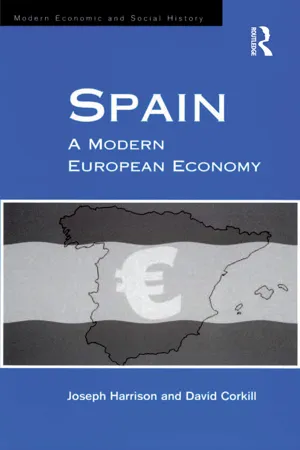
Perhaps more than any other European country, Spain has undergone a remarkable transformation in the post-war period. To the surprise of many, it has succeeded in making the leap from a predominantly agricultural and politically repressed country, to a modern European democracy with a diversified economy containing important manufacturing and service sectors. Yet, despite the fact that at the beginning of the twenty-first century Spain is the world's eighth largest economy, old stereotypes that see the Iberian nation as an inflexible, unchanging society, persist. As such, scholars will welcome this new study which challenges the picaresque and outdated notions of Spanish economic development, replacing them with a picture of rapid and profound modernization. Building upon the recent work of historians and economists, the authors provide a thoughtful and compelling overview of the subject that clearly elucidates both the positive and negative aspects of modern Spanish development. Thus, as well as charting the undoubted successes achieved, persistent problems - most notably high unemployment - are also explored. Written in a straightforward and engaging manner, this book engages with research from a wide variety of disciplines, and will be of interest to anyone with a specific interest in modern Spain, or a wider interest in economic development within the framework of the European Union.
Information
CHAPTER 1
The bumpy road to EMU
Spain entered the twenty-first century with a modern European economy. Over the previous five years the Spanish economy consistently grew at a faster rate than the rest of the European Union. Spaniards from all of the country’s nineteen autonomous communities enjoyed rising living standards. Indeed, the inhabitants of Spain’s most prosperous regions, including Madrid and the Balearic Islands, now belong to the wealthier half of the EU. In January 1999 the country, which not so long ago was dismissed as an agrarian backwater on the southern fringes of the European continent, famous for its lost empire in the New World, its endemic political corruption, civil wars and inward-looking military dictatorships, became a founder member of the European Monetary Union (EMU). Along with other EMU members, it adopted the euro as its sole currency on 1 January 2002. Spain’s participation in the euro zone followed four decades of intense economic, social and political change. Initially, the main evidence of this change was confined to the economic and social spheres. From the late 1950s onwards, a new generation of economic liberals gradually opened up Spain’s relatively closed economy to the process of globalization (Pamuk and Williamson 2000). At astonishing speed, Spain was transformed from a traditional agricultural society into a broad-based industrial nation and finally a predominantly service economy (Requeijo 1989–90; Myro 1997, 49–72). With its fertile irrigated zones, productive car-assembly plants and crowded tourist beaches, the Spanish economy is today a major success story (Ringrose 1996, 3–4; Juliá 1996).
From the mid-1970s, Spain was also engaged in the process of political transformation. To the surprise of many observers, especially outside the Iberian Peninsula, the death of General Francisco Franco in November 1975 set in motion a sequence of events which, in less than a decade, put an end to 36 years of authoritarian rule and saw the consolidation of a remarkably resilient democratic state (Pérez Díaz 1993, 17; Preston 1987). Indeed, so successful was the nation’s progress from dictatorship to democracy under the restored monarchy of King Juan Carlos that political scientists often cite Spain as a paradigm case for subsequent political transitions, above all the dismantling of communism in Eastern Europe after 1989 and the return of democratic rule in Chile in the 1990s following the demise of the Pinochet regime (Casanova 1996; Tusell and Soto 1996).
For long periods of its modern history, Spain’s economy languished. During the nineteenth century, when other European nations experienced their economic take-offs, Spain provides us with a classic example of economic backwardness. Far from closing the gap on the more advanced capitalist nations north of the Pyrenees, Spain fell further behind (Comín 1995, 78). Recent estimates by Leandro Prados and Jorge Sanz (1996, 355–56), for example, show an acceleration of economic growth after 1850 which they ascribe to the spread of free-trade ideas. However, the return of protectionism after 1891, along with such factors as the country’s failure to adopt the gold standard and its costly colonial wars of 1895–98 (resulting in the loss of the highly lucrative Antilles market) led to a slowing down of growth in the years before the First World War. Despite the appearance of economic nationalism, Spain witnessed a further upsurge in growth between 1913 and 1929. Yet the inter-war depression, the impact of the destructive Spanish Civil War of 1936–39 and the ‘hungry years’ of early Francoism brought a further deceleration, putting paid to any possibility of economic convergence. Moreover, while throughout Western Europe the reconstruction of war-torn economies after 1945 took less than a decade to accomplish, Spain’s post-Civil War recovery remained incomplete until the early 1960s.
Although the country’s economic performance during the first two decades of Francoism (1939–59) was disappointing, the introduction of a far-reaching Stabilization and Liberalization Plan in June 1959 is invariably regarded as a major turning point in Spanish economic history (Rubio 1968, 3; Carr and Fusi 1979, 53–54). Above all, the opening up of Spain’s semi-autarkic economy by a number of exogenous factors – foreign trade, inward investment, income from foreign tourism and emigrant remittances – ushered in a delayed industrial spurt. The 1960s boom marked the beginnings of a lengthy and discontinuous phase of catching up between Spain and the European Economic Community (later the European Union) (Comín 1995, 84; Raymond Barra 1995, 517; Requeijo 1998).
Throughout the 1960s and early 1970s, Spain experienced unprecedented levels of economic growth that were matched by dramatic changes in its economic and social structure. Approximately 1.5 million landless labourers and peasant smallholders quit the countryside for the burgeoning industrial conurbations, while another 2 million Spaniards migrated northwards in search of a better life in the booming core economies of Western Europe (see below, Chapter 2). During the final two decades of Francoism, the proportion of the Spanish population employed on the land fell from 50 to 25 per cent. Thus, a process which took nearly three-quarters of a century to accomplish in neighbouring France was compressed into a single generation south of the Pyrenees (Martínez Serrano et al. 1982, 39; Dehesa 1994, 124; García Delgado 1996, 239).
As a late developer whose rapid industrial expansion in the 1960s resulted in a huge dependence on imported oil, Spain felt more sharply than any other Western European nation the international depression of the late 1970s triggered by the decision of OPEC (Organization of Petroleum-Exporting Countries), the oil producers’ cartel, to quadruple the price of crude oil in 1974 and to raise it again in 1979–80. As the country’s inexperienced leadership grappled with a string of outstanding political issues, among them the organization of free elections, the drafting of a democratic constitution and the devolution of power to the regions, the urgent task of readjusting the economy to take account of escalating energy prices was placed on the back burner (Heywood 1995, 37–56; Serrano Sanz 1996, 135–64). Thus, while Spaniards recovered their right to vote or join a trade union, at the same time over a million workers, above all in manufacturing industry, paid a heavy price for the primacy of politics over economics with the loss of their jobs (Pérez Díaz 1999, 108).
Coincidental with Spain’s entry into an enlarged European Economic Community in January 1986, the economy embarked upon a new phase of economic growth. Yet, before long, recovery was once more interrupted by a Europe-wide recession exacerbated by the collapse of the Soviet bloc and the effects of German reunification (Viñals 1996a, 423). As a result, the catching-up process, begun in 1959, was again curtailed. In common with other second-ranking economies, Spain displayed a marked tendency to converge with the European average during periods of expansion while diverging at times of recession (Martín 2000, 10). Writing in 1994, José Viñals of the Bank of Spain’s research department questioned whether Spain would ever close the gap on its European partners. In a pamphlet entitled ‘Is convergence in Spain possible?’, Viñals (1994, 21–25) calculated – somewhat pessimistically – that Spain’s per capita GDP, expressed as a percentage of the EU average (at purchasing power parity), was incapable of breaking through a ceiling of around 80 per cent. Viñals shared the belief, commonly held by Spanish economists, that the chief obstacle to real convergence was the inability of the Spanish economy to generate long-term employment in line with increases in productivity (Martín 1995a, 11–15; Dehesa 1997–98, 51–52; Viñals and Jimeno 1997).
During the second half of the 1990s, the Spanish economy again grew faster than the majority of its European neighbours. Meanwhile, José María Aznar’s centre-right Partido Popular (PP) government, which came to power in March 1996, put full unemployment at the top of its political agenda. Between 1996 and 1999, Spain created as many new jobs as the rest of the European Union put together (Financial Times 2000). Its per capita GDP climbed to 87.8 per cent of the EU average in 2002 (La Caixa 2003, 47). To some extent, the country’s renewed convergence reflected the poor performance of the leading European economies, especially Germany, which were beset by their own economic difficulties. Moreover, convergence did not herald a return to Spain’s spectacular growth performance of the 1960s (Requeijo 1998, 161). A study by Carmela Martín (2000, 10) estimated that it would require another three decades for Spain to reach the average level of European welfare.
The failure of autarky, 1939–59
During the first decade of the Franco dictatorship, dubbed Spain’s ‘lost years’ by its critics, the economy did little more than make good the losses incurred during the destructive Spanish Civil War. The most reliable estimates available of the country’s post-Civil War economic performance by Prados and Sanz (1996, 356) indicate that the Spanish economy stagnated in the 1940s. In the 1950s, however, their findings show a pronounced improvement in the Spain’s economic fortunes, with average yearly growth of 3.8 per cent.
The Franco regime – which seized power in April 1939 with the military and financial backing of Hitler’s Germany and Mussolini’s Italy – was supported by a heterogeneous coalition comprising the armed forces, the Catholic Church, the business community, peasant farmers and sections of the middle class. After three years of fratricidal struggle against the democratically elected Second Republic, the triumphalist New State undertook a brutal repression of its defeated enemies, mainly drawn from the urban and rural lower classes. Up to half a million Republicans, among them the flower of Spain’s intellectuals, artists, doctors and scientists, as well as tens of thousands of workers with irreplaceable skills, were forced into exile. Another 200,000 men and women who stayed on in the Peninsula after the cease-fire were executed by Franco’s firing squads, while the same number died of starvation as a result of the harsh treatment meted out by the victors. In his account of this repression, Michael Richards (1998, 10–11) argues that the material well-being, the identity, conscience and ideals of the country’s ‘Reds’ were cruelly sacrificed in the interests of ‘national resurgence’.
The purging of former Republican sympathizers from the bureaucracy, along with the desire of the victors to reward their loyal supporters, meant that everyday decisions about the management of the economy were entrusted to a coterie of army and navy officers, military engineers and pro-Hitler ‘zealots’ (Hamilton 1943, 104). The newly installed ministers and their civil servants attempted to run the country as if it were a military barracks (Fusi 1985; Velasco 1984, 1988). Dismissive of market forces, the New State’s incompetent authorities paid little or no attention to commodity prices, comparative advantage or opportunity cost. Their prime concerns appear to have been national prestige and technical feasibility (Schwartz and González 1978, 15–37). The dispassionate advice of Spain’s tiny band of professional economists was usually ignored. In the dark days of the 1940s, the Franco dictatorship’s blundering attempts at state intervention and its arbitrary system of rationing gave rise to a society based on privilege, favouritism and corruption. Throughout the Peninsula, a black market, known as the estraperlo, came into operation – often larger than the official market – for a vast array of items including bread, olive oil, medicines, coal, scrap iron and raw cotton (Barciela 1998, 89–90).
During the formative years of the New State, the policy-makers pursued the illusory goal of economic self-sufficiency. The main aspect of their strategy was import-substitution industrialization (see below, Chapter 4). From the very start, commercial policy was directed towards the restriction of imports. Rather than following the orthodox practice of raising the level of tariff protection, this was to be achieved through such devices as bilateral trading agreements, quotas on foreign trade, import and export licences, and the imposition of exchange controls. In addition, Spain’s xenophobic authorities imposed severe curbs on much-needed inward investment (Eguidazu 1978).
Spain’s obsession with half-baked schemes for autarky was partly in response to difficulties which the pro-Axis regime encountered in obtaining energy products, raw materials and machinery from the belligerents in the course of the Second World War. Yet it also reflected the fascist ideology of Franco’s New State. Jordi Catalán (1995a, 73) maintains that the Spanish authorities simply copied the autarkic policies of the German Third Reich and fascist Italy. In contrast to the more open economies of Portugal, Sweden, Switzerland and Turkey, which, like Spain, remained neutral or non-belligerent during the conflict, the Franco dictatorship – with its commitment to economic self-sufficiency – was unable to benefit from an unparalleled opportunity to expand its exports and build up the country’s gold and foreign currency reserves.
After 1945, due to the undemocratic character of the regime, Spain was excluded from the main post-war initiatives in intra-European and transatlantic cooperation. Above all, the country was kept out of the European Recovery Programme (Marshall Aid) and denied membership of the Organization for European Economic Co-operation (OEEC) and the European Payments Union. Isolation imposed considerable costs on the Spanish economy. How did General Francisco Franco’s pariah state survive in this hostile political climate? Traditional interpretations emphasize the massive relief which Spain received from the sympathetic Peronist regime in Argentina during the period 1947–48, and the Pact of Madrid of 1953 which permitted the United States to construct air and naval bases in Spain in return for economic and technical aid (Viñas 1984, 205–37; Rein 1993; Crafts and Toniolo 1996, 24). In contrast, Fernando Guirao (1998) highlights Spain’s commercial relations with Western Europe. Guirao sees the period 1945–57 as a time of transition, when the Franco regime’s autarkic philosophy was gradually dismantled in favour of the new doctrine of development. Francoist Spain’s early drive for industrialization increased rather than diminished the country’s reliance on foreign trade. Spanish industry, he contends, was incapable of substituting domestic production for imports. Without imported raw materials and capital goods, economic activity faced a series of insurmountable bottlenecks. Since foreign aid was ruled out in the late 1940s for largely political reasons, vital inputs for agriculture and manufacturing had to be financed by additional exports, mainly to Western Europe. After the Second World War, Guirao argues, the Spanish economy was viewed by Western European governments as a valuable resource at a time of widespread destruction, starvation and economic dislocation. As a result, the Allies made no serious attempt to topple the discredited Caudillo. Indeed, notwithstanding the decision of the French government in March 1946 to close its Pyrenean frontier indefinitely and the United Nation’s boycott of Spain’s ‘fascist regime’ in December 1946, political ostracism was toned down significantly for economic reasons. Despite the fact that Spain’s foreign trade was comparatively tiny, it still played a significant role when relief and Western European reconstruction had to be carried out with depleted national resources. Purchases from Spain reduced the pressure on imports from the dollar area and saved hard currency for more urgent needs.
After 1951, the Spanish economy started to recover the ground it had lost since the 1930s. In 1954, the 1929 level of per capita GDP – its previous peak – was attained. Manuel-Jesús González (1979, 47) argues that even before Spain’s celebrated Stabilization Plan of 1959 the country experienced ‘extraordinary rates of growth with acceptable stability’. In the opinion of José Luis García Delgado (1987, 170–77), the 1950s constitute a ‘hinge’ decade separating the inward-looking 1940s from the outward-looking 1960s. This belated improvement in Spain’s economic fortunes coincided with Franco’s decision – in the midst of popular protests in the large cities and a deteriorating cold war situation abroad – to reshape his cabinet in July 1951. Among key changes were the appointments of more pragmatic figures, like Rafael Cavestany at the Ministry of Agriculture and Manuel Arburúa at Commerce. In 1953, Spain signed a series of pacts with the United States and a concordat with the Vatican. These agreements were, in principle, conditional on the willingness of Franco’s authoritarian regime to open up the economy and allow a modest degree of pluralism in society. In economic terms, Article 2 of the Defense Support Programme committed the recipient nation to stabilize its currency, establish a realistic exchange rate, balance the budget, eradicate monopolistic practices, stimulate competition and encourage foreign trade. Such fine sentiments were later to inspire the architects of the 1959 Stabilization Plan (Harrison 1991, 109). Yet, in reality, the economic reforms of the early 1950s were little more than a half-hearted attempt at liberalization which soon lost momentum. Cavestany has been praised by some economic historians for permitting agricultural prices to rise in an effort to eradicate the black market for farm products. Even so, his policies still gave excessive protection to inferior goods such as wheat, rice and wine without paying adequate attention to items with increasing demand such as animal and dairy products (see Chapter 3). For his part, Arburúa has been portrayed by his admirers as the originator of a Spanish version of the Soviet NEP (New Economic Policy), struggling to put an end to the prevailing dogma of self-sufficiency (Viñas et al. 1979, II: 849–67). Other scholars, however, while acknowledging the minister’s entrepreneurial flair, stress his indecisiveness and legendary dishonesty. Despite authorizing the allocation of sizeable quantities of foreign currency to purchase raw materials, semi-manufactures and capital equipment for Spanish industry, Arburúa remained firmly committed to the regime’s ultimate goal of import substitution. His conversion to economic liberalism, his critics contend, was merely a ruse in order to obtain a larger slice of American aid (Clavera et al. 1978, 261; González 1979, 102–03; Payne 1987, 465–66). Of greater significance in the long run, the Franco regime’s improved relations with the United States in the 1950s helped undermine what a future Finance Minister referred to as its ‘almost allergic mistrust of any relationship whatsoever with international organizations’ (Navarro Rubio 1991, 108).
As farmers and farm labourers were transformed into factory labourers and construction workers, the availability of cheap and abundant supplies of unskilled labour created the preconditions for the 1960s industrial boom. However, before the Stabilization Plan of 1959, the prospects for Spanish business were far from encouraging. At home, low levels of aggregate demand severely constrained business profits, while the poor quality and lack of competitiveness of Spanish goods held back exports. Equally disturbing for the policy-makers, the level of inflation gathered pace from 1954 onwards, mainly due to a series of public deficits. In April 1956, thousands of factory workers in the Basque Country, Navarre and Barcelona downed tools in protest against the rising living costs. After 1957, Spain was plunged into a balance-of-payments crisis. As Franco’s autarkic experiment hit the buffers, a bitter dispute raged within the ruling élite between, on the one hand, the defenders of the old politics (inflation and industrialization) and, on the other, the proponents of the new politics (liberalization and stabilization). When Spain’s gold and foreign currency reserves were finally exhausted in the spring of 1959, this argument was resolved in favour the liberalizers (Fuentes Quintana 1993, 16).
Confronted with the threat of national bankruptcy, the Caudillo again reshuffled his government. Amongst the cabinet changes of February 1957, out went the old guard of timid reformers and in came a new breed of technocratic modernizers with close ties to the Catholic lay group, Opus Dei. Alberto Ullastres, a professor of Economic History, replaced Arburúa at the Ministry of Commerce, while the Finance portfolio was handed to Mariano Navarro Rubio, a director of the Banco Popular who was married to Miss Spain. The two men, both still in their early forties, joined forces with another member of their association, Laureano López Rodó, already appointed Technical Secretary of the Presidency in December 1956. The technocrats were ably assisted by a brilliant team of professional economists, prominent among them Joan Sardà, head of the research department at the Bank of Spain, and the brains behind the Stabilization Plan, Manuel Varela at the Ministry of Commerce and Juan Antonio Ortiz Gracia at the Finance Ministry (González 1979, 27–35; Fuentes Quintana 1984, 29–30; Varela 1989–90; Estapé 2000, 191–95).
The new ministers and their advisers set out, hesitantly at first, along the obstacle-strewn path from autarky to greater openness. Even so, economic liberalization was not accompanied by the slightest move towards democratic government, the acceptance of free trade unions or a more progressive taxation system. Moreover, the decisions which the technocrats took at this stage hardly added up to a coherent set of economic policies. Instead they consisted of a number of isolated initiatives aimed at tackling the most pressing issues. Among the achievements of the so-called pre-stabilization era were a simplification of Spain’s system of multiple exchange rates and the belated devaluation of the overvalued peseta. Even so, a plethora of economic controls was maintained and, in many cases, extended. Fortunately, the growing rapprochement between Madrid and Washington permitted the Spanish authorities to become a member of a number of supranational organizations which were to offer financial support to the 1959 Plan. These included the Organization for European Economic Co-operation (OEEC), soon to bec...
Table of contents
- Cover Page
- Title Page
- Copyright Page
- Contents
- List of tables
- General editor’s preface
- Preface
- List of abbreviations
- 1 The bumpy road to EMU
- 2 Demography
- 3 Agriculture
- 4 Industry
- 5 The services sector
- 6 The external sector: trade and foreign investment
- 7 The employment crisis and the labour market
- 8 European integration and the Spanish regions
- Bibliography
- Index
Trusted by 375,005 students
Access to over 1.5 million titles for a fair monthly price.
Study more efficiently using our study tools.
Frequently asked questions
Yes, you can cancel anytime from the Subscription tab in your account settings on the Perlego website. Your subscription will stay active until the end of your current billing period. Learn how to cancel your subscription
No, books cannot be downloaded as external files, such as PDFs, for use outside of Perlego. However, you can download books within the Perlego app for offline reading on mobile or tablet. Learn how to download books offline
Perlego offers two plans: Essential and Complete
- Essential is ideal for learners and professionals who enjoy exploring a wide range of subjects. Access the Essential Library with 800,000+ trusted titles and best-sellers across business, personal growth, and the humanities. Includes unlimited reading time and Standard Read Aloud voice.
- Complete: Perfect for advanced learners and researchers needing full, unrestricted access. Unlock 1.5M+ books across hundreds of subjects, including academic and specialized titles. The Complete Plan also includes advanced features like Premium Read Aloud and Research Assistant.
We are an online textbook subscription service, where you can get access to an entire online library for less than the price of a single book per month. With over 1.5 million books across 990+ topics, we’ve got you covered! Learn about our mission
Look out for the read-aloud symbol on your next book to see if you can listen to it. The read-aloud tool reads text aloud for you, highlighting the text as it is being read. You can pause it, speed it up and slow it down. Learn more about Read Aloud
Yes! You can use the Perlego app on both iOS and Android devices to read anytime, anywhere — even offline. Perfect for commutes or when you’re on the go.
Please note we cannot support devices running on iOS 13 and Android 7 or earlier. Learn more about using the app
Please note we cannot support devices running on iOS 13 and Android 7 or earlier. Learn more about using the app
Yes, you can access Spain by Joseph Harrison,David Corkill in PDF and/or ePUB format, as well as other popular books in Storia & Storia mondiale. We have over 1.5 million books available in our catalogue for you to explore.