- 194 pages
- English
- ePUB (mobile friendly)
- Available on iOS & Android
eBook - ePub
About this book
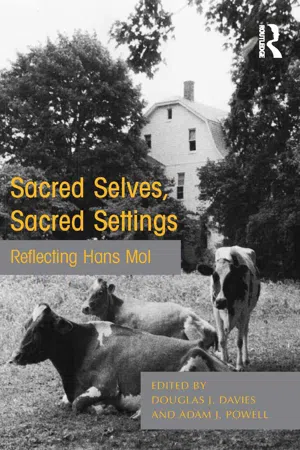
Significantly influencing the sociological study of religion, Hans Mol developed ideas of identity which remain thought-provoking for analyses of how religion operates within contemporary societies. Sacred Selves, Sacred Settings brings current social-religious topics into sharp focus: international scholars analyse, challenge, and apply Mol's theoretical assertions. This book introduces the unique story of Hans Mol, who survived Nazi imprisonment and proceeded to brush shoulders with formidable intellectuals of the twentieth century, such as Robert Merton, Talcott Parsons, and Reinhold Niebuhr. Offering a fresh perspective on popular subjects such as secularization, pluralism, and the place of religion in the public sphere, this book sets case studies within an intellectual biography which describes Mol's key influences and reveals the continuing import of Hans Mol's work applied to recent data and within a contemporary context.
Information
PART I Hans Mol (Re) Considered
1 Hans Mol
DOI: 10.4324/9781315607375-1
Hans Mol was simply following his mother’s example when, at the dawn of the twenty-first century, he set out to compose an autobiography of sorts. For, at the age of 85, Jacoba compiled her life’s most vivid memories for the benefit of her family. Although Hans Mol eventually lost track of the whereabouts of this self-published autobiography, his own autobiographical efforts reflect not only an affinity for the strong familial ties often displayed within Dutch culture of which he was a part but also for his mother and the intuition that allowed her to foresee the identity-constructing effect such a volume might have for her posterity. In the same vein, Mol chose to write an autobiography in which he would share as many details of his life as he could recall, assuming that the eyes casting their gaze upon such material would belong to his relatives. The product of this endeavour, self-published in small quantity, was Tinpot Preacher (Mol 2003). 1
Years before, in the introduction to his seminal work Identity and the Sacred, Mol reluctantly disclosed a few details of his personal biography. There, for the first time in his publications, he revealed his childhood nickname: ‘blikken dominee’ (tinpot preacher) (1976: xi). Initially acknowledging the mocking tone of this appellation as it was spoken by his schoolfellows, Mol seems to have embraced the identity as his life progressed. He was 81 when Tinpot Preacher was published, and those decades spanning the distance between boyhood and wisdom had lent a prophetic resonance to the nickname. Martin Redeker, in his biography of Friedrich Schleiermacher, notes that the latter always viewed himself as a preacher rather than a theologian (1973: 199–200). Something similar can be said for Mol who, at 92, is still an honorary minister at St. Andrew’s Presbyterian Church in Canberra, Australia. However, beyond the Church, his recognized contributions are not theological but sociological though he has continued to engage enthusiastically in Christian ministry. The clever youth who received the nickname for his ready answers in Sunday-school became both a sociologist and an ordained pastor. 2 For academe, and for many of his colleagues, the former overshadowed the latter. For Mol, however, they were two hats on the same rack (Mol 2008: 271). To accept the title of ‘tinpot preacher’ was to accept the appraisal of others whilst retaining a role and a faith that was personal and significant.
* * *
Johannis (Hans) Jacob Mol was born on 14 February 1922 in Rozenburg, Netherlands. His childhood, though it included a move from Rozenburg in the south to Ophemert in the centre of the Netherlands, was primarily defined by farm labour. His father, also a Johannis Jacob Mol, earned a diploma from an agricultural school and decided that his best hopes for continuing the family vocation lay in the farmland available for rent from Baron MacKay, a Scotsman who owned most of Ophemert and the surrounding farms. This move, occurring when Mol was only three years old, would prove intellectually fateful for the farmer’s son.
Mol’s parents were the recipients of liberal educations and had inherited a subculture in the Zeeland islands characterized by a veneration of individuality and self-sufficiency. This progressive bent was precisely what led them to Baron MacKay’s land as the latter believed that this variety of farmer would prove much more valuable than the local types who were seemingly committed to the increasingly antiquated feudal model (Mol 1976: xi–xii). At the same time, this proclivity for independence also alienated the Mol family from both the local working class and the social elites of Ophemert. Unable to speak the local dialect but possessing the intellectual capacity to recognize and decry any social injustices originating within the upper-class, Mol’s parents struggled to maintain their identity as free-thinking farmers. Eventually, their regard for the powers of reason offered them a unique opportunity to speak out for their fellow farmers. Mol once noted that his mother ‘expected much more from radical political action than from praying (ibid.)’. This orientation both to religion and to politics not only resulted in the composition by Mol’s parents of progressive letters sent to farmers’ newsletters across the nation but in crystallizing Mol’s views at a young age. Young Hans believed that the power to effect change resided in the ability to trust rationality. Religion, on the other hand, offered little more than the opportunity to play a pipe organ, the enjoyment of which was somewhat tempered by the necessity of enduring the minister’s Barthian sermons (ibid.: xiii).
An Age of Reason
Respect for enlightened thinking was also fostered at the Gymnasium Mol attended in the nearby town of Tiel. The Gymnasium was an academically rigorous school, and it was there at the age of 12 that Mol first encountered a thoroughgoing love of intellectualism. As an adult, Mol claims that this respect for the powers of reason became ‘much too ingrained’, but there is little doubt that the intensity of the workload and the high expectations of the staff served to establish a solid base for Mol’s academic career (1976: xii). Beyond instruction in six languages, the Gymnasium offered a classical education which, alongside other authors, introduced Mol to Plato’s thought. The Greek philosopher’s probing insights and stirring questions planted a seed of intellectual, existential curiosity that sprouted and thrived years later.
In the meantime, the farmer’s son successfully ignored the bullying of his wealthy, upper-class peers and managed to focus his energies on passing the final exams. Such effort was rewarded in 1941 when Mol passed the exams and was, in turn, eligible to attend university. Having spent his life on a farm, witnessing the incessant struggle of those engaged in agricultural lifestyles and the increasing financial difficulties brought on by the Depression and the Nazi occupation of the Netherlands in 1940 Mol and his parents decided that he should not only earn a university education but should be tested at the Psycho-Technical Institute in Utrecht in order to optimise the suitability of Mol to his chosen field of study. Over three days, Mol underwent psychological testing with the result that he would be best paired with the demands and necessary aptitudes of sociology!
Mol, however, was neither amenable nor convinced. He desired that which was growing more elusive in the early days of World War II, a stable career with ample financial incentive. As the Depression spread, Mol’s parents had been forced to borrow significant amounts of money and were finding themselves uncertain about their financial future. Mol, who had been sent to the Gymnasium in order to avoid life as a farmer, wanted to ease his parents’ burdens. He chose economics instead of sociology and enrolled in the University of Amsterdam.
Envisioning a future career at the large sugar refinery run by a few of his relatives, Mol began studies in economic theory and accounting supplemented by a number of courses in sociology. University work was complicated by the Nazi occupation of Holland. Soon after Mol’s studies commenced, food was rationed through a system of ration cards. Students received limited rations, and Mol was forced to ride the train back to his parents’ home in Ophemert in order to obtain groceries. This was not simply an inconvenience but led to Mol’s first subversive, anti-Nazi action of the war. Transporting suitcases filled with food from Ophemert to Amsterdam, Mol’s parents provided him with the address of Jews who needed food. The latter, typically harboured by sympathetic locals, chose not to register for ration cards in an effort to remain elusive. More than once, Mol delivered food to these individuals, risking his own freedom in doing so.
A Reason to Doubt
Mol could not evade the Gestapo indefinitely. He refused to sign an oath of loyalty to the Nazi cause and, though he had attempted to hide in Amsterdam, the secret police located him and sent him off to work in Germany. Almost 45 years after the actual events, Mol recounted the story of his arrest and imprisonment by the Gestapo in How God Hoodwinked Hitler (1987). After arriving in Kleinwanzleben, the Germans assigned Mol to work in a sugar factory. This decision was based on Mol’s assiduous, intentional display of knowledge concerning the sugar industry. Though the work was forced, the experience and the knowledge gained would eventually prove useful after the war when Mol did, in fact, go to work at his uncle’s refinery. In 1943, however, Kleinwanzleben was less an educational venue and more the setting of the most unequivocally defining event in Mol’s life.
On 22 December, 1943 the Gestapo detained Mol and three of his friends (ibid.: 7). The young Dutchmen were interrogated and confessed. They were guilty of Rundfunkverbrechen, attempting to subvert the Nazi agenda by utilizing a forbidden radio to receive BBC broadcasts whilst engaging in the equally forbidden act of sharing the content of the Allied war updates with other non-Germans (Mol 1976: xiii). Such criminal behaviour was considered seditious par excellence and was suppressed by the threat of death. Expecting the worst, a place among the ranks of concentration camp inmates, Mol learned that he was instead to be sent to a Gestapo prison camp called Rothensee, north of Magdeburg (Mol 1987: 21). For the next three weeks, Mol remained at Rothensee fighting against Nazi cruelty, lice, and an increasing scepticism about his own self-sufficiency.
Mol was relocated to Magdeburg prison to await his trial on 14 January 1944 (ibid.: 39). The trial eventually came after six months of labour in the prison (ibid.: 43). In that time, Mol’s understanding of the world transformed. The human psyche became the subject of diligent scrutiny within the monotonous prison system. Mol observed the psychological advantage of the political prisoners, a group defined by their proclivity for independent thought and equally independent survival (ibid.: 53). The Germans did not allow such prisoners to reside together in the same prison cells, so these anti-Nazi individuals faced their new existences alone. Mol, guilty of undermining the Nazi agenda, was just such a prisoner. He found resolve in his political convictions, but began to question the preparedness of his faith in human reason. On three different occasions Mol was asked to join the Waffen SS, once at Rothensee and twice at Magdeburg (ibid.: 58–60). If he had accepted, his case would have been dismissed and the charges dropped. Yet, his political mettle proved up to the task; Mol refused the offer every time.
The irony, however, was that Mol’s orientation to life was changing in response to an equivalent change in the world. After six months of intense loneliness and unsolicited lessons concerning the potential for human suffering at Magdeburg, Mol was officially sentenced to one and a quarter years of hard labour at Halle Zuchthaus (ibid.: 74). During the ensuing weeks and months, despair and rancour saturated Mol and his fellow inmates, filling the void as hope, dignity, and self-efficacy departed from their minds. He witnessed an outbreak of Typhus, suicide, sexual perversions, nearly died due to infection in his blood, and was forced to uncover unexploded (and highly volatile) bombs. All the while, the intellectual edifice gradually constructed during his childhood and fortified at the Gymnasium attempted to stem the relentless affront presented by the unprecedented experiences of prison.
Looking back on this phase of his life, Mol noted that ‘the prison system hated intellectuals and students … I soon learnt to keep my university education a deep secret’ (ibid.: 78). In such a setting, the precepts of rationality as the supreme foundation for the erection of an indomitable identity succumbed to the functionality of religious faith. The former gave way to the latter because, as Mol states, ‘… in the intellectual world of humanism the basic securities of life have never been radically denied’ (ibid.: 76). World War II stole those securities from Mol and from those with whom he shared this harsh existence. With the benefit of hindsight, he explains that his prison sentence altered his identity:
The old Hans Mol with his arrogant belief in the divinity of reason was gone. He had become chastened by the scourge of war, rejection, cruelty and pain. He had stared death in the face, but incongruously death had sent him back on at least three occasions. He had been set on a path of trust and faith from where there was no return (ibid.: 137).
Freedom and Faith
Early in his academic career, Mol held rationality to be culpable both for the considerable advances and achievements of the twentieth century as well as the injurious, yet prolonged, differentiation of society:
The very principles which have made these economic and technical achievements and adaptations possible (rational analysis and efficient calculation) are structurally unsuited for the provision of a stable frame of reference. However successful rationality may be as a means to achieve ends, it is singularly ill-equipped to provide a uniform world view. Rationality as a norm is essentially divisive. It encourages doubt of assumptions, competes with emotional approaches and obviates cohesion. (Mol 1969: 31)
This divisiveness, this deleterious effect of reason, received significant attention from Mol throughout his tenure as a sociologist of religion. In many ways, the lasting outcome of his prison experiences was veneration of equanimity. His waning confidence in the abilities of human intellect was met by a waxing trust in the efficacy of religious faith. Initially, this newfound perspective altered Mol’s response to, and relationship with, those with whom he came into contact.
After the war, Mol briefly returned to his studies in economics at the University of Amsterdam. This proved fruitless and uninteresting, and in 1946 he accepted a position at his uncle’s sugar refinery in Dinteloord. As assistant to the chief administrator, Mol was in a position of influence within the factory’s hierarchy. Having spent the preceding months attending public lectures on the importance of human rights and management/trade union cooperation, Mol wasted little time in convincing his superior to revive an out-of-print newsletter for the factory employees. De Kleine Courant had existed in the early twentieth century and was effective in mollifying management/labour relations. Mol envisioned a sort of recapitulation; the newsletter condoning the primacy of individual rights and the importance of the mutual regulation of wages and profits. In effect, this was a natural corollary to Mol’s life-changing encounter with fascism and the subsequent discovery of the need for harmony in socie...
Table of contents
- Cover
- Half Title Page
- Title Page
- Copyright Page
- Contents
- List of Tables
- List of Contributors
- Introduction
- PART I HANS MOL (RE)CONSIDERED
- PART II REVISITING THEMES: PLURALISM, SECULARISM AND CONTESTED BORDERS
- Postscript: Reflections of a Sociologist-Priest
- Selected Bibliography of Hans Mol
- Index
Trusted by 375,005 students
Access to over 1.5 million titles for a fair monthly price.
Study more efficiently using our study tools.
Frequently asked questions
Yes, you can cancel anytime from the Subscription tab in your account settings on the Perlego website. Your subscription will stay active until the end of your current billing period. Learn how to cancel your subscription
No, books cannot be downloaded as external files, such as PDFs, for use outside of Perlego. However, you can download books within the Perlego app for offline reading on mobile or tablet. Learn how to download books offline
Perlego offers two plans: Essential and Complete
- Essential is ideal for learners and professionals who enjoy exploring a wide range of subjects. Access the Essential Library with 800,000+ trusted titles and best-sellers across business, personal growth, and the humanities. Includes unlimited reading time and Standard Read Aloud voice.
- Complete: Perfect for advanced learners and researchers needing full, unrestricted access. Unlock 1.5M+ books across hundreds of subjects, including academic and specialized titles. The Complete Plan also includes advanced features like Premium Read Aloud and Research Assistant.
We are an online textbook subscription service, where you can get access to an entire online library for less than the price of a single book per month. With over 1.5 million books across 990+ topics, we’ve got you covered! Learn about our mission
Look out for the read-aloud symbol on your next book to see if you can listen to it. The read-aloud tool reads text aloud for you, highlighting the text as it is being read. You can pause it, speed it up and slow it down. Learn more about Read Aloud
Yes! You can use the Perlego app on both iOS and Android devices to read anytime, anywhere — even offline. Perfect for commutes or when you’re on the go.
Please note we cannot support devices running on iOS 13 and Android 7 or earlier. Learn more about using the app
Please note we cannot support devices running on iOS 13 and Android 7 or earlier. Learn more about using the app
Yes, you can access Sacred Selves, Sacred Settings by Douglas J. Davies,Adam J. Powell in PDF and/or ePUB format, as well as other popular books in Philosophy & Religion. We have over 1.5 million books available in our catalogue for you to explore.