eBook - ePub
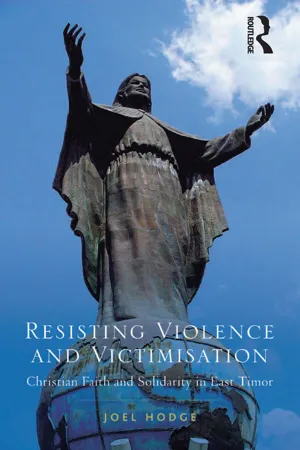
Resisting Violence and Victimisation
Christian Faith and Solidarity in East Timor
- 244 pages
- English
- ePUB (mobile friendly)
- Available on iOS & Android
eBook - ePub
About this book
The reality and nature of religious faith raises difficult questions for the modern world; questions that re-present themselves when faith has grown under the most challenging circumstances. In East Timor widespread Christian faith emerged when suffering and violence were inflicted on the people by the state. This book seeks a deeper understanding of faith and violence, exploring how Christian faith and solidarity affected the hope and resistance of the East Timorese under Indonesian occupation in their response to state-sanctioned violence. Joel Hodge argues for an understanding of Christian faith as a relational phenomenon that provides personal and collective tools to resist violence. Grounded in the work of mimetic theorist René Girard, Hodge contends that the experience of victimisation in East Timor led to an important identification with Jesus Christ as self-giving victim and formed a distinctive communal and ecclesial solidarity. The Catholic Church opened spaces of resistance and communion that allowed the Timorese to imagine and live beyond the violence and death perpetrated by the Indonesian regime. Presenting the East Timorese stories under occupation and Girard's insights in dialogue, this book offers fresh perspectives on the Christian Church's ecclesiology and mission.
Information
Setting the Context
Chapter 1
In Dialogue: Faith and the Victim
A soldier is ordered to shoot some of his own people.1 This order was given to Alexandro after the August 1999 referendum that gave a choice to the East Timorese people between autonomy within Indonesia or independence from Indonesia. Through the lens of Alexandro’s story, I outline my approach to bringing stories from East Timor in dialogue with the insights of Girard, particularly defining how I draw on Girard’s mimetic insight as an interpretative tool.
Alexandro’s Story
Alexandro was a member of the Indonesian military,2 though he was a native of East Timor. With incentives and coercion, the Indonesian military had recruited East Timorese and placed them into special regiments, where they usually remained in the lowest positions. These Timorese brigades provided a presence in the restive province and helped fight the ongoing battle with the East Timorese resistance army, known under the acronym of Falintil.3 Alexandro had previously heard of a plan to attack the general population after the referendum. The plan was later to be exposed as a campaign of state sanctioned and orchestrated violence that sought to punish the Timorese populace for the referendum result and create an impression of civil war, in which the military could claim to be re-establishing order.4 Under this plan, the local Indonesian authorities, military and police constructed and directed militias to target so-called enemies of the state and cause indiscriminate violence.5 The military also participated in the violence.
As part of this campaign, Alexandro was part of a unit in the east that was ordered to cause destruction and directly fire on the populace. However, he could not accept his orders to shoot. Nor could he accept the actions of the other soldiers who were shooting at the populace. Instead of shooting at the people himself, he broke ranks (convincing some other soldiers to do so along with him) and shot the other, non-Timorese soldiers who were killing East Timorese. He, then, deserted his post and fled to the mountains where he sought refuge with other East Timorese people and the East Timorese resistance army (Falintil). He believed he could evade capture in the mountains.
In the midst of battle, Alexandro had a crisis of conscience. This crisis continued after the Indonesian military left East Timor. He felt guilty about what he had done and reflected on it at length. In the moment before the shooting of his fellow soldiers, Alexandro’s examination of conscience led him to conclude that the soldiers were shooting innocent people. He was consciously awakened to the awful violence going on around him and was shocked. His immediate reaction was to use violence against his fellow soldiers to protect those innocent people being killed. He knew that killing was wrong but chose what he saw to be the lesser evil.
Alexandro’s change of heart could be regarded as swapping sides from the Indonesian to the Timorese as the Indonesian state lost control of East Timor. However, what motivated his actions became clear when the United Nations assumed control of East Timor and he settled with his family after his return from the mountains. He recognised that his step out of violence contained violence, and that the violence and killing were wrong. This is a rational deduction but what motivated his rationality? His violence was not motivated by vengeance but he still perceived that it was wrong. Though he tried to protect people, the acts of violence and killing were still something for which he felt regret.
Alexandro, like most East Timorese, is Roman Catholic. After he returned from taking refuge in the mountains, he sought guidance and advice from a family member who is a Catholic religious sister. After his examination of conscience, his guilt became deep contrition. He, then, sought reconciliation with and healing from God. With family support, he undertook the sacrament of reconciliation. He felt his actions had placed something unsurmountable in his life – a sin that needed to be faced. This unsurmountable barrier stood not only between himself and the deceased men, but fundamentally between himself and God. God as creator and judge could heal and reconcile him so that he could be forgiven for his violent actions and sins. In being forgiven, Alexandro felt he could live again, providing an example to his children by always remembering those he had killed and the chance he had been given.
Alexandro’s story highlights some interesting features of Christian experience. His experience does not prove or represent a universal sample of Christian experience but does give some material to question the nature of Christian faith in this case: What is the nature of the faith that Alexandro as a Christian displays? How does it shape moral judgements, especially ones that are not seemingly in one’s own immediate interests and even cause actions that differ from past behaviour with potentially dangerous consequences?
The questions prompted by Alexandro’s experience produce an important starting point for dialogue with the insights of Girard. Girard and those who apply his insights have grappled with similar data and questions about human motivation, violence and culture. For example, Girard indicates that the emergence of a different view of the world not dominated by violence does not easily or naturally occur in human cultures or persons.6 It was this worldview that Alexandro seems to have developed as he rejected victimising his enemies and repented of his actions. While Alexandro’s actions could be justified in the protection of innocents, he felt regret as he awakened to the cycle of violence of which he himself was a part. Alexandro identified this awakening, and his journey for healing, with Christianity. For Girard, the perennial human problem is the cycle of violence that blinds people to their own place in distorted social relations. Girard’s suggestion that Christianity inaugurates a different kind of awareness or consciousness from that caused by the cycles of violence provides an avenue for fruitful exploration of Alexandro’s experience. In order to undertake this exploration, I will briefly outline the nature and purpose of Girard’s work, before providing a fuller exposition of his insights in Chapter 2.
In Dialogue: Girard’s Mimetic Theory and East Timorese Experience
In order to introduce Girard’s insights, let us return to Alexandro’s story and ask: How is this soldier’s perspective possible? Is it just a change of mind? A subjective experience? Or does it really present something about being human? How one answers these questions will depend on one’s understanding of the human person and the epistemological method emerging from this understanding. Present scientific methods can perpetuate a certain view of the human person that is rational, evolutionary and amenable to experimentation and change. This view derives from the epistemological belief that humans come to know only or primarily through experience of and experimentation on the other. According to Joseph Ratzinger, this view has been influenced by the way in which science has developed, that is, as seeking to control its object in order to experiment upon it.7 ‘In the scientific experiment, the object of experience is not free. The experiment depends, rather, on the fact that nature is controlled …’.8 Ratzinger points out that this kind of methodology is inappropriate in the human sciences.9 Despite the recognition that quantitative methodologies have their limits,10 especially in the human and social sciences, an attitude of dissection and deconstruction can still dominate. For example, in writing his first book, Girard underwent a change from the kind of scientific method that Ratzinger critiques. He recounts how he changed from deconstructing and debunking the object of inquiry for his own academic gratification and self-justification, to engaging the other in a more complex and open dialogue.11
As his style of inquiry changed, Girard found he was undergoing a similar experience of conversion as those authors whose works he was analysing.12 According to Girard, novelists such as Proust and Dostoyevsky show an explicit ‘change in outlook’ in their writing derived from a ‘collapse and recovery’.13 These novelists experienced a collapse or ‘existential downfall’ in their attempts at ‘self-justification’ through their creation of caricatured heroes and enemies.14 In this way, the novelist is broken from his attempt to objectify, glorify or blame some other, ‘to realize that he has become the puppet of his own devil. He and his enemy are truly indistinguishable. The novelist of genius thus becomes able to describe the weakness of the other from with himself, whereas before it was some sort of put-up job, completely artificial.’15 This collapse leads toward conversion, even an explicit religious conversion such as for Dostoyevsky in some of his novels (to Christianity).16 Girard concludes that those authors who showed human desire as other-dependent (in books he termed as ‘novels’) had undergone some experience of existential collapse and conversion, while those who had not let go of their ‘Manichean’ caricature of good and evil tried to hide their insecurity by asserting ‘the autonomy and stability of desire’ (in books he termed as ‘romance’).17
Like the novelis...
Table of contents
- Cover Page
- Half Title Page
- Dedication
- Title Page
- Copyright Page
- Contents
- Foreword
- Acknowledgements
- Abbreviations
- Introduction
- Section I Setting the Context
- Section II Violence and Faith
- Section III Sacred Violence and Christian Resistance
- Section IV Solidarity with the Victim
- Conclusion
- Bibliography
- Index
Trusted by 375,005 students
Access to over 1.5 million titles for a fair monthly price.
Study more efficiently using our study tools.
Frequently asked questions
Yes, you can cancel anytime from the Subscription tab in your account settings on the Perlego website. Your subscription will stay active until the end of your current billing period. Learn how to cancel your subscription
No, books cannot be downloaded as external files, such as PDFs, for use outside of Perlego. However, you can download books within the Perlego app for offline reading on mobile or tablet. Learn how to download books offline
Perlego offers two plans: Essential and Complete
- Essential is ideal for learners and professionals who enjoy exploring a wide range of subjects. Access the Essential Library with 800,000+ trusted titles and best-sellers across business, personal growth, and the humanities. Includes unlimited reading time and Standard Read Aloud voice.
- Complete: Perfect for advanced learners and researchers needing full, unrestricted access. Unlock 1.5M+ books across hundreds of subjects, including academic and specialized titles. The Complete Plan also includes advanced features like Premium Read Aloud and Research Assistant.
We are an online textbook subscription service, where you can get access to an entire online library for less than the price of a single book per month. With over 1.5 million books across 990+ topics, we’ve got you covered! Learn about our mission
Look out for the read-aloud symbol on your next book to see if you can listen to it. The read-aloud tool reads text aloud for you, highlighting the text as it is being read. You can pause it, speed it up and slow it down. Learn more about Read Aloud
Yes! You can use the Perlego app on both iOS and Android devices to read anytime, anywhere — even offline. Perfect for commutes or when you’re on the go.
Please note we cannot support devices running on iOS 13 and Android 7 or earlier. Learn more about using the app
Please note we cannot support devices running on iOS 13 and Android 7 or earlier. Learn more about using the app
Yes, you can access Resisting Violence and Victimisation by Joel Hodge in PDF and/or ePUB format, as well as other popular books in Theology & Religion & Religion. We have over 1.5 million books available in our catalogue for you to explore.