- 274 pages
- English
- ePUB (mobile friendly)
- Available on iOS & Android
eBook - ePub
About this book
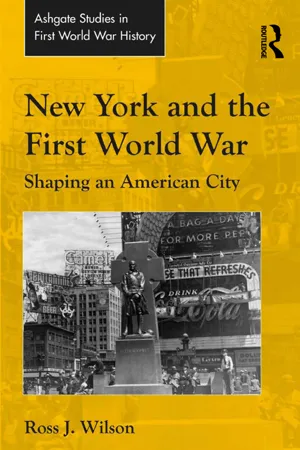
The First World War constitutes a point in the history of New York when its character and identity were challenged, recast and reinforced. Due to its pre-eminent position as a financial and trading centre, its role in the conflict was realised far sooner than elsewhere in the United States. This book uses city, state and federal archives, newspaper reports, publications, leaflets and the well-established ethnic press in the city at the turn of the century to explore how the city and its citizens responded to their role in the First World War, from the outbreak in August 1914, through the official entry of the United States in to the war in 1917, and after the cessation of hostilities in the memorials and monuments to the conflict. The war and its aftermath forever altered politics, economics and social identities within the city, but its import is largely obscured in the history of the twentieth century. This book therefore fills an important gap in the histories of New York and the First World War.
Chapter 1
Introduction
The subject of this book is the city of New York during the First World War; a period when the metropolis witnessed vast alterations in its governance, its citizens and its perception within the wider continental United States. The conflict brought the political, demographic and cultural changes that had occurred in the city during the preceding century into greater focus. Foremost amongst these concerns was that of the city’s character, its identity and the attitudes of its residents in relation to the rest of the nation. This situation arose because of the particular role New York had played in the transformation of the United States; from a collection of rebellious colonies in the late eighteenth century to an industrialised nation ascending to the coveted status of ‘world power’ at the beginning of the twentieth century. The city had been foremost in fuelling this great expansion, enabling the dictum of the nation’s ‘manifest destiny’, by serving as the entranceway to millions of migrants seeking to pursue the promise of the revolution: life, liberty and the pursuit of happiness. However, whilst the city had ‘made America’ through its place as the embarkation point for life in the new world, this role had also come to make America suspicious of the city by the late nineteenth century. A city fuelled by migration, home to ethnic, religious and political diversity, began to be imagined as the antithesis to the image of the nation which had been cultivated through westward expansion. With the settling of the west, the nation of immigrants began to suspect the émigré as lacking in the possession of the singular qualities that made ‘an American’.
These concerns were seemingly compounded with the alteration in the patterns of migration in the latter half of the nineteenth century which saw increasing numbers of southern Europeans and eastern European Jewish communities replacing the traditional source of emigrants from northern Europe.1 The nation’s character was assumed to be compromised by this immigration from new parts of the old world.2 New York became representative of the ills of the United States as its heterogeneous character was assumed to be incompatible with the concept of ‘one nation indivisible’. In these circumstances, the city and its citizens were tested in their loyalty to the nation with the outbreak of war in August 1914. The effects of this conflict in Europe were soon experienced in New York. Indeed, due to its pre-eminent position as a financial and trading centre, its role in the conflict was realised far sooner than elsewhere in the United States. As a city comprised of immigrants from across Europe, the development of the war also placed the city’s residents under greater scrutiny. Religious, ethnic and national ties all shaped responses to the war in New York and each represented a potential point of conflict within the metropolis. As different groups within the city pledged their support for opposing sides in the conflagration, both the peace of the city and the neutral status of the United States were perceived to be in peril. Therefore, although the United States Congress only declared war on Germany in April 1917, the city of New York can be assessed to be involved in the struggle from the very outset of the conflict.
It is this history which shall be the focus of assessment within this book – since, from the declarations of war in Europe during August 1914, plans, policies and preventative measures were put in place to ensure the loyalty of the residents of the city and to maintain the appearance of impartiality. These schemes were also born out of pre-war concerns of the ‘American’ character of the immigrant population of the metropolis. During the war, the city’s inhabitants would be encouraged to represent the city authority’s ideal of ‘one city, one nation, and one loyalty’. With the entry of the nation into the ‘European War’, the focus of this campaign altered to ensure that New York’s immigrant community could steel themselves and represent the nation in a time of war. Once again, the profusion of political and ethnic identities was assumed to suppress the ability of these residents to affirm themselves as ‘100 per cent American’. Wartime programmes of integration and the demand that residents affirm their loyalty through voluntary initiatives and in some cases physical coercion brought the war directly to the city’s inhabitants. After the cessation of hostilities and the return of soldiers from overseas, the wartime experience of the city became a contested object, used by authorities and organisations to maintain the effort of imposing a singular ‘national character’ onto the diverse citizens of New York. In this manner, we can see the history of New York during the First World War as integral to the wider study of the conflict, as it forms direct links with the issues, concerns and events that created and sustained the maelstrom that engulfed European nation states. The war can also be seen as vital in the development of the city, ensuring its economic and cultural pre-eminent status through the intellectual, industrial and trading links forged through the demands of wartime. However, the war can be regarded as the basis upon which the city’s identity was altered, evidenced in the thoughts, habits and ideals of its residents. From a city perceived to be a haven of foreign influence and alien ideas, the First World War made New York into the American metropolis of the twentieth century.
Modernism and the First World War: Europe and the United States
The First World War has come to be regarded as possessing a legacy that shaped the events of the twentieth century, thereby serving as a formative influence on the contemporary world.3 Indeed, the events of the four years of war are considered to be so defining that an array of significant cultural, political and social shifts have been examined as emanating from the conditions wrought by the conflict. Perhaps the most significant of these effects of the First World War is the supposition that the conflict heralded a new, modern era across the world. In this assessment, the experience of industrialised warfare, the effect of mass death on society and the exposure of traditional values of endeavour and sacrifice as ‘the old lie’ ensured the birth of a modernist age.4 The advent of this age is considered to be most suitably expressed through the works of literature, art and sculpture that were produced in the aftermath of the conflict. From the disjointed structure of T.S. Eliot’s The Wasteland,5 the broken narrative of James Joyce’s Ulysses,6 to the cubism of Pablo Picasso and the surrealism of Salvador Dali, the ruins of the conflict, ideological, material and human, are regarded as the basis of the twentieth century.7 Such is the legacy of the conflict that the literary scholar Paul Fussell considered the war to have engineered an ironic mode of communication borne out of the horrors witnessed on the battlefields:
Every war is ironic because every war is worse than expected. Every war constitutes an irony of situation because its means are so melodramatically disproportionate to its presumed ends.8
As part of this modernist programme ushered in by the First World War, the expression of new identities, both national and political, are also presumed to be constituted on the battlefields.9 The imperial possessions of European powers were provided with national narratives through which, for example, concepts of belonging and place within Australia, New Zealand and Canada were developed. In this respect, European hegemony across the globe was challenged and nationalist movements for independency were forged within the crucible of war.
However, this account is one which has been most strongly promoted within European and its dominions’ historiography of the war.10 Across the former combatant states of Europe, the war as a tragic event, fuelling the rise of new modes of expression, is a common thread of interpretation. The ascendancy of this approach has obscured the experience and impact of the war of others apart from European or European colonial subjects.11 In recent years, this oversight has been addressed with detailed studies of the repercussions of the conflict for individuals from the Indian subcontinent, the African colonies, East Asia, the Caribbean and South America.12 In this consideration, what was a global war during 1914 to 1918 has now been recognised and studied as such in the present.13 It is in this broadening of perspectives that we can place the experience of the United States during the war. Whilst the arrival of American material and manpower is regarded as shifting the balance of power in favour of the Entente against their struggle with the Central Powers, the experience of the war for the citizens and the wider nation has been somewhat neglected in comparison to its European counterparts.14 Too often the nation and its people are regarded from a view askew – as a final, extra scene in the bloody drama that unfolded on the battlefields.15 This is perhaps due to the late entry of the United States in the war, after the catastrophic losses in the battles of the Somme, Verdun, Passchendaele and Gallipoli, but it also reflects a peculiar absence of the memory of the war across the nation.
Indeed, whereas the remembrance of the war within Europe has generated and continues to generate a great deal of public, scholarly and political debate, the war in American memory appears not to evoke the same level of obsession.16 This could be explained in the context of the delayed involvement of the United States Army during the war. However, the total number of American deaths from combat and illness during the conflict numbered over 100,000 – more than double the fatalities of the Vietnam War (1955–1975). United States troops also witnessed the full horrors of industrialised warfare in operations, such as that at the Battle of the Argonne Forest, during September 1918, which claimed the lives of nearly 26,000.17 Yet discussions on the impact and the remembrance of the war in the United States have been, until recent years, largely mute. In some respects, perhaps the events of 1914–1918 were reduced in their significance because of the post-war politics of the United States Government. The war was swiftly followed by an unprecedented economic expansion, international isolation, struggles over political representation, the difficult enforcement of the prohibition of alcohol and then the onset of the Great Depression after 1929, when the world’s pre-eminent democracy was shaken by events that appeared unsolvable through the established routes of government. In this context, perhaps the First World War pales into comparison against the wider history of the nation. However, such assessments fail to address a key point in historical investigation: to understand the event in context, rather than in the light of retrospective analysis. Set against the backdrop of the wider twentieth century, the First World War might not appear to have shaped the nation, but in terms of those who witnessed the events, the war possessed a transformative agenda, heralding a modern era that dramatically altered the values and ideals of an ‘American’ identity.
The United States and the First World War
The study of the United States and its participation in the global conflagration of 1914–1918 has been steadily developed in recent years. Whilst the war once was a lacuna of historical analysis in the otherwise rigorous assessment of twentieth-century American history, there now exists a sizeable body of literature that examines the variety of perspectives that the conflict generated across the nation.18 Traditionally, analyses had calculated the way in which politicians and military staff responded to the development of the war in Europe and altered American policy towards the status of a fully-fledged global power.19 However, since the 1980s, with altering trends within American historiography, a greater regard for the social and cultural changes that accompanied the conflict has been expressed by historians.20 Perhaps the forerunner in this field was the work of David Kennedy, Over Here: The First World War and American Society.21 This work provided a detailed assessment of the meanings of the conflict for American society. Kennedy assessed how individuals responded to the changes wrought by war and reacted through cultural and social forms to reshape attitudes and ideas within the United States. In this manner, the study’s great strength was to demonstrate the impact of the war on...
Table of contents
- Cover Page
- Title Page
- Copyright Page
- Contents
- Series Editor’s Preface
- List of Figures
- List of Tables
- Acknowledgements
- 1 Introduction
- 2 New York Before the War
- 3 The Outbreak of Conflict
- 4 Charity and Suspicion
- 5 Preparedness and Identity
- 6 One City, One Nation, One Loyalty
- 7 Conclusions
- Bibliography
- Index
Trusted by 375,005 students
Access to over 1.5 million titles for a fair monthly price.
Study more efficiently using our study tools.
Frequently asked questions
Yes, you can cancel anytime from the Subscription tab in your account settings on the Perlego website. Your subscription will stay active until the end of your current billing period. Learn how to cancel your subscription
No, books cannot be downloaded as external files, such as PDFs, for use outside of Perlego. However, you can download books within the Perlego app for offline reading on mobile or tablet. Learn how to download books offline
Perlego offers two plans: Essential and Complete
- Essential is ideal for learners and professionals who enjoy exploring a wide range of subjects. Access the Essential Library with 800,000+ trusted titles and best-sellers across business, personal growth, and the humanities. Includes unlimited reading time and Standard Read Aloud voice.
- Complete: Perfect for advanced learners and researchers needing full, unrestricted access. Unlock 1.5M+ books across hundreds of subjects, including academic and specialized titles. The Complete Plan also includes advanced features like Premium Read Aloud and Research Assistant.
We are an online textbook subscription service, where you can get access to an entire online library for less than the price of a single book per month. With over 1.5 million books across 990+ topics, we’ve got you covered! Learn about our mission
Look out for the read-aloud symbol on your next book to see if you can listen to it. The read-aloud tool reads text aloud for you, highlighting the text as it is being read. You can pause it, speed it up and slow it down. Learn more about Read Aloud
Yes! You can use the Perlego app on both iOS and Android devices to read anytime, anywhere — even offline. Perfect for commutes or when you’re on the go.
Please note we cannot support devices running on iOS 13 and Android 7 or earlier. Learn more about using the app
Please note we cannot support devices running on iOS 13 and Android 7 or earlier. Learn more about using the app
Yes, you can access New York and the First World War by Ross J. Wilson in PDF and/or ePUB format, as well as other popular books in History & 20th Century History. We have over 1.5 million books available in our catalogue for you to explore.