eBook - ePub
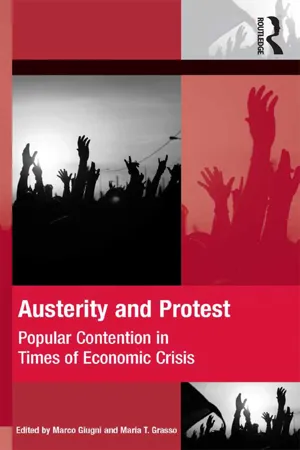
Austerity and Protest
Popular Contention in Times of Economic Crisis
- 226 pages
- English
- ePUB (mobile friendly)
- Available on iOS & Android
eBook - ePub
Austerity and Protest
Popular Contention in Times of Economic Crisis
About this book
What is the relationship between economic crises and protest behaviour? Does the experience of austerity, or economic hardship more broadly defined, create a greater potential for protest? With protest movements and events such as the Indignados and the Occupy Movement receiving a great deal of attention in the media and in the popular imaginary in recent times, this path-breaking book offers a rigorously-researched, evidence-based set of chapters on the relationship between austerity and protest. In so doing, it provides a thorough overview of different theories, mechanisms, patterns and trends which will contextualize more recent developments, and provide a pivotal point of reference on the relationship between these two variables. More specifically, this book will speak to three crucial, long-standing debates in scholarship in political sociology, social movement studies, and related fields: The effects of economic hardship on protest and social movements. The role of grievances and opportunities in social movement theory. The distinction between 'old' and 'new' movements. The chapters in this book engage with these three key debates and challenge commonly held views of political sociologists and social movement scholars on all three counts, thus allowing us to advance study in the field.
Information
Austerity, Economic Grievances, and Protest Politics
Chapter 1
Political Mobilization in Times of Crises: The Relationship between Economic and Political Crises
Introduction
The background to this chapter is the question of how the contemporary Great Recession is influencing politics: what are the conditions under which an economic crisis in general, and the austerity politics of the Great Recession in particular, lead to a political crisis? Political crises are salient events that punctuate the history of a country. They interrupt the steady state equilibrium of incremental policy-making under the auspices of a dominant coalition. When the problems the political system faces can no longer be solved incrementally, they result in political crises—“salient events like wars, revolutions, overt challenges to governmental legitimacy—in which passions are aroused and the very survival of the system is often at stake” (Verba 1965: 555).
There are, of course, political crises that do not result from economic crises. Political crises are the result of poor governance in general, not just of poor economic performance. In particular, political crises may also result from corruption and partiality, disregard for the rule of law, large-scale scandals and general ineffectiveness of government. Granted that political crises are not always the result of economic crises, there are famous examples from history—the experience of the inter-war period in Europe in general and of the Weimar Republic in particular, but also the Latin American experience in the 1980s and 1990s—that point to the possibility of dramatic political implications of deep economic crises. As Gourevitch (1984: 129) has reminded us, “the 1930s were too costly for us not to think about what we can learn from them for the present.” From a contemporary European perspective, I would suggest that this is even truer for the more recent Latin American experience (see Rovira Kaltwasser 2013).
Before I embark on my exploration of possible answers to the question about the crises, let me specify the scope condition of my question: I am formulating this question with respect to the European context. In other words, I am asking the question in the context of more or less established democracies with regular repetitions of free and fair elections. More specifically, I assume the involvement of a set of five highly stylized political actors, which include: inter- and supranational actors (mainly EU-agencies), the national government, the (mainstream) opposition, other (competing) public authorities (such as the (symbolic) President, the Courts, the voters (in a referendum vote) or established interest groups), and new challengers (populist parties, social movement organizations, public interest groups). My reasoning starts from the assumption that national governments (possibly in combination with supra- and international agencies) are the key actors who have the initiative in dealing with the economic crisis: in the Great Recession, it is the national governments that (are forced to) adopt austerity policies, to which the other three types of actors (opposition, other public authorities, outside challengers) react, setting in motion an interaction dynamic that eventually determines the political consequences of the economic crisis. In the terminology of Gourevitch’s (1984: 97) “political sociology of political economy,” the governments choose a policy-approach to deal with the crisis, which suits their politics, while the challengers who seek different policy goals have a need for a politics that will help fulfill their policy. Political protest is part of the politics of the challengers, but the point I wish to make here is that it is embedded into the dynamic interaction with the other key actors that, in turn, determines the outcome of the crisis. It is this dynamic interaction which should constitute the focus of the analysis, not protest per se. My goal in this chapter is rather modest and exploratory: I would like to provide a heuristic framework for approaching this kind of analysis.
Political Crises: Crisis Situations and the Dynamics of Crises
In analogy to Tilly’s (1978) distinction between revolutionary situations and revolutionary outcomes, with respect to political crises, I propose to distinguish between crisis situations and crisis outcomes. A crisis situation is created when routine incremental problem solving no longer works, when institutions are no longer taken for granted and self-reinforcing, when compliance of the citizens is no longer guaranteed, and when positive feedback processes are set in motion that accentuate rather than counterbalance the emerging crisis. In the terminology of a model of path-dependency, the political crisis situation constitutes a “critical juncture” which renders politics more plastic and which modifies the preferences of actors. New alliances become possible and policies may be switched to a new path (Gourevitch 1984). In the terminology of a well-known model of the policy process, a political crisis situation corresponds to the “punctuation” of the “equilibrium” of normal politics (Baumgartner and Jones 1993, 2002). At the moment of punctuation, the policy monopoly of the dominant coalition breaks down and major shifts in political power become possible. Generally, the crisis situation constitutes an opportunity for change.
How do I recognize a crisis situation when I see it? In discussing Latin American crises of democratic representation, Mainwaring et al. (2006) distinguish between attitudinal and behavioral indicators. Among the former, they count lack of confidence in political institutions, among the latter they list electoral volatility, collapse of party systems, wide spread support for outside candidates in presidential elections, and depressed electoral participation. In line with this distinction between attitudinal and behavioral components of a political crisis, I would like to distinguish between latent political potentials and their overt mobilization. The latent potentials refer to the attitudinal components, which constitute the more or less fertile ground for a political crisis. The political crisis only breaks loose, however, once this latent potential is mobilized and manifests itself in behavioral terms. This is to say that a political crisis does not develop as a matter of course, but is the result of political mobilization—either in electoral terms (as indicated by Mainwaring et al.) or in terms of political protest or both. In terms of protest mobilization, we are dealing with large-scale (encompassing) mobilizations of broad social groups, which are triggered by the government’s approach to the economic crisis (its austerity policies in the case of the Great Recession) and explicitly challenge not only its policy approach, but its legitimacy more fundamentally. This kind of encompassing mobilization is to be distinguished from more group- or issue-specific and local protest that does not challenge the way the government is dealing with the crisis and that is unlikely to contribute to the creation of a political crisis (see Shalev 2013).
The crisis dynamics link the crisis situation to the crisis outcomes. These dynamics are constituted by the interaction sequence that is touched off by the mobilization against the government’s policies to meet the economic crisis. They are likely to be highly contingent and we shall be hard put to formulate general hypotheses about the development of political crises caused by economic hardship. In most general terms, we have learnt from the social movements’ literature that political mobilization depends on the interaction between three sets of factors: grievances, organization, and opportunity.
Grievances constitute the latent crisis potentials. They result from the exogenous shock of the crisis, but they may also be the result of long-term social change and endogenous political processes. As a matter of fact, it is unlikely that the economic crisis creates such mobilization potentials from scratch. In any given society there are more or less sizeable latent mobilization potentials linked to the structural conflicts, which predate the crisis and which pre-structure the way the crisis mobilization will play out. The mobilization potentials newly created by the crisis add to this already existing stock of grievances. Most likely, the short-term impact of an exogenous economic shock interacts with the long-term endogenous processes of change. Thus, a deep economic crisis may serve as a catalyst for the mobilization of political potentials that have already been building up for many years. The economic crisis may reshape an already on-going mobilization process: it may reinvigorate this process by intensifying its mobilization, and/or it may redirect this process by focusing it on the issues raised by the economic crisis. But the economic crisis may also, for the first time, trigger the articulation of mobilization potentials which have remained latent until its occurrence.
People with grievances seek to express them, and they do so by raising their voice or by exiting (Hirschman 1970). They raise their voice to the extent that they are organized and have an opportunity to do so. Organization is crucial, and the most important distinction in this respect is the one between top-down and bottom-up. Mobilization can either be organized by members of the political elite (top-down) or by grass-roots organizations (bottom-up) or both. Top-down mobilization of large-scale protest by elites corresponds to what I shall call a “populist strategy.” Let me clarify the notoriously slippery, but widely used term of “populism.” I propose that we should conceive of populism both as an ideology and as a political strategy. As an ideology populism adopts a Manichean view of society dividing it into two antagonistic camps—the virtuous people and some corrupt elites, effectively pitting one against the other (Canovan 1999: 3; Laclau 1977: 172–3; Mudde 2004: 543; Wiles 1969: 166). Populism claims that the people are sovereign, that they have been betrayed by the corrupt elites and that the primacy of the people has to be restored (Mény and Surel 2002: 11f.). Populism as an ideology manifests itself in specific discursive patterns for identifying foes and solidifying the community of friends (Hawkins 2009: 1042; Jagers and Walgrave 2007; Pauwels 2011). Populism as a political strategy is conceptualized as a specific way of competing for and exercising political power: essentially, it refers to the top-down political mobilization of mass constituencies by a personalistic and paternalistic leader who challenges established elites (Roberts 2006: 127). Populism in the strategic sense is, in the final analysis, “a project of power” that seeks to gain the authority of the sovereign state for the personalistic leader so as to allow him to represent the will of “the people” (Urbinati 2013: 140).
While the various sub-types of top-down mobilization can all be characterized as “populist,” mobilization from below is conventionally understood and conceptualized as “movement politics” (Roberts 2007: 14). Such mobilization from below typically follows a radically different pattern: in contemporary Western societies, social movements are “primarily networks of informal groups, semi-formal and formal organizations, and individuals” that “draw upon, or generate, new solidarities and group memberships which cut across the boundaries of any specific traditional political cleavage” (Diani 2000: 397, 399). They are characterized by what Gerlach and Hine (1970) have called SPIN-structures: these are integrated network-structures which are at the same time segmented (composed of many groups) and polycentric (composed of many different leaders). These structures “self-organize” without central or “lead” organizations. More recently, these kind of mobilizing structures have started to benefit from digital technologies, or “connective” mobilizing techniques that allow for carrying out large-scale mobilization processes with a minimum of formal organization and allow citizens to play a more active role in the mobilization processes (Bennett and Segerberg 2012).
Turning to opportunity, we should note, as Piven and Cloward (1977: 15) did a long time ago, that “ordinarily, defiance is first expressed in the voting booth simply because, whether defiant or not, people have been socialized within a political culture that defines voting as the mechanism through which political change can and should properly occur.” Accordingly, as already noted, one of the first signs of a political crisis is electoral volatility—a sharp shift in voting patterns. More generally, in democratic societies, the action repertoire of protests is likely to make use of the available institutionalized channels of access, which means that the privileged institutional space, i.e. the privileged arena to voice grievances are the electoral arena, the judicial arena, and, where available, the direct-democratic arena. In democracies, voters resort to the protest arena to the extent that they are unable to express themselves in institutionalized channels, or their voice in these channels is ineffective.
The electoral arena observes its own rhythm, however, which means that the expression of the voters’ discontent may be impossible in the short run—at least not at the national level, which is the one where the important economic policy decisions are taken. This constraint imposed by the electoral cycle is alleviated by the availability of elections at different levels—there are not only national, but also local, regional, and European elections, taking place at different moments in time and offering as many opportunities to voice discontent. Voters may use each one of these elections to protest against the governments and their policies at various levels. If mobilization in the electoral channel is the most obvious choice, increasingly, direct-democratic institutions are also available for the articulation of grievances. As our comparative analysis of new social movements in Western Europe has shown, such institutions are readily used by social movements when they are available (Kriesi et al. 1995). Other institutional options for the articulation of grievances include litigation in courts. Relying on courts for imposing reforms is, however, severely limited by the bounded nature of constitutional rights and by the fact that the judiciary is appointed by the other branches of government.
In the absence of available options in the institutionalized arenas discontented elites (top-down mobilization) and citizens (bottom up mobilization) may choose to resort directly to protest, and to try to force political concessions from political elites by appealing to the general public. This is Schattschneider’s (1960) idea of the expansion of conflict. Public protest is designed to unleash a public debate, to draw the attention of the public to the grievances of the actors in question, to create controversy where there was none, and to obtain the support of the public for the actors’ concerns. Controversial public debates and support by the general public open up the access and increase the legitimacy of speakers and allies of the protest movements among journalists and decision-makers—the (mainstream) opposition, or other (competing) public authorities (such as the (symbolic) President—who tend to closely follow the public debates (Gamson und Meyer 1996: 288). Challengers who succeed in producing events which become visible in the news media, resonate with other actors (who feel obliged to react) and elicit more positive than negative responses can compete with much more powerful adversaries (Wolfsfeld 1997: 47; Koopmans 2004). As Koopmans (2005: 27f.) points out, the concretely visible response patterns of other actors often emerge in the interaction process between social movements and authorities, i.e. movements may “stumble on opportunities” in a trial and error process. In resorting to protest, challengers may enact established action repertoires (see Tilly 1978), they may, in a process of institutional learning, convert institutionally available repertoires for their own purposes (see Chen 2012), or they may develop new forms of action (see McAdam 1983).
We can expect public protest to interact with the electoral cycle in complex ways: protest mobilization not only influences election campaigns and election outcomes (McAdam and Tarrow 2010), but it also puts pressure on the government in between elections (Goldstone 2003: 8f.). Short of participating in the electoral process themselves, movements can influence the electoral process and the government’s policies between elections through ongoing alliances.
Crisis Outcomes: Electoral and Policy Outcomes in the Short term and the Long term
The possible political outcomes of an economic crisis heavily depend on its duration (Roberts 2003: 52). The longer the economic crisis lasts, the more it will spread the political costs across established systems of interest representation, and the greater the likelihood that it will give rise to important political mobilizations. Moreover, political mobilizations are more likely to have success, the deeper the crisis. Goldstone’s (1980) reanalysis of Gamson’s (1975) classical study found that social movement success is more likely in periods of crisis (major wars, economic or political crises).
The political outcome of the crisis is, however, not determined by the crisis situation. It depends entirely on the interaction dynamics, which means that it is very difficult to attribute outcomes to actors. As Tilly (1999: 268) has observed, “the range of effects far surpasses the explicit demands made by activists in the course of social movements, and sometimes negates them.” There are many different ways to classify outcomes of political mobilization (see Giugni 1998). For the purposes of classifying crisis outcomes, none of these traditional typologies is really very useful, however. Instead of relying on existing typologies, I propose to combine two distinctions for the classification of crisis outcomes: the distinction between electoral and policy outcomes, with the distinction between short- and long-term outcomes. Given that, in times of crises, the main adversary of the challengers is the government, the electoral results are crucial for determining the outcome of the crisis. But elections only constitute the first step in the sequence of events: the next step concerns the policies adopted by the new government. Do they meet the demands of the challengers and to what extent do they do so?
In electoral terms, we can distinguish between the short term and the long term. The literature on economic voting provides us with a short-term view about how an economic crisis may play out in electoral terms (Duch and Stevenson 2008; Lewis-Beck and Stegmaier 2007). This literature is based on the assumption of instrumentally rational voters, who will reward the incumbents with their vote when the economy is good, and punish them when the economy is bad. Note that it is not the personal financial situation, which is considered to be decisive for the economic vote, but the perception of the national economy. This literature indicates that incumbents are generally punished in times of an economic crisis, but that the impact is likely to vary as a function of context conditions (Powell and Whitten 1993; Duch and Stevenson 2008: chapter 9; Hellwig and Samuels 2007; Kriesi 2014). Specifically, this literature shows that the kind of democracy (majoritarian vs proportional), the degree of institutionalization of the party system, and the openness of the national economy constitute important aspects to take into account. It tends to suggest that the Great Recession is just another instance of economic distress, which has cyclical, but no long-term effects on politics. This literature has largely failed to account for the kind of parties that may benefit when voters turn to punishing the governing parties (van der Brug et al. 2007: 18f.; Tucker 2006: 4f.).
In the short term incumbents are, however, not always punished in times of crisis. The outcome may also be a return to the status quo before the crisis, as is illustrated by the events of May 1968 in France, where one of the largest upheavals in any established democracy led to the return of the old guard and to the punishment of the challengers’ allies on the left in the elections of June 1968 (Converse and Pierce 1986). Only 15 percent of the electorate had changed its vote since the previous elections in 1967, but the effect was devastating for the left. Fear of civil war, identification with de Gaulle, and policy concessions (Grenelle agreements in May 1968) drove a majority of swing voters to the right. In another example of the preservation of the status quo, the encompassing protest in Israel in summer 2011 just ended in a return to the status quo once the summer was over.
In the long term, the most impor...
Table of contents
- Cover Page
- Half Title page
- The Mobilization Series on Social Movements, Protest, and Culture
- Title Page
- Copyright Page
- Contents
- Figures
- Tables
- Introduction Austerity and Protest: Debates and Challenges
- Austerity, Economic Grievances, and Protest Politics
- Social Bases of Protest in Times of Austerity
- Perceived Effectiveness and Participation
- Collective Interests and Solidarity
- Austerity, Protest, and the Labor Market
- References
- Index
Trusted by 375,005 students
Access to over 1.5 million titles for a fair monthly price.
Study more efficiently using our study tools.
Frequently asked questions
Yes, you can cancel anytime from the Subscription tab in your account settings on the Perlego website. Your subscription will stay active until the end of your current billing period. Learn how to cancel your subscription
No, books cannot be downloaded as external files, such as PDFs, for use outside of Perlego. However, you can download books within the Perlego app for offline reading on mobile or tablet. Learn how to download books offline
Perlego offers two plans: Essential and Complete
- Essential is ideal for learners and professionals who enjoy exploring a wide range of subjects. Access the Essential Library with 800,000+ trusted titles and best-sellers across business, personal growth, and the humanities. Includes unlimited reading time and Standard Read Aloud voice.
- Complete: Perfect for advanced learners and researchers needing full, unrestricted access. Unlock 1.5M+ books across hundreds of subjects, including academic and specialized titles. The Complete Plan also includes advanced features like Premium Read Aloud and Research Assistant.
We are an online textbook subscription service, where you can get access to an entire online library for less than the price of a single book per month. With over 1.5 million books across 990+ topics, we’ve got you covered! Learn about our mission
Look out for the read-aloud symbol on your next book to see if you can listen to it. The read-aloud tool reads text aloud for you, highlighting the text as it is being read. You can pause it, speed it up and slow it down. Learn more about Read Aloud
Yes! You can use the Perlego app on both iOS and Android devices to read anytime, anywhere — even offline. Perfect for commutes or when you’re on the go.
Please note we cannot support devices running on iOS 13 and Android 7 or earlier. Learn more about using the app
Please note we cannot support devices running on iOS 13 and Android 7 or earlier. Learn more about using the app
Yes, you can access Austerity and Protest by Marco Giugni,Maria T. Grasso,Maria Grasso in PDF and/or ePUB format, as well as other popular books in Politics & International Relations & Political Freedom. We have over 1.5 million books available in our catalogue for you to explore.