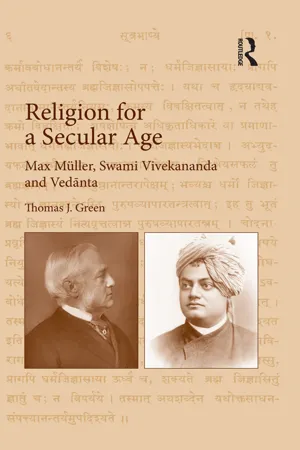
Religion for a Secular Age provides a transnational history of modern Ved?nta through a comparative study of two of its most important exponents, Friedrich Max Muller (1823–1900) and Swami Vivekananda (1863–1902). This book explains why Ved?nta's appeal spanned the ostensibly very different contexts of colonial India and Victorian Britain and America, and how this ancient form of thought was translated by Muller and Vivekananda into a modern form of philosophy or religion. These religiously-committed men attempted to reconcile religion with modernity by appealing to Advaita (literally, 'non-dualistic') Ved?nta's monistic interpretation of reality. The 'scientific' study of religion allegedly demonstrated the evolutionary superiority of Ved?nta and the possibility of religion's survival in 'the light of modern science'. They believed Ved?nta could also provide the religious basis for moral engagement in this world, even as the hold of orthodox Christianity and traditional Hinduism appeared to be weakening. Ved?nta thus served as a way of articulating a form of religion suitable for a secular age – religion which has embraced modern forms of thought while breaking away from creeds, scriptures and institutions to thrive in the spheres of public debate of London, Calcutta and New York.
- 188 pages
- English
- ePUB (mobile friendly)
- Available on iOS & Android
eBook - ePub
About this book
Information
Chapter 1
Foundations
The aim of this chapter is to establish foundations for what follows by setting out the themes that will be explored and developed throughout this book. Simultaneously, we will be considering the foundations upon which Friedrich Max Müller and Swami Vivekananda constructed their interpretations of Vedānta and their associated theories of religion and setting out the intellectual context in which these efforts took place. We will focus on four key aspects: firstly, Müller’s and Vivekananda’s formative encounters with Vedānta; secondly, the influence of idealism and Romanticism in shaping their philosophical, historical and theological convictions; thirdly, Müller’s Liberal Protestant and Pietist background, and Vivekananda’s youthful membership of the Brahmo Samaj; finally, their views of evolution and assessments of the threat posed to religion by materialism.
Early Vedāntic Encounters
This book places Vedānta at the centre of Müller’s and Vivekananda’s attempts to reconstruct religion for a secular age; as such, it is important to understand the sources of their knowledge of this ancient Indian intellectual tradition. In Müller’s case, this is a straightforward exercise as his own writings recall the early- to mid-nineteenth-century enthusiasm for Vedānta in the Germany of his youth. Vivekananda, however, presents us with a more challenging problem as there is scant convincing biographical material available for the same formative period in his life.
Müller’s Education in Vedānta
Friedrich Max Müller’s encounter with Indian philosophy began when he was a young student at Leipzig University (1841–44) where he acquainted himself with Friedrich Schlegel’s (1772–1829) Über die Sprache und Weisheit der Indier (published 1808) and Karl Windischmann’s (1775–1839) Die Philosophie im Fortgang der Weltgeschichte (published 1827–34). While Schlegel’s work was a significant milestone in the German Romantic encounter with India, it is Windischmann who gives the more detailed account of the Upaniṣads and, unlike Schlegel, delves into Shankara’s Advaita Vedānta.1
Müller’s decision to begin studying Sanskrit with Hermann Brockhaus (1806–77) from the winter of 1841 (his first year of university at Leipzig) was motivated not by any great enthusiasm for comparative philology, but rather by his ambition to achieve distinction as a philosopher: ‘While dreaming of a chair of philosophy at a German University, I began to feel that I must know something special, something that no other philosopher knew, and that induced me to learn Sanskrit, Arabic, and Persian.’2 Müller’s philosophical interest in Indology would have inevitably turned his head in the direction of Vedānta and in particular the Upaniṣads since they had already been celebrated by an earlier generation of Romantics as the high watermark of Indian wisdom and philosophy.3
The interpretation of Vedānta which Müller encountered and assimilated in the 1840s was very much a product of the Romantic fascination with India. Romanticism emerged as a distinctive movement in Germany at the end of the eighteenth century and, although the vibrant era of Frühromantik (early Romanticism) was brief, its influence was carried well into the first half of the nineteenth century by Friedrich Schelling (1775–1854), Hegel (1770–1831) and through them and others to Müller and his fellow students in Leipzig.
Romanticism questioned the universalist rationalism of the Enlightenment, favouring instead a poetic vision of the unity of humanity and nature, which found metaphysical expression (especially in later Romantic thinkers such as Schelling) in a pantheistic or ‘panentheistic’ view of a universe unified with God or Spirit. They pursued the origins of language, myth and religion and conceived of the progress of different races, cultures and nations in terms of their unique, irreducible guiding spirit.4 The appeal of Vedānta (and especially the early Upaniṣads) lay in its apparent mythological pantheism, which unified philosophy and religion in contrast to the fractured civilisation of post-Enlightenment Europe.5
While Schlegel and Schelling lauded Vedānta as one of the loftiest achievements in philosophy, for both of them its appeal was diminished by the apparent emptiness of its concept of divinity, which they attributed to the absence of the true revelation of Christianity.6 Interest in Vedānta here seems to have been based on the quest to reconstruct a history of the philosophy of India and Europe culminating in their own amalgamation of Christianity and post-Enlightenment philosophy. Even for an explicitly anti-Christian philosopher like Arthur Schopenhauer (1788–1860), Vedānta (like Buddhism) fell short of his own system because of its entanglement in religious and mythological thought.7
Müller’s early interest in the Upaniṣads and Vedānta is confirmed by his conversations with some of these and other leading intellectuals of the middle of the nineteenth century in which Vedānta featured prominently. He attended Schelling’s lectures on the Philosophy of Mythology while visiting Berlin in 1844 and together they discussed Indian religious thought: ‘[Schelling] was especially interested in knowing what the Vedanta said about the existence of God, how it proved His existence, whether it said that God had created the world, and also whether it said that the world had any reality.’8 On his journey to Paris later that year, Müller made a visit to Schopenhauer in Frankfurt and was informed that the Upaniṣads were the only worthwhile texts in the Sanskrit language.9 In Paris, Müller made the acquaintance of Baron d’Eckstein (1790–1861), of whom he said: ‘He would sit with me for hours… discussing all the time the Vedas and the Upanishads, and the Vedanta philosophy.’10
However, a far more significant result of Müller’s stay in Paris was his tutelage under Eugène Burnouf (1801–52), the pioneering scholar of Sanskrit, who confronted Müller with a choice: ‘Either study Indian philosophy, and begin with the Upanishads and Sankara’s commentary, or study Indian religion, and keep to the Rig-veda, and copy the hymns and Sāyana’s commentary, and then you will be our great benefactor.’11 Burnouf had sufficiently excited Müller’s interest in the Ṛg-veda that he opted to devote his energies to its critical edition and his youthful fascination with Vedānta faded into the background.
We can infer from Müller’s early writings on the Ṛg-veda and other Indian texts that these same Romantic tendencies were at the root of his youthful interest in Vedānta. He saw an unbroken line from the most ancient Indo-European thought of the Ṛg-veda, through to the Upaniṣads and right up to the idealist thought of his own times. The sheer antiquity of the Upaniṣads allowed Indologists to glimpse some of the most ancient recorded thoughts of humanity. Neither was Müller immune to the Indian fever which had gripped earlier Romantics and Schopenhauer; they believed the discovery of Indian philosophy could bring about a new renaissance in Europe.12
It is also clear that the young Müller, like Schelling and Schlegel, was committed to a fulfilment theology of religions where even the most elevated of non-Christian religious views were interpreted as stepping stones to the acceptance of the revelation of Christ as saviour:
Nor should it be forgotten that while a comparison of ancient religions will certainly show that some of the most vital articles of faith are the common property of the whole of mankind, at least of all who seek the Lord, if haply they might feel after Him, and find Him, the same comparison alone can possibly teach us what is peculiar to Christianity, and what has secured to it that preeminent position which now it holds in spite of all obloquy.13
Müller’s early interest in Vedānta was thus rooted firmly in the Romantic tradition of the first half of the nineteenth century. Like his Romantic forebears, interest in Vedānta was kindled by a conviction that the Upaniṣads emerged from the pristine philosophical infancy of the Indo-European mind and that Vedānta was the purest natural religion which only lacked the revelation of Christianity for its perfection.
It was not until 1879 that Müller published his first work on a Vedāntic text, a translation of selected Upaniṣads for the Sacred Books of the East series of which he himself was editor. There was thus a hiatus of a quarter of a century between the high watermark of Müller’s youthful philosophical interest in Vedānta and the first of a series of publications which show a renewed fascination with Vedānta. It is not surprising that Müller had little time to occupy himself with the Upaniṣads and Shankara’s commentaries given that he was engaged in the daunting task of critically editing the Ṛg-veda and with establishing himself as a leading figure in the field of comparative philology. But, as we shall see in Chapter 3, there were perhaps more profound reasons than an increase in free time for his willingness to renew the study of the Vedāntic texts which had first excited his interest in Indology.
Making Vivekananda Vedāntist
As Vivekananda’s name is associated with Vedānta perhaps more than any other figure in modern times, one might suppose that there would be considerable attention devoted to the sources and development of his conception of Vedānta in the numerous biographies of Vivekananda, not to mention those works which are more specifically concerned with his religious thought. Unfortunately this is not the case and there is very little secondary literature which would help us to understand how Narendranath Datta first came across Vedānta and how these early ideas might have developed into Vivekananda’s later Vedāntic teachings. Nevertheless, on the basis of what little information we have, it is possible to indicate some probable sources of his knowledge of and interest in Vedānta.
The account of Vivekananda’s intellectual development disseminated in the publications of the Ramakrishna Math in India and its satellite organisations in America and Europe, presents Ramakrishna as the main source of Vivekananda’s Vedānta.14 This version of events can be amply illustrated by a couple of excerpts from The Life of Swami Vivekananda:
From the very first it was Sri Ramakrishna’s idea to initiate Narendra into the mysteries of the Advaita Vedānta. With that end in mind he would ask Naren to read aloud passages from Ashtāvakra Saṃhitā and other Advaita treatises, in order to familiarise him [Naren] with the philosophy. To Narendra a staunch adherent of the Brāhmo Samāj, these writings seemed heretical and he would rebel saying, ‘It is blasphemous, for there is no difference between such philosophy and atheism.’15
The Master knew that Narendra’s was the path of the Jnāna; for this reason he made it a point to continue to talk of the Advaita philosophy to him.16
On this view, Ramakrishna saw that Naren was most inclined to a rationalist form of Hindu religious life and insisted upon confronting Naren with passages from various Advaita texts, even when his young student insisted that monism conflicted with his ‘staunch’ Brahmo convictions.17
Ramakrishna’s knowledge of Advaita is attributed to a lengthy encounter with a wandering Advaitin ascetic named Tota Puri. According to the Gospel of Sri Ramakrishna (GSR), Ramakrishna was able to attain to the state of monistic s...
Table of contents
- Cover
- Half Title
- Dedication
- Title
- Copyright
- Contents
- Preface
- Abbreviations
- Conventions of Transliteration and Translation
- Introduction
- 1 Foundations
- 2 The Science of Religion and Religion as Science
- 3 Vedānta in Defence of Religion
- 4 Vedānta and the Religious Foundation of Ethics
- 5 Ramakrishna, Vedānta and the Essence of Hinduism
- Conclusion
- Bibliography
- Index
Trusted by 375,005 students
Access to over 1.5 million titles for a fair monthly price.
Study more efficiently using our study tools.
Frequently asked questions
Yes, you can cancel anytime from the Subscription tab in your account settings on the Perlego website. Your subscription will stay active until the end of your current billing period. Learn how to cancel your subscription
No, books cannot be downloaded as external files, such as PDFs, for use outside of Perlego. However, you can download books within the Perlego app for offline reading on mobile or tablet. Learn how to download books offline
Perlego offers two plans: Essential and Complete
- Essential is ideal for learners and professionals who enjoy exploring a wide range of subjects. Access the Essential Library with 800,000+ trusted titles and best-sellers across business, personal growth, and the humanities. Includes unlimited reading time and Standard Read Aloud voice.
- Complete: Perfect for advanced learners and researchers needing full, unrestricted access. Unlock 1.5M+ books across hundreds of subjects, including academic and specialized titles. The Complete Plan also includes advanced features like Premium Read Aloud and Research Assistant.
We are an online textbook subscription service, where you can get access to an entire online library for less than the price of a single book per month. With over 1.5 million books across 990+ topics, we’ve got you covered! Learn about our mission
Look out for the read-aloud symbol on your next book to see if you can listen to it. The read-aloud tool reads text aloud for you, highlighting the text as it is being read. You can pause it, speed it up and slow it down. Learn more about Read Aloud
Yes! You can use the Perlego app on both iOS and Android devices to read anytime, anywhere — even offline. Perfect for commutes or when you’re on the go.
Please note we cannot support devices running on iOS 13 and Android 7 or earlier. Learn more about using the app
Please note we cannot support devices running on iOS 13 and Android 7 or earlier. Learn more about using the app
Yes, you can access Religion for a Secular Age by Thomas J. Green in PDF and/or ePUB format, as well as other popular books in Philosophy & Religion. We have over 1.5 million books available in our catalogue for you to explore.