- 146 pages
- English
- ePUB (mobile friendly)
- Available on iOS & Android
eBook - ePub
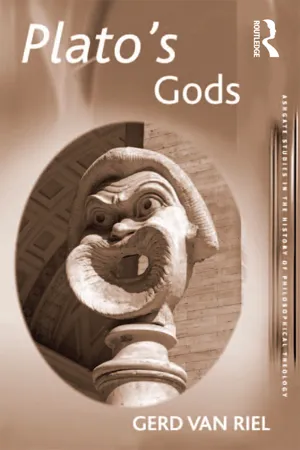
Plato's Gods
About this book
This book presents a comprehensive study into Plato's theological doctrines, offering an important re-valuation of the status of Plato's gods and the relation between metaphysics and theology according to Plato. Starting from an examination of Plato's views of religion and the relation between religion and morality, Gerd Van Riel investigates Plato's innovative ways of speaking about the gods. This theology displays a number of diverging tendencies - viewing the gods as perfect moral actors, as cosmological principles or as celestial bodies whilst remaining true to traditional anthropomorphic representations. Plato's views are shown to be unified by the emphasis on the goodness of the gods in both their cosmological and their moral functions. Van Riel shows that recent interpretations of Plato's theology are thoroughly metaphysical, starting from aristotelian patterns. A new reading of the basic texts leads to the conclusion that in Plato the gods aren't metaphysical principles but souls who transmit the metaphysical order to sensible reality. The metaphysical principles play the role of a fated order to which the gods have to comply. This book will be invaluable to readers interested in philosophical theology and intellectual history.
Information
Chapter 1
Plato’s Religion
1 Plato on the Origin of Religion
1.1 Nature (Φύσις) and Convention (Nόμος)
One of the most important discussions to issue out of what is called the fifth-century enlightenment in ancient Greece, was the debate on the opposition between nature (φύσις) and convention (νόμος). As a result of several changes and innovations in Greek society, and of colonizations and discoveries of non-Greek cultures, the ancestral beliefs and practices were no longer seen as inevitable, natural phenomena, but rather as the effect of invention and convention. This switch from nature to convention is well known. It underlies the entire sophistic movement and is the solid basis of the foundation and organization of new cities – a process in which the sophists actively took part. New colonies were founded and old colonies refounded, while for both, new constitutions had to be drawn up. The most famous attempts in this rush for constitutions are of course those made by Plato himself. His Republic and Laws, or indeed his entire philosophical project, would be inconceivable without the underlying acceptance that society, and the role of the individual in it, can be made. It is hardly a coincidence that the basic word to indicate ‘convention’ in the fifth-century discussion is νόμος (lit. ‘law’), rather than any other word, such as θέσις (‘founding’). This is evidence for the fact that the city and its laws (νόμοι) are seen as providing the paradigm of conventional organization. One could of course dwell on the importance of this feature for the emergence of democracy in ancient Greece. For present purposes, however, it is more interesting to investigate the extent to which religious practice and belief is involved in this view of society as a product of convention, and in particular, how Plato himself – the king, so to speak, of constitutional conventionalism or conventional constitutionalism – accounts for the origin of religion. Is it by nature or by convention?
There is evidence that the fifth-century Greeks, or at least the intellectual upper class, considered religion to be a matter of convention: a fragment of Pindar reads ‘Law (Nόμος), king of all, of mortals and immortals’ (fr. 169), which would imply that the immortals are submitted to law (νόμος). But of course, it remains to be explained what is meant by ‘law’ in this context: it might also be a divine force, which would mean that there is no case for conventionalism after all. In Euripides, however, some 40 years later, the idea is made clearer and stronger: ‘through law (νόμος) we believe in gods’ (Hecuba 798).1 This is in line – as is often the case with Euripides – with ideas propagated by the sophists, who gave a rationalizing account of the origins of worship of the gods. People, they say, paid honour to those things that were vital and useful: earth, moon, sun, water, and new crops and plants (like grain: Demeter, and wine: Dionysus).2 Hence, religion is conventional: it is instituted on the basis of our daily needs and the usefulness of those things that allow us to satisfy them.
This is the situation at the moment when Plato started writing. As could be expected, his answer is not quite in agreement with the prevailing opinion, and in the end, he will even do away with the discussion on nature and convention.
1.2 Politics Cannot Institute Religion
It is obvious from the Republic and the Laws that Plato wants the state to interfere in the smallest aspects of life. But when reading these dialogues, it is very striking that this interference does not concern religion. Of course, the lawgiver must organize and warrant religious practice, but Plato never treats religion in itself as something to be instituted by the state. Religion is not ‘founded’. This picture emerges from Plato’s descriptions of how elementary states grow organically out of primitive conglomerations of individuals and families (Rep. II, 369b–374e and Laws III, 677a–681c). In this context, nothing is said about a possible starting point of religion. If we follow what is said in this respect in the Republic (II, 369b–372d), we learn that people first came together for the exchange of goods that allowed them to meet their daily needs: food, housing, clothing, and so forth. The basic state is very much focused on economy and utility, and everything within it is done to facilitate the supply of products and services. But, of course, this opens a dynamic that can hardly be stopped, as the people begin to look for better and more luxurious products; these elicit new needs, in turn, and soon enough this leads to conflict and war (II, 372d–374e). Hence the need of guardians to protect the state, from within and without, while these guardians must be educated to an outstanding level of moral life.
In the education of the guardians, particular attention is paid to the theology handed down by the poets (II, 377b–383c). Plato bans poetry from his state for several reasons, one of which is the immoral character of the poets’ accounts of the gods. So it is beyond question that the state has to watch over the purity of religious beliefs. But it is another thing to say that the state is to institute or found religion. That idea is explicitly rejected at Republic IV, 427b–e, where Plato concludes a survey of the things that must be organized by law, in the following way:
Adeimantus: What is now left for us to deal with under the heading of legislation?
Socrates: For us nothing, but for the Delphic Apollo it remains to enact the greatest, finest, and first of laws.
A: What laws are those?
S: Those having to do with the establishing of temples, sacrifices, and other forms of service to gods, daemons, and heroes, the burial of the dead, and the services that ensure their favour. We have no knowledge of these things, and in establishing our city, if we have any understanding, we won’t be persuaded to trust them to anyone other than the ancestral guide. And this god, sitting upon the rock at the centre of the earth, is without a doubt the ancestral guide on these matters for all people. (Rep. IV, 427b–c, tr. G.M.A. Grube, rev. C.D.C. Reeve)
Thus, religion and religious practice fall outside the scope of Plato’s constitutional arrangements in the Republic, and rest upon ancestral traditions, guided by their own legislator, the Delphic Apollo.3
The same idea is expressed in the Laws (III, 677a–681c), where we find a similar description of the origins of community and of lawgiving. In the earliest times, people did not suffer any lack; there was no injustice or jealousy, and no religious dissidence:
Now the community in which neither wealth nor poverty exists will generally produce the finest characters because tendencies to violence and crime, and feelings of jealousy and envy, simply do not arise. So these men were good, partly for that very reason, partly because of what we might call their ‘naïveté’. When they heard things labelled ‘good’ or ‘bad’, they were so artless as to think it a statement of the literal truth and believe it. This lack of sophistication precluded the cynicism you find today: they accepted as the truth the doctrine they heard about gods and men, and lived their lives in accordance with it. (Laws III, 679b–c, tr. T.J. Saunders, his emphasis)
Hence, these people did not need (positive) law. And, again, religion is said to be older and, so to speak, more natural than constitutions and laws. It is only when smaller communities start to conglomerate into a larger whole that the lawgiver must decide which set of traditional practices of which group must be taken over by all members of the community (III, 681c). Moreover, private sanctuaries are forbidden in the Laws, because they often are erected for unwholesome purposes, and most importantly, because they threaten the political cohesion of the city. When they are discovered, such sanctuaries must immediately be transferred to public temples (see, e.g., Laws X, 909e–910d).4 These are manifest examples of the city’s directing or sanctioning the religious cult. In general, however, it is clearly stated in the Laws that the lawgiver must not touch the existing gods, temples, rituals, ceremonies, and so forth:
It does not matter whether he is founding a new state from scratch or reconstructing an old one that has gone to ruin: in either case, if he has any sense, he will never dream of altering whatever instructions may have been received from Delphi or Dodona or Ammon about the gods and temples that ought to be founded by the various groups in the state, and the gods or daemons after whom the temples should be named. […] The legislator must not tamper with any of this in the slightest detail. (Laws V, 738b–d, tr. T.J. Saunders)
There are, of course, to be magistrates for the state’s religious services, and above all, supervisors of its religious affairs,5 but they are to administer and oversee cults that predate the establishment of the state. Even the appointment of priests in this state must be made by lot, for it is thereby left to god to decide, although of course the candidates are screened for capability and purity (Laws VI, 759a–760a). At any rate, religion is treated very carefully in the Laws, with a clear concern ‘not to shake the unshakeable’6 or reduce the divine subject to human measure. For god is ‘the measure of all things’ (πάντων χρημάτων μέτρον), and we must do as he pleases (Laws IV, 716c).7 The only – but by no means the insignificant – task of the state is to supervise its people’s religiosity and condemn atheists (see Laws X, 907d–909d). We shall have to come back to all these issues. But in general terms, we may already state that Plato’s lawgiving and constitution presuppose that religious beliefs and practices are a matter of ancestral tradition.
1.3 The Myth of Prometheus
In the context of his descriptions of the elementary state, Plato does not indicate why the legislator must abstain from interfering in religious matters. Ascribing this abstinence to god’s being the measure (μέτρον θεός) might well not be convincing. One could respond, for instance, that the state should take care of religion precisely because the state surmounts the individual perspective, and thus that a kind of usurpation of religious practice by the lawgiver might save the right religious perspective (taking god as a measure), rather than doing away with it. It is a similar concern to safeguard orthodoxy by imposing unity that we find in contemporary churches, the Catholic Church being the most obvious example.
So we must look for a further reason why Plato’s state abstains from instituting religion, and the myth of Prometheus in the Protagoras (320d–322d) provides an interesting clue. As I have argued elsewhere,8 this myth is not just a marvellous piece of sophistic literature that falls short of the standard of philosophical interest one encounters in the myths of other dialogues. No matter how much this myth is influenced by Protagoras’ own teaching, the text as we have it is Plato’s work, and it expresses a number of anthropological points that represent his own doctrines.
One of these anthropological points is that religion is rooted in human nature, even before human beings start to establish a communal life. Hence, the reason for Plato’s political abstinence from religion is an anthropological one: religion is more profoundly attached to human nature than sociality, and that is why the state – as an organization of man’s sociality – cannot act upon this deeper level.
In the sophistic debates over nature and convention, a particular issue of interest was humankind’s apparently non-adapted natural condition. Technique, art, medicine, and so on, were praised as decisive steps with which mankind gained its superiority over nature. This is the subject, for example, of the second stasimon of Sophocles’ Antigone (with the famous phrase: ‘Many are the great things’, ‘πολλὰ τὰ δεινά’), and of the myth of Prometheus, the giver of fire, who remedied the inaptitude of human nature.
We find exactly this myth in the Protagoras, but in a version that is considerably different from the traditional Greek story. The Protagoras text is famous enough, but I shall recall its headlines. The time has come for living beings to be brought to the light, and they are all to be equipped with the natural powers that will be needed to warrant and assure their survival. The task of distributing these powers is handed over to the brother Titans, Prometheus and Epimetheus. The latter is the silly little brother, the family’s stupid, who recklessly asks permission to accomplish the mission on his own. And he sets himself to work: to some animals he gives claws, to others wings, quick or strong limbs, and so on, all in order to secure the survival of each species. Epimetheus gives every kind of animal protection against mutual destruction and natural enemies, against the seasons, and against hunger and thirst. Weak animals are given high fertility, large animals receive strong skins, and so on. Everything looks very harmonious, and Epimetheus is satisfied with his achievement – until, suddenly, he notices one species, somewhere in a corner, which he has completely forgotten. This is humankind: naked, barefoot, without claws, entirely deprived of the natural means of defence. And the problem is that time is short: a solution must be found at once, since the day has come on which all the animals must be brought to the light. Prometheus now has to help his brother, so he hastily steals the divine fire from the working places of Hephaestus and Athena. Thanks to fire, humankind has technique as a stand-in for the human lack of natural defences. And thanks to fire, human beings are able to develop culture: religion, language, clothing, housing, and so on. The worst problem, however, is not yet solved: fire does not protect human beings from their natural enemies. To protect themselves against these horrible threats, people attempt to live together, but because they lack social abilities (call...
Table of contents
- Cover Page
- Title Page
- Copyright Page
- Contents
- Preface
- Introduction
- 1 Plato’s Religion
- 2 Plato’s Theology
- 3 Theology and Metaphysics
- Conclusion
- Bibliography
- General Index
- References to Ancient Authors
Trusted by 375,005 students
Access to over 1.5 million titles for a fair monthly price.
Study more efficiently using our study tools.
Frequently asked questions
Yes, you can cancel anytime from the Subscription tab in your account settings on the Perlego website. Your subscription will stay active until the end of your current billing period. Learn how to cancel your subscription
No, books cannot be downloaded as external files, such as PDFs, for use outside of Perlego. However, you can download books within the Perlego app for offline reading on mobile or tablet. Learn how to download books offline
Perlego offers two plans: Essential and Complete
- Essential is ideal for learners and professionals who enjoy exploring a wide range of subjects. Access the Essential Library with 800,000+ trusted titles and best-sellers across business, personal growth, and the humanities. Includes unlimited reading time and Standard Read Aloud voice.
- Complete: Perfect for advanced learners and researchers needing full, unrestricted access. Unlock 1.5M+ books across hundreds of subjects, including academic and specialized titles. The Complete Plan also includes advanced features like Premium Read Aloud and Research Assistant.
We are an online textbook subscription service, where you can get access to an entire online library for less than the price of a single book per month. With over 1.5 million books across 990+ topics, we’ve got you covered! Learn about our mission
Look out for the read-aloud symbol on your next book to see if you can listen to it. The read-aloud tool reads text aloud for you, highlighting the text as it is being read. You can pause it, speed it up and slow it down. Learn more about Read Aloud
Yes! You can use the Perlego app on both iOS and Android devices to read anytime, anywhere — even offline. Perfect for commutes or when you’re on the go.
Please note we cannot support devices running on iOS 13 and Android 7 or earlier. Learn more about using the app
Please note we cannot support devices running on iOS 13 and Android 7 or earlier. Learn more about using the app
Yes, you can access Plato's Gods by Gerd Van Riel in PDF and/or ePUB format, as well as other popular books in Theology & Religion & Religion. We have over 1.5 million books available in our catalogue for you to explore.