eBook - ePub
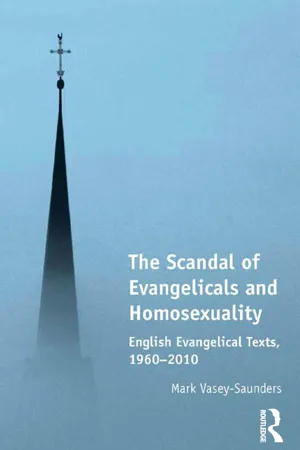
The Scandal of Evangelicals and Homosexuality
English Evangelical Texts, 1960–2010
- 258 pages
- English
- ePUB (mobile friendly)
- Available on iOS & Android
eBook - ePub
The Scandal of Evangelicals and Homosexuality
English Evangelical Texts, 1960–2010
About this book
English evangelicals give the appearance of being a community at war, with each other and with the world around them. The issue of homosexuality is one of the key battlegrounds. How has this issue become so significant to evangelicals? Why is it provoking such violent responses? How is it changing evangelicals, and what might this mean for the future? This book examines the history of evangelical responses to the issue of homosexuality, setting them in a wider historical and cultural context and drawing on the work of Rene Girard to argue that the issue of homosexuality has come to symbolise deeply-held convictions within evangelicalism. The conflict over the issue that is now becoming apparent within evangelicalism reveals deep divisions within the evangelical community that will have great significance for the future. The Scandal of Evangelicals and Homosexuality offers an alternative perspective, seeking not to present an answer to the ethical question, but rather to examine the way the debate has become scandalised and consider the cost. It offers a window into contemporary English evangelicalism and provides an important contribution to international and ecumenical debate.
Information
Chapter 1
René Girard’s Mimetic Theory – A Tool for Exploration
I concluded that violence really is at the heart and secret soul of the Evangelical position on homosexuality, and there are those who very genuinely wish me emotional (if not physical) harm. Page after page of reporting and commentary detailed the invective directed towards gay and lesbian Christians, and revealed to me the highly contagious nature of the aggression and scapegoating that surround the way this issue is handled by certain Evangelicals in the Church.
– Revd G.W. Williams, Vice-Principal of St Michael’s Theological
College Llandaff, letter to the Church Times 20th June 2003.1
College Llandaff, letter to the Church Times 20th June 2003.1
Introduction
The stated evangelical position on homosexuality identifies only a very specific group of homosexual behaviours as sinful, condemns homophobia and calls evangelicals to love of neighbour. My argument is, however, that contemporary evangelicalism contains an implicit rhetoric of violence towards gay people (and more widely towards those identified as liberals) that is at odds with and acts to subvert this explicit rhetoric of love and welcome. This gap between actuality and stated theology cannot simply be dismissed as moral failure. Intelligent and devout evangelicals sincerely hold to the consensus position and seem unable to see that any of their behaviour or attitudes might go against it. This leads me to suggest that deeper and wider influences are acting upon contemporary evangelicalism to subvert its stated position. I will explore the wider cultural and political influences on evangelicalism in Chapter 3, and the deeper themes in evangelical spirituality that shape them in Chapter 4. In order to construct an explanation of these forces that have been shaping evangelical attitudes towards homosexuality, however, I turn in this chapter to the analytic approach and theories of René Girard.
René Girard is a Catholic French-American writer and lecturer who has over many years developed a body of work examining hidden violence in society. His academic work has been produced whilst he lived and worked in the US, though he writes mainly in French, and he has achieved a high level of recognition as a public intellectual in France. His academic training is in literature, and his first work in mimetic theory, Deceit, Desire and the Novel (DD), is essentially a work of literary criticism; however, his exploration of the ideas he first began to uncover in literature has led him to also write in the fields of anthropology, psychology, theology and other more diverse areas.2 In all of these works, Girard sets out the same basic insights, which he now refers to as mimetic theory. Beginning with his analysis of classic novels in DD, Girard began to articulate a theory of human desire and conflict that illuminated the human condition. He then began with Violence and the Sacred (VS) to explore the way that violence is contained by ritual in primitive society, advancing the theory that religion (understood as the containment of unbounded violence through ritualised violence) has been the foundation of civilisation, something spoken of in coded ways through mythology. From TH onwards he began to write explicitly of Christianity as a force for revelation in human history, which has shaped the modern age, even where it is at its most secular, and which offers an alternative to apocalyptic violence.
It must be admitted at the outset that alternative, and considerably simpler, explanations of evangelical violence are possible. The most common are homophobia (evangelical theology and behaviour have been corrupted by or are in themselves expressions of deeply held prejudice) and fundamentalism (evangelical theology and behaviour express a primitive and spiritually immature religious tradition). I will examine both of these alternatives in Chapter 5, once my own argument has been established. My intention in adopting Girard’s theory (which could be seen as an overly complex explanation for an apparently simple phenomenon) is not to suggest that this is the only possible explanation, but rather that it is an interpretatively fruitful one, bringing insight and, importantly, a way forward for evangelicalism that does not entail disowning its own tradition and identity. Most of the alternative explanations offered for evangelical violence towards gay people (like homophobia and fundamentalism) are to one degree or another attacks on evangelicalism itself, and are often offered in a pejorative or at least polemical context. This point is not lost on evangelicals, who are therefore understandably reluctant to accept whatever truth such explanations might offer, something that sharply limits the utility of such explanations as tools for solving the problems they expose. In using Girard’s mimetic theory, I am employing it as a tool for exploring a problem, not seeking to uncritically endorse his work in its entirety.3 Mimetic theory is used here simply as a tool capable of producing a fruitful analysis of an obscured field, the effectiveness of which can be judged by the quality of the analysis produced.
Summarising Girard’s carefully nuanced and wide-ranging thought, developed over several decades and a dozen books, is best done by applying it.4 I therefore turn to examine a paradigmatic incident: the Jeffrey John affair. I will interweave a historical account of events with an exploration of the work of Girard, demonstrating the relevance of his work as it illuminates them.
The Jeffrey John Affair
The Revd Dr Jeffrey John is an Anglican clergyman and theologian, particularly well known as a founder member of Affirming Catholicism, a liberal catholic grouping within the Church of England, and for his advocacy of the ordination of women and the acceptance of permanent, faithful and stable gay relationships as a legitimate Christian expression of sexuality.5 In 1998, following the Lambeth conference of that year, he had made an angry speech to an Affirming Catholicism conference in which he attacked the Church of England’s position on homosexuality as hypocritical, the situation which its policy created as ‘evil’, and in the process revealed that he was in a long-term same-sex relationship.6 The address was not widely known, but was later to be circulated widely by evangelicals.7 In 2003, he was Canon Chancellor and Theologian at Southwark Cathedral.
On 20 May of that year, his nomination was announced as the new Bishop of Reading, Suffragan to the Bishop of Oxford, Richard Harries.8 Within 10 days a letter of opposition had attracted 120 signatories from within Oxford diocese stating: ‘From within the Oxford diocese we wish to put on record our astonishment that someone can be entrusted with the responsibility of a bishop in the church of Christ when they have so strongly and consistently opposed the Church’s moral teaching in relation to same-sex unions’.9 Richard Harries publicly restated his support for Jeffrey John at a diocesan synod meeting, and met privately with 12 evangelical clergy on 10 June, after which Philip Giddings, a prominent Anglican evangelical layman who had been involved in the appointment process, went on record as stating that between 40 and 50 parishes in the diocese might ask for alternative oversight and withhold funding from the diocese.10
On 16 June, nine diocesan bishops, almost all evangelical, signed an open letter drafted by the evangelical Bishop Graham Dow of Carlisle, objecting to the appointment. They expressed the view that although now celibate, Dr John expressed no repentance or remorse about the history of his relationship, that they had reservations about his teaching on the issue (throwing doubt on his declaration that he would abide by Issues), and that the appointment would prejudice the outcome of the church’s reflection on these matters.11 Responding to the concerns raised, Jeffrey John published a personal statement that although he was homosexual in orientation, in a long-term partnership of over 20 years standing, and critical of Issues, he had lived a celibate life since its adoption as the ‘official line’ of the Church of England by the House of Bishops, and would continue to abide by it if made bishop.12 On 21 June, eight diocesan bishops sent a public letter to Rowan Williams, then Archbishop of Canterbury, supporting the appointment.13 Two days later, Rowan Williams wrote a carefully nuanced letter to all diocesan bishops attempting to calm the situation.14 It was too late.
The Evangelical Alliance released a statement, that its members ‘were deeply disappointed’ with the Archbishop’s statement which seemed to ‘express no fundamental concern’ with the appointment. Rod Thomas, spokesman for Reform, said Rowan Williams (whose own appointment they had opposed on the grounds of his views on homosexuality) had ‘not given the leadership we were hoping for’.15 Archbishops of other Anglican provinces began to make statements on the issue, with Peter Akinola, the Archbishop of Nigeria and Peter Jensen, Archbishop of Sydney, being the most vocal opponents of the appointment.16 The Oxford Centre for Mission Studies, ignoring Rowan Williams’s plea for calm reflection, organised a meeting in Oxford attended by leaders of Anglican evangelicalism worldwide, issuing a statement that they would refuse to acknowledge Jeffrey John’s episcopal authority or that of any bishop supporting him, arguing that the appointment flouted settled Anglican teaching.17 On 4 July, a letter with 254 signatures of both clergy and leading lay Anglicans from the diocese was sent to the Archbishop, stating that ‘we believe this crisis threatens the unity and mission not simply of our diocese, but the Church of England and the worldwide Anglican Communion’.18 The next day, following private meetings for both Richard Harries and Jeffrey John with Rowan Williams, Jeffrey John gave a public statement that he was asking for his name to be withdrawn. It was later reported that Rowan Williams, known to be a personal friend of Jeffrey John and sharing his views on homosexuality, had made his decision because of the depth of opposition from wealthy evangelical parishes within the diocese and the disruptive effects on the wider Communion.19
Those opposing the appointment...
Table of contents
- Cover Page
- Dedication
- Title Page
- Copyright Page
- Contents
- Acknowledgements
- List of Abbreviations
- Introduction
- 1 René Girard’s Mimetic Theory – A Tool for Exploration
- 2 The Crisis of Undifferentiation – English Evangelicalism in Late Modernity
- 3 The History of the Evangelical Consensus Position on Homosexuality – A Study of Popular English Evangelical Texts 1960–2010
- 4 Holiness in Late Modernity – An Examination of English Evangelical Traditions of Spirituality
- 5 Homophobia and Fundamentalism as Insufficient Explanations
- 6 Unafraid Evangelicalism
- Conclusion
- Bibliography
- Index
Trusted by 375,005 students
Access to over 1.5 million titles for a fair monthly price.
Study more efficiently using our study tools.
Frequently asked questions
Yes, you can cancel anytime from the Subscription tab in your account settings on the Perlego website. Your subscription will stay active until the end of your current billing period. Learn how to cancel your subscription
No, books cannot be downloaded as external files, such as PDFs, for use outside of Perlego. However, you can download books within the Perlego app for offline reading on mobile or tablet. Learn how to download books offline
Perlego offers two plans: Essential and Complete
- Essential is ideal for learners and professionals who enjoy exploring a wide range of subjects. Access the Essential Library with 800,000+ trusted titles and best-sellers across business, personal growth, and the humanities. Includes unlimited reading time and Standard Read Aloud voice.
- Complete: Perfect for advanced learners and researchers needing full, unrestricted access. Unlock 1.5M+ books across hundreds of subjects, including academic and specialized titles. The Complete Plan also includes advanced features like Premium Read Aloud and Research Assistant.
We are an online textbook subscription service, where you can get access to an entire online library for less than the price of a single book per month. With over 1.5 million books across 990+ topics, we’ve got you covered! Learn about our mission
Look out for the read-aloud symbol on your next book to see if you can listen to it. The read-aloud tool reads text aloud for you, highlighting the text as it is being read. You can pause it, speed it up and slow it down. Learn more about Read Aloud
Yes! You can use the Perlego app on both iOS and Android devices to read anytime, anywhere — even offline. Perfect for commutes or when you’re on the go.
Please note we cannot support devices running on iOS 13 and Android 7 or earlier. Learn more about using the app
Please note we cannot support devices running on iOS 13 and Android 7 or earlier. Learn more about using the app
Yes, you can access The Scandal of Evangelicals and Homosexuality by Mark Vasey-Saunders in PDF and/or ePUB format, as well as other popular books in Theology & Religion & Christian Denominations. We have over 1.5 million books available in our catalogue for you to explore.