- 390 pages
- English
- ePUB (mobile friendly)
- Available on iOS & Android
eBook - ePub
About this book
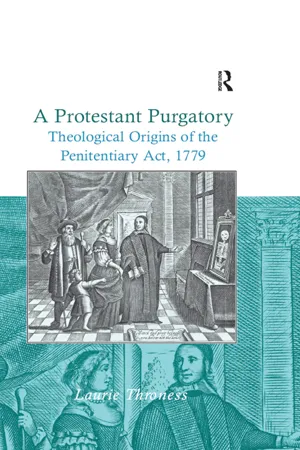
How did the penitentiary get its name? Why did the English impose long prison sentences? Did class and economic conflict really lie at the heart of their correctional system? In a groundbreaking study that challenges the assumptions of modern criminal justice scholarship, Laurie Throness answers many questions like these by exposing the deep theological roots of the judicial institutions of eighteenth-century Britain. The book offers a scholarly account of the passage of the Penitentiary Act of 1779, combining meticulous attention to detail with a sweeping theological overview of the century prior to the Act. But it is not just an intellectual history. It tells a fascinating story of a broader religious movement, and the people and beliefs that motivated them to create a new institution. The work is original because it relies so completely on original sources. It is mystical because it mingles heavenly with earthly justice. It is authoritative because of its explanatory power. Its anecdotes and insights, poetry and song, provide intriguing glimpses into another era strangely familiar to our own. Of special interest to social and legal historians, criminologists, and theologians, this work will also appeal to a wider audience of those who are interested in Christianity's impact on Western culture and institutions.
Chapter 1
The Terror of the Lord
Angels and Judges
That SATAN with less toil, and now with ease
Wafts on the calmer wave by dubious light
And like a weather-beaten Vessel holds
Gladly the Port, though Shrouds and Tackle torn;
Or in the emptier waste, resembling Air,
Weighs his spread wings, at leasure to behold
Farr off th’ Empyreal Heav’n, extended wide
In circuit, undetermind square or round,
With Opal Towrs and Battlements adorn’d
Of living Saphire, once his native Seat;
And fast by hanging in a golden Chain
This pendant world, in bigness as a Starr
Of smallest Magnitude close by the Moon.
Thither full fraught with mischievous revenge,
Accurst, and in a cursèd hour he hies.1
After he had tried and hung two unrepentant witches in Suffolk in 1662 based on bizarre testimony about children vomiting dozens of pins and ‘a two-penny nail with a broad head’,2 Chief Justice Matthew Hale, of whom it is said ‘there is probably no judge in English history who has been held in more honorable estimation’,3 wrote: ‘Government is the Ordinance of God, as well in the Invisible as the Visible World.’4 This statement implies a similarity between the temporal and eternal orders in which human government is a subset of the divine, and temporal laws replicate the eternal for the purpose of countering the same evil restless in both kingdoms: transgression born of rebellion against God. In the first case, rebellion was in heaven resulting in the fall of Satan, and in the second, on earth resulting in Adam’s fall from grace. However, the two kingdoms were curiously intermingled in Adam’s nature: ‘When God created man he design’d to join the Visible and Invisible, the upper and lower World together, by framing such a creature which should partake of both.’5 Religious authorities did not hesitate to take a lesson from above for the good of their congregations below, by including a warning about disobedience from a homily approved by Queen Elizabeth and republished often in the eighteenth century.6 The sermon described Hell itself as the ‘Prison and Dungeon of Rebels against God and their Prince’, and said: ‘where most rebellions and Rebels be, there is the express similitude of Hell, and the Rebels themselves are the very figures of Fiends and Devils, and their Captain the ungracious pattern of Lucifer and Satan the Prince of Darkness.’7 If rebels in Heaven deserved close confinement, how could rebels on earth receive less?
From this short introduction it is already evident that the God of the eighteenth century was intimately involved in the affairs of His creation – especially their moral affairs – and He was not only regarded as an interested observer of their judicial arrangements. He was an active participant; organically connected to and inseparable from the system that dealt with human transgression. It would be impossible to fully understand the legal context in which the penitentiary was introduced without detailing the ways in which the structure and operation of earthly justice was thus patterned after the heavenly.
As described above by Milton in Paradise Lost, after Satan had been cast from ‘the upper World’ with his hosts of rebel angels, he came to earth to further the cause of his rebellion by doing battle for the spirits of men and women, with both good and evil angels interposing. Hale explained:
we see in the visible Administration of the World, or of any one Kingdom thereof, there is continual Diligence on one side by seditious turbulent minded Men to break the peace of a Kingdom or City, or place, which is with much diligence, watchfulness, and vigilancy, attended and prevented by wise and good Men; so there is no less care and vigilancy, and counterworking by the Pure and Good Angels, against the mischievous designs of these evil Spirits against the Children of Men.8
As the celestial hosts battle Satan in the heavens, so people are assisted by angelic forces in their struggle against him on earth. Drawing from scripture (especially the book of Daniel), contemporary authors described various ranks of angels with regional responsibilities. Angels counsel princes, help or break armies, advance empires and mould kingdoms.9 There are ‘Aethereal Princes set over the several Kingdomes of the World; and, in subordination to them, are, the Governours, or tutelary Angels of Provinces, and little Exarchats; and last of all, every mans particular Genius, or Guardian Angel.’10 Through ministering angels ‘God will preserve his Church, and establish it, He will shake the Nations in pieces that do oppose the weal of it.’11 In events great or trivial ‘the course of this World is in general conducted by the Agency of Spirits and subordinate Powers’12 rather than by God’s direct intervention. Even Montesquieu assumed the existence of the laws of the Deity and ‘intelligences superior to men’ in the opening lines of his Spirit of Laws.13
The Church of England’s Collect for the Feast of Michaelmas prays: ‘Mercifully grant, that as thy holy Angels always do thee service in heaven; so by thy appointment they may succor and defend us on earth.’14 It occasioned great panic during the witch trials of New England when some thought that Christians were facing the devil unaided by the spiritual forces of light. At the time the American Puritan Cotton Mather said: ‘The usual Walls of Defence about Mankind have such a Gap made in them, that the very Devils are broke in upon us … as if the Invisible World were becoming Incarnate.’15 No wonder trials and summary executions were necessary there as well as in England. Visible intrusions by the powers of darkness in which evil angels actually impersonated people, provoked the weak to suicide or dragged others out of their chambers to carry them in the air for many miles, had to be stopped at all costs.
Angels both good and evil were a simple fact of life as part of the Great Chain of Being described by Thomas Aquinas in the Middle Ages and widely accepted by learned people of the eighteenth century; the belief was that all created things were ordered by their Creator on a scale of increasing perfection, ranging from inanimate rocks to the highest seraph in Heaven.16 Earthly and divine beings rested on the same hierarchy that ascended heavenward, like unbroken links of Homer’s fabled golden chain.17 The poet Alexander Pope described it:
Vast Chain of Being! which from God began,
Ethereal Essence, Spirit, Substance, Man,
Beast, Bird, Fish, Insect! what no Eye can see,
No Glass can reach! from Infinite to Thee!
From Thee to Nothing! – On superior Pow’rs
Were we to press, inferior might on ours;
Or in the full Creation leave a Void,
Where one step broken, the great Scale’s destroy’d:
From Nature’s Chain whatever Link you strike,
Tenth, or ten thousandth, breaks the chain alike.18
Only fallen angels thrust into Hell were excluded, for they had ‘broke the Chain of Unity, by which the Creature was most firmly linked to its Creator.’19 There was no barrier perceived between earth and Heaven, church and state, the temporal and the eternal, the purposes of God and those of mankind. The gate of Heaven, the foot of Jacob’s ladder on which angels ascended and descended to and from God Himself, was on earth. This upward orientation, this national teleology, was captured by the provost of Trinity College as he told the leaders of the University of Dublin that it was their goal ‘to make this Earth tributary to Heaven’ and ultimately to bring their nation and others to heavenly glory:
thus by the Scale of Visibles, Contemplation and Knowledge lead us up to that Supreme Invisible Power which gives the Spring and Motion to all this mighty Machine; and by the steps and links of the Creation, our Inquisitions may guide us till we ascend to the top of that Chain, which the Poets feign’d was fastned to Jupiter’s Throne.20
There was an analogue to the justice system implicit in the Great Chain of Being; Gerd Mischler calls it ‘The Great Chain of Power.’21 The magistrate was ordained of God to assist in the holy and grave undertaking of national salvation. The right to judge and distribute sentences was not derived from the will of a monarch or a parliament. Just as there was an unbroken hierarchy of being, there was also a ranked classification of judicial officials culminating in the sovereign, which depended for authority on God alone. Speaking to the assizes in Oxford, the eloquent preacher Thomas Bisse reminded justices: ‘in the whole course of our Magistracy, which by a regular subordination of Courts ascending like the steps in Solomon’s Throne, lead up to the Regal Authority, there is no Minister of Justice, but who is also the Minister of God.’22 Again appropriating the illustration of Homer’s golden chain to a Christian use, George Smalridge said in an assize sermon:
He who hath Occasion given Him by the Punishments allotted to Crimes by Humane Laws, thus deliberately to examine the Original of Good and Evil, will perhaps trace it at last to the Fountain-Head, and find that the first Link of this Chain is fix’d to the Throne of God.23
Nowhere can we find their worldview better illustrated than in that defining event of English life, the coronation ceremony. The crowning of George III furnishes us with an elegant example.24 Dressed in elaborate costume, a colourful procession of dignitaries and soldiers wound through narrow London streets thronged with well-wishers on a Thursday in September of 1761 with the prince, dressed in crimson velvet robes, walking under a canopy of golden cloth carried by four nobles.25 The parade ended at Westminster Abbey where an elaborate church service was held, during which the prince was crowned and enthroned by the Archbishop of Canterbury. The service began with prayers both sung and spoken, and a ‘private’ devotional period with the king kneeling at a faldstool, a folding chair used to consecrate bishops. This was followed by a litany, a sermon delivered by the Bishop of Sarum, and a multi-part oath, the first element promising to grant to England the ‘Laws of god, and the true Profession of the Gospel.’ The last part of the oath, made with the sovereign’s hand resting upon the Evangelists, swore to ‘protect and defend’ Bishops and Churches.
Then came the most important part of the service, the anointing, after a choir sung an anthem composed by Handel using words that recalled the crowning of King Solomon in the Old Testament: ‘Zadok the Priest, and Nathan the Prophet, anointed Solomon King; and all the People rejoiced, and said, God save the King! Long Live the King! May the King live for ever!’The king’s ‘surcoat of crimson and velvet’ was removed, and the archbishop anointed his hands, breast, shoulders, arms and head with consecrated oil, just as Israel’s kings were once anointed. This was a crucial moment, because oil in the scriptures symbolizes the third person of the Trinity, the Holy Spirit. The anointing invoked God’s divine Spirit to fill the king and imbue him with wisdom equal to his office. It also implied that the English, like the Israelites, were a special people chosen by God, with a wise king anointed by God’s prophet to rule over them.
Since the Reformation, the nation had been likened by Protestants to ancient Israel. Edward VI was hailed by Archbishop Thomas Cranmer as ‘a second Josiah, who reformed the church of God in his days’26 at his coronation, and the reference was still being made in 1694 when William Fleetwood made the public case that Mary was more like Josiah ‘than any prince besides we have ever had.’27 Thomas Beverley went a step further in noting that the anointing of an Israelite king ‘was a Type of the Great Messiah, of the Great Anointing’ and the ancient kingdom of Israel ‘the first Type of the Kingdom of Christ.’28 The anointing clearly presaged the establishment on earth of the kingdom of God, and spoke to the determination of the political nation that England ought to become that kingdom.
In 1761 the coronation ceremony was already of ancient origin. Its main elements dated from 795 A.D. and Protestants h...
Table of contents
- Cover
- Title Page
- Copyright Page
- Dedication
- Table of Contents
- List of Abbreviations
- Preface
- Introduction
- 1 The Terror of the Lord
- 2 The Intermediate State
- 3 Building the Penitentiary
- 4 Adam’s Doom
- 5 The Man in the Wooden Cage
- 6 The Measure of Sin
- Conclusion
- Bibliography
- Index
Trusted by 375,005 students
Access to over 1.5 million titles for a fair monthly price.
Study more efficiently using our study tools.
Frequently asked questions
Yes, you can cancel anytime from the Subscription tab in your account settings on the Perlego website. Your subscription will stay active until the end of your current billing period. Learn how to cancel your subscription
No, books cannot be downloaded as external files, such as PDFs, for use outside of Perlego. However, you can download books within the Perlego app for offline reading on mobile or tablet. Learn how to download books offline
Perlego offers two plans: Essential and Complete
- Essential is ideal for learners and professionals who enjoy exploring a wide range of subjects. Access the Essential Library with 800,000+ trusted titles and best-sellers across business, personal growth, and the humanities. Includes unlimited reading time and Standard Read Aloud voice.
- Complete: Perfect for advanced learners and researchers needing full, unrestricted access. Unlock 1.5M+ books across hundreds of subjects, including academic and specialized titles. The Complete Plan also includes advanced features like Premium Read Aloud and Research Assistant.
We are an online textbook subscription service, where you can get access to an entire online library for less than the price of a single book per month. With over 1.5 million books across 990+ topics, we’ve got you covered! Learn about our mission
Look out for the read-aloud symbol on your next book to see if you can listen to it. The read-aloud tool reads text aloud for you, highlighting the text as it is being read. You can pause it, speed it up and slow it down. Learn more about Read Aloud
Yes! You can use the Perlego app on both iOS and Android devices to read anytime, anywhere — even offline. Perfect for commutes or when you’re on the go.
Please note we cannot support devices running on iOS 13 and Android 7 or earlier. Learn more about using the app
Please note we cannot support devices running on iOS 13 and Android 7 or earlier. Learn more about using the app
Yes, you can access A Protestant Purgatory by Laurie Throness in PDF and/or ePUB format, as well as other popular books in History & World History. We have over 1.5 million books available in our catalogue for you to explore.