- 360 pages
- English
- ePUB (mobile friendly)
- Available on iOS & Android
eBook - ePub
About this book
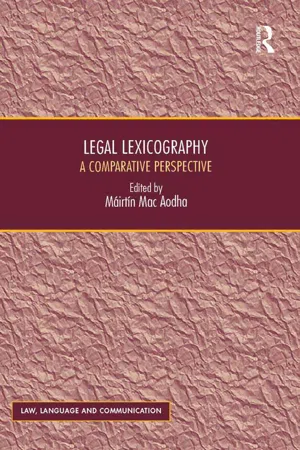
Legal lexicography or jurilexicography is the most neglected aspect of the discipline of jurilinguistics, despite its great relevance for translators, academics and comparative lawyers. This volume seeks to bridge this gap in legal literature by bringing together contributions from ten jurisdictions from leading experts in the field. The work addresses aspects of legal lexicography, both monolingual and bilingual, in its various manifestations in both civilian and common law systems. It thus compares epistemic approaches in a subject that is inextricably bound up with specific legal systems and specific languages. Topics covered include the history of French legal lexicography, ordinary language as defined by the courts, the use of law dictionaries by the judiciary, legal lexicography and translation, and a proposed multilingual dictionary for the EU citizen. While the majority of contributions are in English, the volume includes three written in French. The collection will be a valuable resource for both scholars and practitioners engaging with language in the mechanism of the law.
Chapter 1
A View of French Legal Lexicography – Tradition and Change from a Doctrinal Genre to the Modern Era
According to an expression attributed to the Jurisconsult Javolenus, ‘every definition in civil law is dangerous’.2 However without the definition of legal concepts, an activity as basic as it is daunting, there could be no legal science.
From Roman to modern times, works of a lexicographical nature, in all their forms – glossaries, dictionaries, répertoires (repertories), encyclopaedias and so on – have gone hand in hand with, provided a structure for, refashioned and even sometimes directly led to the development of legal science and the refinement of practice in the most diverse of contexts (Carbasse 2004; Hayaert 2011; Delia 2011). The historical approach to the lexicography of law leads us accordingly to take a broad view of this doctrinal genre (Hakim 2010) which had such an influence on legal literature.
Before the systematization of Roman Law carried out by Gaius and prior to the first attempts at codification under the Late Roman Empire, the Veteres of the Republic, influenced by dialectics and Greek thinking (Gaudemet 1996; Villey 2006), had made significant efforts to define, classify and order the law. While Quintus Mucius Scaevola (140–82 B.C.) would appear to have been the first to have written a treatise on Civil law aimed at classifying legal transactions into kinds and types, it was C. Aelius Gallus, a contemporary of Cicero who compiled the first truly lexicographical work devoted to law, the Verborum quae ad jus pertinent significatione. But the flagship work of Roman legal lexicography, although not strictly a lexicon or a dictionary (Carbasse 2004: 6; Hayaert 2011: 316, 317), is still the title De verborum significatione of Justinian’s Digest (D 50.16). The inspiration through the ages for numerous glosses, commentaries and alphabetical recasts, this disparate text’s original purpose was to elucidate the meaning of legal terms occurring in 246 fragments taken from the leading Roman jurisconsults. The primary definitional purpose of the De verborum, and in particular the alphabetical and analytical works that followed it, make it the key and founding text of legal lexicography.
With the renaissance of Roman Law in the Middle Ages3 and throughout the Ancien Régime, law dictionaries flourished and started to take on the traits they now possess. In the twelfth century the first medieval legal lexicons were produced by French lawyers and civilists, who remained true to their grammarian origins (Carbasse 2004: 10). The most famous of these were Aubert de Béziers, Jacques de Révigny and in particular Albéric de Rosate, author of the Grand dictionnaire de droit civil et canonique compiled circa 1350, and re-edited and recast in the sixteenth century by Decianus. This masterpiece is structured in alphabetical order and designed as a tool for practitioners. The myriad dictionaries that followed this work were conceived as practical works and borrowed heavily from their predecessors (2004: 12).
The Humanist approach to legal lexicography applied by Lorenzo Valla to the De verborum, or that of Maffeus Vergus or Cujas, was not, moreover, to change the aspect or the object of law dictionaries.
At the end of the sixteenth century, François Rageau’s l’Indice des droits royaux et seigneuriaux became the first dictionary of ‘French Law’, jettisoning the Latin tongue for the vernacular. Re-edited by Eusèbe de Laurière in 1703, Rageau’s Indice and Louis Charondas’ Mémorables which appeared shortly afterwards marked the beginning of the new era of law dictionaries published in the seventeenth and eighteenth centuries. In was in this same period that lexicography became a true science with the foundation of the Académie française. It is interesting to note in this connection that the jurisconsults of the Ancien Régime often made reference in their works to ‘general dictionaries’ of the French language. Le Dictionnaire de Trévoux in particular was considered an authority because of the high quality of its articles on the words of the law.4
Dictionaries, legal encyclopaedias, thematic or alphabetical répertoires were from that time on an integral part of legal literature; many of those works, moreover, met with enduring success right up until the nineteenth century and were the subject of numerous re-editions (Bonin 2004; 2011).5 In addition to those works should be mentioned the myriad of alphabetical reports6 dedicated to case-law produced by arrestographes7 (case reporters); these were even sometimes entitled ‘dictionaries’ of legal decisions – the most famous of which is that of de Brillon (1727). These laboriously compiled compilations of legal judgments, meticulously dissected, systematised and compared with other sources of law, follow in effect the model of general lexicographical works (Dauchy and Demars-Sion 2005).
Nevertheless, it is Joseph Ferrière’s Répertoire universel et raisonné de jurisprudence which became le Dictionnaire de droit et de pratique under the editorship of first his son and then de Boucher d’Argis, along with Joseph-Nicolas Guyot’s Répertoire universel et raisonné de jurisprudence which were to become the flagship works of legal lexicography under the Ancien Régime. These works of encyclopaedic scope established the general characteristics of this literary genre and served as models for the lexicographical works of the nineteenth century.
What then are the general and abiding traits which sustain this multiform doctrinal genre and which unite these lexicographical works beyond their sole definitional purpose?
To be useful from a practical as much as a scientific point of view is undoubtedly the primary aim of works of legal lexicography. Their main objective is to render legal norms, principles or institutions easy to understand, accessible and available for use – in other words they are primarily tools. This utilitarian purpose is evident firstly in the form of these works, organised alphabetically or according to subject and making use sometimes of tables or indices. In this respect, legal dictionaries, lexicons or répertoires can be likened to the codification process (Bureau 2003): for codes, like lexicographical works, aim at making the law more accessible, by bringing together and organizing separate legal texts in a single corpus. The sole purpose, moreover, of Gregorian and Hermogenian Codes was to be of use to practitioners by making available inaccessible imperial texts and constitutions (Gaudemet 1996: 24).
Unlike those codes, however, lexicographical works also seek to define the words of the law. It is not a question of simply uniting and making known the rules and the principles, their meaning and terms also have to be explained. It is worth re-emphasizing here that that ‘definition’ is never confined to a mere terminological account of the terms, which account would be of no use to lawyers. In this sense, legal lexicons have followed on from the Roman definitiones, which were not purely lexical definitions. It is more a question of ‘principles, of legal rules, in other words of propositions regarding the institutions designated by the headwords rather than the words themselves’ (Hayaert 2011: 316). A descriptive and synthetic approach to legal entities is still very much the preferred approach in legal lexicography. As a result as Valérie Hayaert points out, ‘there is no watertight division in this type of work between dictionary of language and encyclopaedia’ (ibid.). The exigencies of the legal subject-matter and the practical function of these works, depositaries of definitions, case-law, formulae and extracts from the case-law, cause a blurring of the traditional landmarks of metalexicography.
De Ferrière’s Dictionnaire is a typical example. A collection of customary law, royal law, learned law and case-law, it places the emphasis more on description and analysis than on terminology and the definition of words, and is closer to a répertoire than a pure lexicon (Delia 2011: 337). The same applies to most of the major lexicographical works whose articles often range from learned syntheses, to technical articles and forme brève (‘abbreviated form’).
These works are usually directed at different types of users. However, the learned nature of some types of developments, sometimes recorded by the jurisprudence itself, shows that these works also had a scientific function and could go hand in hand with and serve the development of legal science. They were accordingly also written for the narrower public of university jurisconsults and legal writers.
The dictionaries, index and reports are also aimed at young lawyers embarking on a career or even those students already enrolled at l’École. By making access to the law easier and providing generally understood definitions of the concepts that make up the law, these legal lexicons by their very nature have a capacity to be didactic and paedagogical tools. In his Instructions sur les études propres à former un magistrat, d’Aguesseau gave the following advice to his son: ‘The other thing which would be of great use to you is to read the last two titles of the Digest, which are akin to a supplement to the Institutes; one of these titles deals with legal rules, the other with the meaning of words’. Legal lexicons therefore became part of the training, be it theoretical or practical, of lawyers. This pedagogic function is explicitly stated in the preface to Claude de Ferrière’s Introduction à la pratique, where its author writes ‘[this work] has no great scholarly pretensions and was only produced for ‘those who are embarking on the study of case law’ (Delia 2011: 330, 331).
The same is true of the alphabetical reports written in French which are primarily aimed at recently qualified practitioners as yet uninitiated in the subtleties of case-law and procedure, but also at trainee lawyers. In effect, after the decree of the Édit de Saint-Germain-en-Laye (1679) establishing the teaching of French Law in the universities, reports were to become powerful pedagogic tools, making known customs, laws and case-law through the prism of the judgments which were officially embedded in the curricula (Dauchyand Demars-Sion 2005: 13).
Finally, certain lexicographical works were intended for a wider public not just containing lawyers, to wit, readers who were just keen to know the law. It is in the eighteenth century under the influence of the Enlightenment and of Encyclopaedism, that those who are ignorant of the law, are invited to inform themselves about a law that is in the process of rationalization and that is accordingly becoming more accessible. For example, the Dictionnaire de droit et de pratique is also aimed at those ‘who although their station does not require of them to be versed in law, [they do so] so that they can become familiar with certain rules that are in daily currency, and ignorance of which is shameful and of which every man should have a knowledge for the conduct of his affairs’. Law, although in competition with and supplanted by ‘philosophy’ and ‘politics’, was to remain an essential science at the heart of the training and culture of the learned. As for Godot’s imposing Répertoire, its targeting of a wider public had a cautionary purpose in dissuading private citizens from embarking on expensive litigation where the outcome was in doubt or likely to be unfavourable (Guyot: XIII, XIV).8
Legal lexicographical works therefore contributed to the strides made to unify and rationalise French Law by providing ambitious syntheses of doctrine, practice and case-law and by making access to law, in all its forms, easier. The more comprehensive works could be viewed moreover as a first attempt at synthesis, accompanying and working towards the unification of national law, even though the plurality of sources and the regional particularities of the Ancien Régime made such an attempt daunting. Expressions of a form of legal rationality, at the same time practical, scientific and didactic, these works had as their primary goal to provide answers for the most immediate queries and problems faced by all types of jurisconsults, ranging from the novice to the most inveterate of scholars. Finally, lexicographical works with encyclopaedic pretensions, veritable ‘swiss army knives’ of the law, differ from other works of legal literature by their holistic approach.
Following on directly from their predecessors under the Ancien Régime, the lexicographic works of the nineteenth century were to add to the number of different types of this doctrinal genre and bring them to their highest degree of perfection.
Although the initial aim of those dictionaries was to facilitate the transition and adjustment to the new law (I), legal lexicography was not to really achieve its highest degree of accomplishment until the final two-thirds of the century with the production of ambitious works of unprecedented scope (II).
I) From the Revolution to the Civil Code, Lexicographical Works of Transition
With the advent of the Revolution and in the years that followed the promulgation of the Civil Code, the main purpose of lexicographical works was to facilitate the passage from the ancien droit to legal ecosystems constructed on new paradigms. Works of transition but also synthetic works revealing continuity and intangible principles, the dictionaries and repértoires of this period are amongst the rare works that can be directly exploited to provide a real overview of the law, rationalised and brought up to date. A valuable resource for practitioners, these works were part of the thankless but vital groundwork that first had to be carried out to pave the way for subsequent works on doctrine.
By its legicentric nature (Rials 1988) the unsettled period of the Intermediary Law resulted in total legislative chaos, a situation that was aggravated by the abrupt ideological turnabouts of the Convention Nationale and of the Directoire. While the Revolution made ‘outlaws’ of lawyers, placing them ‘hors la loi’ (Halpérin 1993: 55, 65), and strove to do away with the confusion of sources in favour of a single norm, a number of lexicons and dictionaries were produced to help citizens new to legal commerce, but also lawyers converted into défenseurs officieux, administrators and often appointed judges by reason of their expertise. The desire here once again was to make accessible and comprehensible, to organise or even rationalise a law that was more disparate and uncertain than ever. In 1791 Louis-François Jauffret in the Gazette des Nouveaux Tribunaux painted a grim picture of the administration of justice too often placed in the hands of untalented amateurs in a time of the utmost legal uncertainty. To remedy this situation, the jurisconsult set out to produce a dictionary aimed at clarifying and making accessible a law in the process of being substantially renewed: ‘it is perhaps more important than we realise to illuminate the path of those charged with the precarious duty of applying the laws or we will soon witness a partial law where the arbitrary will cause irreparable damage. Books are needed! […] in response to the numerous requests I have received in t...
Table of contents
- Cover Page
- Title Page
- Copyright Page
- Dedication
- Contents
- List of Figures
- List of Tables
- Acknowledgments
- Notes on Contributors
- Foreword
- Introduction
- 1 A View of French Legal Lexicography – Tradition and Change from a Doctrinal Genre to the Modern Era
- 2 The Early Modern English Law Lexicon
- 3 Legal Lexicography: A View from the Front Lines
- 4 The Challenges of Compiling a Legal Dictionary
- 5 Bilingual Legal Dictionaries: Comparison Without Precision?
- 6 Pour des dictionnaires juridiques multilingues du citoyen de l’Union européenne
- 7 Principes terminologiques pour la constitution d’une base de données pour la traduction juridique
- 8 Translation and the Law Dictionary
- 9 Multinational Legal Terminology in a Paper Dictionary?
- 10 Database of Legal Terms for Communicative and Knowledge Information Tools
- 11 Defining Ordinary Words for Mundane Objects: Legal Lexicography, Ordinary Language and the Word Vehicle
- 12 Establishing Meaning in a Bilingual and Bijural Context: Dictionary Use at the Supreme Court of Canada
- 13 La phraséologie chez des jurilexicographes: les exemples linguistiques dans la deuxième édition du Dictionnaire de droit privé et lexiques bilingues
- 14 Inconsistencies in the Sources and Use of Irish Legal Terminology
- 15 The Struggle for Civic Space Between a Minority Legal Language and a Dominant Legal Language: The Case of Māori and English
- Index for English Language Chapters
- Index for French Language Chapters
Trusted by 375,005 students
Access to over 1.5 million titles for a fair monthly price.
Study more efficiently using our study tools.
Frequently asked questions
Yes, you can cancel anytime from the Subscription tab in your account settings on the Perlego website. Your subscription will stay active until the end of your current billing period. Learn how to cancel your subscription
No, books cannot be downloaded as external files, such as PDFs, for use outside of Perlego. However, you can download books within the Perlego app for offline reading on mobile or tablet. Learn how to download books offline
Perlego offers two plans: Essential and Complete
- Essential is ideal for learners and professionals who enjoy exploring a wide range of subjects. Access the Essential Library with 800,000+ trusted titles and best-sellers across business, personal growth, and the humanities. Includes unlimited reading time and Standard Read Aloud voice.
- Complete: Perfect for advanced learners and researchers needing full, unrestricted access. Unlock 1.5M+ books across hundreds of subjects, including academic and specialized titles. The Complete Plan also includes advanced features like Premium Read Aloud and Research Assistant.
We are an online textbook subscription service, where you can get access to an entire online library for less than the price of a single book per month. With over 1.5 million books across 990+ topics, we’ve got you covered! Learn about our mission
Look out for the read-aloud symbol on your next book to see if you can listen to it. The read-aloud tool reads text aloud for you, highlighting the text as it is being read. You can pause it, speed it up and slow it down. Learn more about Read Aloud
Yes! You can use the Perlego app on both iOS and Android devices to read anytime, anywhere — even offline. Perfect for commutes or when you’re on the go.
Please note we cannot support devices running on iOS 13 and Android 7 or earlier. Learn more about using the app
Please note we cannot support devices running on iOS 13 and Android 7 or earlier. Learn more about using the app
Yes, you can access Legal Lexicography by Máirtín Mac Aodha in PDF and/or ePUB format, as well as other popular books in Law & Comparative Law. We have over 1.5 million books available in our catalogue for you to explore.