eBook - ePub
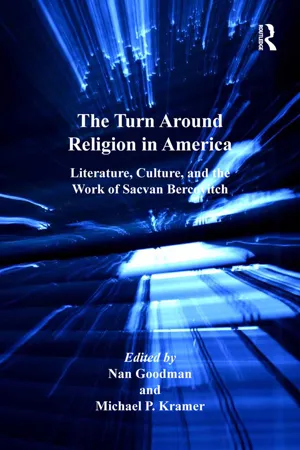
The Turn Around Religion in America
Literature, Culture, and the Work of Sacvan Bercovitch
- 488 pages
- English
- ePUB (mobile friendly)
- Available on iOS & Android
eBook - ePub
The Turn Around Religion in America
Literature, Culture, and the Work of Sacvan Bercovitch
About this book
Playing on the frequently used metaphors of the 'turn toward' or 'turn back' in scholarship on religion, The Turn Around Religion in America offers a model of religion that moves in a reciprocal relationship between these two poles. In particular, this volume dedicates itself to a reading of religion and of religious meaning that cannot be reduced to history or ideology on the one hand or to truth or spirit on the other, but is rather the product of the constant play between the historical particulars that manifest beliefs and the beliefs that take shape through them. Taking as their point of departure the foundational scholarship of Sacvan Bercovitch, the contributors locate the universal in the ongoing and particularized attempts of American authors from the seventeenth century forward to get it - whatever that 'it' might be - right. Examining authors as diverse as Pietro di Donato, Herman Melville, Miguel Algarin, Edward Taylor, Mark Twain, Robert Keayne, Nathaniel Hawthorne, Paule Marshall, Stephen Crane, Ralph Waldo Emerson, and Joseph B. Soloveitchik, among many others-and a host of genres, from novels and poetry to sermons, philosophy, history, journalism, photography, theater, and cinema-the essays call for a discussion of religion's powers that does not seek to explain them as much as put them into conversation with each other. Central to this project is Bercovitch's emphasis on the rhetoric, ritual, typology, and symbology of religion and his recognition that with each aesthetic enactment of religion's power, we learn something new.
Information
Universals
Chapter 1
Built into the System:
Where Protest Lies in Pietro di Donato’s Christ in Concrete
Margaret Reid
At first glance, Pietro di Donato’s Christ in Concrete (1939)1 might fold all too neatly into the model of what so many of us, as students of Sacvan Bercovitch, have come to call American Dissent. It is a coming-of-age story heavy with the rhetoric of the American Dream and crushing in its representation of the dream’s collapse. But here dissent and radicalism have a somewhat different end, shaped precisely by the novel’s engagement in religious themes. As in the Bercovitchean tradition, political dissent here is quintessentially American, and radicalism is “invested in a vision which reinforce[s] (because it emanate[s] from) the values of [the] culture.”2 But di Donato’s protest has a dimension to it irreconcilable to American political rhetoric; his novel reimagines not only America but Catholicism too, thus yielding the possibility of a lasting legacy of protest, a vision that points distinctly away from a renewed America, and instead into a world without idealism, a world of the senses and of what the novel takes to be their dominant form of expression, suffering.
Christ in Concrete opens in 1919, closes in 1929, and is first published in 1939, thus situating it firmly within the context of social realism. Di Donato was born in 1911 in West Hoboken, New Jersey, the oldest son of Italian immigrant parents, and he bases the life of his protagonist—Paul—on his own. Thus the indictments of class, wealth, and privilege that the book contains are a surprise neither for the time period nor for an American bildungsroman. In fact, there is much in the novel to suggest it is a quite typical immigrant novel: the plot directly engages clear patterns that have helped define the genre, with the main character and his surrounding cast caught between the by-now predictable conditions of the immigrant. Assimilation vs. nostalgia, advancement within an adopted culture vs. resistance to it: this is the frame within which we expect to find the immigrant’s response to the ambiguous promises of the adopted country. Indeed such sentimental dreams of progress and of origins do dominate much of the novel, as for example, Geremio (father to Paul, the novel’s main character) predicts proudly that all of his children “will be big American builders … put[ting] the gold away in the basements!” (4), while in contrast, Nazone (Paul’s godfather) begs for work so that he might acquire the money to “return to the beautiful Italia” (21). But Paul is 12 years old when his father is crushed to death in the collapse of an unsafe worksite and only slightly older when his godfather meets a parallel (and equally gruesome) fate, falling from a small platform at his high-rise construction site. With the deaths of these two men go the possibilities of the American dream that sustained Geremio and the dream of return that sustained Nazone, leaving to Paul the obliteration of both of the paradigmatic dreams of the immigrant. Within the novel, it becomes clear that these alternatives are, effectually, equivalencies in a suffocating universe—a universe that stifles the actual life of the immigrant among exhausting (and exhausted) dreams of escape, and one which demands a response quite other than the visionary.
This makes it most surprising, then, that the strongest response that the novel offers is a rethinking of religion itself. This is not to say that religion affords safe refuge from the savagery of industrial America for the immigrant characters here. In fact, religion in the novel initially appears as a third dream of success equally visionary, equally fragile, and equally flawed as the dreams of Geremio and Nazone: this is the Catholic dream of salvation, of which Paul’s mother, Annunziata, is the living embodiment. Like the other visionary solutions, however, this orthodox version of Catholicism cannot withstand the brutality of the novel’s plot, and so all of the dreams that have sustained the adults in Paul’s world seem equally flawed. Practically speaking, Paul’s inheritance is a vacuum: at his parents’ deaths, he inherits his father’s financial obligations and loses his mother’s religious faith.3 Thus it seems that the novel leaves decidedly little room for the expression of protest in a world not only capable of—but seemingly intent upon—the literal crushing of the immigrant and his or her expected narratives of assimilation or resistance.
However, as these familiar responses to the indignities of poverty fall away as options in di Donato’s novel, there remains something sensate and material, the record of experience—particularly of the experience of suffering—built through the processes and products of the laboring body. This is the story of the immigrant’s life that his or her imagination resisted at every turn; it is the pain that the laborer hoped to leave behind. And indeed while it may seem that the suffering of the laborer is entirely co-opted by the forces of industry that own the laboring body, in Christ in Concrete it is a story that retains within it a surprising power, a collective memory that aids Paul in his later visions of success that close the novel.4 In order to find this site of protest, the topic of religion in the novel must be reexamined. While any assessment of Social Realism will attend to representations of class, urban life, proletarian themes, and often ethnicity and/or immigration as well, much less attention has been paid to the role of religion. The topic deserves revisiting precisely because of the achievements of both Jewish and Catholic writers, from the works of Anzia Yezierska, Abraham Cahan, James T. Farrell to—less known but equally intriguing—those of Pietro di Donato.
Perhaps because the art of the period carries with it the general expectation that it advances the message of social change, large-scale social institutions such as those of established religion may be presumed to be left behind in that vision. However, in the cases of both Jewish and Catholic writers, their religious and cultural traditions were enough at odds with American society to place them in an ambiguous position. At the most basic level, writers from these (often immigrant) perspectives asked, did these traditions create impediments to the achievement of the American Dream? Or did they provide refuge from its false promises? For instance when Abraham Cahan’s Asriel Stroon (in “The Imported Bridegroom”5) abandons all else to restore his own sense of Jewishness, we see Cahan’s suggestion that Judaism, once perceived by his character as his greatest challenge to success in America, is—for the same reasons of inherent difference—a peaceful place apart. In this way, Cahan’s Stroon finally rejects the “American” values by which he had led his life as a successful businessman in New York. Younger, less successful, and more naïve than Stroon, who is able to return to Russia and seek some new relation with his ancestry, di Donato’s Paul must radically remake his Catholicism within the brutal conditions of his current American life.6 And in this encounter, we see di Donato wrestle with a complex rereading of the role of religion in America, outside of the Protestant mainstream. The novel quickly dismisses the predictable readings of Paul’s Catholicism as burden or refuge just as it clearly rejects conventional religious belief and practice. As an institution, the Catholic Church as Paul comes to know it in his immigrant neighborhood of New York is a bureaucracy matched in its callousness only by the American government itself.7 However, the Catholic sensibility in the novel becomes something else entirely, a perspective and a source of meaning that points ironically not toward an escape from suffering through salvation, but toward an embrace of suffering for the ways in which it shapes the immigrant experience in the here and now. That is to say, where the Catholic Church as a social institution fails to provide refuge for the immigrant worker in Christ in Concrete, Catholicism as a sensibility maintains its power in the novel as it transforms in Paul from a set of accepted beliefs that read lived experience as prelude to the infinite, into an ethos of suffering and protest both experienced and expressed by the interaction between the physical senses of the laboring body and the American industrial world it is building.8 Paul, that is, comes to embrace his own sensibilities, marked and shaped as they are by his ethnic and religious heritage. His experience of his own life (including his understanding of the suffering before him)—the way in which he bears witness to the corporeality of suffering—is marked by his deeply Catholic desire to understand, or more precisely, to believe in, the purpose of suffering. Thus, di Donato writes a novel less “politically programmatic” than many contemporaneous texts, a novel that does not “propagandize for or against any specific ideology.” Instead, it is a novel, as Michael D. Esposito has argued, with an “intuitive” radicalism, a perspective apart from “existing political structures,” a subjective (indeed, a bodily) radicalism as confusing and contradictory as di Donato himself.9 Always wry and evasive on the questions of whether he rejected Catholicism and/or to what extent he embraced Communism, di Donato was clear on one issue. Whatever his feelings for the Catholic Church as an institution, and for that matter, whatever his feelings on Catholic doctrine and theology, he maintained his love for what he saw as the sensuality of the Catholic sensibility. What I am calling this “Catholic sensibility” is best defined in di Donato’s own words—“the sensuality of the Holy Roman Catholic Church, its art, its music, its fragrances, its colors, its architecture, and so forth”; he (whether fairly or not) calls this dimension of Catholicism “purely Italian,” and labels it both “pagan” and “realist” in its appeal.10
To be sure, this is an elusive concept, but we may see what he means by attending to one of di Donato’s most well-known stylistic triumphs: the vividness of the physical world he creates in the novel. So sensory are his images that both readers and characters are immersed in, if not fully overwhelmed by, the enormity of this world. Di Donato’s language conveys weight, mass, and bulk.11 There is “emotion-filled pageantry of … religious rituals,” and countless almost “photographic” descriptions of human life in all of its complexity.12 While the concreteness of di Donato’s language dominates all descriptions of the fictional world and its dreams, it is perhaps more evident in the pains than the pleasures of life,13 and these pains link the workers to the novel’s image of Christ. In particular, it is di Donato’s way of portraying suffering that is most remarkable in this regard. It may be, as Franco Mulas argues, that the pathos of this largely autobiographical story “forced concreteness on its author,”14 and in doing so, left him ever reaching for words and phrases that would resonate with all of the senses—not only the ear—of the reader. Or, it may be that the author’s insistence on conveying the colorfulness of Italian idiom through literalistic translation creates this linguistic density. But whatever the reason, in his portrayal of the materiality of the world of work, di Donato imagines the world that corresponds to his own image of Christ, one that he links to the southern Italian tradition: “The Italian Christ,” di Donato told the New York Times, “was no neurotic esthete, but a muscled laborer.”15 Christ in Concrete assigns a materiality to the world of work that oddly, unpredictably, transforms to operate as a voice of protest against the world which such labor indeed also builds. Suffering may not lead to salvation for this group of Christ figures, but it does have a power beyond that of the more general Christian image of the quiet, passive acceptance of suffering. Di Donato’s Christ is “muscled,” and his crucifixion will bear the traces of his fight. What liberation there is in the novel is in the expression of this protest, one that emerges as the image of “work” shifts from being the product of the interchangeable, anonymous body to being the expression of the specific, subject-bound experience. Like so many immigrant writers, di Donato found the English language “‘always … inadequate,’”16 but out of this struggle he developed a narrative style that enacts what it portrays: the overwhelming desire that these moments of unspeakable pain be closely linked to the latent hope of salvation, both worldly—into American society and the American dream—and otherworldly, coupled with the fictional world’s utter insistence upon the incapacity for human transcendence, the impossibility of ascension to the American dream, to the dream of returning to a hospitable Italy, to the dream of Christian salvation. These dreams not only fail, but suffocate their believers in the process. As they fall away, they ironically make space for a new trope of immigrant experience—a life of suffering through which the immigrant voice gains both its authority and its substance.
The fact that the American Dream has both inspired and betrayed generations of immigrants is hardly controversial, but what is unique in di Donato’s portrayal is the immigrant’s reciprocal effect on the dream that is left behind. In his engagement with the dream, the immigrant in di Donato’s novel embeds himself within the America that betrays him, adding materiality, weight, to the dream. This dynamic effectively (if figuratively) prevents the transcendence of the dream, refuses to concede to it visionary qualities, and instead fixes it to the earth, history and culture, producing a radical revision of cultural promise, the result of a powerful protest against betrayal. But befor...
Table of contents
- Cover
- Half Title
- Title Page
- Copyright Page
- Dedication
- Contents
- List of Figures
- Notes on Contributors
- Foreword: The Turn Around: A Panoramic Vision of Religion in American Literature
- Acknowledgments
- Part 1 Universals
- Part 2 Particularities
- Afterword: Turn, Turn, Turn: On Sacvan Bercovitch, Ecclesiastes, and American Literary Study
- Works Cited
- Index
Trusted by 375,005 students
Access to over 1.5 million titles for a fair monthly price.
Study more efficiently using our study tools.
Frequently asked questions
Yes, you can cancel anytime from the Subscription tab in your account settings on the Perlego website. Your subscription will stay active until the end of your current billing period. Learn how to cancel your subscription
No, books cannot be downloaded as external files, such as PDFs, for use outside of Perlego. However, you can download books within the Perlego app for offline reading on mobile or tablet. Learn how to download books offline
Perlego offers two plans: Essential and Complete
- Essential is ideal for learners and professionals who enjoy exploring a wide range of subjects. Access the Essential Library with 800,000+ trusted titles and best-sellers across business, personal growth, and the humanities. Includes unlimited reading time and Standard Read Aloud voice.
- Complete: Perfect for advanced learners and researchers needing full, unrestricted access. Unlock 1.5M+ books across hundreds of subjects, including academic and specialized titles. The Complete Plan also includes advanced features like Premium Read Aloud and Research Assistant.
We are an online textbook subscription service, where you can get access to an entire online library for less than the price of a single book per month. With over 1.5 million books across 990+ topics, we’ve got you covered! Learn about our mission
Look out for the read-aloud symbol on your next book to see if you can listen to it. The read-aloud tool reads text aloud for you, highlighting the text as it is being read. You can pause it, speed it up and slow it down. Learn more about Read Aloud
Yes! You can use the Perlego app on both iOS and Android devices to read anytime, anywhere — even offline. Perfect for commutes or when you’re on the go.
Please note we cannot support devices running on iOS 13 and Android 7 or earlier. Learn more about using the app
Please note we cannot support devices running on iOS 13 and Android 7 or earlier. Learn more about using the app
Yes, you can access The Turn Around Religion in America by Michael P. Kramer, Nan Goodman in PDF and/or ePUB format, as well as other popular books in Literature & Literary Criticism. We have over 1.5 million books available in our catalogue for you to explore.