That America was drawn into the Vietnam War by the French has been recognized, but rarely explored. This book analyzes the years from 1945 with the French military reconquest of Vietnam until 1963 with the execution of the French-endorsed dictator, Ngo Dinh Diem, demonstrating how the US should not have followed the French into Vietnam. It shows how the Korean War triggered the flow of American military hardware and finances to underpin France's war against the Marxist-oriented Vietnam Republic led by Ho Chi Minh.
- 252 pages
- English
- ePUB (mobile friendly)
- Available on iOS & Android
eBook - ePub
America's Vietnam War and Its French Connection
1 The Return of French Colonialism to Vietnam and the Formation of the Democratic Republic of Vietnam
Much of the history of French Indochina from the 1870s was one of economic development that tied the colony closer to metropolitan France accompanied by the suppression in local assertion of Vietnamese nationalism. By late in the 1930s, the administrative emphasis was more on accommodating the effects of Japan’s military expansionism and later still the influence of Fascism that flowed from Metropolitan France. The trigger for these latter events was the surrender of France on 14 June 1940 to the invading German Nazi forces. French Fascists emerged to govern southern France, under German direction, while the Nazis occupied the remainder. The French Fascists adopted the famous French military commander, Marshal Petain, as their leader and the name ‘Vichy government’ after the town in southern France where they established their headquarters. They collaborated with the Nazi occupiers in many ways, including the seizure of Jews and Communist Party members for imprisonment in Nazi concentration camps.
The Japanese government had joined with Nazi Germany in the Anti-Comintern Pact in November 1936 as a joint measure to counter Soviet communism; and the Pact led the Japanese into easy collaboration with Vichy France by sharing in their mutual aims. The outcome was that the Vichy government signed an agreement with Japan on 22 September 1940 giving access to local French aerodromes and accommodation for 6,000 operators. On 6 May 1941, a commercial agreement was signed with Japan dealing with commercial and customs duties and the granting of most-favoured-nation treatment to Japanese nationals. This was followed on 29 July 1941 by the Vichy signing a Protocol granting Japanese access to all of the territory of Indochina and the northern regions close to the Chinese frontier. Another agreement, of 30 August 1941, allowed Japanese military forces to move into Indochina, essentially to attack the Chinese (both Nationalist and Communist), against whom they had been fighting since the early 1930s. This document declared that ‘France had agreed to accord in French Indochina such facilities of a military nature as are required by the Japanese army and navy for executing their campaign for the settlement of the China affair [meaning the invasion of China]’.1 America was then not at war with Germany, and the US diplomatically recognized the German-controlled Vichy by appointing an ambassador who was notified in confidence by the State Department of these agreements. However, US officialdom was becoming increasingly alarmed as Japan stretched its military tentacles into south Asia in a clear attempt to dominate the mainly colonial countries in the western Pacific region.
The Roosevelt administration was concerned that the Japanese collaboration with the French Fascists would aid Japan’s plan for expansionism in the region. The US countered by imposing embargoes on the Japanese economy, especially on its import of oil required for its military operations; however, the Japanese showed no intention of reversing their plans. The Fascist-based alliance went ahead, and the US consular officials in Hanoi and Saigon reported to Washington on the inflow of Japanese troops and military equipment overseen by the French Vichy administrators. The numbers of men and equipment indicated a force in excess of requirements to hold this French colonial territory, and it confirmed Indochina becoming the springboard for launching Japanese attacks on other parts of Southeast Asia. The State Department officials prepared a report for President Franklin D. Roosevelt on 1 November 1941 containing further details of the French adapting Indochina to meet Japanese military demands and granting access to the northern region for the possible entry into China of 25,000 troops.2 Through reports from its consuls in Hanoi and Saigon, the State Department reported to the President as late as 6 December 1941 that there were 25,000 Japanese troops in the north and 80,000 in the south and ‘at the outside 450 Japanese planes in Indochina’. Naval Intelligence informed the State Department that their air patrols from Manila had reported that twenty-one troop transports were sighted in Camranh Bay, along with destroyers, and twelve submarines were seen sailing north of Saigon. The US consul in Tsingtao reported that in the preceding ten days an average of three transports had left daily with troops wearing summer uniforms. The consul in Hanoi reported that the Japanese had recently landed a large range of military material in Haiphong, which a French military official had estimated to include 3,400 trucks and tractors, 600 automobiles, 300 motorcycles, 260 tanks, 2,000 machine guns, 2,100 pack horses and a large number of bicycles. Over 20,000 troops had landed in Saigon since 1 November, and 10,000 troops had been sent to Saigon and from there to Haiphong by train. The Military Intelligence Division of the War Department reported that there were 30,000 troops on the island of Hainan, along with ‘an unknown number of planes’ that could readily fly from there to northern Indochina.3 Such reports had come too late for the US to react to because the Pacific War commenced with the Japanese assault on Pearl Harbor on 7 December 1941, which the President branded as the day of infamy.
France and Fascism
Through the German military defeat and the agency of a small Fascist leadership, France had converted from a loyal Western ally to an enemy force collaborating with the Axis powers. The French Army had surrendered Indochina; in the Middle East the Allies were compelled to launch a military strike against the Vichy troops in Syria and Lebanon and the British navy had to expend its valuable resources sinking the French navy moored in Mers-el-Kebir for its refusal to join the Allied naval forces. President Roosevelt, to a greater extent than British Prime Minister Winston Churchill, was highly intolerant of the French and strengthened his intention of stopping France from returning to its Indochinese colony after the war. The President’s attitude arose less from the wish to punish the disloyalty of the French towards the Allied cause and more from the scorn with which he regarded the French colonial practices. He judged the French to be ‘poor colonizers’ who had ‘badly mismanaged’ Indochina and exploited its people. ‘France had renounced all claim to Indochina’, he added, ‘when it capitulated to the Japanese in 1940’.4 He said that the French had ‘milked it for one hundred years’ and that the locals were entitled to ‘something better’.5 The Indochinese should be enabled to help plan their own independent government, he added.
The Pacific War and the Re-emergence of Colonial Interests
Towards the end of the Pacific War, Roosevelt’s anti-French policy took the form of stopping the French military from participating in the liberation of Indochina. On 17 February 1944, he ordered that ‘no French forces should be used in liberating Indochina’.6 But the Free French forces of General Charles de Gaulle were not to be deterred from planning their recapture of French Indochina. They attempted to insert themselves (with British assistance) into the South East Asian Command (SEAC), located in Kandy in Sri Lanka, with French forces under General Blaizot to reoccupy French Indochina. De Gaulle visited Washington in July 1944 with this and other plans, and to assist Roosevelt in his negotiations the State Department warned the President of de Gaulle’s reoccupation plan.7 On 26 August 1944, the British government requested American approval for these French proposals, to which the State Department replied that the matter would be discussed between the President and Prime Minister Churchill at the Quebec conference. There was little outcome for Indochina in Quebec other than Britain’s Lord Mountbatten urging that Indochina be excluded from the SEAC theatre and that British and French troops recapture it.8 By late August 1944, the Germans had withdrawn from Paris, but much of the nation remained under German occupation.
By the end of 1944, the war in Europe was heading into its final phase as the Russians and the Allies pushed towards Germany from their eastern and western fronts. In the Pacific, the war was moving closer to the Japanese home islands, and much of what remained of the Japanese naval fleet was destroyed in the battle of the Leyte Gulf. More importantly was the re-election on 7 November 1944 of President Roosevelt for an unprecedented fourth term, although fewer of his Democratic Party members were re-elected to Congress. By early November 1944, more French troops arrived in Ceylon in a silent agreement with the British. The report from the US embassy in Colombo was that ‘The French Military Mission, which is large, has arrived in Ceylon and has received American approval and is now recognized openly and officially’.9 It had consisted of about fifty men, and pending US approval they were accommodated in a local hotel. The French were attempting to avoid Roosevelt’s strictures by using the British connection to move quietly into Indochina through the back door of Ceylon. The French duplicity would soon be exposed.
An official of the State Department prepared a paper on the 2 November 1944 titled ‘Recent Developments in Relation to Indochina’. The paper, which had been sent to General Donovan, the head of the Office of Strategic Services (OSS), from his representative in SEAC concluded with a comment on the selfishness of the British, French and Dutch bent on regaining their colonies, which read partly as follows:
There can be little doubt that the British and Dutch have arrived at an agreement with regard to the future of Southeast Asia, and now it would appear that the French are being brought into the picture… . It would appear that the strategy of the British, Dutch and French is to win back and control Southeast Asia, making the fullest use possible of American resources, but foreclosing the Americans from any voice in policy matters.10
President Roosevelt received this paper on 2 November and he immediately replied to the Under Secretary of State the next day using White House letterhead giving three instructions: the first made it clear that there must be no American approval given to any French military mission that had recently been ‘recognized openly and officially’ in Ceylon. The second stressed that US officials were to make no decisions on political questions ‘with the French mission or anyone else’, as no final decision had been made of the future of Indochina. The third referred to the collusion between the British, Dutch and French to re-establish their colonies: all US officers were to make it clear to these three European nations that ‘the US expects to be consulted with regard to any future of Southeast Asia’.11 The British kept pressing the Americans to allow Lord Mountbatten to incorporate into SEAC the small French force in India as well as the expected larger force to be used in the liberation of Indochina. The State Department simply repeated Roosevelt’s instructions that no accreditation was to be given by SEAC to the French Military Mission and that US representatives in the Far East were ‘not to make any decision with such a Mission in regard to political questions’.12
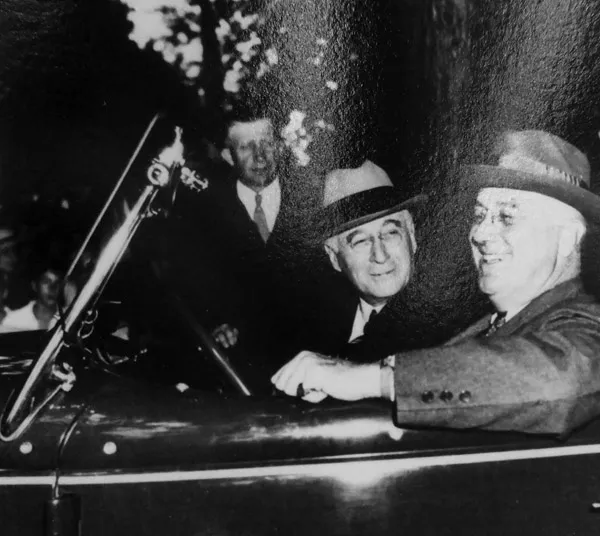
Figure 1.1 President Roosevelt in his limousine with his friend and businessman Bernard Baruch. The President sought to have French Indochina made a trust territory under the United Nations after the Pacific War rather than allow it to be re-colonized by the French. NARA
The French Continue to Make Problems
By late in November 1944, the French-Indochina position became enmeshed in the SEAC-China planning arrangements. The Americans were concerned over a report that an ‘oral understanding between the Generalissimo [Chiang Kai-shek] and Admiral Mountbatten giving both the SEAC and the China theatre the right to engage in pre-operational activities in Indochina’ had been made. The US recognized these events to have ‘serious political as well as military implications’. The President had remarked of this assistance as follows: ‘It is my judgment on this date that we should do nothing in regard to resistance groups or in any other way in relation to Indochina’. The State Department sought to learn more about the reported ‘oral understanding’ and the political implications. It was decided to cable ambassador Hurley in Chungking asking him to discuss any political implications with General Albert Wedemeyer, US Chief of Staff to Chiang Kai-shek and commander of the US army forces, China theatre; the two Americans would discuss the matter then talk to the Generalissimo. Thereby the reported ‘oral understanding’ could be assessed and the political implications gauged.13
With the Pacific War moving towards a late phase, the State Department discussed what its aims were to be in Indochina against what it believed the four other participants hoped to gain there. China wanted to secure its south-western flank ‘through which the French collaborators admitted the Japanese’. It wanted access to the port of Haiphong to break the French economic stranglehold on the railway goods passing into southern China, and it continued to give ‘support to the Annamite Revolutionary Party’. The Indochinese themselves wished to maintain a ‘substantial sentiment for independence or self-government’. The French and British sought ‘particip...
Table of contents
- Cover
- Title
- Copyright
- Contents
- List of Figures
- List of Maps
- List of Tables
- List of Abbreviations
- Acknowledgments
- 1 The Return of French Colonialism to Vietnam and the Formation of the Democratic Republic of Vietnam
- 2 The US Reaction to French Colonialism and the Franco-American Affiliation
- 3 The Return of the French Army and the Collapse of French-DRV Negotiations
- 4 The Modus Vivendi and the Battle for Haiphong
- 5 The DRV’s Evacuation to the Mountains, Moutet’s Failed Mission to Ho Chi Minh and Admiral d’Argenlieu’s Departure From Office
- 6 French Military Losses against the DRV and the French Search for a Replacement of Its Colonial Administration
- 7 The Rise of Communist China and the Crisis of Bao Dai
- 8 Vietnam Linked to Korean War and de Lattre’s Campaign against General Giap
- 9 Off-Shore Procurement and French Victories against the DRV’s Campaigns
- 10 Early Eisenhower Years and the Bao Dai Problem
- 11 Eisenhower’s Plans for Financing the French and the Rise of Ngo Dinh Diem
- 12 French Attacks on the People’s Army and the Battle of Dien Bien Phu
- 13 How Dien Bien Phu Was Lost and the Role of Secretary Dulles in Geneva Negotiations
- 14 The United States in Post-Armistice Indochina and the Direct Funding for Ngo Dinh Diem
- 15 General Collins’ Mission and the Problems of Diem’s One-Man State
- 16 Kennedy Sends Aid in Lieu of Troops and the Deaths of Diem and Kennedy
- Conclusion
- Selected Bibliography
- Index
Trusted by 375,005 students
Access to over 1.5 million titles for a fair monthly price.
Study more efficiently using our study tools.
Frequently asked questions
Yes, you can cancel anytime from the Subscription tab in your account settings on the Perlego website. Your subscription will stay active until the end of your current billing period. Learn how to cancel your subscription
No, books cannot be downloaded as external files, such as PDFs, for use outside of Perlego. However, you can download books within the Perlego app for offline reading on mobile or tablet. Learn how to download books offline
Perlego offers two plans: Essential and Complete
- Essential is ideal for learners and professionals who enjoy exploring a wide range of subjects. Access the Essential Library with 800,000+ trusted titles and best-sellers across business, personal growth, and the humanities. Includes unlimited reading time and Standard Read Aloud voice.
- Complete: Perfect for advanced learners and researchers needing full, unrestricted access. Unlock 1.5M+ books across hundreds of subjects, including academic and specialized titles. The Complete Plan also includes advanced features like Premium Read Aloud and Research Assistant.
We are an online textbook subscription service, where you can get access to an entire online library for less than the price of a single book per month. With over 1.5 million books across 990+ topics, we’ve got you covered! Learn about our mission
Look out for the read-aloud symbol on your next book to see if you can listen to it. The read-aloud tool reads text aloud for you, highlighting the text as it is being read. You can pause it, speed it up and slow it down. Learn more about Read Aloud
Yes! You can use the Perlego app on both iOS and Android devices to read anytime, anywhere — even offline. Perfect for commutes or when you’re on the go.
Please note we cannot support devices running on iOS 13 and Android 7 or earlier. Learn more about using the app
Please note we cannot support devices running on iOS 13 and Android 7 or earlier. Learn more about using the app
Yes, you can access America's Vietnam War and Its French Connection by Frank Cain in PDF and/or ePUB format, as well as other popular books in History & 20th Century History. We have over 1.5 million books available in our catalogue for you to explore.