eBook - ePub
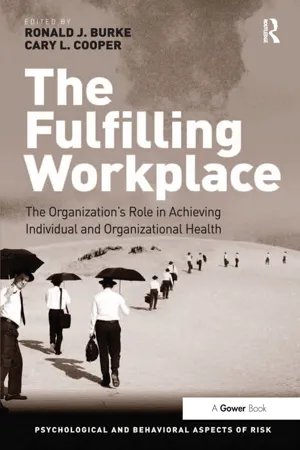
The Fulfilling Workplace
The Organization's Role in Achieving Individual and Organizational Health
- 346 pages
- English
- ePUB (mobile friendly)
- Available on iOS & Android
eBook - ePub
The Fulfilling Workplace
The Organization's Role in Achieving Individual and Organizational Health
About this book
It is very easy for organizations to ignore or overlook the impact of social and commercial change-of increased pressure to deliver profit (above all else) and of transformation in the ways in which we are now working-on the mental health and, consequently, the performance of their employees. And yet there is plenty of evidence that in many workplaces, performance is down, stress is up and professional employees are struggling to balance their home and work lives. This collection, while looking at individuals, places the spotlight on organizational initiatives to support the development of attitudes, values, character and behaviors in employees. The aim of these initiatives is to increase our resilience to those experiences and events which impact on performance. There is a particular focus on managerial and professional jobs where employee discretion and commitment are critical. The Fulfilling Workplace extends the themes developed in early titles in the Psychological and Behavioral Aspects of Risk Series deeper into organizations; to explore the organization's role in coming to grips both with human frailties and toxic workplaces-both destructive to individual and organizational health.
PART I Nature of the Issues
CHAPTER 1 The Healthy Organization: Reducing High-risk Individual Behavior and Organizational Toxicity
Introduction
Consider these observations about men and women in managerial and professional jobs:
• At least half the occupants of managerial and professional jobs are falling short in their performance (Hogan & Hogan, 2001).
• A growing number of surveys of managers and professionals have found that their levels of work stress has increased, and this has elevated levels of psychological distress and diminished physical health (Barling, Kelloway & Frone, 2005; Schabracq, Winnubst & Cooper, 2003).
• More managers and professionals have reported working more hours in more intense jobs and taking less than their full allotment of vacation time (Burke, 2006; Burke, 2010a; Burke & Cooper, 2008; Hewlett & Luce, 2006).
• Increasing numbers of managers and professionals report work–family and family–work concerns (Drago, 2007; Friedman & Greenhaus, 2000; Hochschild, 1997).
• Concerns have been raised about the character (greed, materialism, corruption) of managers and professionals given the increasing number of corporate scandals worldwide (Baker, 2010a, 2010b; Burke, 2011; Burke & Cooper, 2009; Dillon & Cannon, 2010; Glasbeek, 2002; Henriques, 2011; Lewis, 2010, 1989; Madrick, 2011; McLean & Elkind, 2005; Michaelson, 2009; Naylor, 2011; Rosen & Rosen, 2011; Smith, 2010; Sorkin, 2011). Executives at Goldman Sachs (and elsewhere) apparently walked a fine line between immoral/unethical actions and illegal actions. Big banks and law firms are increasingly being accused of turning a blind eye or failing to stop fraud artists. JPMorgan agreed to pay $153.6 million to settle a probe undertaken by the Securities and Exchange Commission for its role in approving mortgage securities but as almost always happens admitted to no wrongdoing (Moore, 2011). None of the central Wall Street figures have been convicted of any crimes. Issues of character have come to be seen as a significant factor in leadership success (Bakan, 2004; Burke, 2009a, 2009b; Gandz, Crossan & Seijts, 2010; Huffington, 2003; Parker, 2011; Rate & Sternberg, 2007; Schyns & Hansbrough, 2010). Shapiro and Von Glinow (2007) note the financial costs to organizations when senior executives engage is such behaviors and are convicted for their transgressions.
• Managers and professionals, including members of boards of directors, have their reputations compromised by being associated with firms guilty of financial fraud (Cowen & Marcel, 2011; Pozner, 2008). Being associated with a fraud incident indicates that individuals failed to fulfill important professional obligations. For example compromised directors are often dismissed from existing board seats and have difficulty in getting new board appointments.
• The current (July 2011) frenzy about the phone hacking and bribery initiatives undertaken by some employees of News Corporation in the UK reflects many of these elements. Some employees felt a need to engage in unethical and illegal activities to get an edge on the competition, sometimes involving hacking of phone and e-mail messages and the bribery of police officers to obtain scoops; police officers offered inside information in return for monetary benefits, some mangers were aware of these activities and signed off on them, resulting in what some have termed a culture that both encouraged and supported these behaviors. These activities have resulted in criminal charges being filed against some individuals and other individuals convicted and serving jail sentences, the resignation of high-ranking News Corporation executives and high-ranking police officers, the death of one whistle-blower, the loss of reputation to both News Corporation and the media more broadly, and the loss of billions of dollars worth of News Corporation stocks. It is doubtful whether Rupert Murdoch and his son James will be able to retain control of News Corporation. Hackgate, as this crisis has been dubbed in the UK, reflects the four stage of crisis laid out by Jordan-Meier (2011): fact finding, the unfolding drama, finger-pointing, and ultimate resolution and fallout.
• More people worldwide are getting fed up with “bad companies” (Bassi, Frauenheim, McMurrer & Costello, 2011); tired of the greed, pollution, product recalls, tainted food, poor service, and shabby employers. People are longing for “worthy companies”
• We are fed up and we’re not going to take it any more—corruption that is. Anna Hazare, a 74-year-old Indian who has stood up for justice throughout his life and career, currently jailed, will be holding a 15-day hunger strike to protest levels of corruption in India. His stance had received the support of millions (Fatah, 2011). In India, a bribe must be paid for almost everything.
• Increasing numbers of women who obtain business education, start their careers in large organizations, and “opt out,” reflecting a loss of talent (Barreto, Ryan & Schmitt, 2009; Maineiro & Sullivan, 2006). Women continue to be seriously underrepresented in science, technology, engineering, and mathematics (Burke & Mattis, 2007; Ceci & Williams, 2007) and in the ranks of senior levels of management worldwide (Davidson & Burke, 2011; Wittenberg-Cox & Maitland, 2008) and on corporate boards of directors (Vinnicombe, Singh, Burke, Bilimoria & Huse, 2008). Talents of half the population are underappreciated and underutilized as a result.
• Although the standard of living has increased over the past two decades in developed countries, indicators of satisfaction and happiness have remained flat. Materialism has not increased levels of individual well-being. Something seems to be missing in people’s lives (Diener & Seligman, 2004; Kasser, 2002; Roberts, 2011; Whybrow, 2005).
• There has been some writing that addresses issues such as the paradox of success, the failure of success, the costs of success, the dark side of success, and career success and personal failure (Korman & Korman, 1980; O’Neill, 2004). Important writing in the past 20 years has shed light on the costs of success (Albion, 2000; Bogle, 2005, 2009). We have come to understand the mythology of success (success is absolute and final, money is central to the meaning of success, craving more, ambition to achieve success, success will make one free). We have come to better understand antecedents of “career success and personal failure” and possible resolutions (Bronson, 2005; Cloud, 2008; Porras, Emery & Thompson, 2007; Seligman, 2002). We are slowly but surely coming to better understand why leaders fail—and failure rarely results from a lack of intelligence, not working hard enough, or not possessing adequate technical skills (Charan & Colvin, 1999; Dotlich & Cairo, 2003; Finkelstein, 2003; Furnham, 2004).
• These experiences also impact the performance of men and women holding jobs at all levels, particularly managerial and professional jobs where employee discretion and commitment are critical to peak performance. They make it harder to compete in a “war for talent” (Michaels, Handfield-Jones & Axelrod, 2001). They also affect an organization’s effectiveness and success.
• Initiatives have been developed for individuals to address many of these concerns. Solutions have been proposed including integrating one’s life roles, stepping back and renewing oneself, getting past the fear of letting go, and being satisfied with “enough.” Individuals who successfully integrate their important life roles (for example, work, family, community, self) perform better in their jobs and are in better psychological and physical health (Friedman, 2008). But success in these efforts also requires change on the part of workplaces (Rothstein & Burke, 2010).
In Risky Business: Psychological, Physical and Financial Costs of High Risk Behavior in Organizations (Burke & Cooper, 2010), we laid out several areas of high-risk individual behavior and organizational values, tasks and processes that had psychological, physical, and financial impact on individuals, families, organizations, and communities. The former included human frailties—individual attitudes and behaviors, and the latter—work and organizational experiences harmful to individual well-being and ultimately to organizational effectiveness. Human frailties included engaging in theft, criminal and fraudulent behaviors, work addiction, alcohol and substance abuse, and engaging in high-risk sexual relationships both inside and outside the workplace (Adebowale & Reed, 2010; Burke, 2011, 2010b, 2010c; Carnes, 2001; Ghodse, 2005; Kingston, 2011; Lefkowitz, 2009; Roman & O’Brien, 2010; Shulman, 2010; Tobutt, 2011; Tomlinson, 2009). Velez-Mitchell and Mohr (2011) believe that addiction is rampant in many countries and they review addiction to consumption, alcohol, drugs, sex, food, celebrity, porn, gambling, pharmaceuticals, and the internet (see also Leonard, 2010; Shaeffer, 1997; Underhill, 2008; Van Cleave, 2010).
It seems today that scandals involving human frailties are as likely to involve money as sex (for example, Bernie Madoff, Raj Rajaratnam, Eliot Spitzer, Bill Clinton, John Edwards, Tiger Woods, Silvio Berlusconi, John Ensign, and Dominque Strauss-Kahn). Most people can relate easily to sex scandals since sex involves desires shared by almost everyone. But why would anyone risk their reputation, career, and family for a few minutes of gratification? Money, on the other hand, lasts much longer.
Toxic organizational environments included those that exhibited acts of employee discrimination (for example, age, gender, race, sexual orientation), instances of sexually intimate and sexually harassing relationships, job demands leading to diminished employee well-being and performance, those that tolerate fraud and corruption, being exposed to unsafe or unhealthy working practices and conditions leading to sickness and sometimes death, abusive bosses, workplace bullying and occasional acts of workplace violence (Albrecht, Sanders, Holland & Albrecht, 2011; Anand, Ellstrand, Rajagopalan & Joshi, 2009; Ashforth, 1997, 1994; Cartwright, 2010; Clarke, 2010; Dipboye, 2010; Einarsen, Aasland & Skogstad, 2010; Glasso, Vie & Hoel, 2010; Kusy & Holloway, 2009; Lubit, 2004; Magley, Bauerle & Walsh, 2010; Zyglidopoulos & Fleming, 2009).
The Royal Canadian Mounted Police (RCMP) has been rocked by a series of sexual harassment clams. The newly appointed head of the RCMP stated that he would be addressing these claims and changing the culture to make it more hospitable to women. Yet a senior RCMP officer was found guilty of abuse of authority, sexual assault, sexual harassment, sexual discrimination and lying to a senior officer but was punished by a reprimand and the loss of ten days of pay when he admitted to having a sexual relationship with a fellow officer (Toronto Star, 2012) This “slap on the wrist” does not seem to be an effective way to change their culture.
Bennett and Randolph (2011) reported that there has been a 42 percent increase since 2009 in the filing of disability-discrimination charges with about 30,000 charges filed with the US government in 2011. It is not clear whether this represents an increase in actual disability-discrimination or the inclusion of more mental and physical impairments now, but this figure is worrisome.
This chapter includes the following content: real-life examples of human frailties and organizational toxicity, the key role of leadership, toxic leadership, the toxic triangle, leadership pathologies, “dark side” personality traits, workplace incivility, ethics and values, corporate wellness programs, and organizational initiatives that address both human frailties and levels of organizational toxicity.
The present collection, while looking at individuals, places the spotlight on initiatives that organizations can undertake to support the development of attitudes, values, character and behaviors in employees that will lessen the incidence and consequences of human frailties and particular risky work place experiences and events. Thus it is an antidote to some of the issues raised in Risky Business. How can individuals prevent themselves from becoming a casualty of some risky individual choices and behaviors (for example, work addiction, greed, hubris, failings of character, unbridled ambition, materialism)? What can organizations do (for example, improving quality of relationships, increasing equity and fairness, creating a safety culture, supporting ethical behaviors) to better understand and identify human frailties and limit their risks and to become less toxic or not toxic at all (Kusy & Holloway, 2009)?
This volume extends our work deeper into organizations and their role in coming to grips with both human frailties that end up causing damage, and toxic workplaces, again destructive to individual and organizational health. A toxic culture exhibits high levels of mistrust, dishonesty, abuse and lack of fairness and equity.
Connection to Workplace and Organizational Realities
Anyone who reads the business press today will see the relevance of these volumes to workplace realities (BP in the Gulf of Mexico, recent resignation of the CEO of Hewlett Packard, Alan Hurd, for harassment and questions about his expense accounts).
Here are some recent and current examples of human frailties and organizational toxicity that have been reported in various media to give the reader a sense of why and how we see this volume applicable to actual workplace experiences.
• British Petroleum (BP) oil rig explosion in the Gulf of Mexico causing deaths has raised the issue of whether BP put production and profits before worker safety. BP has had other safety violations and fines in their sites.
• Research reported by The Canadian Press (Toronto Star, 2011a) indicated that truck drivers hauling explosive or flammable materials have killed or badly injured people after getting drunk or stoned.
• Mining disasters in New Zealand, West Virginia (US), Columbia, Chile and China (several) causing deaths.
• Shooting of dozens of police officers in Mexico killing some and wounding others.
• Abusive bosses and too many assholes at work (Sutton, 2007, 2010).
• Workplace violence and employee rampages against others in their organization (Lester, 2011).
• Fraudulent elections in several counties (Haiti, Afghanistan, Egypt, Iraq, Ivory Coast, Russia, among others).
• A Canadian firm, Niko, was fined $9.5 million for offering bribes to a Bengladeshi government minister (car, travel) to deal with protests for locals following a natural gas explosion (Krugel, 2011).
• Spate of suicides in both France and China (France Telecom, Foxcom) attributed to workplace stress.
• British designer John Galliano was immediately terminated at Dior following accusations he made racial insults and expressed an admiration for Adolf Hitler (National Post, 2011a). He will likely be prosecuted for his remarks and also likely go into rehab. American actor Charlie Sheen was also terminated by ABC from his TV sitcom which paid him well over $1 million an episode for his rant against his producer and a host of other ...
Table of contents
- Cover
- Half Title
- Title Page
- Copyright Page
- Table of Contents
- List of Figures
- List of Tables
- List of Contributors
- Acknowledgements
- PART I NATURE OF THE ISSUES
- PART II OPTIMAL INDIVIDUAL AND ORGANIZATIONAL OUTCOMES
- PART III INDIVIDUAL RESOURCES
- PART IV ORGANIZATIONAL INITIATIVES
- Index
Trusted by 375,005 students
Access to over 1.5 million titles for a fair monthly price.
Study more efficiently using our study tools.
Frequently asked questions
Yes, you can cancel anytime from the Subscription tab in your account settings on the Perlego website. Your subscription will stay active until the end of your current billing period. Learn how to cancel your subscription
No, books cannot be downloaded as external files, such as PDFs, for use outside of Perlego. However, you can download books within the Perlego app for offline reading on mobile or tablet. Learn how to download books offline
Perlego offers two plans: Essential and Complete
- Essential is ideal for learners and professionals who enjoy exploring a wide range of subjects. Access the Essential Library with 800,000+ trusted titles and best-sellers across business, personal growth, and the humanities. Includes unlimited reading time and Standard Read Aloud voice.
- Complete: Perfect for advanced learners and researchers needing full, unrestricted access. Unlock 1.5M+ books across hundreds of subjects, including academic and specialized titles. The Complete Plan also includes advanced features like Premium Read Aloud and Research Assistant.
We are an online textbook subscription service, where you can get access to an entire online library for less than the price of a single book per month. With over 1.5 million books across 990+ topics, we’ve got you covered! Learn about our mission
Look out for the read-aloud symbol on your next book to see if you can listen to it. The read-aloud tool reads text aloud for you, highlighting the text as it is being read. You can pause it, speed it up and slow it down. Learn more about Read Aloud
Yes! You can use the Perlego app on both iOS and Android devices to read anytime, anywhere — even offline. Perfect for commutes or when you’re on the go.
Please note we cannot support devices running on iOS 13 and Android 7 or earlier. Learn more about using the app
Please note we cannot support devices running on iOS 13 and Android 7 or earlier. Learn more about using the app
Yes, you can access The Fulfilling Workplace by Ronald J. Burke, Cary L. Cooper in PDF and/or ePUB format, as well as other popular books in Business & Business General. We have over 1.5 million books available in our catalogue for you to explore.