eBook - ePub
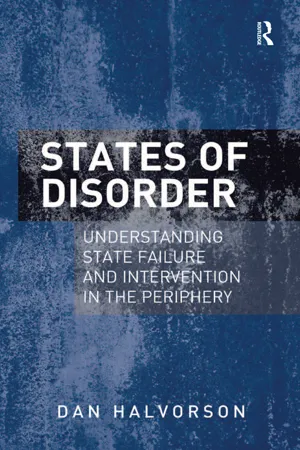
States of Disorder
Understanding State Failure and Intervention in the Periphery
- 208 pages
- English
- ePUB (mobile friendly)
- Available on iOS & Android
eBook - ePub
About this book
There have always been weak or 'fragile' states in the modern era or poorly governed and disorderly political communities in earlier times. Yet the idea of state failure has only acquired such prominence in the post-Cold War period. Why would many countries in the less-developed world be considered 'failed' states after 1990, but not in 1965 when there is little meaningful difference in their observable empirical conditions? What counts as state 'failure' is ultimately a subjective political judgement made by the great powers of the day. This judgement is based on the sensitivity of great powers to particular types of disorder generated from the periphery in different historical periods. This book is a comparative history of the conditions under which great powers care enough about disorder from the periphery to mount costly armed interventions to reverse what they deem to be state 'failure'.
Information
Chapter 1Introduction
DOI: 10.4324/9781315610733-1
State ‘failure’ is the label currently applied to the perennial problem in international politics of disorder on the periphery. This book is about why great powers intervene with armed force to reverse state failure in peripheral regions of the world. Such regions may be geographically near or far, but states of disorder on the periphery are not an existential threat to great powers (Taliaferro 2004b: 184). The survival or territorial integrity of great powers is not threatened by present disorder on the periphery be it post-Cold War ethnic conflict in the Balkans or in sub-Saharan Africa, or even by violent transnational activity that strikes at the core, such as the al-Qaeda terrorist attacks of 11 September 2001 directed from Afghanistan (Jervis 2002). During the Cold War, Washington’s security posture toward the Third World was characterized by repeated commitments to strategically marginal areas out of a symbolic concern to maintain credibility. These were often in support of ‘weak states of dubious legitimacy’, riven by ‘internal conflicts over religion, ethnicity, class, status, and ideology’ (Linantud 2008: 638). Disorder on the periphery is a problem of weakness not strength. This distinguishes failed states from so-called ‘rogue’ states that seek to develop the material capacity to directly threaten great powers or their vital interests. This is not to say that great powers do not have important interests in peripheral areas. But peripheral disorder is not a direct material threat to great powers in a traditional security sense that necessarily calls for a military response. Interventions in the periphery are military actions of choice rather than of necessity.
But a policy choice to intervene in the periphery to restore order is not taken in the expectation of material gain or even to directly avert losses. To the contrary, these military operations are costly in economic and human terms. They hold unforeseeable and unintended consequences, and are often damaging to the material interests of the intervening power. In this they confound rational explanations for state behaviour. They are also different from conquest or colonization. Their objective is to restore or build a viable state in conformity with the norms of appropriate statehood in the international society. The choice to intervene with military force in the periphery – assuming responsibility for an uncertain outcome – is mostly taken reluctantly by policy-makers, but often taken nonetheless. In each of the case studies of intervention examined in this book, rational alternatives to the military actions undertaken were available to policy-makers, but were ruled out for intangible prestige-based motives.
The meaning of state failure in any historical period, and why major powers might intervene to restore order, cannot be understood in a narrow materialist sense. Neither can assessments of state fragility based on the empirical conditions within peripheral states comprehend the meaning of state ‘failure’. What failed states do threaten is intangible, but far more important to the most powerful states than the material interests they may hold in the periphery. Failed states threaten the ideas, values and principles on which the international society is ordered. Material conditions are not irrelevant to questions of state failure, but are indirect. Andrew Phillips (2011: 23–4) argues that the normative complexes of international order must rest ‘on a permissive order-enabling material foundation’. Or as Torbjørn Knutsen (1999: 2) puts it, power is the ‘decisive background determinant of order’. The distribution of capabilities provides the material structural conditions for international order. Power and norms are intimately connected. All sovereign states have an in-principle concern for the maintenance of an international society. But it is the great powers of the era that establish the normative criteria on which that society should operate. Great powers define the standards of legitimacy for state identities and behaviour within the international society. Their domestic institutions serve as models for appropriate statehood that others must approximate. The ordering principles of international society reflect the values and serve the interests of those powerful states that gave rise to them. Because of this, international orders are marked by varying degrees of interpretation, contestation and legitimacy.
Intervention in international relations is typically defined as the ‘dictatorial or coercive interference, by an outside party or parties, in the sphere of jurisdiction of a sovereign state, or more broadly of an independent political community’ (Bull 1984: 1). Interventions in the periphery, as considered here, are certainly coercive, but less overtly dictatorial than this definition allows. The three interventions examined in this book were all consensual, in that they took place at the invitation or acquiescence of the legitimate government of the targeted state as recognized by international law. Intervention in the periphery is also a broader concept in its objectives than the above definition stipulates. Its protagonists usually seek a measure of control over present and future governance outcomes from targeted states through the restoration or promotion of enduring institutional arrangements, rather than the temporary manipulation of internal events or processes for short-term objectives.
In this context, Elizabeth N. Saunders (2009: 123–5) makes the distinction between ‘transformative’ and ‘non-transformative’ strategies of intervention. Both share the definition of military intervention ‘as an overt, short-term deployment of at least 1,000 combat-ready ground troops across international boundaries to influence an outcome in another state or an interstate dispute; it may or may not interfere in another state’s domestic institutions’ (Saunders 2009: 122–3). The objective of transformative interventions is to interfere with or determine the domestic institutions of the targeted state. Non-transformative interventions, as the label suggests, seek to deal with a particular crisis or alter a foreign policy action without the intention of altering institutional structures (Saunders 2009: 123–5). Definitions like this are shown in this book to be problematic because embarking on an intervention in the periphery is rarely a clean-cut policy decision, the attributes of which become operative at a particular point in time. In the cases examined here, each intervention evolved haphazardly in response to events on the ground, the political climate at home, and the mounting concerns of decision-makers. On the other hand, interventions in the periphery by great powers to restore order do seem to be genuinely transformative, regardless of their intent, in that shoring up weak state structures prevents institutional changes that might otherwise occur (Saunders 2009: 124).
The term ‘international order’ is used here in a specifically English School sense as the ‘pattern’ or set of normative principles on which the international society is ordered. Following Hedley Bull (1966), this pattern may be pluralist or solidarist. Pluralist orders embody thin normative claims. They accept a variety of regime types and hold minimal standards for state behaviour. In solidarist international orders, states operate within a thick legal and normative environment densely packed with rules and expectations reflecting the values of leading actors. This creates a high normative standard for states’ identities and behaviours (Buzan 2004: 46–51, Hurrell 2007). This approach to international order differs somewhat from more expansive understandings that equate it with the constitutive structures of the international society and their transformations over time on a world historical scale (e.g., Reus-Smit 1999, Phillips 2011). My purpose in this book is narrower. Patterns of international order are used as an interpretive framework to enable a more historically-informed understanding of the nature of state failure in international society and why great powers persistently intervene with military force to restore order in the absence of existential threats to their security. When the term international order is used throughout the book, it refers to the pattern of order in the international society, whether pluralist or solidarist. Chapter 3 elaborates a more substantive account of this concept of international order, and its dynamics in historical context.
Chapter 4 presents the book’s first case study focusing on the 1882 British intervention in Egypt, which took place on the periphery of the multipolar European international system of the late-nineteenth century. The identities of the great powers ranged from absolute monarchy in Tsarist Russia to democratic republicanism in France. This plurality of state forms in the multipolar European system was reflected in an international order codified in the classic ‘standard of civilization’. The standard provided explicit normative criteria that held minimal requirements for state identity but stringent criteria for international conduct. The standard enjoyed wide legitimacy within the international society and formed the criteria against which non-European states such as Japan could be admitted. Its provisions were, however, subject to a degree of interpretation by the great powers. The British variant considered here, for instance, placed particular emphasis on sound finance and the sanctity of international treaties as providing the discipline and character for good government (Cain and Hopkins 2002: 45–8).
By contrast to the legitimacy of the ‘standard’, Washington’s vision during the Cold War of a non-communist, ‘free world’ order in the modernizing Third World periphery was heavily contested. The second case considered in Chapter 5, the 1965 US combat intervention in South Vietnam, was undertaken in the postcolonial international order that emerged in the early decades after World War II. The foundational United Nations (UN) Charter principles of sovereign equality, non-intervention and national self-determination provided for a pluralist international order. Again, this featured minimal requirements for state identity but stringent standards for behaviour. While both protagonists in the Cold War struggle shared anti-colonial convictions, international order was heavily contested in the bipolar international system. Each side had a clear ideological vision and sought to exclude that of the other within their strategic spheres of influence. Power and order were tightly interlocked within the zero-sum bipolar structure.
The liberal international order that emerged at the end of the Cold War with the collapse of the Soviet Union is solidarist and universalizing, underwritten by US unipolarity. In the post-Cold War period, normative principles of appropriate statehood such as democratization and liberal governance have come to enjoy high levels of international consensus and legitimacy, but with less room for contestation and interpretation. The book’s third case study in Chapter 6, the 2002 French intervention in Ivory Coast, was undertaken in the solidarist liberal international order of the first decade of the twenty-first century. The French view of state failure, which is mainly concerned with violent ethnic conflict, differs somewhat from the Anglo-American emphasis on ungoverned political spaces and transnational security threats, but liberal-democracy as the standard for appropriate statehood remains uncontested.
Once established, international orders become path dependent and status quo-oriented. The great powers that established them and benefit most from them will be most concerned for their preservation. More important than this, being a source and exemplar of international order is integral to the identity and ontological security needs of status quo great powers. It imbues their national identity with a meaning that gives a sense of purpose and agency in the world. Rather than their physical security, disorder on the periphery threatens the ontological security of status quo great powers by challenging their role identity as the source and guarantor of international order. Taken at face value, ‘disorder’ could mean many things depending on the standpoint and assumptions of the observer. What resonates for great powers as ‘disorder’ is a breach of the ordering principles by which they seek to manage the international society. While there may be some similarities in the empirical characteristics of disorder over time, such as military coups and violent civil unrest, the meaning and significance of this to great powers is relative to the prevailing international order.
Identities are shaped, routinized and sustained through social relationships. This process is reflected in the biographical narratives states develop to maintain a coherent sense of national identity through the flux of time and historical events (Steele 2008: 2–3). Both individuals and collectivities understand themselves and find meaning through the stories they tell about themselves. Stories provide the necessary shape through which collective energies and anxieties can be channelled. In framing or constructing narratives, motifs and archetypes are deployed as recurring anchors that bind stories together, giving them meaning and coherence across time. Meaning is important because it ‘determines how people will react to, interpret, or deal with any event and force’ (Reeves 2004: 78). States’ identity narratives provide the evaluative frameworks through which events are interpreted and motives formulated by political decision-makers. Political leaders will typically have a strong identification with their state’s identity narrative (Sasley 2011).
Stable, ordered patterns of relationships are also crucial for ontological security because they allow for predictability about the future, which in turn is required for a meaningful sense of agency in the world. This is particularly important for status quo actors that are satisfied with the present state of affairs. The ontological security of status quo great powers is challenged by disruptions to routinized relationships, role identities and the narratives that ground and support them, through ‘normative threats’ to international order (Creppell 2011). Such disruptions to international order impinge directly on the prestige of status quo great powers – on their reputation, credibility and national honour. Under certain conditions, these become powerful motives for action because of the disjuncture created between a negative turn of events and the identity narratives within which political actors find meaning (Steele 2008: 2–3, 13).
Failed states are not a direct security threat to major powers. They are a normative threat to international order, which is why they are taken so seriously. The meaning of state failure in any historical period is judged against the principles of appropriate statehood promoted and legitimized by the great powers. In this sense, ‘failed’ states are a socially constructed category. The norms of international order are constitutive of state failure in a given period. They also provide the threshold conditions for permissible intervention in the international society. A more interesting observation explored in Chapter 2 is that not all states are able to be socialized to international order norms at any given time. Normative pressures within the international society to transform the internal character of peripheral states often results in the disorder currently characterized as state failure. For example, in Chapter 6, post-Cold War pressures for democratization in Ivory Coast directly prompted a political crisis that resulted in two military coups, foreign intervention, the partition of the country, and violent civil unrest in what had previously been West Africa’s most stable and successful state. This observation is also borne out in the historical case studies where modernizing pressures coming from outside contributed to the breakdown of order in peripheral states.
A Challenge to Orthodoxy
Placing state failure and intervention in a historical context of international orders is a challenge to the academic and policy orthodoxy that has developed since the end of the Cold War. The orthodox view of state failure began to emerge in the early 1990s. Robert Kaplan (1994: 45) depicted the dire consequences of state failure along a string of West African states in an influential 1994 article, ‘The Coming Anarchy’, and predicted that this was ‘what the political character of our planet is likely to be in the twenty-first century’. Kaplan’s article foreshadowed the intense academic and policy interest that built throughout the 1990s about a crisis of governance and order in large swathes of the postcolonial and post-communist world. By the turn of the century, the ‘pathologies’ of state failure, exemplified by the cases of Sierra Leone, Liberia, Afghanistan, Somalia and Haiti, had become a commonplace in the academic literature. Internally, failed states were characterized by corrupted and disintegrating institutions, endemic civil war often along ethnic lines, human rights abuses and intractable poverty. Externally, failed states generated massive cross-border refugee flows and disease epidemics, facilitated transnational crime, and exported a contagious instability and disorder to regional neighbours.
It was only following the 11 September 2001 terrorist attacks on the United States, planned and directed by al-Qaeda from Afghanistan, that the failed state t...
Table of contents
- Cover Page
- Half Title Page
- Dedication
- Title Page
- Copyright Page
- Table of Contents
- Acknowledgements
- List of Abbreviations
- 1 Introduction
- 2 Rethinking State Failure
- 3 International Order, Capabilities and Ontological Security: An Interpretive Framework
- 4 British Intervention in Egypt, 1882
- 5 United States’ Intervention in South Vietnam, 1965
- 6 French Intervention in Ivory Coast, 2002
- 7 Conclusions
- References
- Index
Trusted by 375,005 students
Access to over 1.5 million titles for a fair monthly price.
Study more efficiently using our study tools.
Frequently asked questions
Yes, you can cancel anytime from the Subscription tab in your account settings on the Perlego website. Your subscription will stay active until the end of your current billing period. Learn how to cancel your subscription
No, books cannot be downloaded as external files, such as PDFs, for use outside of Perlego. However, you can download books within the Perlego app for offline reading on mobile or tablet. Learn how to download books offline
Perlego offers two plans: Essential and Complete
- Essential is ideal for learners and professionals who enjoy exploring a wide range of subjects. Access the Essential Library with 800,000+ trusted titles and best-sellers across business, personal growth, and the humanities. Includes unlimited reading time and Standard Read Aloud voice.
- Complete: Perfect for advanced learners and researchers needing full, unrestricted access. Unlock 1.5M+ books across hundreds of subjects, including academic and specialized titles. The Complete Plan also includes advanced features like Premium Read Aloud and Research Assistant.
We are an online textbook subscription service, where you can get access to an entire online library for less than the price of a single book per month. With over 1.5 million books across 990+ topics, we’ve got you covered! Learn about our mission
Look out for the read-aloud symbol on your next book to see if you can listen to it. The read-aloud tool reads text aloud for you, highlighting the text as it is being read. You can pause it, speed it up and slow it down. Learn more about Read Aloud
Yes! You can use the Perlego app on both iOS and Android devices to read anytime, anywhere — even offline. Perfect for commutes or when you’re on the go.
Please note we cannot support devices running on iOS 13 and Android 7 or earlier. Learn more about using the app
Please note we cannot support devices running on iOS 13 and Android 7 or earlier. Learn more about using the app
Yes, you can access States of Disorder by Dan Halvorson in PDF and/or ePUB format, as well as other popular books in Politics & International Relations & International Relations. We have over 1.5 million books available in our catalogue for you to explore.