- 258 pages
- English
- ePUB (mobile friendly)
- Available on iOS & Android
eBook - ePub
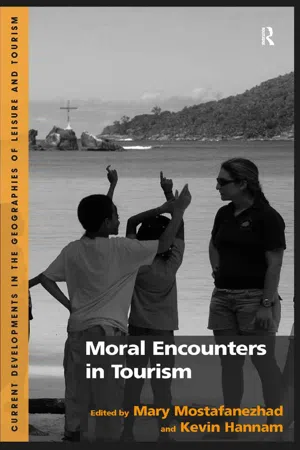
Moral Encounters in Tourism
About this book
This first full length treatment of the role of morality in tourism examines how the tourism encounter is also fundamentally a moral encounter. Drawing upon interdisciplinary perspectives, leading and new authors in the field address topics that range from volunteer tourism to fertility tourism to reveal new insights into the ways tourism encounters are implicated in, and contribute to, broader moral reconfigurations in Western and non-Western contexts. Illustrating the role of power and power relations in tourism encounters within different political, economic, environmental and cultural contexts, the authors in this anthology analyse, theoretically and empirically, the implications of the privileging of some moralities at the expense of others. Key themes include the moral consumption of tourism experiences, embodiment in tourism encounters, environmental moralities as well as methodological aspects of morality in tourism research. Crossing disciplinary and chronological boundaries, Moral Encounters in Tourism provides a much-anticipated overview of this new interdisciplinary terrain and offers possible routes for new research on the intersection of morality and tourism studies.
Chapter 1
Introducing Moral Encounters in Tourism
Tourists are travellers in hypermorality … (MacCannell, 2011, pp. 216–217).
Introduction
Concerns over the ethical production and consumption of tourism experiences have become frequent topics of consideration among scholars, practitioners and advocates over the last two decades. Numerous non-governmental organizations (NGOs) (such as Tourism Concern) and academic advocacy networks (such as the Responsible Tourism Network) focused on ethical tourism agendas reflect the contemporary institutionalization as well as a growing consensus regarding the need for ethical tourism programs (Duffy and Smith, 2003; Hultsman, 1995; Lea, 1993; Lovelock, 2008; MacCannell, 2011). Academic research on ethical tourism is well represented in the literature including numerous publications which examine the ethics of travel, tourism experiences as well as research on tourism (Bergmann and Sager, 2012; Castañeda, 2012; Duffy and Smith, 2003; Fennell and Malloy, 1999; Molz and Gibson, 2012).
While increased attention has focused on the intersection of ethics and tourism, with a few notable exceptions surprisingly little has been said about the role of morality in tourism (see Butcher, 2003; Phillimore, 2004). The inattention to morality by tourism scholars is curious given the obvious centrality of morality to tourism as both a practice and object of study. Indeed, it is noted how “The paucity of formal discussion about this issue is particularly unfortunate in tourism studies, given that those of us working here operate on loaded moral territory, confronting a phenomenon that at once speaks of light hearted pleasure and heavy social consequences” (Caton, 2012, p. 1906).
While there has been little discussion about the role of morality in tourism encounters, tourism itself has been heavily moralized. As Castaneda notes, tourism is widely viewed as an inherently moral activity. From the 1960s to the 1980s tourism was viewed as either inherently good or inherently bad: “Those who considered it a positive force saw it not simply a ‘passport to development’ (e.g., de Kadt 1979), and thus a solution to problems of endemic poverty and cultural ‘backwardness’ based in Third World under development, but also a ‘force for world peace’ (D’Amore, 1988; Castenada and Burtner 2010),” while other studies explicitly moralized tourism, as an ‘evil’ force derived from European colonialism, capitalism, and modern nation-state building projects (see Brown 2000; Turner and Ash 1976)” (Castañeda, 2012, p. 47).
In the early days of tourism studies, tourism scholars contributed to a widespread moralizing of tourism as a frivolous, inauthentic, consumerist experience. Daniel Boorstin (1961) and Dean MacCannell’s (1976) seminal publications outlined the tourism studies agenda for at least the following two decades with their theories on tourists’ acceptance of pseudo-events and their apparent “search for authenticity,” respectively. Among scholars who moralized tourism as inherently “bad,” there was, and still is, a notable focus on tourism’s impact on local communities. As Castañeda (2012, p. 47) notes,
The very idea of impact is inherently associated with this morality because it is an ideological concept that was used to argue single, one-way cause-effect relationships without taking into account long term socio-historical processes or considering the multiple and different consequences and effects that tourism could have on the diverse stakeholders, communities, classes, businesses, policy-makers, governments, and social groups that are involved in tourism and tourism development projects.
These blanket assessments of tourism worked well to overshadow the varied ways that tourism affects a diverse range of actors.
By the 1990s, “we started to define how to make tourism ethical instead of asserting that it was morally good or bad in all social contexts” (Castañeda, 2012, p. 48). Thus, tourism scholars began thinking beyond moralizing commentary on a homogenized “industry” and began focusing on the role of ethics in diverse tourism experiences. It was during this period that a widespread panic in tourism studies emerged over the ethics of tourism. Numerous publications emerged to caution us about the potentially unethical nature of tourism, generally. Butcher notes how this panic led some to ask: “wouldn’t you be better off at home?” (Butcher, 2003, p. 2). And indeed, some did arrive at such a conclusion. The effectiveness of this concern has been effective to some extent as today ethical issues are now part of mainstream conversations regarding tourism practice and policy.
We begin this anthology with our main argument that the tourism encounter is also a moral encounter, the implications of which have yet to be fully worked in popular or academic circles. We focus on encounter as it “enables closer dissection of the moments and spaces in which power is exercised, and relations of care extended” (Gibson, 2010, p. 521). Whether engaging with explicitly moral tourism or tourism where engagements with morality is less obvious, tourism is mediated by a range of moral issues that are often more implicit than clearly expressed. Like mobility, we argue that tourism “is not a neutral term, not even if we frame a technical definition. It will always have moral implications” (Zeitler, 2012, p. 233). In this anthology we seek to develop an argument about the relationship between tourism and morality. We see tourism as a moral field of experience that is ripe for theoretical and empirical investigation (MacCannell, 2011, p. 3). Thus, along with Caton (2012, p. 1906), we seek to bring tourism studies into the moral turn, yet caution that “the road before us is long. We have only just taken up the journey in earnest, and we have far to go.”
Defining Morality
Morality is perhaps one of the most contested concepts in philosophy. Like the culture concept for anthropologists, there may be as many definitions of morality as there are philosophers. Smith (1997, p. 585) has noted that:
we are told that engaging in moral practice presupposes moral facts, and that this presupposition is an error, and that moral commitment involves no such error; we are told that moral facts exist, and that these facts are no different from those that are the subject-matter of science, and we are told that moral facts exist but they are of a special kind; we are told that moral facts exist and are part of the causal explanatory network, and we are told not just that moral facts play no causal role but that there are no moral facts at all; we are told that there is an internal and necessary connection between moral judgment and the will, and we are told that this connection is altogether external and contingent; we are told that moral requirements are requirements of reason, and we are told that it is not necessarily irrational to act immorally, that moral evaluation is different in kind from the evaluation of people as rational or irrational; we are told that morality is objective, that there is a single true morality, and we are told that morality is not objective, that there is no single true morality. Numerous distinguished philosophers are associated with these various conflicting positions … The scene is so diverse that we must wonder at the assumption that these theorists are all talking about the same thing.
In this anthology we understand morality is a socially constructed set of values that are agreed upon by individuals and societies (Pennycook, 1994). This perspective departs from moral philosophy in that we understand morality in Foucauldian terms to refer to the mediation of personal conduct through socially constructed or learned ways of being (Foucault, 1976, 1990) rather than ascribing to a universal moral code. As a social—and by implication—cultural system, morality differs within and between cultures and is embedded in particular relations of power and spatial contexts. The spatiality of morality is mapped on to an uneven terrain of political, economic and cultural relations. As Caton (2012, p. 1906) suggests, morality refers to the “human imaginative and discursive capacity for considering how things should be, as opposed to describing how things are—what is sometimes referred to as the “is” versus “ought” distinction.” This distinction regarding what “is” and “ought” to be is part of broader, historical and political discursive project that extends to one’s personal character as well as belief systems about how one “ought to be.” In this way, morality is distinguished from ethics which addresses the philosophy behind one’s beliefs within social system. Ethics tends to refer to individual behaviour or codes of behaviour for a social group (professional ethics, family ethics, etc.) while morality refers more broadly to beliefs regarding how things ought to be across the range of human experience (Smith, 2000; Duffy and Smith, 2003; Williams, 2012).
Critical Tourism Studies
The chapters in this anthology thus highlight various ways in which the tourism encounter is also a moral encounter. This is particularly so because tourism is also a highly mediatized encounter where issues of history, race, class, ethnicity, gender and sexuality, among others, play central roles. Diekmann and Hannam’s (2010) discussion of the influence of the film Slumdog Millionaire on practices of slum tourism in India provides a case study of such mediatized moral tourism encounters. Indeed, attention to issues of social, economic and political inequality as well as social and environmental justice is what brings this anthology into conversation with emerging work in critical turn in tourism studies (Ateljevic, Harris, Wilson, and Leo Collins, 2005; Ateljevic, Pritchard, and Morgan, 2007; Bianchi, 2009). Following Gibson, for us, “research is critical because of its opposition to systems of domination, orthodoxies, injustices and oppressions,” and like Gibson, we “report on recent research organized via critical ‘threads’—which are admittedly neither complete nor perfectly linear” (Gibson, 2009, p. 527). As a social practice, tourism is therefore mediated by a range of moral and therefore political issues as in our view, morals have both political foundations as well as effects (Castañeda, 2006, p. 132). This is in part because morals are spatially organized and situated within particular relations of power that makes a “morality before politics” position theoretically suspect. For example, Smith (1997, p. 588) points out how “the original position, under which people decide on institutions behind a veil of ignorance as to their actual position in society, as an imaginary moral landscape … a particular geography of morality … the ultimate colorblind, non-sexist, non-racial community … a utopia with a moral order we can only dream about.”
While we situate this anthology within the growing field of critical tourism studies, we want to distinguish between our positioning and that of scholars who adopt an overtly “critical-of-tourism” stance (as was common in scholarship between the 1960s–1980s [Castañeda, 2006]). Critical tourism studies, we observe, is frequently misinterpreted as disgruntled, pessimists who moralize tourism as “all bad.” On the contrary, we understand critical tourism studies in the sense of critical theory and its revolutionary possibilities for denaturalizing what are sometimes, but not always taken-for-granted experiences of injustice and marginalization as they exist in relation to tourism. Thus, while the chapters in this anthology contribute to emerging conversations in critical tourism studies, we also want to make the point that critical tourism studies need not seek refuge in critique alone. We argue with Caton (2012, p. 1915) that “anti-foundationalism represents a great step forward in terms of forcing us to come face to face with the inherently situated nature of human knowing, but it leaves us no less impotent than does traditional positivism when comes to the ability to produce value-engaged research.” All human experiences, according to this perspective, can be critiqued in terms of its hegemonic or anti-hegemonic persuasion. Thus, we concur with Gibson (2010, p. 525) who argues that “[w]ithout tourism, the world would be dull—and, more pointedly, tourism’s only alternative, immobility, is an invitation to xenophobia. For this reason tourism encounters warrant further analysis and reflection.”
The Moral Turn in the Social Sciences
While it is argued that “[m]orality tends to receive little direct consideration in the realm of mainstream social science” (Caton, 2012, p. 1906), we suggest that this paucity is particularly problematic in tourism studies. Indeed, other social science disciplines have engaged with issues of morality in explicit ways.
Historical geographers such as Felix Driver (1988) showed how moral concerns in the nineteenth century gave rise to new spatial regimes of disciplinary power that sought to shape the conduct of certain populations. David Matless (1997), meanwhile, has shown how in the 1930s and 1940s, leisure practices in the English countryside were presented in terms of moral citizenship, with intellectual, spiritual and physical cultures of landscape being combined as a means to ‘improve’ the citizen. The important point here is that moral concerns can signal the emergence of new notions of space and society which are not neutral.
Since the 1990s geography’s “moral turn” has also led to new studies of contemporary geographies of responsibility, of understanding regimes of caring at a distance (Holloway, 1998; Conradson, 2003; Valentine, 2005; Lawson, 2007). Indeed, it has been noted that, “All geographies are, in the last analysis, moral geographies” (Clive Barnett and Land, 2007, p. 499). Additionally, the intersection of race, class, ethnicity, gender with morality, is a frequent topic of geographical inquiry (Barnett and Land, 2007; Freidberg, 2003; Goodman, 2004; McEwan and Goodman, 2010; Smith, 1998, 2000).
Anthropology has a long history of addressing moral issues from a subjective as well as cross-cultural perspective. Marcel Mauss’s seminal publication The Gift: The Form and Reason for Exchange in Archaic Societies (1954) influenced generations of anthropologists to examine morality cross-culturally. There has also been a renewed interest among anthropologists who address the phenomenology of morality as well as the role of morality in anthropological fieldwork and ethnographic methods (Castaneda, 2006; Clifford, 1988; Clifford, 1998; Mattingly, 2012; Munzel, 1998; Zigon, 2009). More recently, interdisciplinary fields such as cultural and visual studies have also experienced similar “moral turns” since the early 2000s (Chen, 1996; Durham, 2001; Jancovich, 2002; Wood, 2003).
The chapters in this anthology complement emerging trends such as those in geography and anthropology as well as integrate social science research on morality within tourism studies. Building on current research such as embodied encounters in tourism, the political economy and political ecology of tourism, moral economies of production and consumption as well as moral issues in tourism research, this anthology provides ethnographic and theoretical illustrations of moral issues in tourism and tourism research.
Moral Tourism Encounters
As an anthology on moral tourism encounters, we feel the need to emphasize the centrality of the role of encounter in tourism. As Gibson (2010, p. 521) notes, “beyond its industrial and labour market structure, at the heart of tourism is encounter—perhaps its defining, distinguishing feature.” It is within these borderlands of encounter that “hosts” and “guests” find themselves with a range of moral decisions that extend well beyond the potential of their individual experience and cultural knowledge. Additionally, encounter or contact involves the uneven merging of varied flows of cultures that are not wholly distinct but always, already in the process of recreating themselves. As such, “[c]ontact approaches presupposed not sociocultural wholes subsequently brought into relationship, but rather systems already constituted relationally, entering new relations through historical processes of displacement” (Clifford, 1997, p. 7). It is for this reason that MacCannell (2011, p. 28) notes how “Fantasy is the only thing that easily and naturally occupies the moral no-man’s –land between tourists and the people who live in the places they visit.” Yet, these fantasies emerge not within a distinct set of boundaries between inside and outside, but instead, “travel, or displacement, can involve forces that pass powerfully through—television, radio, tourists, commodities, armies” (Clifford, 1997, p. 28). It is through what Gibson (2010) describes as the “micro-analysis of encounters” that we can begin to understand the varied ways that morality mediates the tourism encounter. MacCannell (2011, p. 228) argues that “[t]he defining characteristic of tourists is that they purposefully cross lines of moral difference in order to experience that difference.” Thus, he outlines a range of tourists’ reactions to moral difference including 1) the relativist position (i.e. they accept the moral differences without trying to ‘go native’); 2) the assimilationist position (i.e. they assimilate to local morals); 3) the missionary position (i.e. their way is morally superior and the ‘natives’ should be converted); 4) transgressive entitlements (i.e. they disregard moral differences altogether); and 5) cool indifference (MacCannell, 2011, pp. 221–222). These modes of encounter provide a range of possibilities for the tourist. Yet, they also emphasize a theoretical and empirical gap around the role of morality for tourism producers and host community members (a topic that we believe demands further analysis).
It is clear that there is a new generation of tourists who align themselves with the relativist and, or assimilationist position and these positions are highlighted in what has become known as moral tourism experiences. Numerous networks and organizations have developed to engage with the morality of tourism encounters. Examples include the UNWTO World Committee on Tourism Ethics, Tourism Concern and the International Centre for Peace through Tourism Research, among others. Indeed, by the late 1990s, the UNWTO Global Code of Ethics put an institutional face to ethical tourism agendas (Castañeda, 2012, p. 48). The UNWTO and related institutions and organizations play an important role in codifying ethics in the tourism industry.
These emergences parallel fair and ethical trade movements which brand themselves as such based on their environmental sustainability, cultural understanding and labour practices (Gibson, 2010, p. 522). It is widely observed that the emergence of ethical tourism programs and institutions reflect broader trends in alternative consumerism in the Global North where tourism has taken on a “kaleidoscopic character” in its proliferation of niche tourism markets (Gibson, 2009). Key characteristics of these markets include sustainability, fair trade and ethical production practices (Butcher, 2003, 2008; Mowforth and Munt, 2009; Wearing, 2010). These characteristics are echoed in sustainable tourism, responsible tourism, fair trade tourism and ethical tourism.
Over the last decade these practices have become increasingly mainstream, while new niche markets have emerged such as volunteer tourism, dark tourism, slum tourism, food tourism and medical tourism: all now significant players in the tourism industry. This is perhaps un...
Table of contents
- Cover Page
- Title Page
- Copyright Page
- Contents
- List of Figures
- Notes on Contributors
- 1 Introducing Moral Encounters in Tourism
- SECTION 1: MORAL CONSUMPTION IN TOURISM
- SECTION 2: EMBODIED TOURISM ENCOUNTERS
- SECTION 3: ENVIRONMENTAL TOURISM MORALITIES
- SECTION 4: MORAL METHODOLOGIES
- CONCLUSION
- Index
Trusted by 375,005 students
Access to over 1.5 million titles for a fair monthly price.
Study more efficiently using our study tools.
Frequently asked questions
Yes, you can cancel anytime from the Subscription tab in your account settings on the Perlego website. Your subscription will stay active until the end of your current billing period. Learn how to cancel your subscription
No, books cannot be downloaded as external files, such as PDFs, for use outside of Perlego. However, you can download books within the Perlego app for offline reading on mobile or tablet. Learn how to download books offline
Perlego offers two plans: Essential and Complete
- Essential is ideal for learners and professionals who enjoy exploring a wide range of subjects. Access the Essential Library with 800,000+ trusted titles and best-sellers across business, personal growth, and the humanities. Includes unlimited reading time and Standard Read Aloud voice.
- Complete: Perfect for advanced learners and researchers needing full, unrestricted access. Unlock 1.5M+ books across hundreds of subjects, including academic and specialized titles. The Complete Plan also includes advanced features like Premium Read Aloud and Research Assistant.
We are an online textbook subscription service, where you can get access to an entire online library for less than the price of a single book per month. With over 1.5 million books across 990+ topics, we’ve got you covered! Learn about our mission
Look out for the read-aloud symbol on your next book to see if you can listen to it. The read-aloud tool reads text aloud for you, highlighting the text as it is being read. You can pause it, speed it up and slow it down. Learn more about Read Aloud
Yes! You can use the Perlego app on both iOS and Android devices to read anytime, anywhere — even offline. Perfect for commutes or when you’re on the go.
Please note we cannot support devices running on iOS 13 and Android 7 or earlier. Learn more about using the app
Please note we cannot support devices running on iOS 13 and Android 7 or earlier. Learn more about using the app
Yes, you can access Moral Encounters in Tourism by Mary Mostafanezhad,Kevin Hannam in PDF and/or ePUB format, as well as other popular books in Business & Hospitality, Travel & Tourism Industry. We have over 1.5 million books available in our catalogue for you to explore.