- 218 pages
- English
- ePUB (mobile friendly)
- Available on iOS & Android
eBook - ePub
About this book
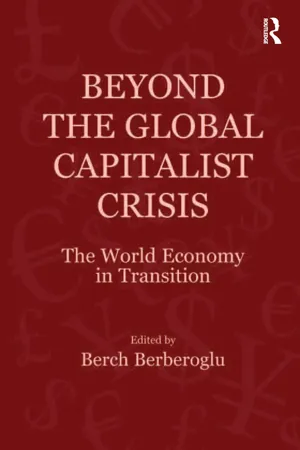
The deep economic recession that has occurred in all major sectors of the U.S. and global economy is a manifestation of the underlying contradictions of the capitalist system that has resulted in the accumulation of vast fortunes on one side and impoverishment, debt, and destitution on the other. In short, the crisis of global capitalism is the result of the immense disparities in wealth and income and a consequent widening gap between capital and labor. This ground-breaking book brings together a team of experts on the contemporary global capitalist political economy who are able to shed light on the inner workings of global capitalism and the capitalist globalization process that has led to the growth and development of capitalism from the national to the global level, with all its fundamental internal dynamics and contradictions operating on a world scale. It will make an important contribution to understanding the underlying causes of the current global economic crisis and show the way out of this crisis by way of a powerful critique of the global capitalist system that will ultimately go through a major economic, political, and social transformation. Analysis of the global capitalist crisis raises questions regarding the process of capitalist globalization, especially now that neoliberal economic policies have failed. Does this signal the end of capitalist globalization and the collapse of the global capitalist system? This book will take up these questions and entertain the possibility of a new beginning in the global political economy through an analysis of the next period of post-capitalist developments worldwide that may set the stage for the rise of socialism across the globe.
Information
Chapter 1
Introduction: The Global Capitalist Crisis and its Aftermath
Berch Berberoglu
Global capitalism is in serious crisis, and the current continuing severe global recession is the worst economic downturn since the Great Depression of the early twentieth century. As neoliberal capitalist globalization comes under mounting criticism and attack across the world, and as the global economic crisis takes on depression-era characteristics, neoliberalism and neoliberal economic policies have now become thoroughly discredited in many countries around the world. As millions of unemployed working people look for a job to pay for their basic necessities, capitalist states throughout the world have spent hundreds of billions of tax dollars to bail out failed commercial and financial institutions, with more than a trillion dollars of economic stimulus program by the United States government alone and several hundreds of billions of dollars by other governments in Europe, China, and elsewhere, to save the global capitalist system from total collapse.
Despite the active role of the imperial state in intervening in the global capitalist economy to reverse its decline and fall, corporations and banks, ranging from mainstays of capitalist economies, such as General Motors and Chrysler, to some of the biggest commercial banks, such as Citigroup and Bank of America, to financial and brokerage firms, insurance companies, and real estate underwriters, such as Lehman Brothers, American Insurance Group (AIG), Fannie Mae and Freddie Mack, have come to a halt with some having declared bankruptcy, and by so doing have threatened to take down with them the entire global capitalist system. As a result, and with a ripple effect across the U.S. economy over a period of less than a year, the U.S. stock market plunged more than 50 percent from its highs of 14,000 in late 2007 to 6,500 in early 2009, with more than a trillion dollars of value lost in the stock market—a development that has shaken markets across the globe and resulted in similar losses in stock markets throughout the capitalist world. Clearly, from late 2007 to early 2009 capitalism has gone through its biggest worldwide economic decline since the Great Depression of 1929, and this has come to signal the end of global capitalism as we have come to know it.
Although the U.S. stock market has recovered from its February 2009 low of around 6,500 to above 12,000 in February 2011, with hundreds of billions of dollars in profits recovered by the owners of capital, such recovery has not touched millions of workers who have lost their jobs and millions more who have lost their homes to foreclosures, while the living conditions of tens of millions of employed workers have deteriorated to the point of a drastic decline in their standard of living, shouldering massive personal and family debt, compounded by a national debt that they have been forced to bare for the bailout of failed banks and financial institutions, as well as costly wars from which only a small segment of the population (the capitalist class) benefits at the cost of the working people and the nation as a whole. Hence we have the irony of Wall Street recovery (amassing of enormous profits) and Main Street decline and demise (and increasing destitution) of the working class now facing continued high levels of unemployment, loss of benefits, and a precarious existence near the boundaries of poverty and mass deprivation, which is threatening the very fabric of life under advanced capitalism.
Given the failure of neoliberalism and neoliberal capitalist policies around the world, capitalist globalization—as an extension of the capitalist system in general on a global scale—has led to such a crisis across the world that many are now asking what is in store for the future of the global economy and which direction it will take in the period ahead. This was the main topic of discussion among the leaders of the world’s leading economies at the G-20 meetings in London in April 2009, which resulted in guarded optimism that through substantial reforms in global financial institutions and an active interventionist state that monitors the situation with greater regulation of the economy, the evolving economic situation might provide the basis of a new global economic order. What that order will look like and what role the United States will play in it are questions that remain open and contingent on the solutions adopted at the national and global levels, especially in Europe, East and South Asia, and other emergent centers of global economic power in the aftermath of the current global capitalist crisis.
Contradictions and Crises of Global Capitalism and the Capitalist State
The development of capitalism over the past one-hundred years has formed and transformed capitalism in a crucial way, one that is characterized by periodic crises resulting from the capitalist business cycle that now unfolds at the global level. The current crisis of global capitalism is an outcome of the consolidation of monopoly power that the globalization of capital has secured for the transnational monopolies (Sassen 2009). This has led to a string of problems associated with the contradiction between the expanded forces of production and existing exploitative social relations of production (i.e., class relations), which manifests itself in a number of ways, including:
1. The problem of overproduction, resulting from the imbalance created between wages and prices of commodities fueled by low purchasing power;
2. Sub-prime mortgage and credit card debt and rising foreclosures and bankruptcies as the unemployed become unable to pay off their debts;
3. Increasing unemployment and underemployment resulting from outsourcing of jobs to low-wage sweatshops in export processing zones abroad, compounded by the continued application of high technology in production (i.e., automation);
4. Intensification of the exploitation of labor through expanded production and reproduction of surplus value and profits by further accumulation of capital and the reproduction of capitalist relations of production on a world scale;
5. Increased polarization of wealth and income at the national and global level between the capitalist and working classes and growth in numbers of the poor and marginalized segments of the population throughout the world.
These and other related contradictions and crises of global capitalism define the parameters of modern capitalist imperialism and provide us the framework of discussion on the nature and dynamics of imperialism, capitalist globalization, and the global capitalist crisis today.
Given the logic of global capital accumulation in late capitalist society, it is no accident that the decline of the domestic economy of advanced capitalist countries over the past three decades corresponds to the accelerated export of capital abroad in search of cheap labor, access to raw materials, new markets, and higher rates of profit. The resulting deindustrialization of the domestic economy has had a serious impact on workers and other affected segments of the laboring population and has brought about a major dislocation of the national economy (Bluestone and Harrison 1982; Phillips 1998; Berberoglu 2003).1 This has necessitated increased state intervention on behalf of the monopolies and has heightened the contradictions that led to the crisis of advanced capitalist society in the early twenty-first century.
The widening gap between the accumulated wealth of the capitalist class and the declining incomes of workers (within a deteriorating national economy and the state’s budgetary crisis) has led to the ensuing political crisis within the state apparatus and has sharpened the class struggle in a new political direction. As the crisis of the capitalist economy has brought the advanced capitalist/imperial state to the center stage of economic life and revealed its direct ties to the monopolies, thus exacerbating the state’s legitimization crisis, the struggles of the working class and the masses in general are becoming directed not only against capital, but against the state itself.
The crisis of the capitalist state on the global scene is a manifestation of the contradictions of the world economy, which in the early twenty-first century has reached a critical stage in its development. The massive flow of U.S. transnational investment throughout the world, especially in Western Europe, Japan, and other advanced capitalist regions, has led to the post-World War II reemergence of inter-imperialist rivalry between the major capitalist powers, while fostering antagonisms between them in the scramble for the peripheral regions of the global capitalist economy through the imposition of neoliberal policies across Latin America, Asia, Africa, and the Middle East (Hart 1992; Falk 1999; Halliday 2001).
With the integration of the economies of Western Europe into the European Union (EU) and the emergence of China as a powerful economic force in the late twentieth and early twenty-first century, the position of the United States in the global economy has declined relative to both its own postwar supremacy in the 1940s and 1950s and to other advanced capitalist economies since that time. Despite the fact that U.S. capital continues to control the biggest share of overseas markets and accounts for the largest volume of international investments, its hold on the global economy has recently begun slipping in a manner similar to Britain’s in the early twentieth century. This has, in turn, led the U.S. state to play a more aggressive role in foreign policy to protect U.S. transnational interests abroad. Its massive deployment in the Middle East in the early 1990s, which led to the Persian Gulf War of 1991, and subsequently its intervention in Afghanistan in 2001 and war against Iraq in 2003 (both of which are still continuing as of 2011) has resulted in great military expenditures that has translated into an enormous burden on working people of the United States, who have come to shoulder the colossal cost of maintaining a global empire whose vast military machine encompasses the world (Berberoglu 1999, 2003, 2005).
In the current phase of the crisis of U.S. capitalism and the capitalist state the problems the state faces are of such magnitude that they threaten the supremacy of the United States in the global political economy and by extension the global capitalist system itself. Internal economic and budgetary problems have been compounded by ever-growing military spending propped up by armed intervention abroad, while a declining economic base at home manifested in the housing and banking crisis, deindustrialization, and a recessionary economy is further complicated by the global rivalry between the major capitalist powers plus China that is not always restricted to the economic field, but has political (and even military) implications that are global in magnitude (Harvey 2003; see also Panitch and Leys 2003).
The growing prospects of inter-imperialist rivalry between the major economic powers, backed up by their states, are effecting changes in their relations that render the global political economy an increasingly unstable character. Competition between the United States, Japan, and Europe, and the emergence of China, Russia, and other rival states, are leading them on a collision course for world supremacy, manifested in struggles for markets, raw materials, and spheres of influence in geopolitical—as well as economic—terms, which may in fact lead to a new balance of forces, and, consequently, alliances that will have serious political implications in global power politics. As the continuing economic ascendance of the major economic rivals of the United States take their prominent position in the global economy, pressures will build toward the politicization and militarization of these states from within, where the forces of the leading class bent on dominating the world economy will press forward with the necessary political and military corollary of their growing economic power in the global capitalist system (Hart 1992; Falk 1999), as has been the case with the German, French, Russian, and Chinese opposition to war against Iraq in the United Nations Security Council in 2003.
These developments in global economic and geopolitical shifts in the balance of forces among the major powers will bring to the fore new and yet untested international alliances for world supremacy and domination in the post—cold war era. Such alliances will bring key powers such as Russia and China into play in a new and complicated relationship that holds the key for the success or failure of the newly rising economic centers that will emerge as the decisive forces in the global economic, political, and military equation in the early decades of the twenty-first century (Halliday 2001; Guthrie 2006; Stephens 2009).
The contradictions and conflicts imbedded in relations between the rival states of the world will again surface as an important component of international relations in the years ahead. And these are part and parcel of the restructuring of the international division of labor and the transfer of production to overseas territories in line with the globalization of capital on a worldwide basis—a process that has serious consequences for the economies of both the advanced capitalist and less-developed capitalist countries. Economic decline in the imperial centers (manifested in plant closings, unemployment, and recession) and super-exploitation of workers around the world (maintained by repressive military regimes) yield the same combined result that has a singular global logic: the accumulation of transnational profits for the capitalist class of the advanced capitalist countries—above all, that of the United States, the current center of global capitalism. It is in this context of the changes that are taking place on a world scale that the imperial state is beginning to confront the current crisis of global capitalism.
Impact of Capitalist Globalization on the Current Global Economic Crisis
The global expansion of capital (i.e., capitalist globalization) has had a great impact on the current global economic crisis. This impact is the result of the globalization process which has destroyed national economies in the interests of transnational capital that profits from its global operations on a worldwide basis. This has brought about contradictions at a dual level. At the global level, it has meant first and foremost the ever-growing exploitation of workers through the use of cheap labor. In addition, it has caused a depletion of resources that could be used for national development, as well as environmental pollution, and other health hazards, a growing national debt, tying many countries to the World Bank, the International Monetary Fund, and other global financial institutions, and a growing militarization of society through the institution of brutal military and civilian dictatorships that violate basic human rights. The domination and control of less-developed countries for transnational profits through the instrumentality of the imperial state has at the same time created various forms of dependence on the center that has become a defining characteristic of globalization in the age of imperialism (Amaladoss 1999; Sklair 2002).
Domestically, the globalization of capital and imperialist expansion has had immense dislocations in the national economies of imperialist states. Expansion of manufacturing industry abroad has meant a decline in local industry, as plant closings in the United States and other advanced capitalist countries have worsened the unemployment situation. The massive expansion of capital abroad has resulted in hundreds of factory shutdowns with millions of workers losing their jobs, hence the surge in unemployment in the United States and other imperialist states (Wagner 2000). This has led to a decline in wages of workers in the advanced capitalist centers, as low wages abroad have played a competitive role in keeping wages down in the imperialist heartlands. The drop in incomes among a growing section of the U.S. working class has thus lowered the standard of living in general and led to a further polarization between labor and capital (Berberoglu 1992a, 2002).
The globalization of capital and the integration of national capitalist economies into the global capitalist system, a process that has been developing over the past several decades, and its intensification under neoliberal policies over the past twenty years, has had a direct impact on the extent and depth of the current global economic crisis. Previously nationally-based economies, now under the control of transnational corporations and international financial institutions, have become appendages of the global economy that operates under the logic of global capital accumulation for the benefit of the transnationals and their owners, while at a great cost to those who become victims of this process.
A major global economic crisis, such as the one we are experiencing today, greatly affects the economies of those nations that have become part of the global capitalist system. Thus, all the known consequences of such economic downturn (growing consumer debt, rising unemployment and underemployment, declining purchasing power, home mortgage foreclosures, bankruptcies, and a host of other economic problems) are the very ingredients of a system-wide crisis that has affected not only the advanced capitalist countries (where the current crisis originated), but all others integrated into the global capitalist system. And more so is the case with the latter, as they are more vulnerable to the forces of the global economy and its periodic crises.
The contradictions of global capitalist expansion, which has caused so much exploitation, oppression, and misery for the peoples of the world, both in the less-developed and in the imperialist countries themselves, has in turn created the conditions for its own downfall. Economically, it has afflicted the system with recessions, depressions, and associated realization crises; politically, it has set into motion an imperial interventionist state that through its presence in every corner of the world has incurred an enormous military expenditure to maintain an empire, while gaining the resentment of millions of people across the globe who are engaged in active struggle against it.2
The imperial capitalist state, acting as the repressive arm of global capital and extending its rule across vast territories, has dwarfed the militaristic adventures of past empires many times over. The global capitalist state, through its political and military supremacy, has come to exert its control over many countries and has thus facilitated the exploitation of labor on a world scale. As a result, it has reinforced the domination of capital over labor and its rule on behalf of capital. This, in turn, has greatly politicized the struggle between labor and capital and called for the recognition of the importance of political organization that many find necessary to effect change in order to transform the global capitalist system.
The greatest voices are being heard in this regard in countries most affected by the global capitalist crisis, in particular the southern European countries of Greece, Portugal, Spain, and Italy, as well as Ireland and Iceland further north. But, while there has developed a mass movement against neoliberalism across Latin America over the past several decades, the center of attention has quickly turned to the Middle East, as rebellion and revolution have spread across North Africa, from Tunisia to Egypt and the rest of the Middle East, including Yemen, Bahrain, Jordan, Lebanon, and Iran.
The contradictions of the unfolding process of global expansion and accumulation have brought to the fore new political realities: renewed repression at home and abroad to control an increasingly frustrated working class in the imperial heartland, and a militant and revolutionary mass of workers and peasants in the Third World poised to resist capitalist globalization (Houtart and Polet 2001; Petras and Veltmeyer 2001; Polet 2007). It is these inherent contradictions of modern global capitalism that are making it increasingly difficult for the imperial state to control and manage the global political economy, while at the same time preparing the conditions for international solidarity of workers in confronting global capital throughout the world.
Outline of the Book
This book has been conceived as a long-term project exploring the evolution, development, cr...
Table of contents
- Cover
- Half Title
- Title Page
- Copyright Page
- Table of Contents
- List of Figures
- List of Tables
- Notes on Contributors
- Preface and Acknowledgements
- 1 Introduction: The Global Capitalist Crisis and its Aftermath
- 2 The Origins and Development of the Global Capitalist Economy and Capitalist Crises
- 3 The Great Recession and the Financial Crisis in the United States, the Epicenter of the Global Capitalist Crisis
- 4 The Global Capitalist Crisis and World Depression
- 5 The Global Capitalist Crisis and the European Union, with Focus on Greece
- 6 The Global Capitalist Crisis and Latin America
- 7 The Global Capitalist Crisis and the Rise of China to the World Scene
- 8 The Global Capitalist Crisis and the End of Neoliberal Capitalist Globalization
- 9 The Collapse of Global Capitalism and the Movement Toward Socialism in the Twenty-first Century: New Beginnings
- 10 Conclusion: Beyond the Global Capitalist Crisis
- Select Bibliography
- Index
Trusted by 375,005 students
Access to over 1.5 million titles for a fair monthly price.
Study more efficiently using our study tools.
Frequently asked questions
Yes, you can cancel anytime from the Subscription tab in your account settings on the Perlego website. Your subscription will stay active until the end of your current billing period. Learn how to cancel your subscription
No, books cannot be downloaded as external files, such as PDFs, for use outside of Perlego. However, you can download books within the Perlego app for offline reading on mobile or tablet. Learn how to download books offline
Perlego offers two plans: Essential and Complete
- Essential is ideal for learners and professionals who enjoy exploring a wide range of subjects. Access the Essential Library with 800,000+ trusted titles and best-sellers across business, personal growth, and the humanities. Includes unlimited reading time and Standard Read Aloud voice.
- Complete: Perfect for advanced learners and researchers needing full, unrestricted access. Unlock 1.5M+ books across hundreds of subjects, including academic and specialized titles. The Complete Plan also includes advanced features like Premium Read Aloud and Research Assistant.
We are an online textbook subscription service, where you can get access to an entire online library for less than the price of a single book per month. With over 1.5 million books across 990+ topics, we’ve got you covered! Learn about our mission
Look out for the read-aloud symbol on your next book to see if you can listen to it. The read-aloud tool reads text aloud for you, highlighting the text as it is being read. You can pause it, speed it up and slow it down. Learn more about Read Aloud
Yes! You can use the Perlego app on both iOS and Android devices to read anytime, anywhere — even offline. Perfect for commutes or when you’re on the go.
Please note we cannot support devices running on iOS 13 and Android 7 or earlier. Learn more about using the app
Please note we cannot support devices running on iOS 13 and Android 7 or earlier. Learn more about using the app
Yes, you can access Beyond the Global Capitalist Crisis by Berch Berberoglu in PDF and/or ePUB format, as well as other popular books in Politics & International Relations & Globalisation. We have over 1.5 million books available in our catalogue for you to explore.