eBook - ePub
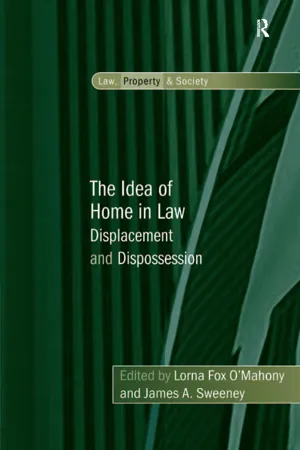
The Idea of Home in Law
Displacement and Dispossession
- 248 pages
- English
- ePUB (mobile friendly)
- Available on iOS & Android
eBook - ePub
About this book
The Idea of Home in Law: Displacement and Dispossession explores an important set of legal and policy issues surrounding the concepts of home and homelessness, taking a growing area of legal scholarship into the new arena of human rights and international law. The collection considers the ideas concerning home - both in the sense of the dwelling place as a special type of property, and territorial claims to homeland - which underpin many contemporary legal problems, by examining a range of contexts where people are displaced or dispossessed from their homes. The essays focusing on dispossession consider themes ranging from mortgage and rent arrears in the UK to responses to the foreclosure crisis in the USA, and from eviction for the purposes of economic development in South Africa to the exclusion of asylum seekers from the UK's social housing and welfare provision, and within the framework of the European Convention on Human Rights. The displacement theme, meanwhile, examines transnational 'home' issues from the experiences of exiles and refugees in areas of conflict to the impact of the broader context of economic, social and cultural rights on attempts to protect housing and home through international law. At the heart of each essay the contributors, experts from across the fields of law, policy, and housing rights, examine the circumstances in which displacement and dispossession take place, and reconsider how law and policy respond to such circumstances with a particular focus on the impact of loss of home for the human person. At a time of particular and increasing concern about security of tenure and the role of law and policy in protecting people who are vulnerable to forced eviction, The Idea of Home in Law presents a bold opportunity to raise questions about the 'rights' and norms associated with housing and home, and to generate new insights for scholarship and for national and international policy debates concerning displacement and dispossession.
Chapter 1
The Idea of Home in Law: Displacement and Dispossession
(1) The Idea of Home in Law: Thinking about Loss of Home
The idea of home is both present and absent in law. In one sense, ideas concerning home – both in the sense of the dwelling place as a special type of property, and territorial claims to homeland – underpin many contemporary legal problems, typically where people have been displaced or dispossessed from their homes. For example, the significance of the home as dwelling place has been highlighted in the rise in repossession and foreclosure statistics following the recent crunch in the credit and housing markets.2 Indeed, the global financial crisis triggered by the subprime mortgage lending crisis that began in 2007 has clearly demonstrated the potentially widespread risks of displacement and dispossession from our dwellings, bringing into sharp relief the adverse consequences associated with losing their home3 to many individuals and households who might not previously have expected that they would have been exposed in this way.4 As the crisis in the housing and mortgage markets has brought home to us our vulnerability to displacement and dispossession, we are well placed – perhaps more so than at any other time in recent years – to empathise with those people, whether in our own communities or elsewhere in the world, who have lost, or are at risk of losing, their homes and so becoming displaced or dispossessed. This presents an opportune moment to reflect on our shared human need for a secure dwelling place, and our vulnerability to loss of home. With this in mind, this collection sets out to examine some of the circumstances in which displacement and dispossession takes place, and argues that it is timely to consider how law and policy respond to such circumstances.
There are a myriad of circumstances in which displacement and dispossession from home occurs, ranging from mortgage repossession to displacement following natural disaster.5 This collection focuses primarily on those instances of displacement and dispossession which might be regarded as resulting from human agency, specifically, from either economic or political events or circumstances. There is a particular case for scrutinising law and policy responses to displacement and dispossession in these cases, as the causes of these home losses can be viewed as rooted in the human actions of law and policy agendas. In addition, as in any case of displacement and dispossession, the consequences of loss of home, particularly where it occurs on a widespread basis, generate costs which are borne not only by individuals but by society at large.6 Where home loss results from economic or political circumstances the balancing exercise carried out by the policy maker in each context – between protecting home values and a range of countervailing demands – merits particular attention.
The importance of ‘being at home in the world’ for human flourishing, and the consequences of alienation when the connection with one’s home is lost, are common philosophical themes,7 and underpin much political philosophy, from Hegel to Heidegger. These perspectives have, in turn, influenced property theory as it has been brought to bear on issues in law and society. For Hegel,8 the justification for private property was rooted in the role of property appropriation in the formation of identity. Property was identified as a vehicle through which the individual could manifest himself as a human being in the world; by appropriating property, the person confers personal meaning onto the property and expresses his identity outwardly through exercising his will in relation to the property.9 Furthermore, the purpose of this appropriation was not merely to satisfy the possessor’s needs, but also to enable the human person to experience freedom;10 and only from that position of freedom could the person then engage in civil society. While Hegel’s analysis focused on private property more generally, and particularly on ownership of private property, the significance of housing and home for Hegelian self-development, and the implications this bears for law and policy, has been most notably developed through Radin’s concept of property for personhood.11
The core of Radin’s theory was the idea that an individual’s attachment to particular property, for example their home, may be so strong that the particular property becomes constitutive of their personhood. Radin conducted a positivist analysis of the personhood perspective, and concluded that the relationship between property and ‘personhood’ had: ‘commonly been both ignored and taken for granted in legal thought’.12 However, the central premise of Radin’s analysis was her normative argument ‘that to achieve proper self-development – to be a person – an individual needs some control over resources in the external environment.’13 Furthermore, in identifying those resources most essential to the person, Radin noted firstly that ‘some property is worthier of protection than other property’,14 and – crucially – that the measure of whether property is ‘worthier of protection’ by virtue of its role in personhood, can be determined by considering the loss that would be suffered by the property holder if they were to be dispossessed of that property. Indeed, Radin proposed that the function of the personhood perspective was to ‘serve as an explicit source of values for making moral distinctions in property disputes’;15 for example, by taking account of the impact of dispossession or displacement in contests where a certain type of property is at stake.
The occupied home is widely recognised as a quintessential example of ‘worthy’ property. In Radin’s analysis, different forms of property were described as being located on a continuum, ranging from property that is constitutive of personhood (described as ‘personal property’16) to property that carries no meaning beyond its capital value (described as ‘fungible property’). Radin argued that ‘in our social context a house that is owned by someone who resides there is generally understood to be towards the personal end of the continuum.’17 This argument was strengthened by the view that where certain types of property are constitutive of personhood, this is valued as a positive relationship between the person and the property. Radin claimed that ‘[t]here is both a positive sense that people are bound up with their homes and a normative sense that this is not fetishistic’;18 and so is a relationship which laws and policies should support.
The chapters in this collection develop this argument through analyses of various contexts in which the individual’s personhood is threatened by loss of control over the ‘resources’ – both practical and symbolic – represented by control over or connection with home. The papers start from the premise that it is a necessary aspect of human existence that, at the most basic level, everyone must exist in some relationship with place and either with a meaningful connection to home; or, in the absence of such a meaningful connection, in a state of alienation.19 Heidegger argued that the human condition – human ‘being’ – is rooted in these connections with home: people cannot ‘be’ without having some connection to a particular place.20 This human need for connection to home can be described as ‘multi-scalar’,21 in that it involves connections at various levels, from the attachment to home at the household level through the dwelling house itself, to the connection a person feels to a home-city or nation-state as home. As such, the issues of displacement and dispossession from home clearly go beyond considerations of private property, to encompass a set of issues relating to citizenship and exile from homeland. The importance of dwelling as the basis for human existence is brought into sharp relief by experiences of displacement and dispossession, and these multi-scalar attachments to home – from dwelling house to nation-state – are also reflected in this collection. These essays reflect on law and policy responses to disruptions ranging from repossession of the dwelling house, whether in a landlord or creditor possession action or at the hands of the state through compulsory acquisition, to the experiences of people who are both dispossessed from their properties and displaced from their homelands, often because of conflict or other political events. Yet a common thread connects the varied contexts considered in the essays: the impact of loss of home for the human person, and the extent to which this is present, or absent, in legal analyses.
The contribution of political philosophy is important in bridging the gap from a factual account of the ways in which a person identifies with a place as their home – towards an argument for the protection of ‘settled expectations’ that can support ideas of ‘rights’ and so generate a legal endorsement of a person’s ability to exercise control within the territory that provides their housing and home. In the context of property rights, this argument appears to support the proposition that only those settled expectations generated by law – and so already protected – should be recognised.22 Waldron argued that ‘the principle of respect for expectations and the concomitant idea of identifying with a property object cannot be the foundation of a principle of entitlement; such a principle must already be generally respected before the relevant expectations can come into play.’23 The question which remains concerning the origin of such principles of entitlement has been variously answered in theories of concerning first acquisition of property. Hegel, for example, argued that the recognition of property rights rooted in the expression of the person’s will through possession was an essential precondition for the person to engage in civil society: that one achieves personality through the social anchor of property, which enables the person to become at home in the world.24
Yet, while Hegel’s justification for private property recognises that property can function to anchor the person in the world, and Radin’s theory of property for personhood provides a basis for arguing that certain types of property, most particularly the home, are worthy of special protection because of their role in constituting personhood, these property theories do not go so far as to advocate that housing or home should be available to all: ‘There is no suggestion that each and every person can or should have certain sorts of property in order to be at home in the world…’.25 This argument is, however, explicitly made in the statement on ‘Progressive Property’ published in the Cornell Law Review in 2009,26 which proposed that our shared commitment to the values of ‘life and human flourishing, the protection of physical security, the ability to acquire knowledge and make choices, and the freedom to live one’s own life on one’s own terms’,27 implicates moral and political conceptions that require property law to promote ‘human flourishing’. While our perspectives are sympathetic with those underpinning progressive property, the question of ‘property entitlements’ is not one this book seeks to address. Rather, the papers in this collection seek to consider the significance of human relationships with housing and home not from a ‘strong property rights’ stance, but from alternative perspectives.28 The emergent legal concept of home29 focuses on the proposition that the relationship between a person and their home – distinct from any ‘strong property rights’ the...
Table of contents
- Cover Page
- Title Page
- Copyright Page
- Contents
- Notes on Contributors
- Acknowledgements
- 1 The Idea of Home in Law: Displacement and Dispossession
- 2 Dispossession for Arrears: The Weight of Home in English Law
- 3 Home as Ownership, Dispossession as Foreclosure: The Impact of the Current Crisis on the American Model of ‘Home’
- 4 Housing Rights in the Intersection between Expropriation and Eviction Law
- 5 The Displacement and Dispossession of Asylum Seekers: Recalibrating the Legal Perspective
- 6 Can International Housing Rights Based on Public International Law Really Impact on Contemporary Housing Systems?
- 7 The International Law Rights to Home and Homeland
- 8 Loss of the Home during Armed Conflict: ECHR Case Law on Destruction, Eviction and Denial of Access
- 9 Re-thinking Responses to Displacement and Dispossession
- Index
Trusted by 375,005 students
Access to over 1.5 million titles for a fair monthly price.
Study more efficiently using our study tools.
Frequently asked questions
Yes, you can cancel anytime from the Subscription tab in your account settings on the Perlego website. Your subscription will stay active until the end of your current billing period. Learn how to cancel your subscription
No, books cannot be downloaded as external files, such as PDFs, for use outside of Perlego. However, you can download books within the Perlego app for offline reading on mobile or tablet. Learn how to download books offline
Perlego offers two plans: Essential and Complete
- Essential is ideal for learners and professionals who enjoy exploring a wide range of subjects. Access the Essential Library with 800,000+ trusted titles and best-sellers across business, personal growth, and the humanities. Includes unlimited reading time and Standard Read Aloud voice.
- Complete: Perfect for advanced learners and researchers needing full, unrestricted access. Unlock 1.5M+ books across hundreds of subjects, including academic and specialized titles. The Complete Plan also includes advanced features like Premium Read Aloud and Research Assistant.
We are an online textbook subscription service, where you can get access to an entire online library for less than the price of a single book per month. With over 1.5 million books across 990+ topics, we’ve got you covered! Learn about our mission
Look out for the read-aloud symbol on your next book to see if you can listen to it. The read-aloud tool reads text aloud for you, highlighting the text as it is being read. You can pause it, speed it up and slow it down. Learn more about Read Aloud
Yes! You can use the Perlego app on both iOS and Android devices to read anytime, anywhere — even offline. Perfect for commutes or when you’re on the go.
Please note we cannot support devices running on iOS 13 and Android 7 or earlier. Learn more about using the app
Please note we cannot support devices running on iOS 13 and Android 7 or earlier. Learn more about using the app
Yes, you can access The Idea of Home in Law by Lorna Fox O'Mahony,James A. Sweeney in PDF and/or ePUB format, as well as other popular books in Law & Law Theory & Practice. We have over 1.5 million books available in our catalogue for you to explore.