eBook - ePub
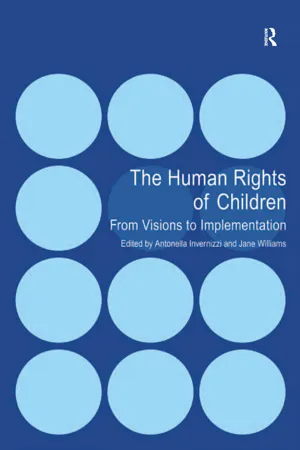
The Human Rights of Children
From Visions to Implementation
- 372 pages
- English
- ePUB (mobile friendly)
- Available on iOS & Android
eBook - ePub
About this book
This volume provides a series of critical analyses of some of the contemporary debates in relation to the human rights of children, resituating them within visions which informed the text of the United Nations Convention on the Rights of the Child in 1989. The studies embrace examination of some of today's widespread interpretations of the CRC, analysis of what is implied by a human rights-based approach in research and advocacy and consideration of advances and barriers to research and to several aspects of CRC implementation. With contributions by leading experts in the field, the book examines the CRC as an international instrument, its inherent dilemmas and some of the debates generated by the challenges of implementation. It embraces examinations of different levels of governance from the international to the state party, regional and local levels, including institutional developments and changes in law, policy and practice. The book will be a valuable resource for students, researchers and policy-makers working in the area of children's rights and welfare.
Chapter 1
The Value and Values of Children’s Rights
‘Each time we let in a new excluded group, each time we listen to a new way of knowing, we learn more about our current way of seeing.’ This was written by Carrie Menkel-Meadow in 1987, and it was not written about children, or their rights. But it is a useful point to make at the beginning of a chapter on children’s rights. The language of rights can make visible what has too long been suppressed. And children’s rights, their values were for most of history not discussed, indeed they were denigrated.
Why Rights are Important
It is worth asking first why rights are important, not rights for children, but rights generally. And there are a number of reasons.
They are universal, available to all members of the human family. They do not depend on gender or race or class or competence. Of course, in the past there were attempts to so confine them. Women were non-persons, and people of colour were kept in subservience by policies which justified so-called ‘separate but equal’ practices or worse by slavery and similar regimes. But just as concepts of gender inequality have been key to understanding womanhood and women’s social status, so the ‘concept of generation is key to understanding childhood’ (Mayall 2002). It has always been to the advantage of the powerful to keep others out: it is not therefore surprising that adults should want to do this to children – that they should wish to keep them in an often imposed and prolonged dependence which history and culture show to be neither inevitable nor necessary. It is worth always thinking of the other side of inclusion – of exclusion and what this generates both on the part of the excluders and their victims, the socially excluded. We can note the way the powerful regulate space (social, political, geographical), define participation, marginalise significance and frustrate development.
Rights too are indivisible and inter-dependent. Rights include the whole range of civil, political, social, economic and cultural rights. The denial of one right can impact upon, even totally undermine, other rights. Rights work best where all have rights. A society which denies women rights, for example freedom from domestic violence, is unlikely to protect children from abuse. The same applies the other way round too.
Rights are important because they recognise the respect the bearers of rights are owed. To accord rights is to respect dignity. To deny rights is to cast doubt on humanity and integrity. Rights affirm the principle which we tend to associate with Immanuel Kant that we are ends in ourselves, and not means to the ends of others.
It is, therefore, important that, as Ronald Dworkin so eloquently reminded us, we see rights as ‘trumps’ (Dworkin 1977). As such, they cannot be knocked off their pedestal because this would be better for others, even for society as a whole, were these rights not to exist. We grant the right not to be tortured – and we should – even to those who would dismantle our liberal rights-based values. Of course, for the powerful – and for children adults are always powerful – rights are an inconvenience, just as they are for those battling against the threat of terror. The powerful would always find it easier if those below them lacked rights. It is easier to rule, decision-making is swifter, cheaper, more efficient, more certain when the rights of others do not get in the way. It is hardly surprising that we have had to fight for the rights we have and often to fight to keep them.
Rights are important because those who have them can exercise agency. Agents are decision-makers. They are persons who can negotiate with others, who can alter relationships and decisions, who can shift social assumptions and constraints. And there is now clear evidence that even the youngest amongst us can do this (Alderson, Hawthorne and Killen 2005). That we don’t believe this is in part because we don’t want to do so. As agents, rights-bearers can participate. They can make their own lives, rather than having their lives made for them. And participation is itself a fundamental human right. It enables us to demand rights. We are better able to do so where there is freedom of speech and orthodoxies can be challenged (this was recognised by John Stuart Mill), as well as freedom of association, and freedom of information.
Rights are an important advocacy tool (see also Veerman 1991), a weapon to use in the battle to secure recognition. Giving people rights without access to those who can present those rights, without the right of representation, is thus of little value. That is one of the reasons why the cutback in access to legal aid and advice is so sad. The emphasis on the importance of advocacy points also to the rather obvious fact that we must get beyond rhetoric. Rights without remedies are of symbolic importance, nothing more. And remedies themselves require the injection of resources, a commitment on behalf of all of us that we respect the institution of rights, that we want them to have an input on the lives of all people, and not just on the lives of the powerful and the privileged.
And so rights offer legitimacy to campaigns, to pressure groups, to NGOs, to lobbies, to direct and indirect action, in particular to those who are disadvantaged or excluded. They offer a way in; they open doors. The silenced may rediscover their voices. Rights are ‘a militant concept’, part of an ideology in a campaign for social change (Cohen 1980: 52).
Rights are also a resource; they offer the opportunity to make reasoned argument. They can put a moral case. And too often opponents of rights have little to offer in response. A glance at history reveals this all too tellingly. Think of the opposition to the extension of the suffrage. Think of the kind of arguments adduced to counter gay rights, for example to gay marriage. I am always reminded of Lord Devlin’s invocation of ‘widespread intolerance, indignation and disgust’ (Devlin 1965: 17) as the basis for decision-making. Or, in relation to children, the response to the demand that violence should not be used against children in the name of punishment, the incantation ‘it never did me any harm’ (to which it is difficult to resist adding sed quaere!)
Rights offer fora for action. Without rights the excluded can appeal to the charitable nature of others, they can request, they can beg, rely on noblesse oblige, hope that others will be benevolent or co-operative, or even sensible and foresighted. But they cannot demand: they lack the entitlement to do so.
And yet what the excluded must lack is a right one rarely finds articulated. This is the right to possess rights. Few have postulated this better than Hannah Arendt. She observed, à propos the Shoah (the Holocaust), that ‘a condition of complete rightlessness was created before the right to live was challenged’ (Arendt 1986: 296). She explains: before the Nazis robbed the Jews of their lives, they robbed them of their humanity, just as generations had done, and continue to do so, with slaves. To quote Arendt again: ‘Slavery’s fundamental offense against human rights was not that it took liberty away … but that it excluded a certain category of people even from the possibility of fighting for freedom – a fight possible under tyranny, and even under the desperate conditions of modern terror (but not under any condition of concentration-camp life)’ (Arendt 1986: 297).
So Why Has it Been Thought Unimportant to Give Rights to Children?
Many of today’s critics of children’s rights are passionate defenders of the rights of others. Martin Guggenheim, for example, who is so convinced of the evils of recognising children’s rights that he calls his book What’s Wrong With Children’s Rights and unashamedly omits a question mark, talks of parents’ rights as ‘sacred’ (Guggenheim 2005: 71). And there are legal disputes which, though they centre self-evidently on the rights of children, are fought as if the children do not count. The Williamson case is a prominent example. This revolved about whether parents (as well as teachers) could exercise their right, as they saw it, to continue the practice of beating children in their Christian fundamentalist schools. Throughout this dispute was conceived as one between the state (it had by then banned corporal punishment from schools) and parents and teachers. Children were just objects, whose bottoms were to be fought over, not subjects in their own right. They were not represented: their views were not sought or known. The courts found against the parents and teachers. But it is significant that the state did not argue that corporal punishment necessarily involved an infringement of any of the rights of children. It is, of course, a clear breach of the UN Convention on the Rights of the Child. At least Arden LJ recognised that the common law ‘effectively treats the child as the property of the parent’, and she realised the inevitable, that the courts would one day have to consider whether this is ‘the right approach’. More significantly, children’s rights were afforded a ringing endorsement by Baroness Hale in the House of Lords, and this is not the only occasion when she has put her head above the parapet in this way. Her judgment begins:
This is, and always has been, a case about children, their rights and the rights of their parents and teachers. Yet there has been no one here to speak on behalf of the children. The battle has been fought on ground selected by the adults.1
Her speech is, she says, ‘for the sake of the children’.
Children’s rights have been neglected for a number of reasons. The shadow of children as property, rather than as persons, still hangs over debates about children. But there are more significant explanations today. I discussed some of these in an article I wrote nearly 20 years ago, and I will do no more than state those again here. There is the argument that the importance of rights and rights language is exaggerated. There are two versions of this. One, with veritable vintage, attacks rights themselves. It is, however, significant that even among radical thinkers today the importance of rights to the less powerful is not denied (Crenshaw 1988, Williams 1991). The second strand of this argument emphasises that there are other morally significant values like love, friendship, compassion, altruism, and that these raise relationships to a higher plain than one which relies on rights (and duties). The problem with this is that it is not the experience of many children.
The second argument is related to the first. It assumes that adults already relate to children in terms of love, care and altruism, so that the case for children’s rights is otiose. But this idealises adult–child relations. There is a tendency for those who postulate such an argument to adopt a laissez-faire attitude towards the family. A good example is the philosophy of Goldstein, Freud and Solnit (1979) that minimum coercive intervention into the family – of course very much the ideology of the Children Act 1989 – accords with their firm belief in ‘individual freedom and human dignity’. The trouble is that this overlooks whose freedom and what dignity this upholds.
The third argument equally rests on a myth. It sees childhood as the best years of our life, a golden age, a time when we are spared the rigours of adult life, a time for joy and play. But for many this image of, what John Holt (1975) called, ‘happy, safe, protected, innocent childhood’ is just a distortion of the truth. Children are still subjected to abuse, exploitation and the worst form of labour, including slavery.
But there are other reasons why rights for children have been neglected. I will mention two.
The first explores the implication of the public–private dualism for children (see further Freeman 2011). Much has been written of this in relation to women, but curiously little in the case of children. So, what is the impact on children of ‘relegating’ them to the ‘private’ realm? Rights are largely public coinage: it is thought they are not as important in the private sphere. But the curtain of privacy cloaks all manner of evils – the many ‘wrongs’ inflicted on children. It also stifles the opportunities children might have to participate in the public arena, to communicate their views to decision-makers. And when they do communicate their opinions in public, they are deemed ‘out of place’, and met with patronisation or simply ignored. This is not, of course, to say that the position of the child is any stronger in the private sphere – the power imbalance ensures this. The public/private divide is a social construction, and it is problematic. Where does the school fit? As far as children are concerned, the school may well be experienced as private, rather than public. Certainly, in so far as the language of rights has any meaning in the school setting, the rights inhere in parents rather than children. Not all children are in school. Many – at least 20 per cent of the world’s children – work, many in ‘hazardous forms of labour’. Many more are engaged in low-status work in the home environment. This work is largely hidden within a private economy of care: it is not paid employment and there are few if any employment rights. For such children the ‘heartless world’ has been installed in the so-called ‘haven’ (Lasch 1977). Also hidden are the many ‘young carers’, perhaps as many as 50,000 in Britain.
But, perhaps the most interesting group of children to test the public/private binary are street children. They are not a category recognised as such by the CRC Committee, though as children many of the articles of the Convention address their situation. The street is ‘a metaphor’ for the public sphere. Street children are ‘out of place’, they don’t belong in the street, which is adult territory. They should be at home, in the family, in the private world. Instead, they are doing things on the street, like sleeping and eating which should be done in the privacy of the family. Thus, they are an anomaly. They are not really children, and not quite ‘human’. Is it any surprise that there are parts of the world where state authorities have pursued policies of ‘cleansing’? Dickens describes street children, though he does not use this label. We don’t perceive of our children on the street as ‘street children’. But we see them as truants, as gangs, as nuisances, and perceive them as a threat. They are not ‘street children’, because they are found in Rio, Bangkok and Nairobi. However, because we perceive them as a threat, we control more and more the public space of children, confirming that they are supposed to be in the private space of the family or quasi-private space of the school, but not roaming in adult territory. And so we use group dispersal powers and employ the ‘mosquito’. The former are incompatible with the CRC (most obviously Article 15). The latter – an ultrasonic device which disturbs young ears – is an outrage. The practice has been condemned by the CRC Committee (CRC/C/GBR/CO/4. paras 34 and 35), but its demise is not expected in the near future.
Rights for children have been undermined for a second reason. It was Onora O’ Neill who wrote that ‘a child’s “main” remedy is to grow up’ (O’Neill, 1988). She articulated more thoughtfully what many believe. Adults have duties to children, but children don’t have rights. For Harry Brighouse, it is indeed, ‘strange’ to think of children as having rights (Brighouse 2002: 31). Why? Because on this analysis a child is an adult in the making. S/he is a future adult, rather than a young human being. The child lacks skills – is incompetent – whereas the adult is the finished product with full competency. So, we are expected to understand childhood through adulthood. Children’s lives and activities are envisaged as ‘preparation for the future’. On this view children undertake a journey that ends with adulthood. This of course assumes, as Lee points out (2001), that adults are stable and complete. This is a view of childhood nurtured by many disciplines: developmental psychology (the works of Piaget [1929] being prominent), social anthropology (for example, the work of Margaret Mead), and sociology (including Talcott Parsons [1951]). Together, these disciplines constructed children as dependent, incomplete, inadequate. Such a model left little scope for any notion of the child as ‘agent’. The talk was all of children as ‘becomings’. But now we recognise that they are ‘beings’, and some of us recognise that they are both beings and becomings. A new sociology of childhood has emerged. Lawyers joined in. By the late 1980s it was recognised that children were ‘beings’, social actors, agents. This was reflected in the Gillick case. In this, Lord Scarman expressed the view that a child’s capacity to make her own decisions depended upon her having ‘sufficient’ knowledge and ‘intelligence to make the decision’, and not on ‘any politically fixed age limit’.2 This was articulated by two leading sociologists of childhood thus:
… children are and must be seen as active in the construction of their own lives, the lives of those around them and of the societies in which they live. Children are not just passive subjects of social structures and processes. (James and Prout 1997: 8)
It is important to recognise that children are more than pre-adult ‘becomings’. But it is equally important to understand that appreciating that they are ‘beings’ does not preclude their being also ‘becomings’ (see also Uprichard 2008). It is all too easy to assume children have to be one thing or the other. We like to dichotomise. We like clear categories. This may be one of the reasons why we struggle with adolescence (Scott 2000–2001). But we accept laws which permit children to do different things at different ages: marry at 16, but not vote until 18. And, rather perversely, be criminally responsible at 10, even, as we saw in 2010, for rape (Atkinson 2010).
The Value of Rights of Children
The world now acce...
Table of contents
- Cover Page
- Dedication
- Title Page
- Copyright Page
- Contents
- List of Figures
- List of Tables
- Notes on Contributors
- Preface and Acknowledgements
- List of Abbreviations
- Introduction Human Rights of Children: From Visions to Implementation?
- 1 The Value and Values of Children’s Rights
- 2 Are Children’s Rights still Human?
- 3 Understanding a Human Rights Based Approach to Matters Involving Children: Conceptual Foundations and Strategic Considerations
- 4 The CRC: Dynamics and Directions of Monitoring its Implementation
- 5 Acknowledging Children as International Citizens: A Child-sensitive Communication Mechanism for the Convention on the Rights of the Child
- 6 Has Research Improved the Human Rights of Children? Or Have the Information Needs of the CRC Improved Data about Children?
- 7 How are the Human Rights of Children Related to Research Methodology?
- 8 Using the Convention on the Rights of the Child in Law and Policy: Two Ways to Improve Compliance
- 9 Using the CRC to Inform EU Law and Policy-making
- 10 The Roles of Independent Children’s Rights Institutions in Implementing the CRC
- 11 Multi-level Governance and CRC Implementation
- 12 Human Rights and Child Poverty in the UK: Time for Change
- 13 An Exploration of the Discrimination-Rights Dynamic in Relation to Children
- 14 Child Health Equity: From Theory to Reality
- 15 Our Rights, Our Story: Funky Dragon’s Report to the United Nations Committee on the Rights of the Child
- Index
Trusted by 375,005 students
Access to over 1.5 million titles for a fair monthly price.
Study more efficiently using our study tools.
Frequently asked questions
Yes, you can cancel anytime from the Subscription tab in your account settings on the Perlego website. Your subscription will stay active until the end of your current billing period. Learn how to cancel your subscription
No, books cannot be downloaded as external files, such as PDFs, for use outside of Perlego. However, you can download books within the Perlego app for offline reading on mobile or tablet. Learn how to download books offline
Perlego offers two plans: Essential and Complete
- Essential is ideal for learners and professionals who enjoy exploring a wide range of subjects. Access the Essential Library with 800,000+ trusted titles and best-sellers across business, personal growth, and the humanities. Includes unlimited reading time and Standard Read Aloud voice.
- Complete: Perfect for advanced learners and researchers needing full, unrestricted access. Unlock 1.5M+ books across hundreds of subjects, including academic and specialized titles. The Complete Plan also includes advanced features like Premium Read Aloud and Research Assistant.
We are an online textbook subscription service, where you can get access to an entire online library for less than the price of a single book per month. With over 1.5 million books across 990+ topics, we’ve got you covered! Learn about our mission
Look out for the read-aloud symbol on your next book to see if you can listen to it. The read-aloud tool reads text aloud for you, highlighting the text as it is being read. You can pause it, speed it up and slow it down. Learn more about Read Aloud
Yes! You can use the Perlego app on both iOS and Android devices to read anytime, anywhere — even offline. Perfect for commutes or when you’re on the go.
Please note we cannot support devices running on iOS 13 and Android 7 or earlier. Learn more about using the app
Please note we cannot support devices running on iOS 13 and Android 7 or earlier. Learn more about using the app
Yes, you can access The Human Rights of Children by Antonella Invernizzi, Jane Williams in PDF and/or ePUB format, as well as other popular books in Law & Law Theory & Practice. We have over 1.5 million books available in our catalogue for you to explore.