eBook - ePub
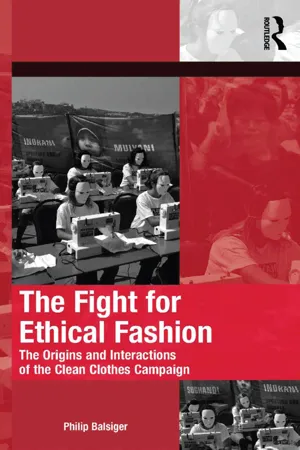
The Fight for Ethical Fashion
The Origins and Interactions of the Clean Clothes Campaign
- 200 pages
- English
- ePUB (mobile friendly)
- Available on iOS & Android
eBook - ePub
The Fight for Ethical Fashion
The Origins and Interactions of the Clean Clothes Campaign
About this book
From consumer boycotts and buycotts to social movement campaigns, examples of individual and collective actors forging political struggles on markets are manifold. The clothing market has been a privileged site for such contention, with global clothing brands and retailers being targets of consumer mobilization for the past 20 years. Labels and product lines now attest for the ethical quality of clothes, which has, in turn, given rise to ethical fashion. The Fight for Ethical Fashion unveils the actors and processes that have driven this market transformation through a detailed study of the Europe-wide coordinated campaign on workers' rights in the global textile industry - the Clean Clothes Campaign. Drawing on insights from qualitative fieldwork using a wide range of empirical sources, Philip Balsiger traces the emergence of this campaign back to the rise of 'consumer campaigns' and shows how tactics were adapted to market contexts in order to have retailers adopt and monitor codes of conduct. By comparing the interactions between campaigners and their corporate targets in Switzerland and France (two countries with a very different history of consumer mobilization for political issues), this ground-breaking book also reveals how one campaign can provoke contrasting reactions and forms of market change.
Chapter 1
Introduction: Contentious Markets
The Fight for Ethical Fashion
On a Thursday evening sometime in the spring of 2007, a few activists, staff members of an NGO, and invited guests gathered at a small clothing store in the center of a big Swiss city to celebrate the publication of an ‘ethical shopping map.’ It listed all the shops where interested consumers could buy clothes produced according to ethical criteria: fashion made with organic or fair trade cotton, t-shirts and jeans produced by workers getting a living wage and working in factories that respected basic safety standards, second-hand dresses or jackets made of recycled materials. The map also featured detailed information on different certification schemes and monitoring initiatives on the social standards in the clothing industry. To the activists’ great excitement, it was widely reported on in the media, with newspapers and TV celebrating the rise of ethical fashion as a new trend.
Almost a decade earlier, the same NGO that was behind the ‘ethical shopping map’ had been part of a coalition that launched a campaign targeting the biggest Swiss clothing retailers. Through a postcard petition and regular evaluations of the retailers’ practices, the campaign put pressure on the firms and asked them to guarantee the respect of minimal social standards in their supply chains. According to the makers of the campaign, around 70.000 such postcards were sent to different clothing companies over the next few years by concerned consumers all over Switzerland, bringing some of the leading Swiss retailers to join a pilot project on the monitoring of codes of conducts.
Both of these actions—the map from 2007, and the petition from 1999—were part of a collective ‘fight for ethical fashion,’ taking place not only in Switzerland but in many Western countries at around the same time. Today clothing comes not only in all kinds of colors, fabrics and cuts, but also comes as organic, fair trade, or carbon neutral. Consumers now find ethical brands and clothing lines on the fashion market, and these market changes would not have been possible without the work of social movement entrepreneurs launching campaigns and targeting corporations. Through petitions, evaluations, maps and many other tactics, activists put the question of the social and environmental conditions in the garment industry on the agendas of clothing retailers and in the minds of consumers. They mobilized consumers at the same time as they raised their awareness of labor abuses and companies’ responsibility for them. And they directly targeted and publicly exposed firms to make them acknowledge the problem and change their policies and practices.
Over the past twenty years, the global anti-sweatshop movement has mobilized citizens all over Europe and North America. Social movement coalitions with third-world advocacy groups, unions, consumer organizations and student groups have fought together in various campaigns for the rights of factory workers in a globalized world, allying consumers in the West to their cause (Featherstone 2002, Sluiter 2009). They have attracted the media’s attention to cases of labor abuses and thus shamed global companies for the way their clothes are produced. They have also collaborated with firms and governments to experiment with novel forms of control and regulation. In the course of this process, firms have come to develop counter-strategies, adopt certifications, join monitoring systems elaborated in collaboration with NGOs and/or governments, or launch ‘ethical’ product lines. New niche markets have developed around ethical clothing, inspired by and sometimes originating from actors belonging to the anti-sweatshop movement. Together, these developments have provided a variety of ways for citizens and consumers to mobilize, by protesting and by expressing their solidarity with workers through their consumption behavior.
How did social movements come to use the market place for their struggles? How does contention in markets work—how do activists and firms interact? And how can we explain the rise, dynamics and consequences of anti-sweatshop movements and campaigns? Through a comparative inquiry into the origins and interactions of this movement in Switzerland and France, this book sheds light on protest in the market place, and shows how contexts and strategic interactions shape the unfolding of professionalized movement campaigns. It delves into the history and unfolding of the fight for ethical fashion in those two contrasting cases. To describe, compare and explain the rise, strategies, interactions and outcomes of anti-sweatshop campaigns, it builds on a wide range of sources and methods, from archives and the analysis of internal and published campaign material, to interviews and participant observation.
The anti-sweatshop movement has been one of the most visible movements targeting corporations over the past few decades; it has innovated tactics adapted to the marketplace, but it has been only partially successful in pushing clothing firms to accept tougher social standards in their supply chains. In Europe, it is the European-wide coordinated network called the Clean Clothes Campaign (CCC) that mostly stands for this mobilization on behalf of working rights in the globalized clothing industry. The CCC was founded in the Netherlands in the early 1990s (Sluiter 2009). Over the last two decades, coalitions have formed in as many as 14 European countries to give voice to the CCC’s claims, each one of them constituting a national branch of the network. Built around NGOs, unions, consumer organizations, or third world advocacy groups, these national coalitions have developed professionalized campaigns using a variety of action forms in order to enforce the CCC’s main claims, namely that corporations adopt the specifically developed Clean Clothes code of conduct and participate in multi-stakeholder initiatives to monitor the code’s implementation.
In spite of their transnational coordination, the campaigns were very much shaped by the national contexts of the states they took place in. They were carried by nationally distinct coalitions, developed a distinct tactical repertoire, and chose national (clothing) retailers as their targets. Interaction dynamics between campaigns and corporations were thus taking place primarily at the level of nation-states, and the campaigns’ outcomes depended on those interactions. Of course, the CCC’s (and also the broader anti-sweatshop movement’s) ultimate goal was to improve working conditions in developing countries, and social standards, codes of conducts and their independent monitoring were means to achieve this. However, assessing the impact of the movement for workers in producing countries is not part of this study, which focuses instead on the interactions between campaigners and clothing retailers in the countries where the campaigns mobilized (for assessments on outcomes for factory workers in developing countries, see for instance Brooks 2009, Friedman 2009, Locke 2013). While the articulation of local struggles and transnational campaigns is thus out of this study’s scope, it sheds light on the ‘national’ shaping of transnational mobilizations, analyzing the interaction dynamics between historically and geographically located movement actors and firms. The study reveals that although campaigners and their targets were inserted into global networks (transnational advocacy networks and global supply chains (Keck and Sikkink 1998)) they primarily opposed themselves on national stages.
The dynamics of the CCC in these two countries were very different. In France, a broad coalition campaigned from 1994 to 2005, launching several petitions and rankings that rated the ‘social performances’ of retailers, and mobilizing a large network of local grassroots coalitions. The targeted French retailers, for their part, did not remain inactive in the face of this mobilization. They fought back by founding a monitoring scheme based on social auditing called Initiative Clause Sociale to counter the coalition’s claims, denouncing the campaign’s strategy and questioning its legitimacy. In Switzerland, at about the same time, a joint pilot-project on the monitoring of working conditions in the production of clothes came to its end and was to be renewed thanks to state funding. This initiative involved three Swiss retailers selling clothes, and three organizations from the sector of development aid and third world advocacy: the Bern Declaration, Lenten Fund, and Bread for All. These three organizations had, in 1999, launched the Swiss ‘Clean Clothes Campaign’ through a postcard petition and regular evaluations of the Swiss clothing retailers’ social records and reactions to the campaign’s claims. But the initiative coming out of the pilot project of collaboration had mixed success, and firms gradually developed other strategies to counter the campaign’s demands.
How did the campaigns emerge, how did they target corporations, and how can we explain their impact? In more than one way, movements targeting corporations constitute a conceptual challenge to social movement studies, a challenge that has to be addressed in order to answer these questions. Drawing on and expanding the rising literature on the ‘contentiousness of markets’ (King and Pearce 2010), the study develops a theoretical framework that attempts to combine the insights from structural approaches in movement research with the recently renewed interest in more dynamic accounts of movements. At the core of these accounts stands a focus on strategic interactions (Jasper 2004, 2006, Fligstein and McAdam 2012).
The Conceptual Challenge of the Contentiousness of Markets
The anti-sweatshop movement, with its campaigns, falls into a particular category of protest: it did not primarily seek legislative change by contesting national or supranational state institutions, but directly addressed its claims to clothing brands and retailers such as Nike, Carrefour, or Migros in Switzerland. For a long time, movement scholars were primarily interested in the contentious interactions between protestors and the state, and neglected other arenas of protest (Van Dyke et al. 2004, Armstrong and Bernstein 2008). But in recent years, the study of movements and markets has rapidly developed as an emerging field of studies at the intersection between social movement scholars and scholars coming from organization studies and economic sociology (Davis et al. 2005, Schneiberg and Lounsbury 2008, Soule 2009, King and Pearce 2010). In parallel, scholars of political participation have taken to studying ‘political consumerism’ (Micheletti 2003, Micheletti et al. 2004), that is boycotts, and ‘buycotts’ (i.e. buying products for ethical or political reasons) as increasingly frequent forms of citizen involvement in politics.
Why this sudden interest in the marketplace as an arena for movement politics? Perhaps scholarly interest reflects the growth of market contention. Some authors suggest that with the growing power of corporations, movements increasingly target firms directly (Klein 2002, Micheletti 2003, Soule 2009). But the empirical evidence for such a shift in contentious repertoires is not conclusive; Soule (2009), who has the most systematic data available, cannot show a clear trend over time. If anything, many historical studies suggest that markets have always been sites of protest (see for instance Chatriot et al. 2006, Cohen 2003, Glickman 2005, 2009, Trentmann 2006). That movements target corporations and provoke market change is thus nothing new; social movements often play a crucial role in creating, establishing, or transforming markets and organizational forms. Polanyi (1985 [1944]) pointed to the social and political ‘embeddedness’ of markets and their contention. The rise of economic sociology since the early 1980s has further shown how the functioning and structures of markets are shaped by politics and policies (Fligstein 1996, 2001), and how social movements can be important actors in processes of market change (Rao 2009). The recent ‘discovery’ of market protest has thus more to do with evolutions within the social sciences studying markets and movements. A change of research focus from market stability to market change has led organizational scholars to discover social movement organizations (SMOs) and processes as an object of study (Davis et al. 2005, Lounsbury and Ventresca 2002, Rao 2009); at the same time, many social movement scholars have criticized the state centeredness of movement studies (Van Dyke et al. 2004) and have started to move towards the study of movements in multi-institutional contexts (Armstrong and Bernstein 2008; for examples of such studies, see Davis et al. 2005, Soule 2009, Rojas 2007, Walker et al. 2008).
Thus, parallel and sometimes common developments in both fields have produced a number of studies on the ‘contentiousness of markets’ (King and Pearce 2010; similar overviews can be found in Schneiberg and Lounsbury 2008, Soule 2012, Walker 2012). This literature has shown the various ways through which movements (try to) change corporations and markets. Some tactics resemble classic forms of protest: situated outside of corporations, movements use extra-institutional tactics in order to pressure their corporate targets (Soule 2009). Examples include anti-corporate protest (King and Soule 2007); boycotts (King 2008a) and tactics of public shaming, when corporate practices are publicly denounced by social movement organizations (Bartley and Child 2011). So, movements develop contentious frames against given corporate practices (den Hond and de Bakker 2007, Lounsbury 2005, Lounsbury et al. 2003, Raeburn 2004). Such frames are also used to mobilize consumers and shape demand within markets. While consumer studies and studies of political participation have observed an increased trend towards individual practices of boycott and buycott (Micheletti 2003, Micheletti et al. 2004, Harrison et al. 2005, Forno and Ceccarini 2006), a social movement perspective can illustrate the role of collective mobilizations in shaping consumer preferences and behavior (Balsiger 2010, Dubuisson-Quellier 2013b). Other studies have shown that movements also challenge corporations from within, using insider tactics such as shareholder activism (Davis and Thompson 1994, Giamporcaro-Saunière 2004) or promoting change through employee groups who use creative, yet usually quite moderate forms of mobilization adapted to the characteristics of the organizational setting (Raeburn 2004, Scully and Segal 2002, Kellogg 2011).
Besides contesting corporate practices, movements also seek to collaborate with firms, and have thus contributed to putting in place novel forms of private regulation. Sometimes, movements which start off as anti-corporate campaigns evolve into systems of private regulation (Bartley 2003, 2005), such as certification schemes for fair trade or environmental labels. In such instances, the boundaries between insiders and outsiders, claim-makers and targets, become blurred, as new entities emerge where corporations and movements work together. Finally, movements also contribute to the creation of new markets and categories. Movements give symbolic and material resources to the creation of new niche markets, either indirectly, such as in the temperance movements’ role in opening entrepreneurial opportunities for the development of the soft drink industry (Hiatt et al. 2009); or directly such as when movements promote solar energy, windmills, organic food or grass-fed meat, and movement actors themselves become producers (Sine and Lee 2009, Vasi 2009, Weber et al. 2008). In these instances, movements use forms of prefigurative politics: instead of challenging power holders, they directly adopt the changes they are fighting for by developing alternative practices and building up new institutions.
This review and classification of studies on the ‘contentiousness of markets’ reveals the conceptual challenges this kind of protest poses to traditional definitions of social movements. Two points stand out. First, a clear-cut distinction between insiders and outsiders, challengers and members, seems inept to capture the empirical realities of contentious markets, where movement organizations collaborate with firms to establish forms of private regulation and where social movement actors may become economic actors themselves. Second, but linked to the first point, studies on movements in markets make a strong empirical case for the need for a broad definition of tactical action repertoires, beyond the common focus of social movement studies on collective, public, and contentious action forms. The analysis of tactical action repertoires must also include non-contentious, private, and individual actions1 and examine how different contentious and non-contentious, individual and collective tactics are articulated with one another and used to provoke change in different settings. In sum, studying protest in markets must lead us to bring together three perspectives on movements: the focus of the political process paradigm on contentious and collective protest, the acknowledgment that movements also use institutionalized means to fight for change, and a Meluccian perspective on new social movements as ‘challengers of codes’ (Melucci 1996) in everyday lives.
Contexts and Strategic Interactions
Some of the main studies on ‘movements and markets’ adopt the language of opportunity structures to markets and apply the concepts of the political process model (McAdam et al. 1996) to the new environment. Authors have suggested different terms to denote these opportunity structures, each time associated with a different conceptualization. Opportunity structures are industrial (Schurman 2004), institutional (Raeburn 2004), economic (Wahlström and Peterson 2006, Luders 2006), or corporate (King 2008b, Soule 2009). The factors constituting these opportunity structures should grasp what influences movement dynamics in market arenas. Those studies thus highlight many different factors that determine the responsiveness of targets (see Table 1.1). Some of those factors are situated at the level of the industry or organizational field, often putting to use neo-institutional theories of organizations and markets to explain the interactions between firms and movements. Neo-institutionalist approaches conceptualize firms as part of organizational fields (DiMaggio and Powell 1983, Scott 1995). Coercive, normative and cognitive isomorphic pressures lead to the development of identical practices by all organizations part of the same field. This means that the rise of new norms, adopted by professional corps such as human resource managers, triggers new practices. When large firms, or firms widely viewed as conservative change practices, this can be a strong signal and may lead other members of the organizational field to do the same (Briscoe and Safford 2008). Movements can try to take advantage of such isomorphic pressures by targeting specific firms and by using examples of firms that have made changes in their framing strategies (Raeburn 2004). Other studies adopt a perspective which is more attentive to power dynamics within fields, where incumbents are opposed to challenger actors (Fligstein 2001). The position of firms within fields may explain their reaction to movement demands. Schurman (2004) holds that challenger firms may respond positively to movement demands because they see it as a strategy to improve their position vis-à-vis bigger firms. The opposite hypothesis can be made, too: incumbent firms embrace change to maintain their dominant position. More generally, intense competition may favor reactivity by firms (King 2008b). Some conceptualizations also highlight the relation of an industry sector to the political arena—some sectors such as nuclear energy may be particularly sensitive and therefore protected by the state, while others are less subject to government actions (Schurman 2004, King 2008b. Wahlström and Peterson 2006). The existence of an industry association can also be an important feature channeling corporate reactions (Wahlström and Peterson 2006). Finally, the structure and the cultural characteristics of the product and of its ‘global value chain’ (Gereffi and Korzeniewicz 1994) also shapes corporate reactions to movements (Schurman and Munro 2009). For technologically complex products, suppliers are usually quite powerful actors in supply chains because their know-how and high skills cannot easily be dropped for cheaper competitors. But for a low-technology industry such as apparel, the opposite is the case, and clothing brands and retailers are the dominant actors (Locke 2013). This means that they can potentially put pressure on their suppliers to impose changes. Finally, building on the varieties of capitalism literature (Hall and Soskice 2001), authors have pointed to differences in the national organization of capitalism that can influence corporate reactions to pressure from social movements (Bair and Palpacuer 2012). In coordinated market economies, in particular, industry self-regulation and negotiations between companies and unions are common, and this may have spillover effects on the attitudes of companies to demands coming from other civil society actors.
At the level of single corporations, authors have singled out the instability of firms (for instance provoked by...
Table of contents
- Cover Page
- Title Page
- Copyright Page
- Contents
- List of Figures, Tables and Documents
- Preface
- 1 Introduction: Contentious Markets
- 2 The Rise of Consumer Campaigns
- 3 Launching a Campaign
- 4 Building a Campaign
- 5 Campaign Styles and Protest in the Marketplace
- 6 Campaigning Over Time
- 7 Strategic Interactions and Campaign Outcomes
- Conclusion: Contention, Consumers, and Corporations
- References
- Index
Trusted by 375,005 students
Access to over 1.5 million titles for a fair monthly price.
Study more efficiently using our study tools.
Frequently asked questions
Yes, you can cancel anytime from the Subscription tab in your account settings on the Perlego website. Your subscription will stay active until the end of your current billing period. Learn how to cancel your subscription
No, books cannot be downloaded as external files, such as PDFs, for use outside of Perlego. However, you can download books within the Perlego app for offline reading on mobile or tablet. Learn how to download books offline
Perlego offers two plans: Essential and Complete
- Essential is ideal for learners and professionals who enjoy exploring a wide range of subjects. Access the Essential Library with 800,000+ trusted titles and best-sellers across business, personal growth, and the humanities. Includes unlimited reading time and Standard Read Aloud voice.
- Complete: Perfect for advanced learners and researchers needing full, unrestricted access. Unlock 1.5M+ books across hundreds of subjects, including academic and specialized titles. The Complete Plan also includes advanced features like Premium Read Aloud and Research Assistant.
We are an online textbook subscription service, where you can get access to an entire online library for less than the price of a single book per month. With over 1.5 million books across 990+ topics, we’ve got you covered! Learn about our mission
Look out for the read-aloud symbol on your next book to see if you can listen to it. The read-aloud tool reads text aloud for you, highlighting the text as it is being read. You can pause it, speed it up and slow it down. Learn more about Read Aloud
Yes! You can use the Perlego app on both iOS and Android devices to read anytime, anywhere — even offline. Perfect for commutes or when you’re on the go.
Please note we cannot support devices running on iOS 13 and Android 7 or earlier. Learn more about using the app
Please note we cannot support devices running on iOS 13 and Android 7 or earlier. Learn more about using the app
Yes, you can access The Fight for Ethical Fashion by Philip Balsiger in PDF and/or ePUB format, as well as other popular books in Business & Fashion & Textile Industry. We have over 1.5 million books available in our catalogue for you to explore.